Edge & Node is now a member of the @CantonFdn and an active validator on the @CantonNetwork, the privacy-enabled chain where Euroclear, Broadridge, Tradeweb, and SBI Digital Asset Holdings settle real-world assets.
Our validator node joins 678 others securing a network that processes $1.9M in daily fees. Beyond running infrastructure, we are participating in Canton special interest groups, contributing to Canton Improvement Proposals, and developing proposals for the Foundation's new Protocol Development Fund.
Edge & Node builds verifiable data infrastructure for regulated institutions, and Canton is where many of those institutions transact onchain. Foundation membership gives us a direct role in the governance and protocol decisions shaping how tokenized capital markets operate.
.@beincrypto published a feature by Mohammad Shahid on the question regulators, courts, and compliance teams are all circling: who is responsible when an AI agent loses your money?
Edge & Node CEO @rodventures opens the piece and is quoted throughout, alongside voices from @Nethermind and @MetaMask. The case study is May's Grok/Bankrbot exploit, where a Morse-code prompt injection moved an estimated $150K-$200K from a linked wallet.
Rodrigo's argument in three parts: responsibility lands on the company that deployed the agent, never on the model. Most companies can show the transaction but cannot produce the permission behind it. And the agent should never hold the keys, it proposes a payment while a separate system decides whether that payment is permitted.
Full piece: https://t.co/WaJCGmdJxS
It was an honor to host TekTrek Cohort One at @thehousesf this summer.
An incredible group of student founders building across AI, healthcare, robotics, infrastructure, and more. Proud to have hosted them at The House and excited to see what they build next. 👏
TekTrek’s first round trip is complete.
Most programs pull East Coast talent west and keep it there. TekTrek features the best of both worlds: in June, 44 students primarily from @MIT, @Harvard, and @Princeton went to San Francisco to build. Ten weeks later, they brought their companies home to Boston.
They worked from the Presidio, learned from 120+ mentors, met founders and technology leaders, and built alongside a community that believes the next generation should be the ones sculpting the future.
Homecoming was just as eventful: a Science Dinner at the CPO Ed Baker (@ed_baker_whoop) of @WHOOP's home in Cambridge, featuring presentations from Boston's Mayor Michelle Wu, @CFS_energy's cofounder/CSO Brandon Sorbom (@BrandonSorbom), and @duolingo's CPO Cem Kansu (@cemdnsu).
At the MIT Showcase, 17 teams took the stage, including Brian Elliott, CEO and cofounder of @blitzyai, who opened with his original founding pitch. Among the 300+ attendees there were more than 90 investors. Then a reception at The ‘Quin House with Sandy Edgerley and Aaron Edell (@aaronedell)of @awscloud, one of TekTrek’s supporters, who announced he is committed to tripling his token support for the program.
The closing day on Martha’s Vineyard brought together HBS Professor Rosabeth Moss Kanter (@RosabethKanter), Mitch Kapor, NASA astronaut Leland Melvin (@Astro_Flow), Olympic gold medalist Tenley Albright, and @siegelendowment’s Executive Director & President Katy Knight (@sayskaty).
At the heart of TekTrek is a simple idea: AI is fundamentally changing what small teams can accomplish. Bring exceptional builders together, surround them with the right people, and give them the environment, community, and resources to move faster. AI has radically changed what a small team can build. As John Werner, Chief Architect and Cofounder of TekTrek often says: “three is the new thousand.”
Congratulations to the teams of Cohort One. The first of many!
#TekTrek #ArtificialIntelligence #Startups #Entrepreneurship #MIT #Harvard #Princeton
Open Source AI Summit SF lands at @thehousesf this Friday, August 28, and the event is already at full capacity.
The speaker list runs from a co-authors of Attention Is All You Need to researchers at NVIDIA and Stanford, the former global CTO of AI at the Linux Foundation, and founders from Fireworks AI and NEAR.
Waitlist and agenda: https://t.co/udz2vmxpmE
Open Source AI Summit SF is happening this Friday at @thehousesf and we have reached full capacity! Welcoming a couple of speakers to the strong lineup💘
@achowdhery at Stanford University to talk about self improving AI
@JeanKossaifi at NVIDIA Research to talk about AI aided engineering and how it uses open source AI
@matthew_d_white: Former global CTO of AI of Linux Foundation and CTO of PyTorch
@dzhulgakov: Co-Founder of @FireworksAI_HQ@lukaszkaiser: Co-author of Attention is All You Need, ex OpenAI
@ilblackdragon: Co-Founder at @NEARProtocol, Co-author is Attention is All You Need, ex Google Research
Agenda confirmed in a couple of days!
https://t.co/TECdf7yw32
Edge & Node is now a member of the @CantonFdn and an active validator on the @CantonNetwork, the privacy-enabled chain where Euroclear, Broadridge, Tradeweb, and SBI Digital Asset Holdings settle real-world assets.
Our validator node joins 678 others securing a network that processes $1.9M in daily fees. Beyond running infrastructure, we are participating in Canton special interest groups, contributing to Canton Improvement Proposals, and developing proposals for the Foundation's new Protocol Development Fund.
Edge & Node builds verifiable data infrastructure for regulated institutions, and Canton is where many of those institutions transact onchain. Foundation membership gives us a direct role in the governance and protocol decisions shaping how tokenized capital markets operate.
The FASB proposed guidance last week that would let companies classify stablecoins as cash equivalents on their balance sheets, with comments due November 19.
Cash-equivalent treatment is the accounting status corporate treasurers have been waiting on, because it means holding USDC stops creating a separate line-item headache in financial statements and starts reading the way money market funds do. Auditors sign off on cash equivalents only when they can verify the asset exists and settles as claimed, so every finance team that takes the option inherits a new requirement: proving onchain balances and flows to audit standards. Most audit firms today check blockchain balances by hand, screenshots and block explorer exports, and that process breaks the first time a client holds stablecoins across five chains.
Amp gives treasury and audit teams a SQL database over blockchain data where every query result carries a cryptographic proof it matches the chain, so the balance and its evidence arrive together.
Edge & Node CEO @rodventures sat down with @jacksonaltonh from TheStreet @RTB_io for an interview published today on why enterprises still keep agents away from real money.
His answer comes from Edge & Node's own sales calls with financial institutions: the blocker is governance rather than model quality. Corporate procedure assigns a human to every approval, execution, and incident report, and an autonomous agent breaks that chain, so adoption waits on the chief legal, security, and financial officers who have to sign off. Institutions run sandboxed proofs of concept with limited spend today, loosening the leash as rules solidify.
The thesis worth bookmarking from the piece: "not necessarily the smartest agents that will win going forward, but the most accountable ones."
Full conversation ⬇️
WATCH: Edge & Node CEO Rodrigo Coelho says AI agents are ready to spend money, but humans aren’t ready to let them.
In a conversation with Jackson Hinkle
@edgeandnode | @rodventures | @jacksonaltonh
Living in the Bay Area and want to be part of one of the biggest tech communities in SF?
@thehousesf is hiring event staff in the Presidio. Paid, part-time, flexible shifts.
Details below ⬇️
Edge & Node CEO @rodventures joined Kristina Podnar on The Power of Digital Policy podcast to talk through the moment AI stops advising and starts spending.
An agent with access to a payment rail holds permission. Authorization is a separate grant of authority, and on stablecoin rails the money is gone the second it moves, so the two get confused exactly once. Rodrigo makes the case for policy checks at the wallet level, outside the LLM, where a hallucination or prompt injection cannot reach them. Also in the episode: who carries accountability when an agent pays wrong, and the four areas regulators should address first: identity, authorization, observability, and governance.
Full episode: https://t.co/cxhOF1IOlG
Crypto trading firm Wintermute published its first-half market report: institutions accounted for roughly 72% of spot volume on the firm's OTC desk, a record share and up from about 61% in the back half of last year. Realized volatility sits around 45% this cycle against roughly 70% in earlier ones. In practice that changes how the market trades. Institutional flow concentrates in a handful of large assets, so broad altcoin rallies where everything pumps together get less likely each quarter. Desks that answer to auditors and regulators also cannot run on screenshots of block explorers, they pull chain data through SQL pipelines with documented lineage, the same way they consume equities data from Bloomberg. Crypto data tooling is converging on the standards of traditional market data, and vendors who can prove their numbers match the chain win those contracts. We built Amp for exactly that buyer: a SQL database over blockchain data where every query result carries a cryptographic proof it matches the chain, so the audit answer ships with the number.
TL;DR on Regulation Crypto Assets, the rulebook the SEC proposed yesterday: https://t.co/Q8LnLKjh8b
Today, launching a token in the US means risking a securities violation, because the SEC can classify almost any token sale as an unregistered security. This proposal writes down exactly how to do it legally.
Two legal paths to raise money:
1️⃣ Small teams can raise up to $5 million over four years by publishing basic disclosures about the project. 2️⃣ Larger teams can raise up to $75 million per year if they also publish financial statements and keep reporting after the sale.
An exit from securities law entirely. A token counts as a security because investors depend on the founding team to make it valuable. Under this rule, once the team finishes building what it promised, that dependence ends and the token stops being a security. Ethereum reached that point informally years ago. This writes the test into law so any project can pass it.
One rulebook instead of 51. Federal rules would override state-by-state registration, so a compliant raise works in every state at once.
Public comments are open for 60 days, then the SEC decides whether to finalize.
US crypto projects have incorporated offshore for a decade specifically to avoid this uncertainty. Clear rules bring those companies, and the next ones, home.
x402 payments now ship natively inside AWS. AgentCore payments hit general availability today, meaning any agent built on Bedrock can pay for APIs, data, and model inference on its own, with spending caps enforced by the infrastructure.
ampersend has been running this in production since the preview. an agent sends a request to a paid model endpoint, receives a payment required response, pays in USDC on Base, and gets its answer back. one integration covers every provider, and ampersend settles with them behind the scenes.
AWS published the full walkthrough of our build: https://t.co/MEVlWTJDNT
Quarterly stablecoin volume more than doubled in the year since GENIUS passed. Clarity built the market, and rulemaking now turns it into a regulated industry, with licensing thresholds and reporting obligations deciding who operates inside it. Every issuer and institution under those rules will need to prove reserves, flows, and settlement against data any counterparty can independently check. Regulators will expect that proof to exist before they issue licenses, so the infrastructure for verifying onchain activity gets built first.
Amp is that infrastructure by design: a SQL database over blockchain data where every query result carries a cryptographic proof it matches the chain, so a compliance report and its evidence arrive as one object.
The data on what happened after GENIUS passed last year speaks for itself ↓
Now comes the rulemaking.
This week’s Treasury proposal begins defining the bounds of the U.S. stablecoin market: who is issuing here, who can offer stablecoins to U.S. users, and when a license is required.
📺 Watch the full presentation on agentic payments and guardrails by @rodventures & @impranavm_ from this year's @aiDotEngineer World's Fair in San Francisco.
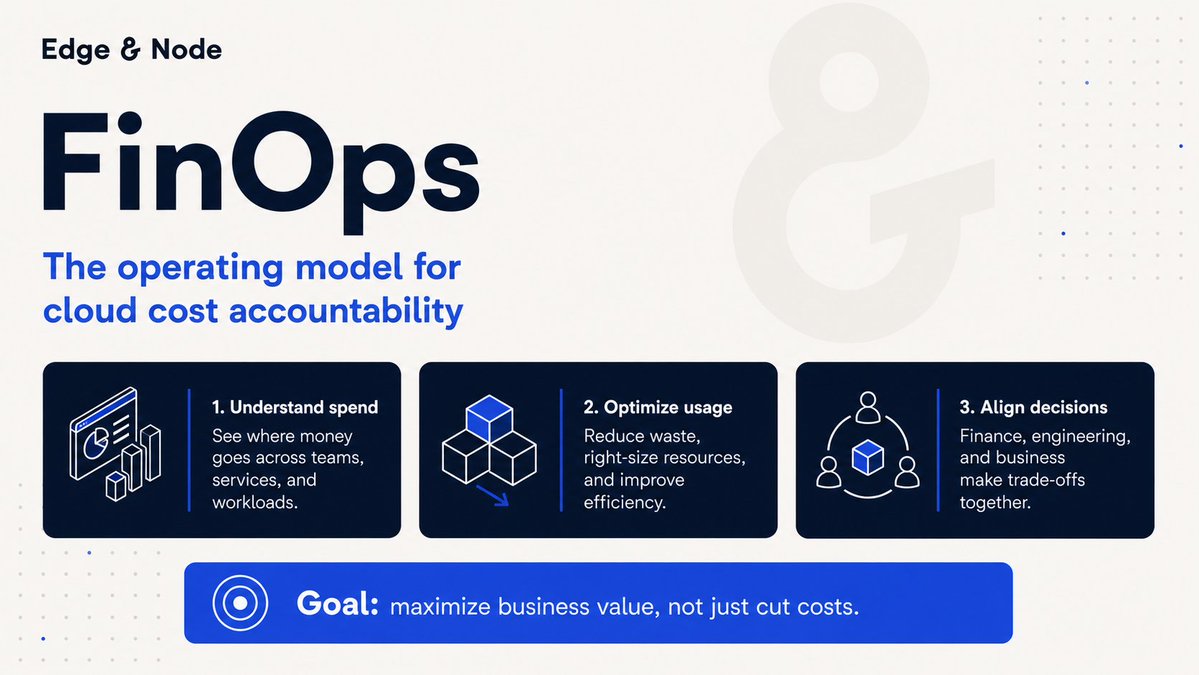
FinOps & Blockchains, explained.
FinOps is the discipline enterprises developed to manage cloud spending once infrastructure moved from procurement cycles to pay-as-you-go. Any engineer could suddenly provision resources in seconds, and finance discovered the true cost weeks later on a sprawling invoice. The practice that emerged runs on three phases: inform, meaning full visibility into who spends what and why; optimize, meaning rightsizing workloads and eliminating waste; and operate, meaning continuous budgets, forecasts, and accountability. Mature teams measure themselves in unit economics, tracking cost per customer or per query instead of staring at one monthly total.
Blockchain infrastructure is entering the same phase cloud went through a decade ago. Teams now run archive nodes, indexing pipelines, and ETL jobs whose costs blur together across engineering time and vendor subscriptions, with little ability to attribute spend to a specific dataset or workload. Onchain settlement adds something cloud never had, since every transaction is recorded on a public ledger where cost and activity can be verified at the source. The organizations treating blockchain data spend with FinOps discipline today will hold a real advantage as this infrastructure becomes a standard budget line.
Tokenized assets crossed $60 billion this year, and research into the market found that a large share of that value is not actively trading at all. A meaningful portion of tokenized instruments is built to stay out of public trading entirely, while distributed tokens move freely on public rails. Institutions solved the representation problem, putting treasuries and funds onchain at scale, and market depth now depends on the infrastructure that lets any counterparty independently verify holdings, flows, and settlement across both categories.