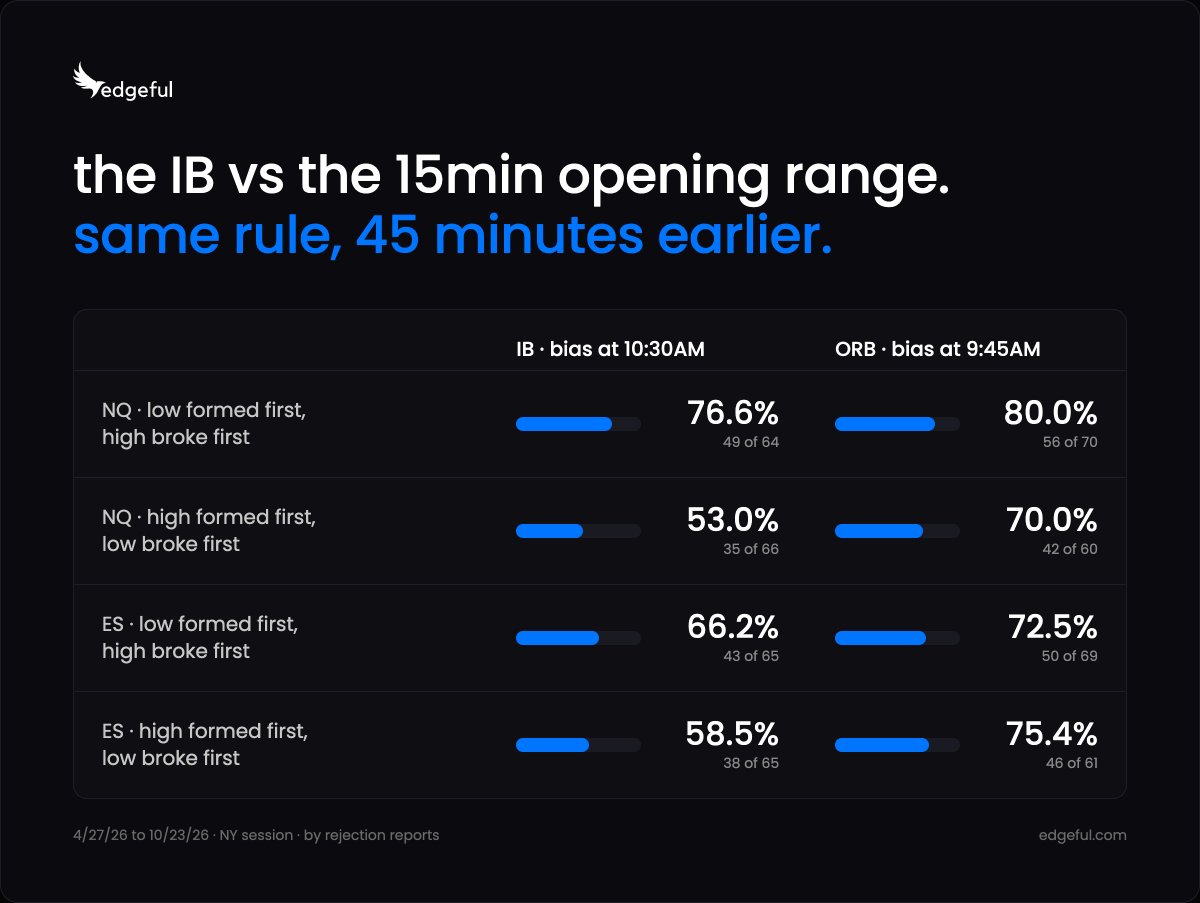
the IB by rejection has been one of the most popular setups in our community.
but you have to wait until 10:30AM ET to use it.
so we wanted to see if there was another option for traders who want to be active in the first 30 minutes.
here's how you can trade the 15min ORB instead:
this fully automated $ES ORB algo caught a 70-point winner yesterday…
since July 26th, this algo has produced:
→ $17,937.50 net profit
→ 64.15% win rate
→ 3.82 profit factor
→ 53 trades
→ $2,325 max drawdown
this is one of the optimized 5min ORB strategies available in the algo templates.
you can review the backtest, explore the settings, and test it yourself.
🇬🇧 London 09.11.26
🟢 +$465.50 scalping $NQ
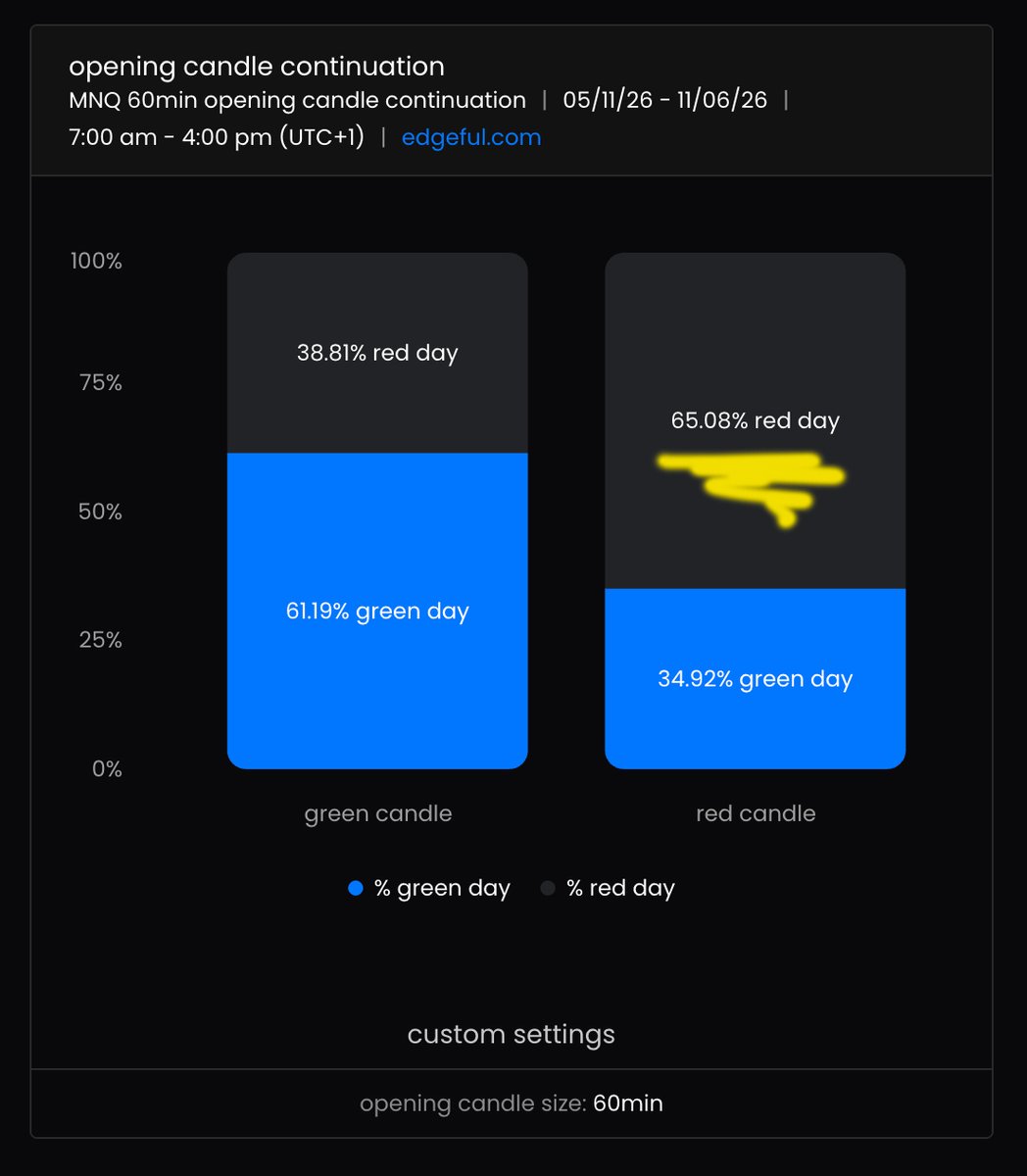
I treat the first hour like the movie trailer for the day. This morning's trailer was red. And according to @edgeful, when it's red, the whole day ends red about 65% of the time.
So I didn't need to watch the whole movie.
Took shorts following my strategy, got paid 🍿
here's how to use the first hour on $NQ to build a bias:
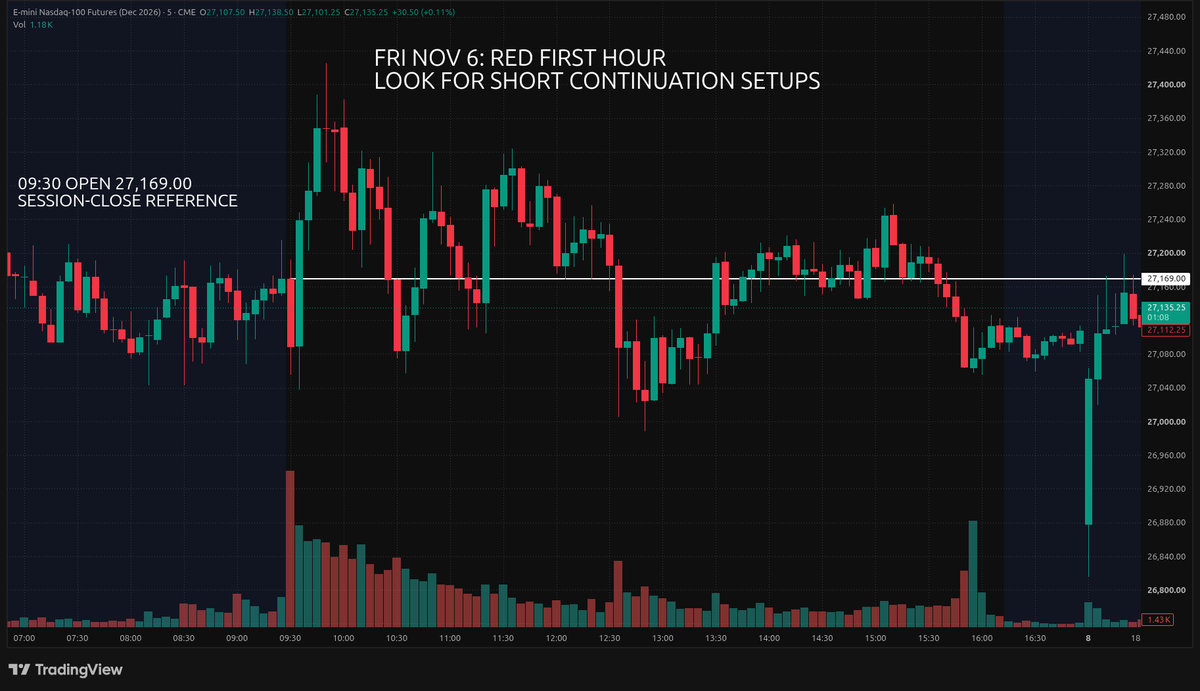
on Friday, November 6, the first hour closed red at 10:30 EST.
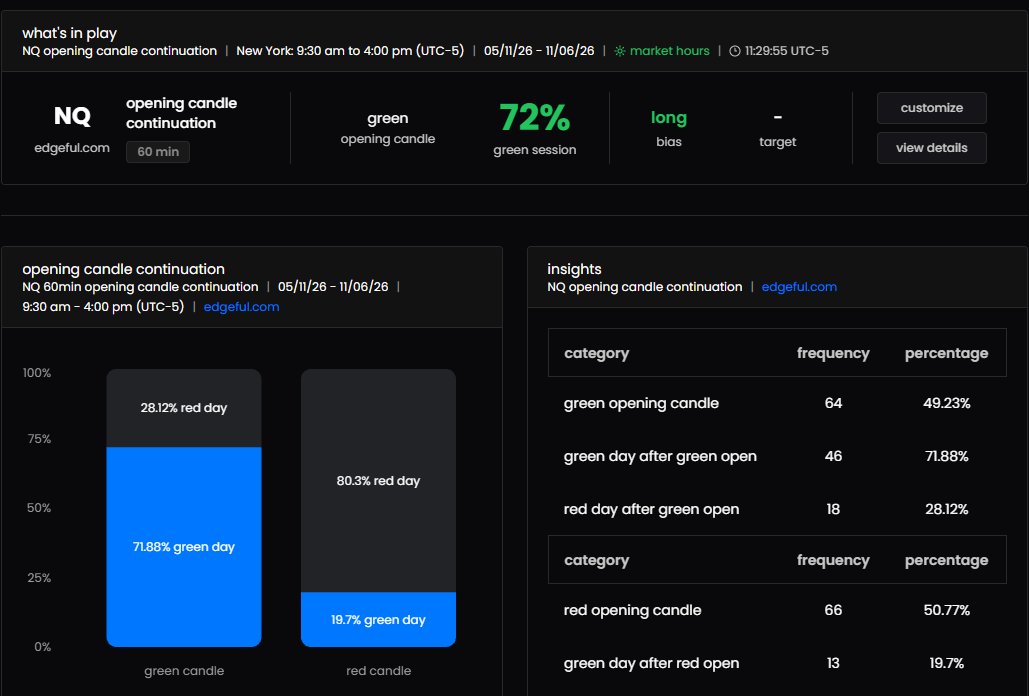
the current 6-month NY opening candle continuation report, set to 60min, shows:
→ 80.3% of red-first-hour sessions closed red
→ 53 of 66 sessions
how to use it:
wait for the first hour to close. if it's red, prioritize short continuation setups for the rest of the session.
mark the 9:30 open. a red session close means finishing below it. on Friday, that reference was 27,169.00.
that's a directional bias, not an entry or fixed target. the stat doesn't describe a straight move down.
if $NQ breaks the overnight high or low, you need to know this stat:
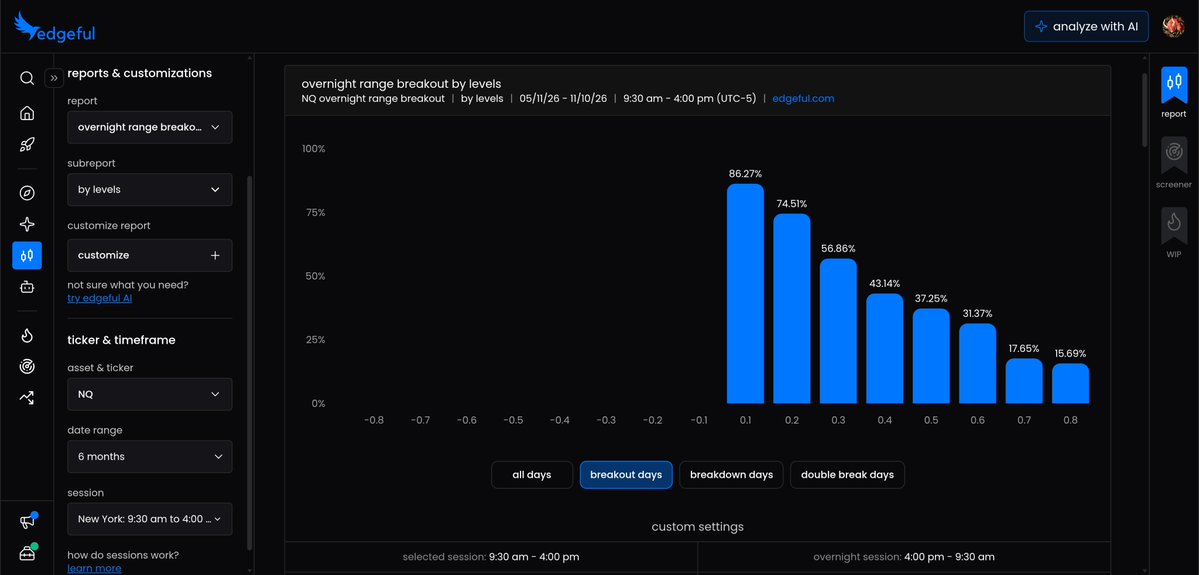
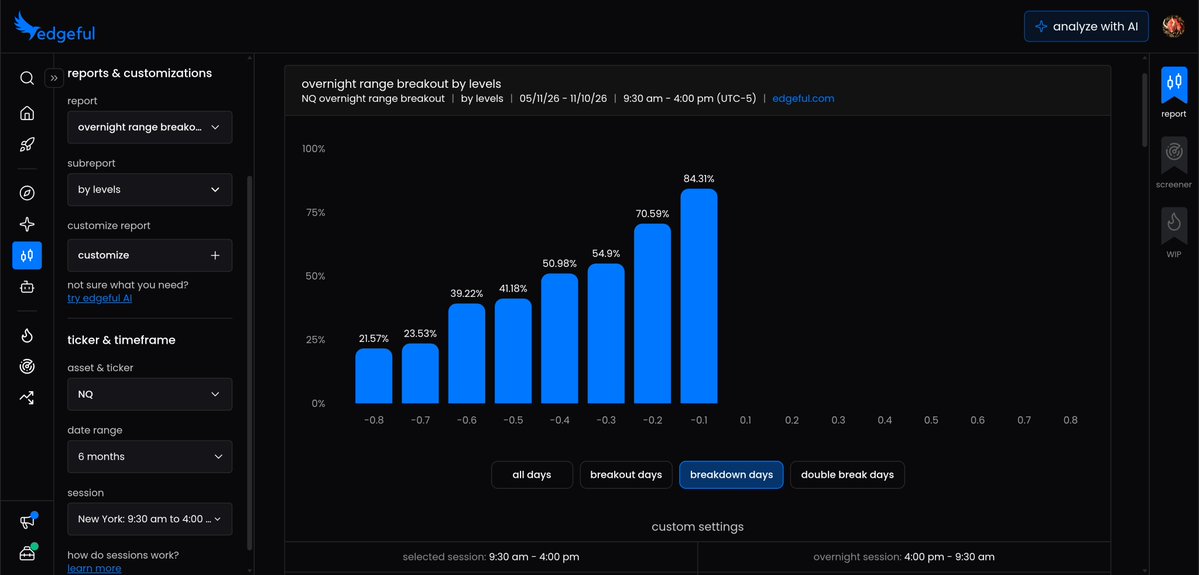
over the last 6 months in the NY session, the overnight range by levels report on $NQ shows:
→ only the overnight high broke: 74.51% reached the 0.2 extension
→ only the overnight low broke: 70.59% reached the 0.2 extension
takeaway:
overnight high breaks = look for longs targeting the 0.2 extension
overnight low breaks = look for shorts targeting the 0.2 extension
This is all backed by real data. Like I keep saying.
Today was the perfect example.
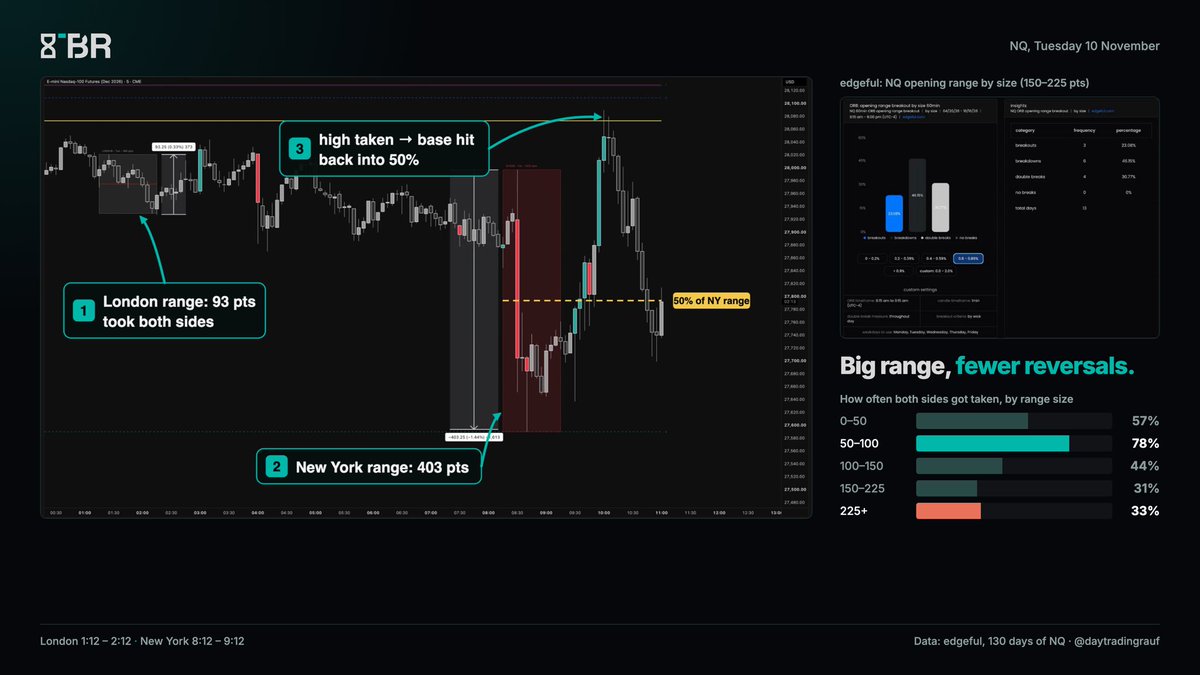
London range (1:12 – 2:12): 93 points.
Small range. It took both the high and the low.
New York range (8:12 – 9:12): 403 points.
On a range that size, only 33% of days take both sides.
So the play wasn't the full reversal. It was base hits back into 50% of the range.
Same system. The range size just tells you how much to expect.
Data from @edgeful
if you're interested in automating any part of your trading, or running backtested strategies by hand, we've got a free playbook for you.
breaking down trading the 5min ORB on ES:
https://t.co/JpWodsOkHg
Fable 5.2 analyzed the ORB on $NQ and found this to be the best double break stat:
after testing 374 different range and time combinations on $NQ over 2 years, the strongest setup was:
→ 10min ORB from 9:15–9:25am ET
→ both sides broke by 9:55am on 75.0% of sessions
→ 387 out of 516 trading days
→ random-walk baseline: just 34.3%
that's a +40.7 percentage point edge over random.
even better:
→ last 12 months: 79.1%
→ prior 12 months: 70.9%
→ unseen 2022–2024 data: 71.3%
takeaway:
the strongest double-break setups formed BEFORE the 9:30 NY open.
mark the 9:15–9:25 range and watch for both sides to break by 9:55am.
you might be trading the first 15 minutes on $NQ completely backwards…
over the last 6 months in the NY session, the 15min ORB by rejection report shows:
→ ORB low formed first = 79.17% broke the ORB high first
→ ORB high formed first = 70.69% broke the ORB low first
takeaway:
ORB low forms first = look for longs targeting the ORB high
ORB high forms first = look for shorts targeting the ORB low
the first 5min ORB break on $GC hasn't held on most Wednesdays…
over the last 6 months, on Wednesdays:
→ broke both sides of the 5min ORB: 80.77%
→ broke only one side: 19.23%
21 of the last 26 Wednesdays on $GC broke both sides of the 9:30–9:35 range.
takeaway:
first 5min ORB break on a Wednesday = look for a reversal toward the opposite side
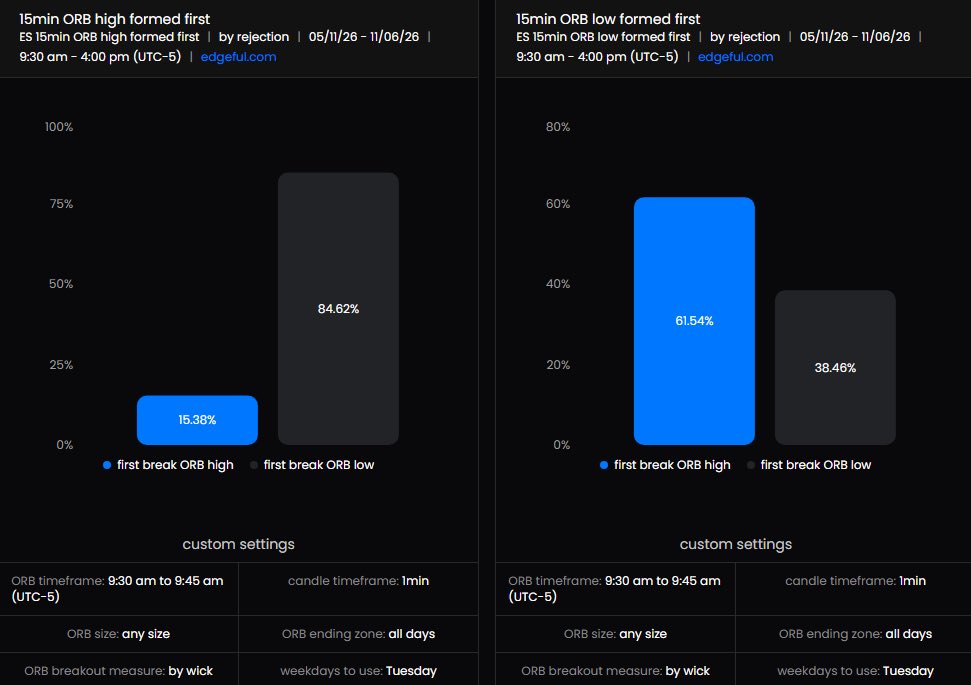
This is for the ES ORB traders
On Tuesdays, if the high forms first, the low breaks first 84.62% of the time.
If the low forms first, the high breaks first 61.54% of the time.
High formed first data 👀
6 months worth of data via @edgeful
if you're still in this game after everything it's cost you — the time, the money, the doubt, the people who didn't understand — then you have something most traders never develop: a tolerance for the process. that's rarer than any strategy.
the most successful traders you'll never hear about aren't posting on social media. they're quietly compounding in the background while everyone else fights for attention. the real flex is silence with results.
The first hour on NQ tells you how the day closes.
Last 6 months, pulled with @edgeful:
→ Green first hour: day closed green 46 of 64 times (72%)
→ Red first hour: day closed red 53 of 66 times (80%)
If the first hour is red, stop trying to buy the bottom all day.
Run these reports yourself → https://t.co/mBa8Uu1iNK (double AI tokens your first month)
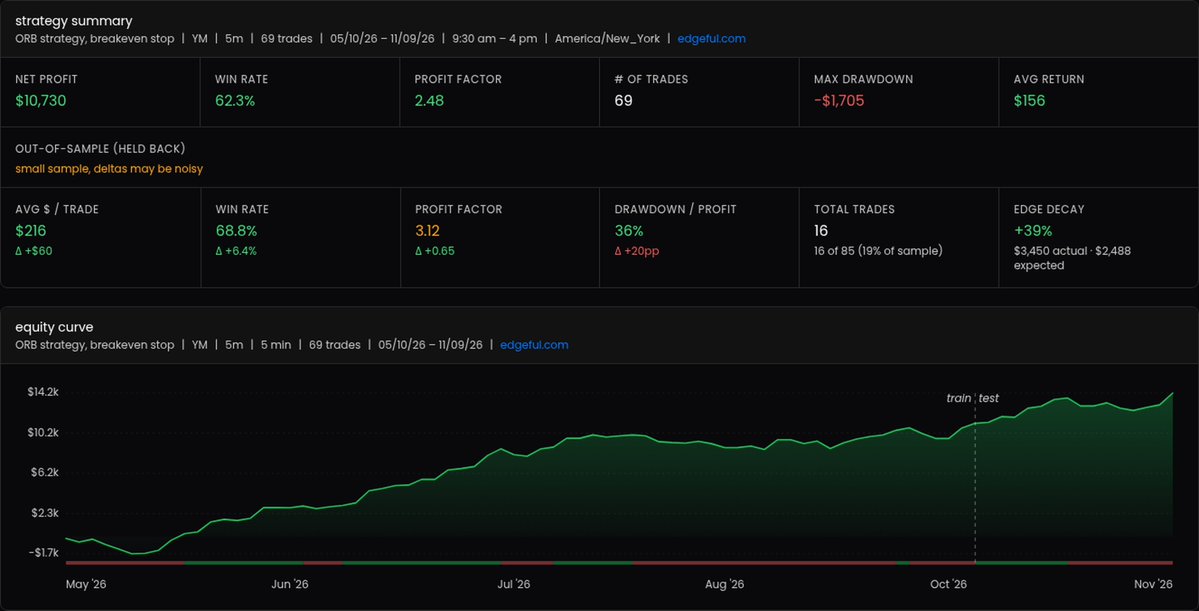
$3,450 out-of-sample on a $YM ORB algo, when the backtest expected $2,488…
over the last 6 months:
→ $10,730 net profit
→ 62.3% win rate
→ 2.48 profit factor
→ 69 trades
→ -$1,705 max drawdown
then on untouched holdout data:
→ 68.8% win rate
→ 3.12 profit factor
→ $216 average per trade
→ 16 trades
takeaway:
the holdout sample is only 16 trades, so there's still more testing to do…
but the win rate and profit factor both improved on data the optimizer never saw.
you don't have to build an algo from scratch…
explore optimized strategies, review their historical performance, and test them yourself.
https://t.co/iO9POxJgdB
this fully automated $ES ORB algo caught a 70-point winner yesterday…
since July 26th, this algo has produced:
→ $17,937.50 net profit
→ 64.15% win rate
→ 3.82 profit factor
→ 53 trades
→ $2,325 max drawdown
this is one of the optimized 5min ORB strategies available in the algo templates.
you can review the backtest, explore the settings, and test it yourself.
here's how to use the first hour on $NQ to build a bias:
on Friday, November 6, the first hour closed red at 10:30 EST.
the current 6-month NY opening candle continuation report, set to 60min, shows:
→ 80.3% of red-first-hour sessions closed red
→ 53 of 66 sessions
how to use it:
wait for the first hour to close. if it's red, prioritize short continuation setups for the rest of the session.
mark the 9:30 open. a red session close means finishing below it. on Friday, that reference was 27,169.00.
that's a directional bias, not an entry or fixed target. the stat doesn't describe a straight move down.
you might be trading the opening gap on $NQ completely wrong…
over the last 6 months in the NY session:
→ gaps up filled: 81%
→ gaps down filled: 82%
13 of 16 gaps up and 9 of 11 gaps down returned to yesterday's close.
takeaway:
gap up of 0.2%–0.39% = look for shorts targeting yesterday's close
gap down of 0.2%–0.39% = look for longs targeting yesterday's close