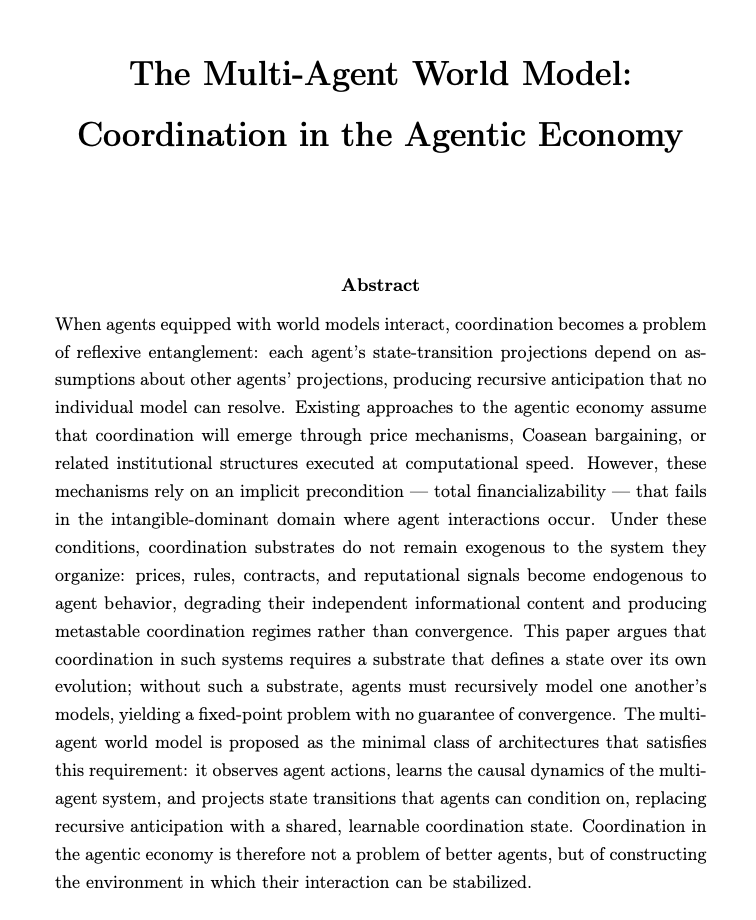
The dominant mental model for the agentic economy is Coasean bargaining at scale, agents serving as tireless negotiators in order to reduce transaction costs to near-zero. Krier (DeepMind), Shahidi et al. (NBER), Rothschild et al. all assume coordination will emerge through prices + property rights executed at computational speed.
New paper argues this gets the problem wrong at the level of substrate. When agents with world models interact, the coordination medium itself becomes endogenous to their behavior. The problem now lies in the reflexive entanglement that exists between competing state-transition projections that no market mechanism can resolve.
I argue that the solution lies in constructing this environment: a world model of the multi-agent system itself.
theognis warns cyrnus to seek the company of the noble (ἀγαθοί) and avoid the base (κακοί), for character is formed through association: “from the noble you will learn noble things; if you mingle with the base, you will lose even the sense you have” (theognidea 35–36).
we can all be the most fastidious students of history, but we are also living in history for the very first time, with all our receptors activated, creating a new reality
You are dealing with a species that for a long span of history endlessly committed transgressions in earthly life for momentary pleasure -- while fully believing that transgressions in earthly life condemned the transgressor to infinite torment, and that the avoidance of said transgressions granted the avoider infinite bliss. We are not a serious species!
v surprising that eric gans is shaping up to be the "philosopher du jour," was expecting more uexküll given the biological analogies between his work / world model developments. one would consider umswelt a far more tantalizing area of focus than the center, but what do I know.
there’s this cyberpunk fantasy where people want to be netrunners, they imagine they’ll have marginal power over big systems in a world with terawatt datacenters or whatever, but this being even remotely possible, much less desirable, hinges on a fairly particular version of how our universe is shaped… and it’s pretty unclear whether it is in fact shaped like that
"Capitalist economics is extremely sensitive to hyperstition." - Land
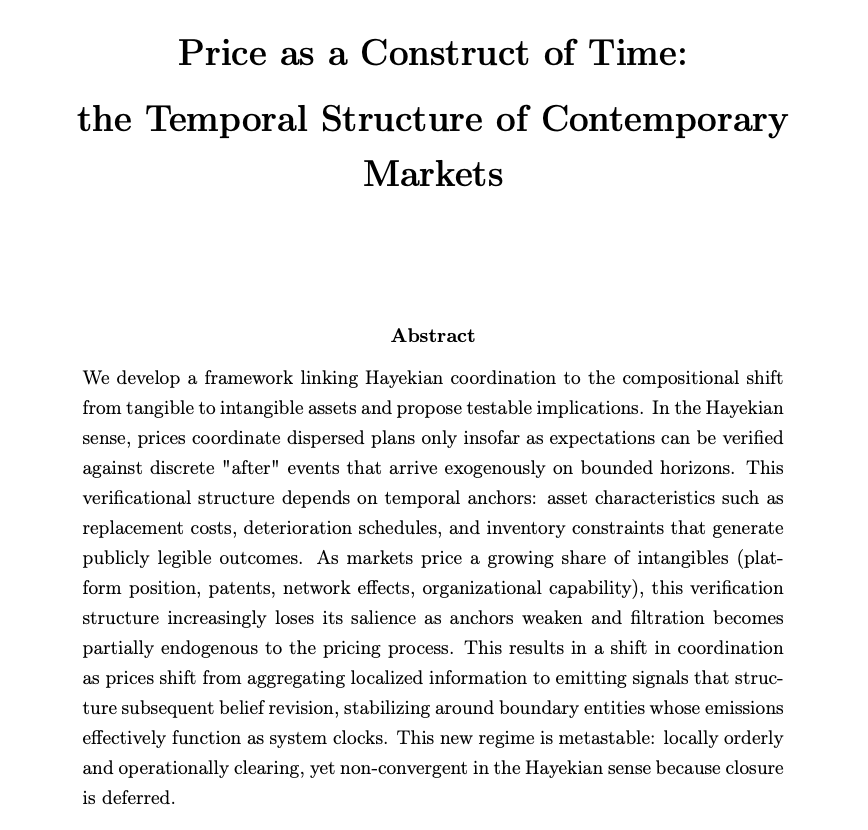
Amidst a transition towards intangibles, the tenet economy has emerged: boundary entities emit and absorb information in a recursive loop, narratives continuously shifting the information environment itself.
The greatest hidden knowledge in the “Great Books” is astrological.
Plato’s Republic, say. Read closely about the soul’s (possible) parts as Hydra, Lion, Man. Take these seriously, and you will perhaps see a side of Plato you didn’t know existed.
What is Capricorn the gate of?