Timelocks are one of Bitcoin's most underrated features.
CLTV (CheckLockTimeVerify) prevents a UTXO from being spent until a specific block height or timestamp.
CSV (CheckSequenceVerify) prevents spending until a relative number of blocks have passed since the UTXO was created.
These enable: inheritance plans, payment channels, vaults, and time-delayed security mechanisms.
Smart contracts on Bitcoin. No Solidity required.
bitcoin:native
Timelocks are one of Bitcoin's most underrated features.
CLTV (CheckLockTimeVerify) prevents a UTXO from being spent until a specific block height or timestamp.
CSV (CheckSequenceVerify) prevents spending until a relative number of blocks have passed since the UTXO was created.
These enable: inheritance plans, payment channels, vaults, and time-delayed security mechanisms.
Smart contracts on Bitcoin. No Solidity required.
bitcoin:native
Zenon is infrastructure for the massive IoT data, machine economy, high-frequency interactions and payments rather than another general-purpose EVM style monolith chasing trading signals.
Zenon stands out from the hype as a specialized, high-scalability Layer 1 DAG - optimized for real-world, high-frequency use cases like IoT, micropayments, and edge sovereignty—areas where traditional blockchains (even "cheap fee" ones) fall apart at scale.
The core pain point: on most chains, even sub-cent fees explode into millions annually for high-volume, low-value data streams (e.g., 10k sensors @ 1 tx/min). Zenon's response—feeless operations via Plasma (QSR fusion or PoW), independent account chains in a block-lattice + Meta-DAG setup—is engineered precisely for this. Devices can publish compact data asynchronously without wallets, backends, or per-tx costs, while maintaining cryptographic guarantees (Ed25519 signing, SHA3-256, etc.).
Key Positioning Strengths
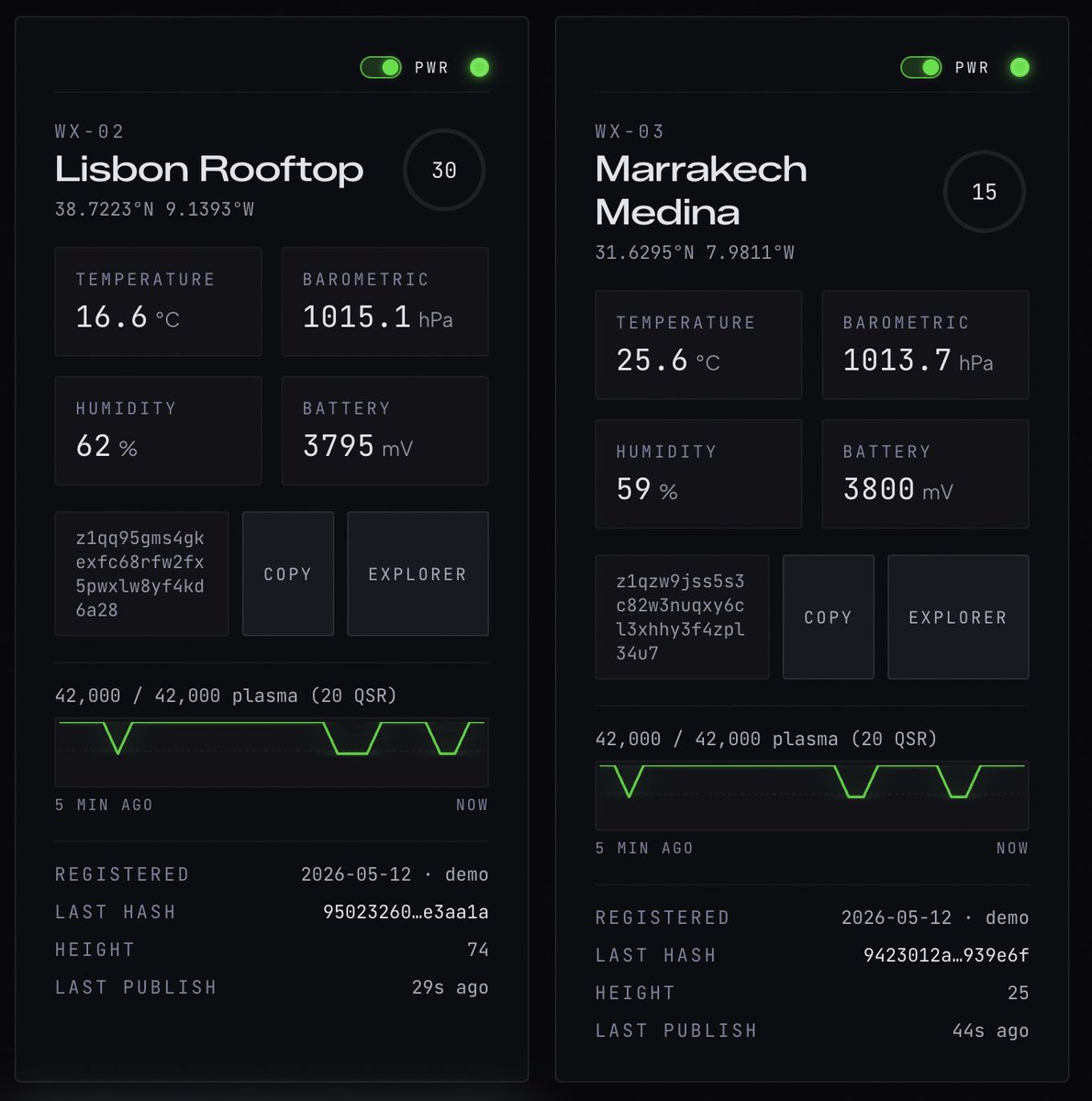
IoT/Edge Focus: The weather station proof-of-concept (4 simulated stations pushing telemetry data every 60s to public nodes on alphanet/mainnet) demonstrates sovereignty and simplicity. No intermediaries, true edge publishing. This isn't just marketing—it's a live illustration, resilient data flows that monolithic chains can't match economically.
Dual-Ledger (NoM) Architecture
ZNN for security/staking, QSR as "fuel"/anti-spam (Plasma). Hybrid PoW+PoS, block-lattice for user accounts + Meta-DAG for consensus. This enables high throughput, parallelism, and feeless ZTS tokens that inherit the same properties. It's a deliberate departure from single-ledger designs.
Bitcoin Ethos + Practicality
Zenon mphasizes decentralization, censorship resistance, and BTC interoperability. Aimed at complementing Bitcoin rather than competing directly in DeFi hype.
Developer/Real-World Angle
Feeless streaming/micropayments suit AI agents, sensors, payments—narratives that are gaining traction. The demo lowers barriers (public nodes, no wallet needed for basic publishing).
Realistic Caveats in the Field
Zenon is still early-stage (alphanet/mainnet phase, smaller market cap in the low millions recently). It has strong technical differentiation but faces the usual challenges: adoption, ecosystem growth, and proving long-term security/decentralization at scale. Many DAG/IoT projects have existed (IOTA, etc.), but Zenon's dual-coin + Plasma + lattice combo is distinctive. High risk/reward potential.
Cheap gas fees are not cheap when you do the math. 10,000 sensors publishing onchain events once per minute costing $0.001 in gas totals a cost of $5 Million per year. Cheap is not cheap at scale.
IoT, internet, and payments systems demand true scalability and sovereignty at the edge.
Every design factor has been taken into account in the the dual-ledger DAG.
How is Zenon foundationally set up for the agent-as-primary-user future?
— actually well, but the value story has to come from protocol primitives, not products.
Five mechanisms already in the protocol that translate agent throughput → ZNN/QSR demand:
1. Plasma fusion is the agent-throughput primitive.Agents need predictable throughput. Today's competitors solve this with paid gas (Ethereum L2s) or paid subscriptions (centralized RPC).
Zenon's model: lock ZNN to generate plasma. More agent traffic = more demand for plasma capacity = more ZNN locked.
The token sink is structural, not speculative.
The thing missing today is a metered layer on top so sporadic agent users can pay-per-transaction without owning ZNN themselves — that's a primitive worth specifying (pay-with-QSR-into-fusion-pool).
2. Pillar/sentinel staking is restaking-AVS, accidentally.EigenLayer hit $20B TVL because protocols want shared security without spinning up their own validators.
Zenon already has natively-staked validators (pillars + sentinels) producing deterministic ordering + Bitcoin-bridge security.
Position pillar restaking as a service to other crypto protocols (Bitcoin-secured AVS for Lightning routing nodes, BitVM verifiers, sidechain consensus). ZNN demand grows with the number of protocols that lease pillar security.
3. Trustless BTC bridge is the primary capital onramp.$1T+ of BTC sits idle on Bitcoin. Stacks/RSK/Liquid all wrap it custodially.
Portal + PTLC + Bitcoin SPV are exactly the primitives for a non-custodial bridge. When agents start running BTC-yield strategies, they need somewhere to deploy that's non-custodial — that's the demand driver. ZNN/QSR get used as the bridge's economic-security layer.
4. Deterministic momentum ordering is MEV-free settlement.Agent strategies lose money to MEV on Ethereum. They'll route to chains that eliminate it structurally.
Zenon's momentum ordering is structurally MEV-resistant (no mempool reordering, no priority gas auctions). Agent volume migrates → QSR plasma consumption rises → ZNN locked in fusion rises.
5. Embedded contracts are agent-composable primitives.The 13 pending specs (PTLC, Bitcoin SPV, Governance, Atomic Swap, Multisig, Streaming, ZNS, Portal, Commit Channels, GALV, DID, Sentinel Validator, Commitments) — every one is a primitive an agent framework can compose against.
Compare: Ethereum agents compose against thousands of opaque ERC-20s + leaky AMM contracts. Zenon agents would compose against a curated, audited primitive library.
What to build (not UIs):
• Ship every pending embedded contract spec (the 13 above)
• Better RPC/SDK surface targeting agent frameworks (LangChain, AutoGPT, MCP servers, Letta) — nebula directions style ergonomic CLI but for ZNN ops, not Nebula state
• Bitcoin-Core-grade testing + security review for every primitive (the differentiator vs Solana's ship-it-and-pray)
• Reference implementations for agent-flow templates (BTC-yield strategies, cross-chain arb, restaking allocation)
• Documentation written for agent-builders (capability-oriented), not consumer devs (UI-oriented)
Value capture maps directly to volume:
• Plasma fusion → ZNN locked grows with agent throughput
• QSR consumption → structural sink per agent transaction
• Pillar yields → grow with bridge + restaking-AVS volume
• Sentinel yields → grow with verification volume
The narrative for ZNN/QSR holders isn't "this is infrastructure, trust me on price."
It's: every agent interaction with the network removes ZNN from float (fusion) + consumes QSR (plasma).
If agents are the primary crypto user 5 years out, the chain that gets that traffic compounds value naturally. Bitcoin's model exactly — no foundation, no products, the protocol's properties drive the demand.
The Syrius/UI-polish work isn't worthless — it's just not load-bearing for the agent-future thesis. It's load-bearing for early human users who validate the network exists. Treat it as bootstrap, not destination.
AI agents are becoming the primary user of crypto, not humans clicking UIs. Agents need fast settlement, deterministic ordering, no gas friction, and verifiable proofs. They don't need Stacker News marketing. They need APIs and on-chain primitives.
@Zenon_Network's structural properties were designed for this without knowing it. Feeless plasma (no per-action gas math for agents), deterministic momentum ordering (MEV-resistant by construction so agents can rely on outcomes), pillar/sentinel staking (shared
security primitive that AVS-style protocols can borrow), pseudonymous community (no foundation incentives skewing roadmap toward consumer apps).
@Bitcoin needs a settlement-adjacent compute layer that isn't Stacks/RSK/Liquid. Those all chase users with apps. The opening is "infrastructure layer Bitcoin protocols compose against" — PTLC + Bitcoin SPV + Portal bridge are exactly the right primitives for that.
The ZENON Red autoNoMous organization rolls out in phases
1. Alphagent: the test-run. only markdown
2. Betagent: agents actually build n' deploy stuff
3. Full autonomy: aliens only interact as things break
Any claw derivative agent works
More info: https://t.co/ZNs3pdrAir
The strategic bet that wins is shipping a genuinely trustless BTC ↔ ZNN bridge before Stacks / Botanix / Citrea / Mezo / BOB do, and publishing continuous adversarial proof of its correctness so Bitcoiners actually believe it. That’s the only narrative position no other L1 can credibly claim.