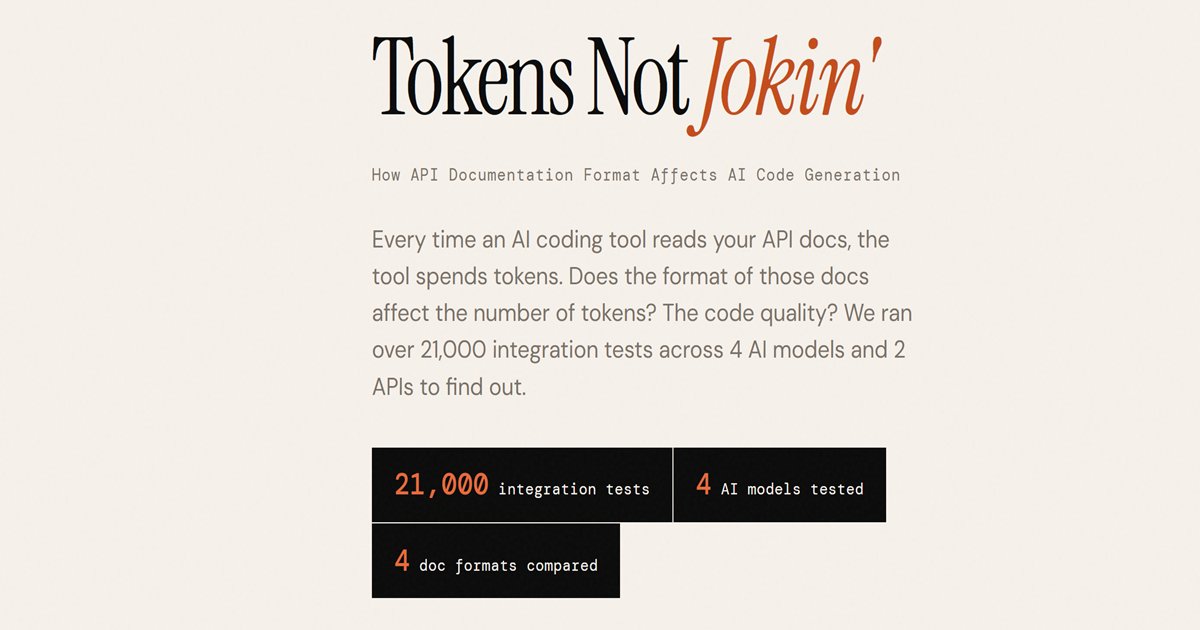
If you test how well AI tools use Stripe's API docs, how do you know the AI isn't just drawing on patterns it already learned?
You can't. Every popular API is all over the training data.
So I built two APIs from scratch. No public footprint. No prior exposure. Then I documented each one in four formats and ran 21,000+ integration tests.
The methodology story: https://t.co/7kzudnaevN"
Your company tracks API latency, uptime, error rates, and developer satisfaction scores.
But nobody's tracking what it costs AI tools to read your API docs.
Every time a developer points Cursor or Copilot at your documentation, tokens get consumed. The format of those docs determines how many. Some formats use up to 80% more tokens than others for the same information.
That's real money. And it compounds across every endpoint, every developer, every day.
There's no dashboard for this. No metric. Most API platform teams don't even know the question exists.
I've been researching this with over 21,000 integration tests across 4 AI models and 2 APIs. The results are surprising, and they're coming in March.
The book is https://t.co/kOrttSXW7x
It annoys my that Snoop Dogg gets so much attention at the Olympics. Dude is getting paid a mountain of money to be there. Meanwhile, Flava Flav out here sponsoring whole ass women’s teams so they can compete without the financial stress and strain that comes with it and he doesn’t get nearly enough love for that, imo.
@DenizCamp Hot take, but when any media property in the last 20 years is successful and is then transformed into a machine that exists to churn out endless sequels and prequels, having a story come to an end is refreshing. I'm sure the restriction contributed to the creativity.
Every time a developer points Cursor or Copilot at your API docs, they consume tokens. But does the format of those docs matter? Does it affect token consumption, the code quality, or both?
Nobody's isolated the variable. Not with clean data. And if you tried, you'd hit a problem: popular APIs show up everywhere. GitHub repos, Stack Overflow, tutorials, blog posts. When an AI tool generates Stripe integration code, is it reading the docs or drawing on patterns it already learned?
You can't isolate the variable so you can't accurately measure.
So I built two control APIs from scratch. No public footprint. No prior exposure. I documented each one in four different formats and ran over 21,000 integration tests across four AI models, from local models you can run on a laptop to frontier cloud APIs.
Clean data. No question of contamination.
Book coming in March. Learn more at https://t.co/XfhMB5bpaf
WELCOME TO THE SKILL ERA OF THE INTERNET
for the last 15 years, if you wanted to build a serious software company, you built a product and exposed an api.
that was the move.
you created functionality… payments, messaging, email, search, analytics… and then you let developers plug into it.
the companies that won owned the pipes.
stripe owned payments.
twilio owned messaging.
sendgrid owned email.
the api was the distribution layer.
once you were integrated, you were embedded.
that model made sense in a world where execution was scarce.
llms compress execution into a prompt.
so the center of gravity shifts.
in this cycle, you build expertise and package it as a skill.
an api is a doorway into a function.
here’s how to send an email.
here’s how to process a payment.
here’s how to fetch this data.
it’s precise. mechanical. bounded.
a skill is a doorway into judgment.
here’s how to audit a landing page like a serious growth operator.
here’s how to structure a legal intake so you catch the real risk.
here’s how to clean and enrich messy directory data so it actually turns into revenue.
you’re encoding a way of thinking.
and that changes how companies are built and how they scale.
in the api era, distribution meant convincing developers to integrate you.
you needed docs. sdk’s. developer evangelism.
you fought for a place inside someone else’s codebase.
in the skill era, distribution means becoming part of someone’s agent workflow.
a founder opens claude code.
they type /seo-audit.
your skill runs.
it frames the output.
it structures the analysis.
it guides the decisions.
your expertise lives inside the execution layer itself.
you aren’t pulling users into your interface.
you’re embedding your thinking into theirs.
that changes company design.
the old playbook looked like this:
build saas
design ui
onboard users
drive retention
expand seats
the new playbook looks more like this:
encode a high-leverage playbook
package it as a skill
let agents call it thousands of times per day
the interface shrinks.
the leverage expands.
a strong skill doesn’t serve one user at a time.
it serves fleets of agents.
one installation can mean your methodology is invoked across hundreds of companies automatically.
the scaling curve looks less like seats and more like invocations.
what’s happening underneath all of this is simple:
software used to be the executor.
now software is the orchestrator.
next, expertise becomes infrastructure.
in the api era, the winners owned the pipes.
in the skill era, the winners own the patterns.
patterns for closing deals.
patterns for pricing.
patterns for positioning.
patterns for enrichment.
patterns for research.
many new companies will look surprisingly small on the surface.
a tight repo.
a handful of powerful skill files.
maybe 2–5 people maintaining and improving them.
but those skills will sit inside thousands of workflows, shaping decisions at scale.
and it’s creating a new class of companies built less around dashboards and more around encoded judgment.
THIS IS THE SKILL ERA OF THE INTERNET.
welcome.
Let’s use the ICE playbook - round up everyone named in the Epstein files and anyone who protected them, detain them without due process, send them to concentration camps, then ship them off to some third-world prison. We’ll sort out innocence later… if we ever bother.
This shows what's possible with WebMCP, a new standard for browser-native AI integration. No servers. No complexity. Just web apps that work for humans AND AI agents. What would you build with this pattern?
@AnthropicAI@alexalbert__#MCP#WebMCP#AI#REACT
I built a kanban board where Claude and I work together in real-time. No backend. No API. No sync protocol. Just React state + WebMCP. I drag cards with my mouse. Claude creates and organizes them through MCP tools. We're both editing the same board simultaneously. 🧵
Try it yourself: Live demo: [Vercel URL] Blog post: https://t.co/sxQevHlqc8 Source: https://t.co/G5tZVg1zNV Connect your Claude and start collaborating with AI on the same board.