Han hecho una conferencia de prensa para quejarse de IPSOS que es una empresa PRIVADA no es la ONPE
JAJAJAJAJAJAJA 🤣
Como se burlaban de renovación popular y de porky
Ahora tenemos a la “izquierda fraudista”
Esto es cine y KARMA gente jajajaja
🍿
🚨 Roberto Sánchez firmó el 12 de mayo un compromiso con la Fenatep que, entre otras cosas, hipoteca al candidato con un cambio de la Constitución y, sobre todo, con la liberación de los que ellos denominan ‘presos políticos’. Para entendernos mejor, Sánchez se ha comprometido con el Movadef a “impulsar la libertad de los luchadores populares y al cese de los llamados juicios penales”.
📌 Investigación completa: https://t.co/P9YmQYFBZQ
Me sorprende cuanta gente no está utilizando IA para aprender inglés mucho más rápido.
Aquí tienes 7 prompts para Claude para practicar conversaciones reales y empezar a hablar con mucha más fluidez.
(🔖 Guárdalos para probarlos después) 👇
Python lists look simple until you start working with real datasets.
That’s where list methods become important.
From cleaning values and removing duplicates to building pipelines and preparing data for analysis, list methods are used everywhere in Python workflows
#python
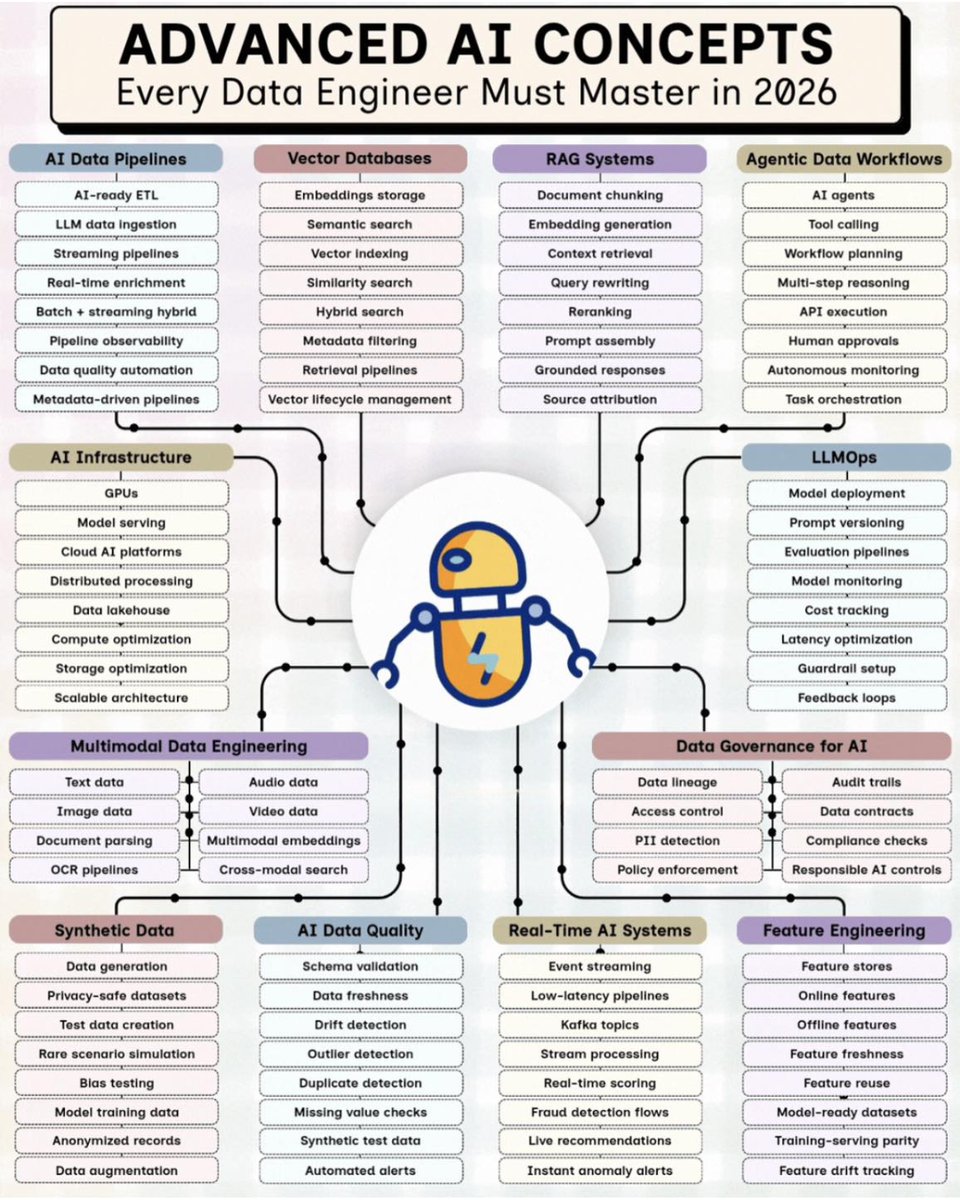
Advanced AI Concepts Every Data Engineer Must Master in 2026
In 2026, data engineers need to understand how data powers AI systems.
Because modern AI products depend on more than pipelines, warehouses, and dashboards.
They need:
➞ Clean data
➞ Real-time pipelines
➞ Vector databases
➞ RAG systems
➞ AI data quality checks
➞ Feature engineering
➞ LLMOps
➞ Data governance
➞ Agentic workflows
➞ Multimodal data processing
This is where the role of a data engineer is changing.
Earlier, the focus was mostly on collecting, transforming, and storing data.
Now, data engineers also need to prepare data for AI models, retrieval systems, autonomous agents, and real-time decision-making systems.
That means understanding concepts like embeddings, vector indexing, prompt versioning, context retrieval, model monitoring, drift detection, data lineage, synthetic data, and AI-ready pipelines.
The future data engineer will not just build data infrastructure.
They will build the foundation for intelligent systems.
If you are learning data engineering in 2026, do not stop at SQL, Spark, Airflow, Kafka, and cloud platforms.
Start learning how AI systems consume, retrieve, validate, monitor, and act on data.
That is where the next big opportunity is.
♻️ Repost to help others grow
SOLID Principles Explained with Clear Examples:
𝐒 - 𝐒𝐢𝐧𝐠𝐥𝐞 𝐑𝐞𝐬𝐩𝐨𝐧𝐬𝐢𝐛𝐢𝐥𝐢𝐭𝐲 𝐏𝐫𝐢𝐧𝐜𝐢𝐩𝐥𝐞
A class should have only one reason to change.
- Example: Instead of one giant User class that handles authentication, profile updates, and sending emails, split it into UserAuth, UserProfile, and EmailService.
𝐎 - 𝐎𝐩𝐞𝐧/𝐂𝐥𝐨𝐬𝐞𝐝 𝐏𝐫𝐢𝐧𝐜𝐢𝐩𝐥𝐞
Classes should be open for extension but closed for modification.
- Example: Define a Shape interface with an area() method. When you need a new shape, just add a Circle or Triangle class that implements it.
𝐋 - 𝐋𝐢𝐬𝐤𝐨𝐯 𝐒𝐮𝐛𝐬𝐭𝐢𝐭𝐮𝐭𝐢𝐨𝐧 𝐏𝐫𝐢𝐧𝐜𝐢𝐩𝐥𝐞
Subtypes must be substitutable for their base types without breaking behavior.
- Example: If Bird has a fly() method, then Eagle and Sparrow should both work anywhere a Bird is expected.
𝐈 - 𝐈𝐧𝐭𝐞𝐫𝐟𝐚𝐜𝐞 𝐒𝐞𝐠𝐫𝐞𝐠𝐚𝐭𝐢𝐨𝐧 𝐏𝐫𝐢𝐧𝐜𝐢𝐩𝐥𝐞
Don't force classes to implement interfaces they don't use.
- Example: Instead of one fat Machine interface with print(), scan(), and fax(), break it into Printable, Scannable, and Faxable. A SimplePrinter only implements Printable.
𝐃 - 𝐃𝐞𝐩𝐞𝐧𝐝𝐞𝐧𝐜𝐲 𝐈𝐧𝐯𝐞𝐫𝐬𝐢𝐨𝐧 𝐏𝐫𝐢𝐧𝐜𝐢𝐩𝐥𝐞
High-level modules should not depend on low-level modules. Both should depend on abstractions.
- Example: Your OrderService should depend on a PaymentGateway interface, not directly on Stripe or PayPal.
The real power of SOLID is not in following each principle in isolation. It's in how they work together to make your code easier to change, test, and extend.
♻️ Repost to help others learn this