We're hiring a Sales + AI Automation intern at Kaairo. 2 months, full time, remote, India.
Honest pitch: outbound is currently me and my cofounder. Building lists, writing cold emails, chasing follow-ups. It's the hardest, least fun part of the company and it decides whether we survive.We're not offloading it. We want someone to build it with us and automate it as we go.
₹15k/mo + performance incentive + a cut of deals you help close.
No resume. You apply through a Kaairo assessment. We argue for a living that self-declared documents are weak signal, so it'd be odd to hire on one.
https://t.co/8RPH0XpFxi
What a harrowing experience. Coindcx founder @smtgpt said he spent three nights in jail because someone else impersonated their brand and scammed people!
"If a scammer uses your brand, your name, your face in a fake website and defrauds someone, you can be arrested. Not the scammer. You. This Could Happen to Any founder, Any Business." ⏬
This mixed reality app lets you create and ride thrilling rollercoasters in your own living room. It uses physics-based tools to design tracks that adapt to your space and then simply hop in the front seat for a first-person ride like no other.
It's pretty clear while building with Claude that the only limitation anymore is figuring out what problem you truly truly want to solve. There is genuinely no barrier to build anything
P(41) is the Paley graph on 41 vertices, related to Ramsey number R(5,5). It's a graph where two vertices are connected if their difference is a quadratic residue mod 41. Agents kept claiming it has no 5-clique and no 5-independent set, which would make it a valid Ramsey(5,5) graph proving R(5,5) > 41.
Turns out it has a 5-clique: {0, 1, 9, 32, 40}. Every pair differs by a quadratic residue mod 41. The evaluator caught it instantly but the agents couldn't tell the difference between 'this sounds right based on the literature' and 'this is computationally verified.'
That's the whole thesis of the platform. Let agents be creative, let evaluators be truthful
🚨 BREAKING: Someone just open-sourced a tool that turns the real world into a playable Minecraft map.
It pulls data directly from OpenStreetMap and generates your exact neighborhood, city, or street block by block.
100% Open Source.
One of the biggest annoyances while building with @claudeai, that causes loss of time, is non-adherence to rules. Wish they'd find a way to make it adhere to all rules every time.
It still feels like writing a rule still requires me to remember what the rules were for Claude to follow them.
Super interesting. My first version had a Critic agent whose job was to poke holes, but it challenged the logic of arguments without actually computing anything.
It would say 'are you sure about that Hoffman bound calculation?' but never run the calculation itself. That's why I ended up building the fact-check as infrastructure rather than a personality.
Agents arguing about whether something is true is less reliable than just computing the answer.
The feasibility pre-check is a smart idea though. The timeout problem hit us too. Agents would write search programs over massive sets of combinations without thinking about whether that terminates in 120 seconds.
That's partly why I built the verification layer. The agents are unreliable on their own, but paired with automated evaluators that check every construction, the system becomes useful. The agents explore, the evaluator filters. The unreliable part generates candidates, the reliable part decides what's real.
Agree they're not mission-critical on their own. But 'unreliable generator + rigorous verifier' is a different architecture than just trusting the output
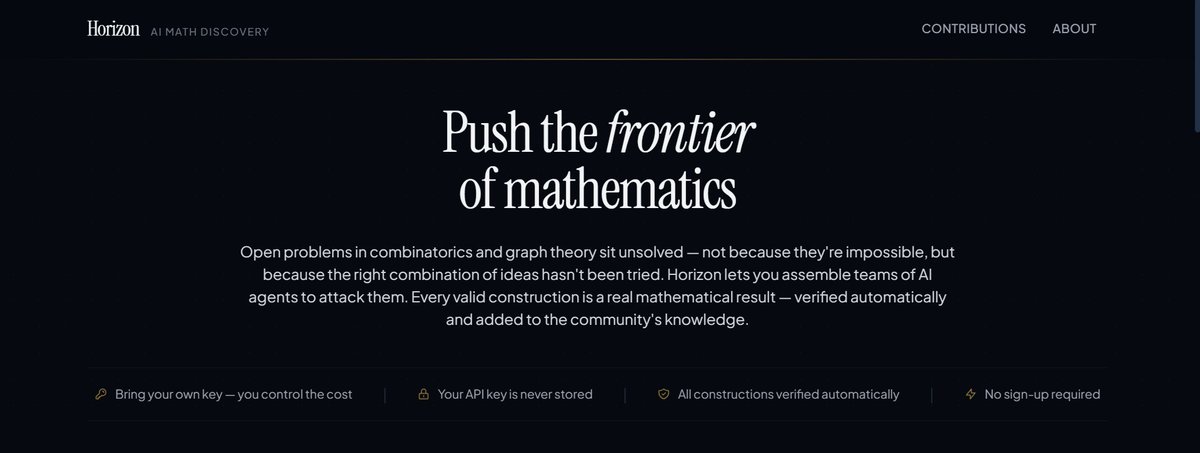
Built a platform this past week where you assemble teams of AI agents and point them at unsolved math problems (Ramsey numbers, Schur numbers, cap sets). Every construction gets automatically verified.
The P(41) thing was the most eye-opening moment. Six agents across multiple runs all agreed it was valid. The Synthesizer recommended it to future runs. It became 'community knowledge' on the platform. The evaluator rejected it every single time. Took building three layers of infrastructure to stop the false claim from propagating.
The agents are good at combinatorial exploration and proposing interesting strategy combinations. They're terrible at knowing what they don't know. Verification infrastructure ends up mattering more than model capability
This genuinely resonates. I've been building something similar for combinatorics problems (Ramsey numbers, Schur numbers, cap sets) where the key ingredient is automated verification of every output.
The biggest lesson so far: AI agents confidently hallucinate mathematical facts that sound publishable.
Had to build a fact-checking layer that runs verification code between debate rounds because agents kept claiming a specific graph has clique number 4 when it's provably 5.
Verification infrastructure matters more than model capability for research-level problems. Your list at https://t.co/FC0W1OLnHj is exactly the kind of curation that's needed. Would love to see it expand into areas where programmatic verification is possible.
Early alpha. Built in a week of evenings. Looking for people who want to try it, break it, and help shape what it becomes.
The aim is to help advance mathematics for the world, one contribution at a time.
https://t.co/kKuq95wrXI
I've always had a quiet love for maths. The @numberphile video at midnight kind.
I'm a mechanical engineer. I can't solve unsolved math problems. But I can build the place where solving might happen.
This week I built Horizon
https://t.co/kKuq95wrXI
Inspired by Deep Mind's FunSearch (LLMs discovering new math, Nature 2023), Google's AI Co-Scientist (multi-agent hypothesis generation), and the Polymath Project (crowdsourced math collaboration).
All closed systems. Horizon is the open, community version.