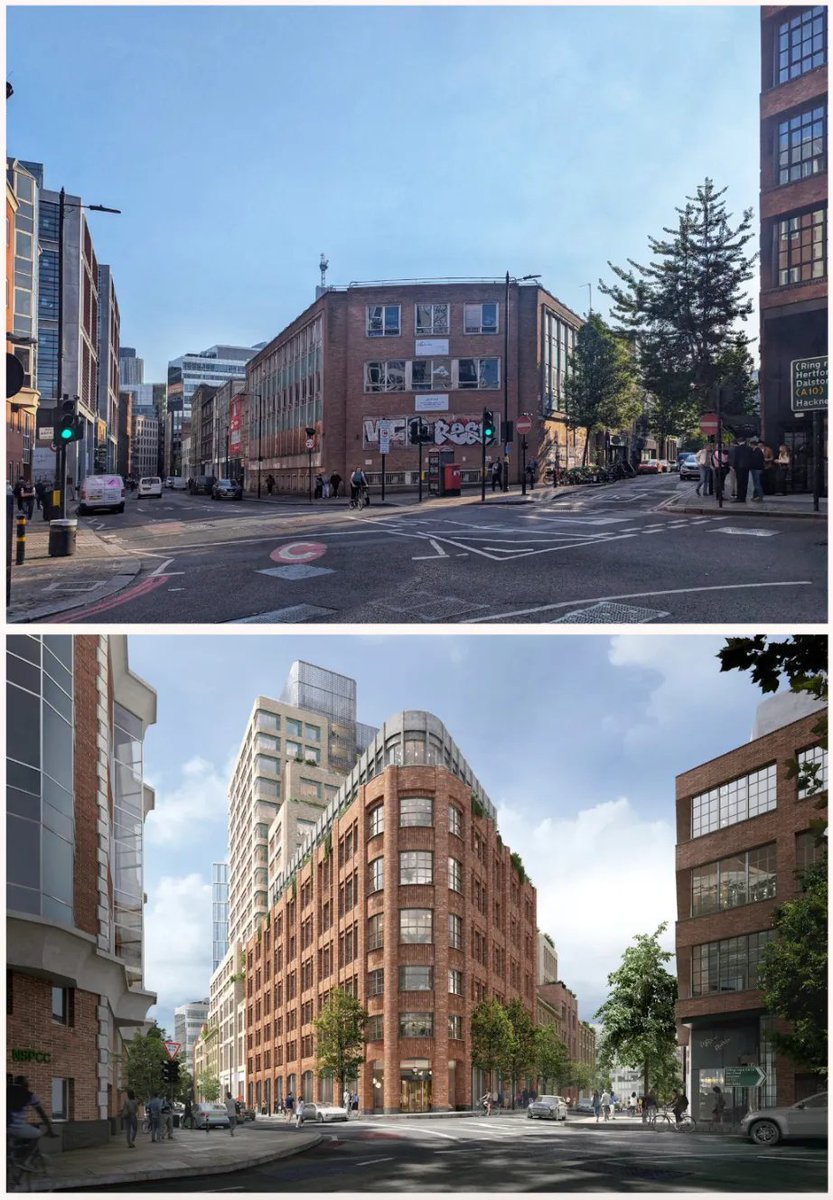
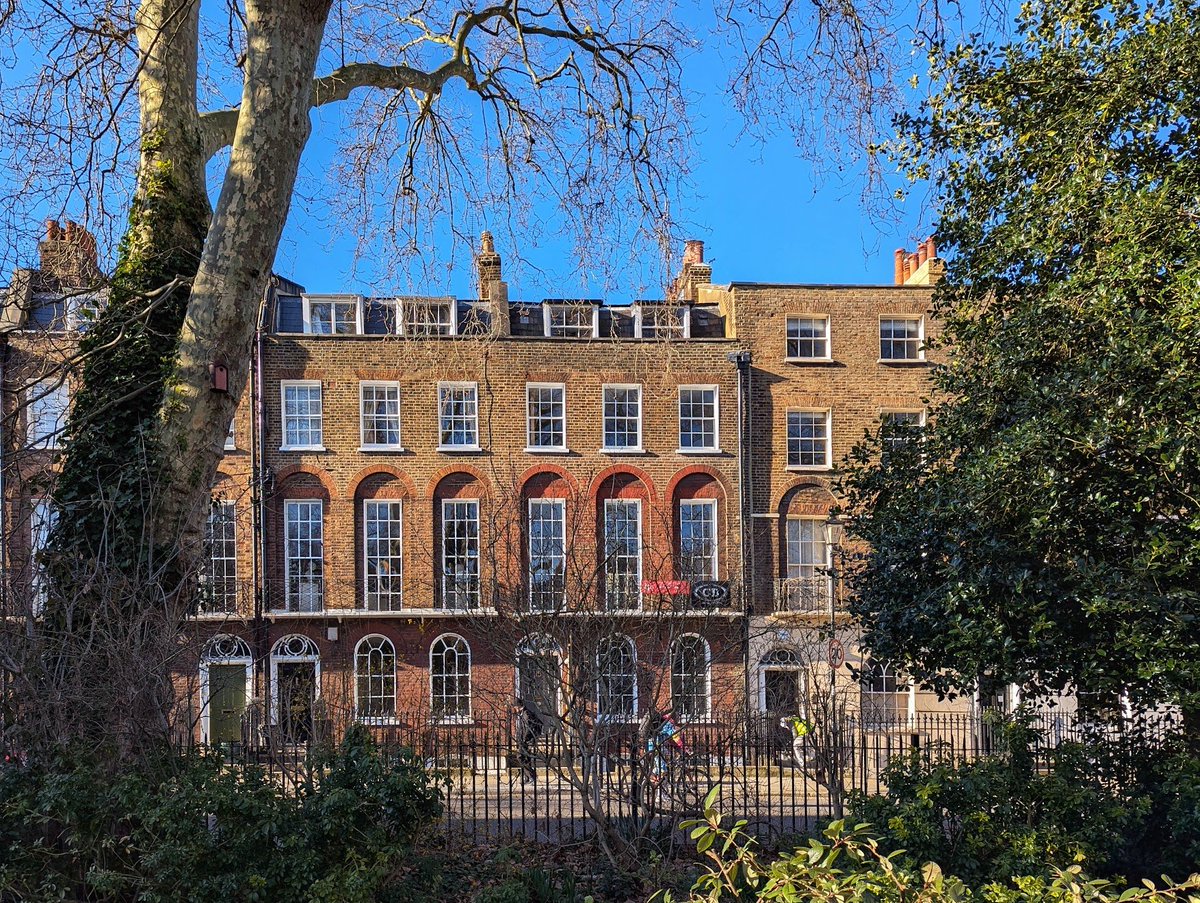
Every city could have this and all it would take is for the council to adopt a design code, and tell developers they will get automatic permission if they build precisely this.
£179,000,000 was spent on the Stonehenge tunnel.
So, where is it?
Well, there is no tunnel.
The only thing £179,000,000 produced was paperwork. That's it.
Do you think this an acceptable use of taxpayers money?
Hackney Council voted 5:2 last night against the planning dept's recommendation to reject the Shoreditch Works densification scheme. But in a rather baffling twist, the chair said they could not actually accept the scheme, so the decision has been deferred. Some thoughts:
1. Hackney has a lot of great councillors. The committee was extremely conscientious, battling through mountains of technical detail in a meeting that ran non-stop from 6:30pm to midnight. Crucially, they kept sight of the big picture – the fact that, whatever view one may take on certain fine details, this is basically a brilliant and even world-leading scheme.
2. The planning officers seemed like intelligent and decent people, but they had become very wound up over relatively minor details. Most of their attention was absorbed by a tortuous debate about the fact that the developer was only offering a discount to council-favoured businesses on 7 percent of the floorspace, rather than 10 percent as the council prefers. Whatever you may think about this question (and personally I am sceptical about the idea of 'affordable workspace' generally), it seemed like an insane reason to reject the whole development.
3. I was left with renewed unease about the Govt's plans to delegate more decisions to officers rather than councillors. Sometimes councillors have more perspective than officers, and can thus bring some common sense to decision-making. I know councillors can be a bit daft too, but the choice between the two doesn't seem straightforward to me.
4. Time is now very short. Hackney has elections in May and will enter purdah in March. Labour is likely to take heavy losses in the local elections and the council may fall to the Greens. I hope I am wrong, but I suspect the Greens will be hostile to the scheme. There is a pro-building majority on the planning committee at the moment, but they have only seven weeks to get this application back in front of them, and a chair who is determined to block it. The portcullis is falling. The silver lining, however, is that GLA may intervene to approve the scheme. The events of last night surely made that more likely.
5. Is it normal for the chair to be openly hostile to the applicant, and openly biased against them? I haven't seen it before, but maybe I have been lucky in my planning committees. I was very surprised when the chair refused to let the (pro-development) ward councillor for Shoreditch speak, despite its being reqested by another member of the committee. Surely it is natural for the elected representative of the affected area to have a voice?
6. The evening was interesting for those, like me, who are interested in the underlying political economy of land-use restrictions. In general, development control exists to prevent disruption to local people. But southern Shoreditch has hardly any local residents and the local office workers (such as me) are sympathetic or indifferent to the scheme. The council received only 3 letters of opposition, less than the average suburban conservatory extension! Pretty much nobody is opposed to this massive development on account of its having negative effects on them, because it doesn't have any negative effects on anyone.
What we see here, then, is an institutional infrastructure ultimately generated by NIMBYism, continuing to operate even when NIMBYism is absent. I suspect there are many such cases.
According to the Census, England and Wales added around 400,000 homes net between 1821 and 1831.
Scaled for population (12m in 1821), that would equate to our building 2 million homes by 2035, twice the rate of the Government's target, and around three times current output level.
Scaled to existing stock (2m in 1821), that equates to our building nearly 6 million homes by 2035, six times the current target rate and ten times current actual output.
Scaled to GDP (i.e., if housebuilding had increased at the same rate as overall productive power), that equates to building perhaps 12 million homes by 2035, 12 times the Government's target rate and 18 times what we are actually achieving.
Add to this that new homes between 1821 were generally larger and of better quality than the existing stock, and were concentrated in the locations of highest demand. This means that the raw numbers *understate* how much value was added to our housing stock in that decade.
The Government is considering requiring that everyone hire an architect in order to submit a planning application or a building control application.
This would be a mistake. If the state wants buildings to meet certain standards, it should simply require that they do so. We have a system for this – two systems, in fact, namely building regulations and planning.
There is no good reason to require hiring people with architecture degrees to sign off designs. This is a classic case of valuing process over outcomes. Developers could and would simply employ tame architects to rubber-stamp whatever they were doing anyway. 'Protection of function' is a completely toothless instrument for improving design standards.
What it would do, of course, is add cost -- exactly what British housebuilding does not need at the moment.
The Government should discard this idea immediately.
Reporting in @ArchitectsJrnal.
In 2023, national policy was quietly altered to allow more mansard extensions. Few people knew about this and most councils ignored it, so both application rates and their likelihood of being approved by local councils remained largely unchanged.
However, the rate of success at *appeal* has gone up from 19% to 42%, because appeals are judged by a branch of the national government. As news of this gets out, more people will put in applications, and eventually councils may stop uselessly resisting so many of them.
A couple of councils have been pioneering policies like this already, like Tower Hamlets, which recently allowed a wave of mansards subject to careful design controls. The introduction of this led to application success rates in Tower Hamlets jumping from 27% to 93%.
Opponents argue that mansards compromise streetscape uniformity and put excessive visual pressure on the street. You can get a sense of the profound frivolousness of these objections by considering this before-and-after from Tower Hamlets: trivial or zero visual harm has been done, in return for an enormous benefit to residents.
As Dresden shows, it is possible & increasingly normal to put back what was lost, to recreate cities of walkability & beauty & to celebrate the local over the loveless. Thanks to popular demand …
This is a big deal and extremely good news. The GLA is proposing to withdraw several of its most damaging anti-density restrictions. If they actually do it, this will help to pluck housebuilding in London from the abyss.
Note though that (a) because of the long application, permission and construction cycle, it will be years before this has much effect on completions and (b) lots of damaging policies by the national government remain in place. We aren't out of the woods yet.
The Canadian government has announced they will fast-track houses through Canada's equivalent of planning if they use one of a set of government-issued designs.
Not a bad idea, in principle. But the actual designs they have chosen (all of which look roughly like the below) would almost certainly do worse in a visual preference survey than the generic suburban houses next to them in these renderings.
This is the perenial problem with bureaucratically chosen designs, and a reminder of the importance of basing any such policies on serious visual preference surveying.
An interesting feature of Scottish planning is that it occasionally allows ruined castles to be restored. The reason is partly that conserving a ruin is actually very difficult: once rainwater can enter the masonry, frost action destroys the mortar and the building eventually collapses completely.
This building, Fairburn Tower, was abandoned in the eighteenth century. It was restored by the Landmark Trust, which now lets it to tourists.
@createstreets Phase one of Earl’s Court is already cooked. At least it is hopefully happening with desperately needed new homes. But let’s hope that the later phases dare to differ & dare to be beautiful. London would be the better for it. Or so I argue in @Telegraph
https://t.co/VXeRO3Swou