كثير يسأل: هل استخدام الذكاء الاصطناعي في كتابة الأبحاث مقبول؟
هذه الورقة تلخص أفضل الممارسات والتوصيات الأخلاقية لاستخدامه بطريقة صحيحة، مع الحفاظ على النزاهة العلمية وجودة البحث.
ورقة جميلة وأنصح بقراءتها لكل مهتم بالبحث العلمي. 👌
🚨 URGENTE!
Segundo uma fonte com quem converso diariamente, o clima é de pânico na campanha de Flávio Bolsonaro após o lançamento do novo jingle de Lula.
De acordo com essa fonte, a avaliação interna é que a música acertou em cheio porque fala diretamente com o sentimento do povo. A preocupação, ainda segundo essa fonte, é que o jingle ganhe força rapidamente nas ruas, nas redes sociais e se torne um dos grandes símbolos desta eleição.
Se essa percepção se confirmar, a disputa pela atenção do eleitor pode ganhar um novo capítulo.
LULA TETRA
"Israel é o único país do mundo capaz de bombardear 9 países e invadir 3 países vizinhos em um único ano; matar 100.000 pessoas (25.000 crianças) em 1.000 dias; deslocar quase 6 milhões de pessoas em 3 países; submeter 2 milhões de pessoas em Gaza à fome; violar as Convenções de Genebra e de Viena, o direito internacional, os direitos humanos e a soberania estatal; sequestrar, estuprar e torturar crianças e mulheres; atirar, prender e assassinar... e, ainda assim, posar de vítima."
SSO vs OAuth vs OIDC vs SAML
𝗦𝗦𝗢 is a user experience, not a protocol. It lets users log in once and access multiple apps without re-authenticating; providing seamless access across tools. It relies on protocols like SAML or OIDC.
𝗢𝗔𝘂𝘁𝗵 is for authorization. It lets apps access user data or services without sharing credentials. It controls what an app can access, not identity.
𝗢𝗜𝗗𝗖 is an authentication layer on top of OAuth 2.0. It verifies user identity and provides user info via ID tokens (usually JWTs). It’s the standard for login + identity in modern apps.
𝗦𝗔𝗠𝗟 is an older, XML-based authentication protocol used for enterprise SSO. It’s still widely used in legacy and enterprise systems, though newer applications increasingly adopt OIDC. It’s powerful but more complex than OIDC.
If you remember one thing: OAuth = access, OIDC = identity, SAML = enterprise SSO, SSO = the experience.
What else would you add?
——
𝗔𝗿𝗲 𝘆𝗼𝘂 𝘀𝘂𝗿𝗲 𝘆𝗼𝘂𝗿 𝗿𝗲𝘀𝘂𝗺𝗲 𝗽𝗮𝘀𝘀𝗲𝘀 𝗔𝗧𝗦 𝘀𝗰𝗮𝗻𝘀? Check by using Kickresume’s ATS Resume checker.
Check your ATS score here → https://t.co/pvpaXVnW7f
Thanks to our partner Kickresume who helps keep our content free.
——
♻️ Repost to help others learn and grow.
➕ Follow me ( Nikki Siapno ) to improve at system design.
🚨 Guarda esta clase magistral de 1 hora.
Se llama “How to Speak” y durante más de 40 años fue una de las charlas más legendarias del MIT.
Patrick Henry Winston, profesor del MIT, tenía una idea muy simple, tu forma de comunicar puede cambiar tu vida.
Dropout by hand ✍️ ~ 10 steps walkthrough below
Dropout is the simplest trick in deep learning that actually works: during training you randomly switch neurons off, so the network cannot lean on any one of them. It is two lines of code and almost nobody has worked through what those lines do to the numbers.
So I drew and calculated one entirely by hand.
Goal: train one pass through a small network with two dropout layers, then run inference with dropout switched off.
The network: Linear(2,4), ReLU, Dropout(0.5), Linear(4,3), ReLU, Dropout(0.33), Linear(3,2).
= 1. Given =
A training set of two examples, X1 and X2, and the weight matrices for all three linear layers.
= 2. Draw the first random numbers =
Let us draw 4 random numbers, one per neuron in the first hidden layer. Above 0.5 we keep (◯), below we drop (╳). Here that gives [◯, ╳, ◯, ╳].
= 3. Build the first dropout matrix =
We turn that pattern into a diagonal matrix. The scaling factor is 1/(1-p) = 2, so a kept neuron gets 2 and a dropped one gets 0. Multiplying by it does both jobs at once: it deletes the 2nd and 4th neurons and doubles the two that survive.
= 4. Draw the second random numbers =
Let us do it again for the 3 neurons in the next layer, this time against p = 0.33. The result is [◯, ◯, ╳].
= 5. Build the second dropout matrix =
We set the diagonal to 1.5 where kept and 0 where dropped. Only the 3rd neuron goes.
= 6. Feed forward =
Let us run the whole thing top to bottom: one matrix multiplication per layer, ReLU setting the negatives to zero, and the two dropout matrices doing their work in between. The outputs Y come out at the bottom.
= 7. MSE loss gradients =
We compare Y against the targets Y', subtract, and multiply each element by 2. That is the whole gradient of the mean squared error.
= 8. Update the weights =
Let us push those gradients back through the network and update the weights (marked in light red).
= 9. Deactivate dropout =
Training is over, so we set both dropout matrices to the identity. Every neuron is back, and nothing is scaled.
= 10. Feed forward again =
One more pass, this time on unseen data, to make the prediction.
You have just trained and run a network with dropout by hand. ✍️
The outputs:
Training outputs Y = [-6, 9; 13, 4]
Loss gradients = [-4, 4; 6, -2]
Inference outputs = [13, 13; 4, 3]
💾 Save this post!
#AIbyHand #Dropout #DeepLearning #NeuralNetworks
LSTM by hand ✍️ ~ 15 steps walkthrough below
Since Hochreiter and Schmidhuber introduced them in 1997, LSTMs were the most effective way to handle long sequences, right up until the Transformer wave. They are a recurrent network: they read one input at a time and carry a memory forward. Lately recurrence is back in fashion (Mamba), because attention does not scale to hundreds of thousands of tokens.
So I drew and calculated one entirely by hand.
Goal: run an LSTM cell over a sequence of three inputs, filling in every gate and memory cell yourself.
1. Given
Three inputs X1, X2, X3, and four weight matrices: forget, input, candidate, and output.
2. Initialize
Let us set the previous hidden state h0 and the memory cell C0 to their start values.
3. Linear transform
We multiply the four weight matrices by the stack of the current input, the previous hidden state, and a 1.
4. The gates
Let us squash three of those results with sigmoid, giving the forget, input, and output gates, each between 0 and 1.
5. Update the memory
We forget part of the old memory (C0 times the forget gate) and add the new (the candidate times the input gate). That is the new memory C1.
6. Candidate output
Let us apply tanh to the new memory.
7. Update the hidden state
We multiply that candidate by the output gate. The result is h1.
8. Process X2
Copy h1 and C1 forward, then repeat the whole cell: linear transform, the gates, update memory to C2, output gate to h2.
9. Process X3
Once more. Copy h2 and C2 forward, repeat, and read off h3, the final hidden state.
Now you can show off to your friends that you calculated an LSTM by hand. ✍️😉
💾 Save this post!
#AIbyHand #LSTM #DeepLearning
Bambi the Destroyer returns on Saturday Morning with pure ’80s retro camp! Epic villains, wild fantasy action, and over-the-top B-movie energy. Think classic adventure vibes with a strong female hero leading the charge. Pure PG-13 nostalgic fun.
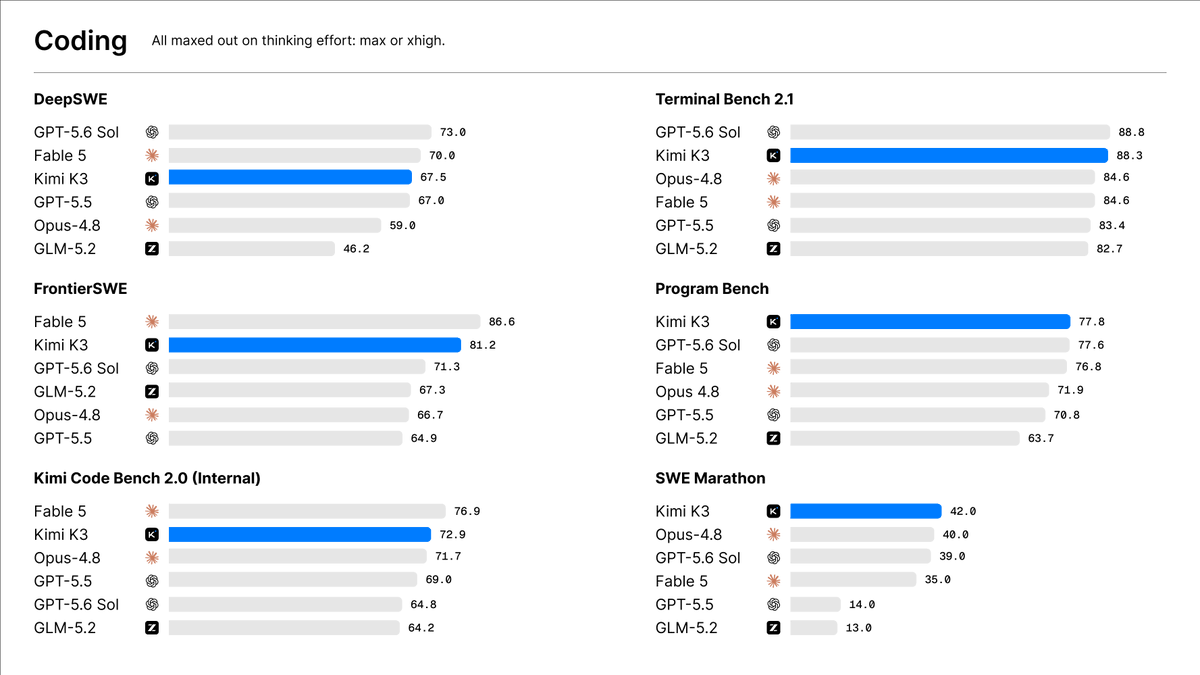
Introducing Kimi K3: Open Frontier Intelligence
🔹 2.8 Trillion Parameters, 1 Million Context, Native Multimodal
🔹 Kimi Delta Attention enables up to 6.3x faster decoding in million-token contexts
🔹 Attention Residuals deliver ~25% higher training efficiency at <2% additional cost
🔹 Built for long-horizon agentic coding and self-evolving workflows
Kimi K3 is now live on on https://t.co/zrk6zZxZUo, Kimi Work, Kimi Code, and the Kimi API.
Open Weights by July 27, 2026.
🔗 API: https://t.co/XCrgjXAqMw
🔗 Tech blog: https://t.co/YTfiMSNM1f
Você sabia que existe um filme de ficção científica em que os alienígenas procuram por Jesus Cristo?
Em Proximity (2020), seres extraterrestres altamente avançados chegam à Terra em busca de respostas sobre a origem da existência e acreditam que Jesus é a chave para compreender esse mistério. É uma proposta incomum que mistura ficção científica, mistério e reflexões sobre fé.