Companies exploring new territories for engineering talent without any know-how about the market salaries, incentives and people motivators, will seriously damage the market, but also the engineers professional path and growth.
The fallacy of this is that more creates more. More hours, more hiring, more something.
And it is true in a sense. If you put in more work, more work will happen. But I think for most startups, the leverage is really in how differently you approach the problem, how well you cultivate your team, and the strategy.
Any large company can outspend you on hours. They have thousands or tens of thousands more people, spending more hours. If hours worked were the metric, every large company and government organization would always win and do the best work. More hours, better output.
This thinking is often representative of younger founders, where the startup becomes their identity and life. They have a hard time doing anything else, and cannot understand that your work is not the person that is you. But activities outside of work can grow you as a person too and make you do better work.
I’ve never worked this way. As a designer, I always saw the need to take a step back, to take a break. At times, I might work 12 hours or 16 hours, or whatever amount was needed, but it wasn’t the norm. You just can't grind design, you need inspiration. But taking that step away from the work, would give me more perspective, inspiration and I could approach the problem differently or I could just see the solution.
Grinding is never good for any creative problem, and startups or creating new products are often mostly about creative problem solving. Grinding works ok for email jobs, or where you just executing on very clear playbook.
With Linear, we’ve never worked this way. We work reasonable hours, 5 days a week. All of us founders have families. Many of our employees have families. I personally stop every evening, spend time with the family, cook dinner for the family, eat dinner together, and focus on things outside of work. Sometimes I work in the late evenings or weekends, but to me the pride is that I don’t need to. Company should be succesful without it.
My goal is to build a company that is sustainable in the long term, and doesn’t require heroics or personal sacrifices every single day.
There are times when our team is heroic. Launches, incidents, some other work that just needs to be done. They will work late into the night because they know it is the right thing. But we don’t require that every day or every week, and the more this happens, the more I think it is a failure of our company and leadership. The team and the leaders should always keep a reserve to use when something is needed.
Our thinking was also that quality, which we value, doesn’t emerge from working more or stressing people more. It emerges when you create the conditions for it to emerge. Often it is the appreciation, space, time, and how the person feels. A person who is rested will do better work.
I wouldn’t attribute much of our success to working a lot. The success came from having clear thinking, ideas, and focus to do the right things.
I sometimes wish we could move the culture more toward a Zen master.
Real mastery is not exerting the most effort. It is achieving the outcome with the least necessary effort.
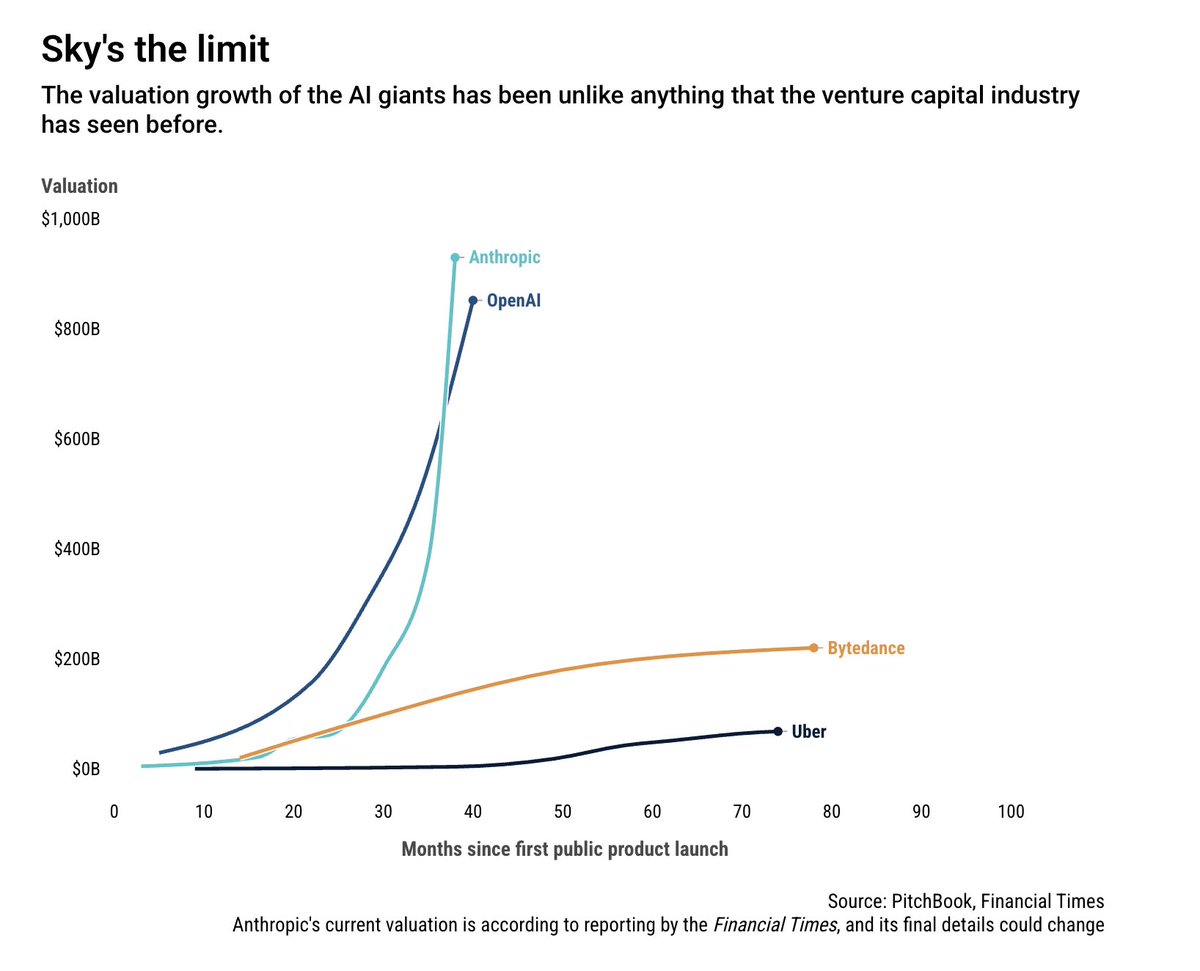
unprecedented to see these explosive valuations on AI companies; still an open question what will happen with valuations and the VC industry with more capabilities in the hands of founders prioritizing building over fundraising
for those considering traveling by car US <> Mexico for the FIFA world cup, here’s a cost-benefit breakdown; break-even at 2+ trips with 3+ people, also worth factoring in the corruption element
A lot of noise about whether SW engineers still matter. This piece reframes it: code is instructions for a machine (being commoditized) and a conceptual model of a domain (becoming more valuable). "Cognitive debt" is the real risk. https://t.co/VzUJcapENM
Introducing the OpenAI Deployment Company, which will help businesses maximally succeed with their deployments of AI.
Starting with 150 Forward Deployed Engineers and Deployment Specialists, and $4 billion of initial investment from 19 partners.
interesting to see software jobs re-surging. from conversations with technical leaders, forces behind the numbers: a) AI unlocking building options for non-digital industries and b) local maxima reached in some companies, growing teams w/AI is the natural next step
Brex showed up early for founders worldwide, expanded KYB when others wouldn’t, and grew on conviction/WoM + solid ux. This is a legit exit and a founder story for the books of fintech and startups.
Getting ready to support new use cases for ground transportation and logistic companies at Coba (YC S23), all on top of 24/7 on-chain operability and security protocols. More to come.
We’ve got bandwidth for only 5 more platforms before our Q3 roadmap locks. Want embedded multi-currency accounts, currency conversion, and global payouts (US-MX + 190 countries) live in < 2 weeks? DM “API” to plan your onboarding.
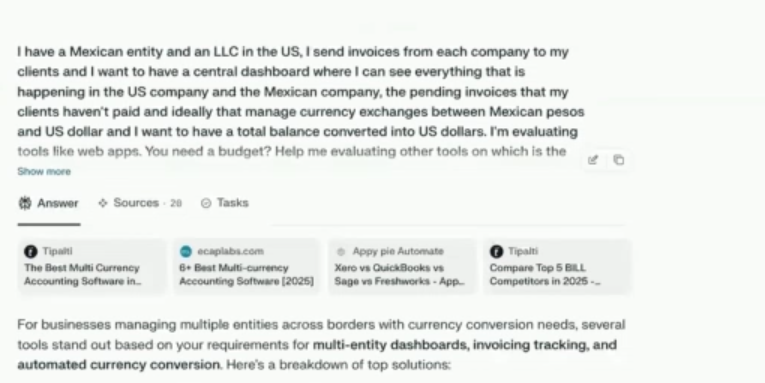
Fun win this week: A founder found @Cobaremote via a Perplexity answer for the 1st time - high-quality conversation. Takeaway: include the new 'llms.txt' standard in your website, add clear details and publish content + structured info to support your value prop.
The next chapter of American growth runs south of the border, beyond the Rio Grande. That's why we removed the banking barrier. US Companies can open a Mexican CLABE account from their laptop, move Mexican Pesos like a local, and keep North America building at full speed.
Pumped with what the @Cobaremote crew just shipped: one dashboard, multiple currencies (USD, MXN, EUR & more) for anyone doing business in the US-MX-CA corridor. Financial infrastructure should be the default, not a nice-to-have. More to come!
New at @Cobaremote: one dashboard, 30+ currencies. Get paid in USD, MXN, EUR, even CAD & CNH, hold funds, move them locally, and convert only when the rate is right. Quick demo GIF ⬇️
Handling cross-border cash flow headaches? DM us or visit https://t.co/s7TAifbEeK. Let’s fix it
📣 Big news: @Cobaremote partners with @Monex_USA to supercharge USD<>MXN payments for businesses in the US-MX corridor.
⚡ Faster settlements
💱 Better FX
🛠 Enterprise tools
🧠 Embedded capabilities
More information is available here: https://t.co/1Tgy6d5Czj
El #dólar hoy esta a un muy buen nivel 🚀!
Para todos los que tienen sus dólares en https://t.co/1Ose47PclL del viernes a hoy van a poder llevarse un 3.17% más de pesos por sus dólares 🤑
Crees que siga subiendo? En que momento planeas cambiar #dólares a #pesos?
Just had an incredible visit with the Bangor Savings Bank team in Maine!🦞🏦. Their support has been key to @Cobaremote growth. Grateful for our partnership as we continue building secure, cross-border financial services for our clients. Excited for what’s next! 🚀
How does a company pivot from talent connection to fintech?
@edolopez of @Cobaremote shares Coba's exciting journey on the Lobster Talks podcast.
Link of pod in bio!
#startups#pivot#fintech
I enjoyed this conversation with @GJarrosson from Lobster Capital. We talk about @Cobaremote and the pain points of cross-border payments in the US-MX corridor. Check it out!
📢 New Lobster Talks episode!
Dive into cross-border payments with Eduardo de Leon (@edolopez) of YC backed @cobaremote. Discover how Coba is simplifying financial transactions for contractors in LatAm.
https://t.co/PctvBeU1Ss
#fintech#crossborderpayments
📢 New Lobster Talks episode!
Dive into cross-border payments with Eduardo de Leon (@edolopez) of YC backed @cobaremote. Discover how Coba is simplifying financial transactions for contractors in LatAm.
https://t.co/PctvBeU1Ss
#fintech#crossborderpayments