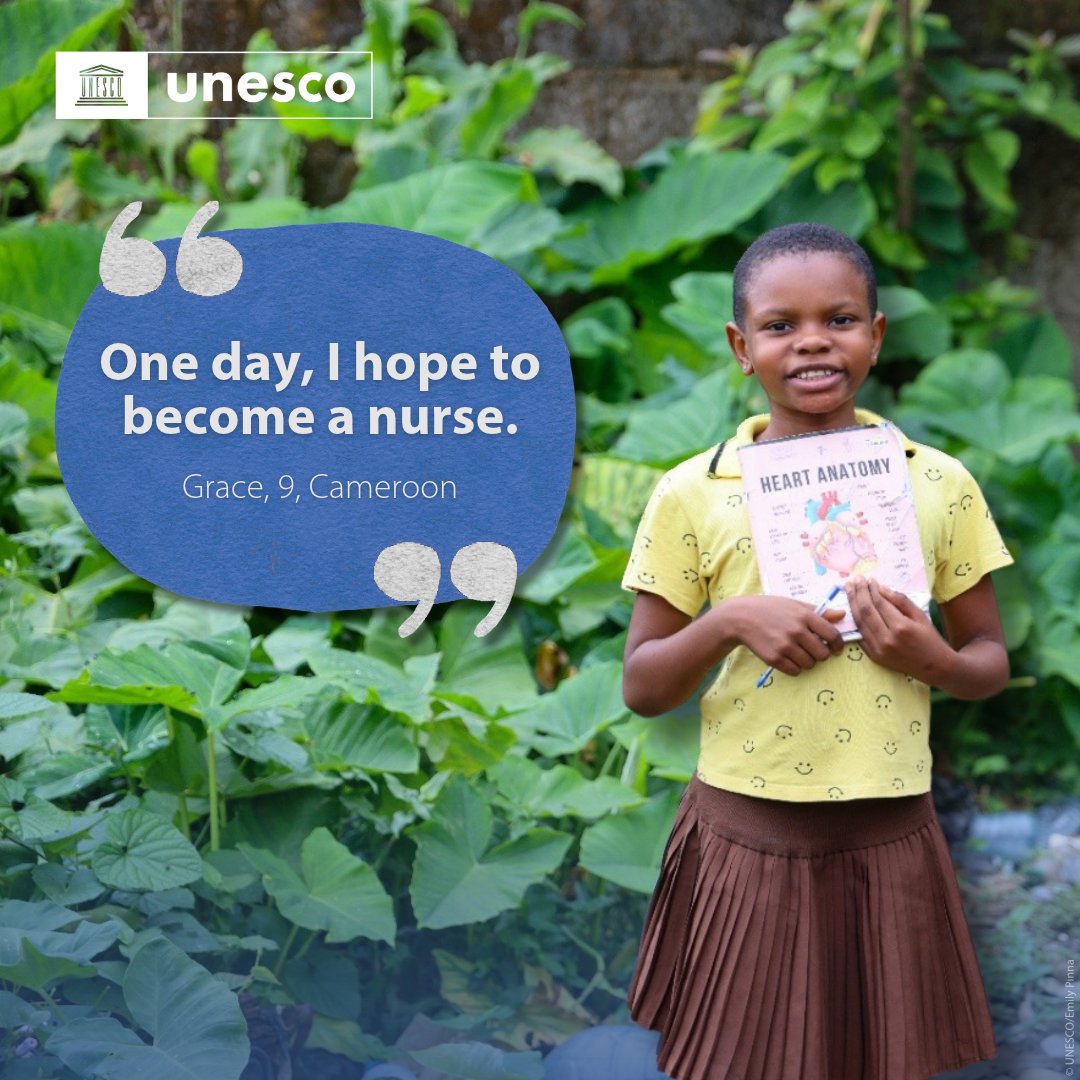
For nine-year-old Grace in Buea, Cameroon, going to school for the first time is opening up new possibilities. With the support of teachers and a safe, welcoming environment, she is taking her first steps towards a future she can shape for herself.
Her story is a reminder of why sustained investment in education in emergencies matters: every child affected by crisis deserves the opportunity to learn, thrive and pursue their aspirations.
The @EduCannotWait High-Level Replenishment Conference reaffirmed this commitment, with US$541.6 million pledged towards its 2027–2030 replenishment target.
Through its work with partners, UNESCO helps children access education during crises while strengthening the systems and capacities needed to sustain learning through emergencies and beyond.
Read Grace’s story: https://t.co/kENHpdLttY
#LeadingSDG4 #EducationInEmergencies #HopeStartsHere
⏳ Still time to register!
Our next foresight consultation turns to a pressing challenge: making sure education works for every learner, and supports their well-being along the way.
Join UNESCO, the SDG 4 High-Level Steering Committee and participants from around the world to help shape a more equitable future for education.
Through interactive and collaborative exercises, you will have the opportunity to share your perspective and help shape the next global agenda for education beyond 2030.
📅 16 November
🕐 14:00 - 16:00 CET
💻 Online
🌐 English and Spanish
📢 Open to all: Teachers, learners, researchers, policymakers, civil society organizations, and partners.
👉 Don’t miss it. Register here: https://t.co/M44JTd1Huj
🎙️ With the participation of:
🔹 H.E. Mr José Carlos Mahía, Minister of Education and Culture of Uruguay, HLSC representative for Latin America and the Caribbean
🔹 Ms Justine Sass, Head of Education, UNESCO Regional Office for Eastern Africa
🔹 Dr Abdulsalam Aljoufi, Advisor, Arab Bureau of Education for the Gulf States (ABEGS)
🔹 Ms Sabrina Capasso, Director-General for International Affairs and Internationalization of the National Education Systems, Italy
🔹 Ms Mitsue Uemura, Head of the United Nations Girls’ Education Initiative (UNGEI)
🔹 Mr Refat Sabbah, President, Global Campaign for Education (GCE)
#EducationBeyond2030 #LeadingSDG4
@Abegsorg, @UNGEI
Jobs are evolving. Technologies are moving fast. Societies are transforming.
What does this mean for learning, and for the teachers at the heart of it?
UNESCO and the SDG 4 High-Level Steering Committee invite you to a global foresight consultation exploring how the purpose and organization of learning may shift, which knowledge and capabilities will matter most, and what support teachers will need in the years ahead.
Through interactive and collaborative exercises, you will have the opportunity to share your perspective and help shape the next global agenda for education beyond 2030.
📅 18 November
🕐 14:00 - 16:00 CET
💻 Online
🌐 English
📢 Open to all: Teachers, learners, researchers, policymakers, civil society organizations, and partners.
👉 The future of education is being written now. Register now and add your voice: https://t.co/M44JTd1Huj
#EducationBeyond2030 #LeadingSDG4
@gbceducation, @WorldBankGroup, @ADB_HQ
The commitments announced at the @EduCannotWait High-Level Replenishment Conference mark an important step towards ensuring that children and young people affected by conflict, displacement and climate-related disasters can continue to access quality education.
With US$541.6 million pledged – 90% of its replenishment target – the conference underscored the importance of sustained, predictable financing to protect learning and support education through emergencies and protracted crises.
These commitments align with the priorities of the SDG 4 High-Level Steering Committee, which has placed resilient education systems at the center of its work for 2026–2027. Stronger, more resilient systems are essential to accelerating progress towards SDG 4 and ensuring learning continuity in the face of crises.
Sustainable education financing is key to this effort. Global commitments, innovative financing and partnerships can help ensure predictable and equitable resources for education, strengthen national systems, and deliver quality education for every learner, including in crisis-affected contexts.
Investing in education through crises is not only about meeting immediate needs. It is about protecting learning today while building stronger education systems.
#LeadingSDG4 #EducationInEmergencies #HopeStartsHere
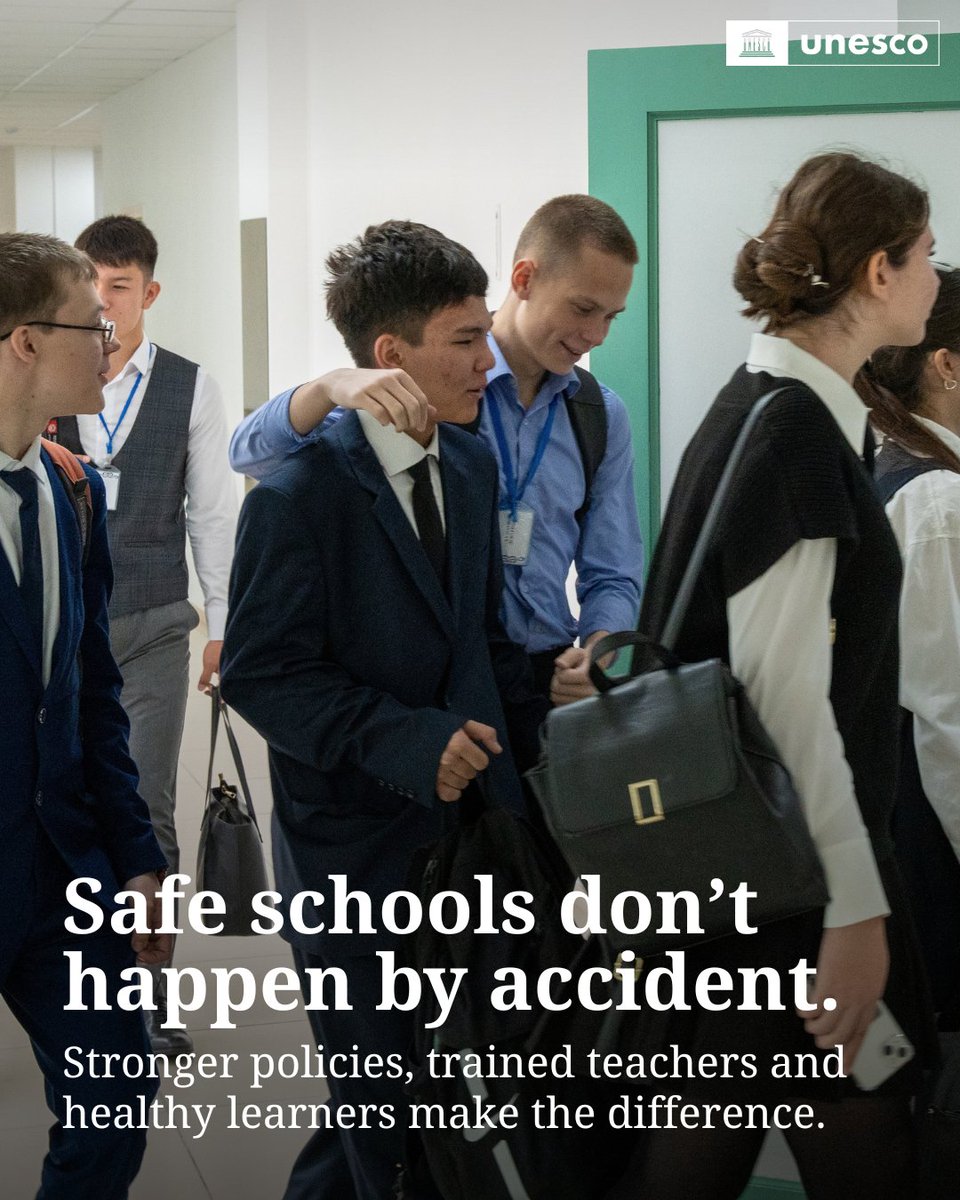
Every learner deserves to feel safe and well, at school and online.
On the International Day against Violence and Bullying at School, including Cyberbullying, this year’s theme is clear: Every learner safe and well: from promise to practice.
As we organize global consultations on the future of education beyond 2030, safety and well-being have emerged as a clear priority:
🌍 A priority for youth: 190,000 young people and students from 194 countries ranked it among their top priorities for the future of education in the global youth consultation.
🔭 A key finding from experts: 4,000 experts from 113 countries and 731 institutions from 98 countries identified it as both a risk and a challenge, in the foresight exercise on the megatrends shaping education.
The message is the same from both: no one can learn without feeling safe. Now is the time to turn that promise into practice, in every classroom and on every screen.
Discover how UNESCO is working to make schools safe for every learner: https://t.co/FIYp18ai8M
#StopBullying #LearnAndThrive #EducationBeyond2030 #LeadingSDG4
How can education secure the funding, leadership and commitment it needs in the years ahead?
With budgets under pressure, economic uncertainty and shifting development priorities, UNESCO and the SDG 4 High-Level Steering Committee invite you to join a global foresight consultation on financing, governing and delivering education transformation.
The consultation will explore how the post-2030 education agenda can set clear responsibilities, strengthen accountability and turn commitments into action.
Through interactive and collaborative exercises, you will have the opportunity to share your perspective and help shape the next global agenda for education beyond 2030.
📅 17 November
🕐 14:00 - 15:30 CET
💻 Online
🌐 English
📢 Open to all: Teachers, learners, researchers, policymakers, civil society organizations, and partners.
👉 Bring your ideas to the conversation. Register today:
https://t.co/M44JTd1Huj
#EducationBeyond2030 #LeadingSDG4
@GPforEducation, @AgendaCAF and the International Education Funders Group
Globally, 140 million boys and 133 million girls are still out of school.📚
Behind these figures are children and young people missing out on the chance to learn, grow and shape their own futures. Poverty, conflict, disability, gender and where they live all play a role in keeping them out of the classroom.
Every boy’s, every girl’s and every child’s education is a human right.
Leaving no one behind means reaching every learner, especially those furthest behind, and making sure that all children have the opportunity not only to attend school but also to learn and thrive there.
🔗 Learn more about gender equality in education: https://t.co/goesw79vQO
#LeaveNoOneBehind #LeadingSDG4
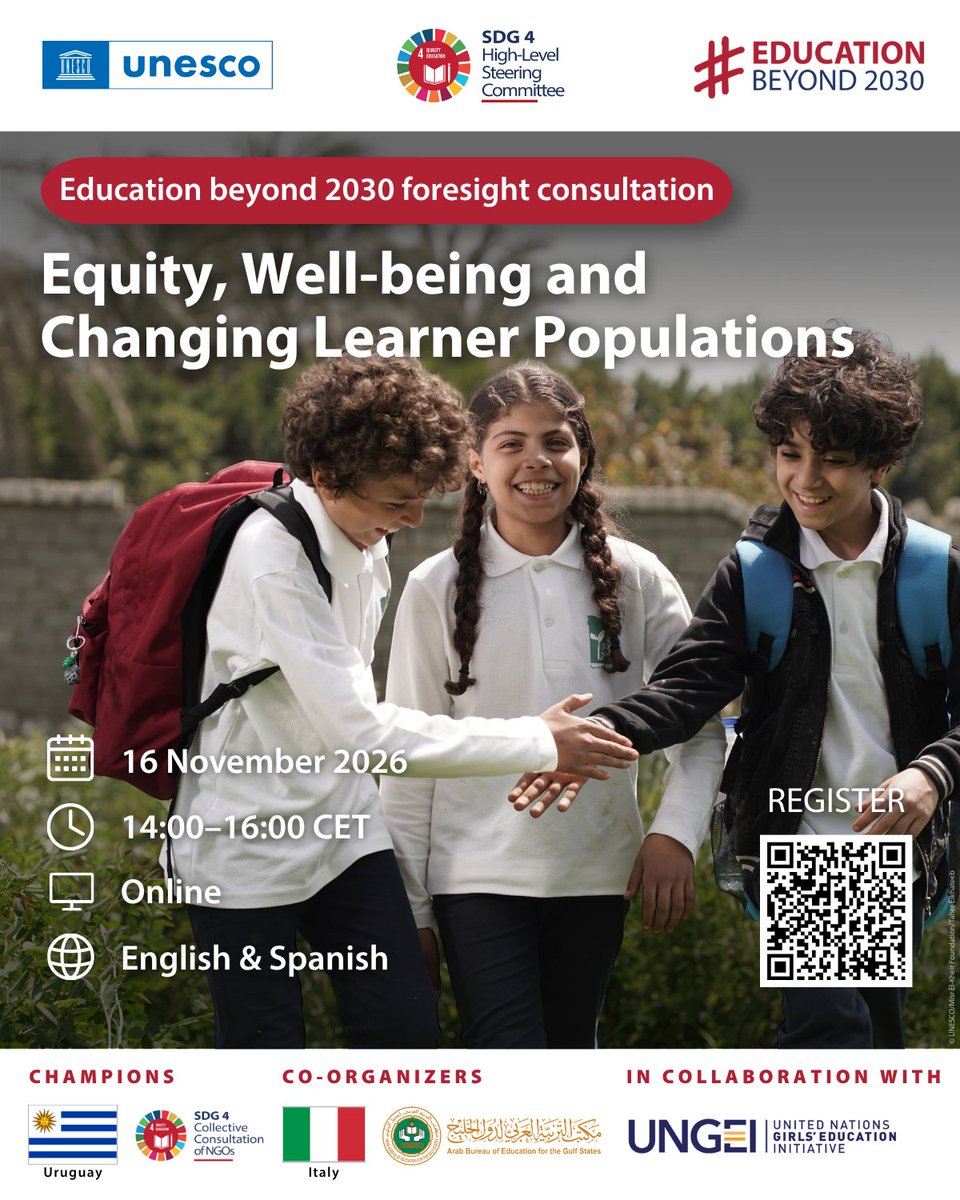
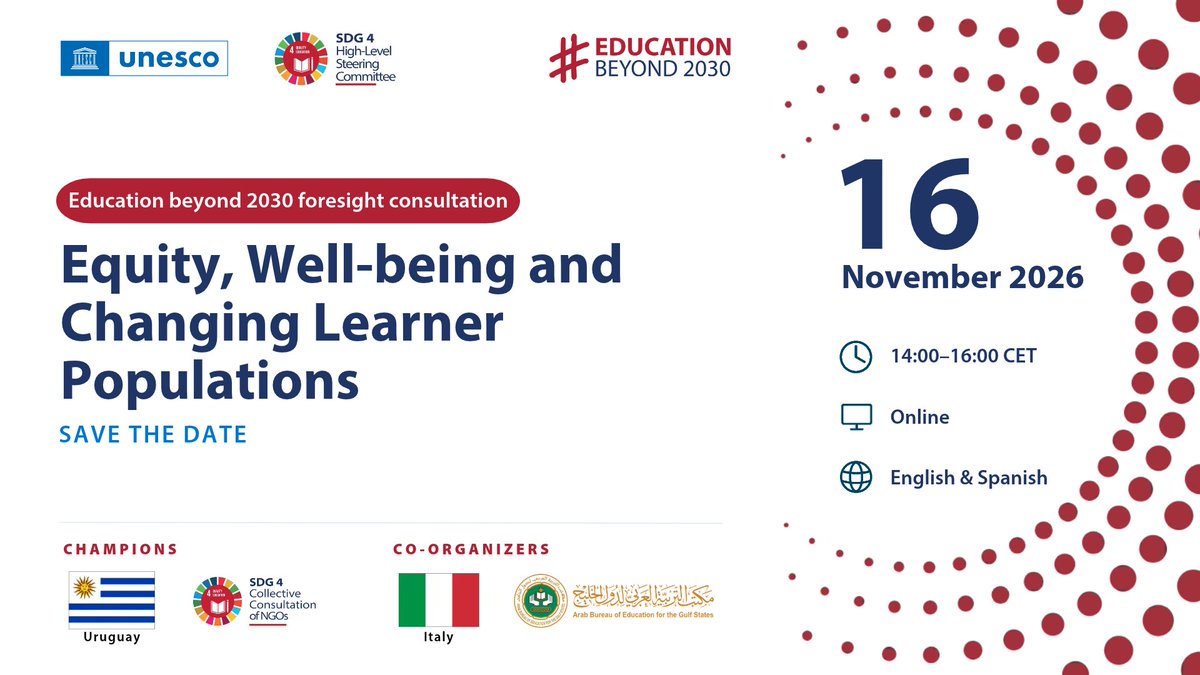
Every learner deserves to thrive, but who those learners are is changing.
Migration, demographic shifts and growing inequalities are reshaping classrooms around the world. What will it take to put equity and well-being at the heart of education after 2030?
UNESCO and the SDG 4 High-Level Steering Committee invite you to join a consultation exploring exactly that. Through interactive and collaborative exercises, you will have the opportunity to share your perspective and help shape the next global agenda for education beyond 2030.
📅 16 November
🕐 14:00 - 16:00 CET
💻 Online
🌐 English and Spanish
📢 Open to all: Teachers, learners, researchers, policymakers, civil society organizations, and partners.
👉 The future of education is being written now. Add your voice: https://t.co/M44JTd19EL
#EducationBeyond2030 #LeadingSDG4
@Abegsorg
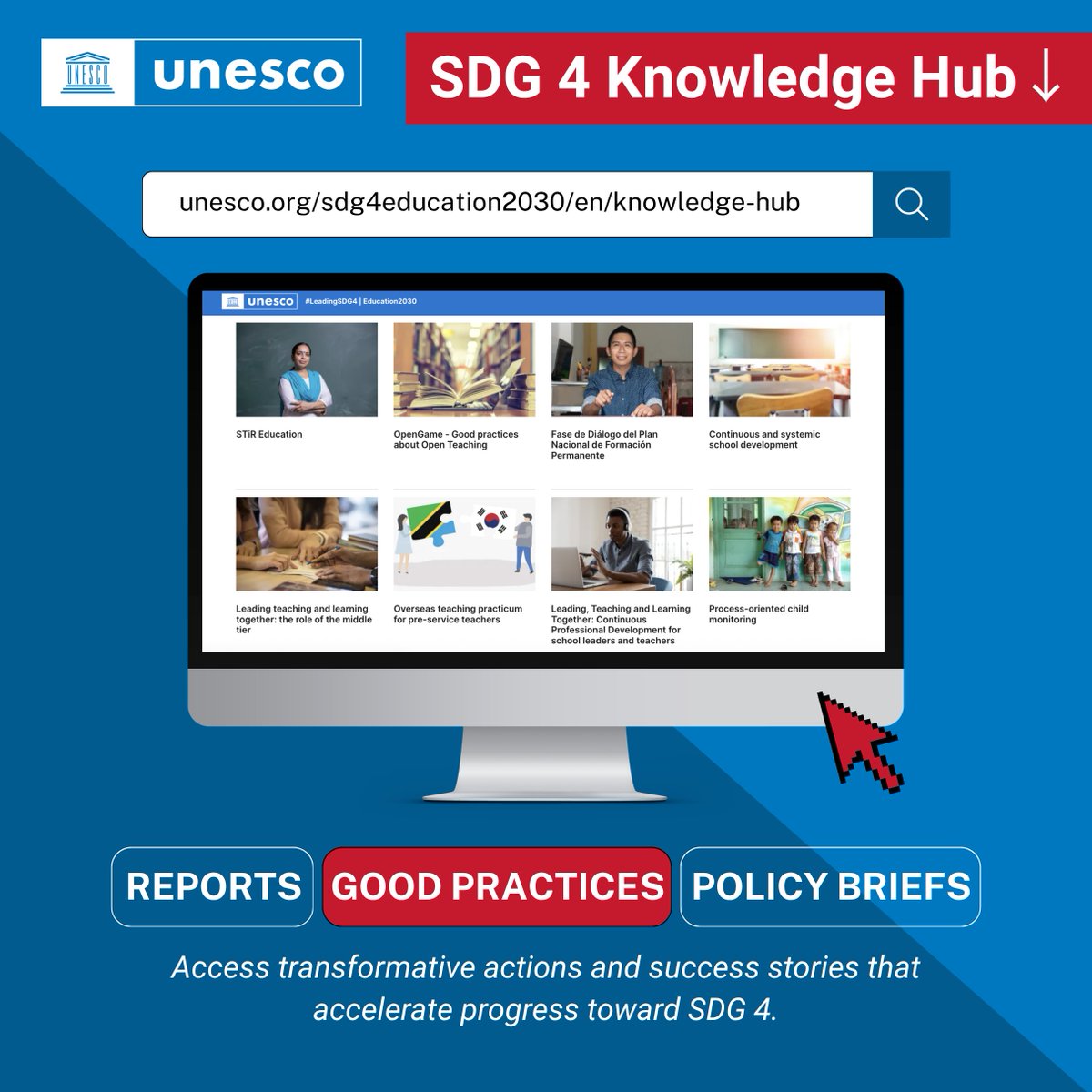
🌍 We asked for your SDG 4 good practices, and you delivered.
Thanks to contributions from education stakeholders around the world, we've already published 392 good practices on the SDG 4 Knowledge Hub.
📚 Explore our growing collection of good practices and discover how educators, governments, organizations, and communities are advancing quality education around the world.
Get inspired by what's working across different contexts and regions, with new practices being added regularly.
🔗 https://t.co/KMMdZ4YDfh
#LeadingSDG4
🌍 More than 200,000 young people from 194 countries shared their hopes, concerns and aspirations for the future of education through the consultation conducted by UNESCO and the SDG 4 High-Level Steering Committee, with the support of Japan.
Now, youth representatives are synthesizing these insights into a Youth Agenda for Education Beyond 2030: a collective vision developed by youth, for youth.
More than a statement of aspirations, the Agenda will outline the future young people want to see, the actions they are ready to lead, and the conditions needed to turn ambition into reality.
📢 The Youth Agenda for Education Beyond 2030 will be unveiled shortly.
Join us for the official launch:
🗓️ Thursday, 29 October 2026
🕒 15:00-16:45 JST | 07:00-08:45 CET
▶️ Learn more and watch live: https://t.co/XLp87zNckH
#EducationBeyond2030 #LeadingSDG4
In partnership with @UNUniversity and the Government of Japan
🎤 Whose voice should shape the future of education? Teachers. Learners. Researchers. Policymakers. Civil society.
As part of the Education Beyond 2030 foresight exercise, UNESCO and the SDG 4 High-Level Steering Committee are bringing together diverse perspectives from around the world through a series of thematic consultations.
Together, participants will examine the emerging trends, opportunities and risks that may transform education between 2030 and 2045 and help identify priorities for the future of learning.
The discussions will help inform future priorities for education and ensure that different experiences and viewpoints are reflected in the conversation.
Join us and contribute your perspective.
👉 https://t.co/pjeKjZQFcg…
#EducationBeyond2030 #LeadingSDG4
@eduint, @INEEtweets, @Abegsorg, @GPforEducation, @AgendaCAF, @InternationalEducati, @gbceducation, @WorldBankGroup,@ADB_HQ, @OECDEduSkills , @UNICEFEducation, @UNICEFEducation
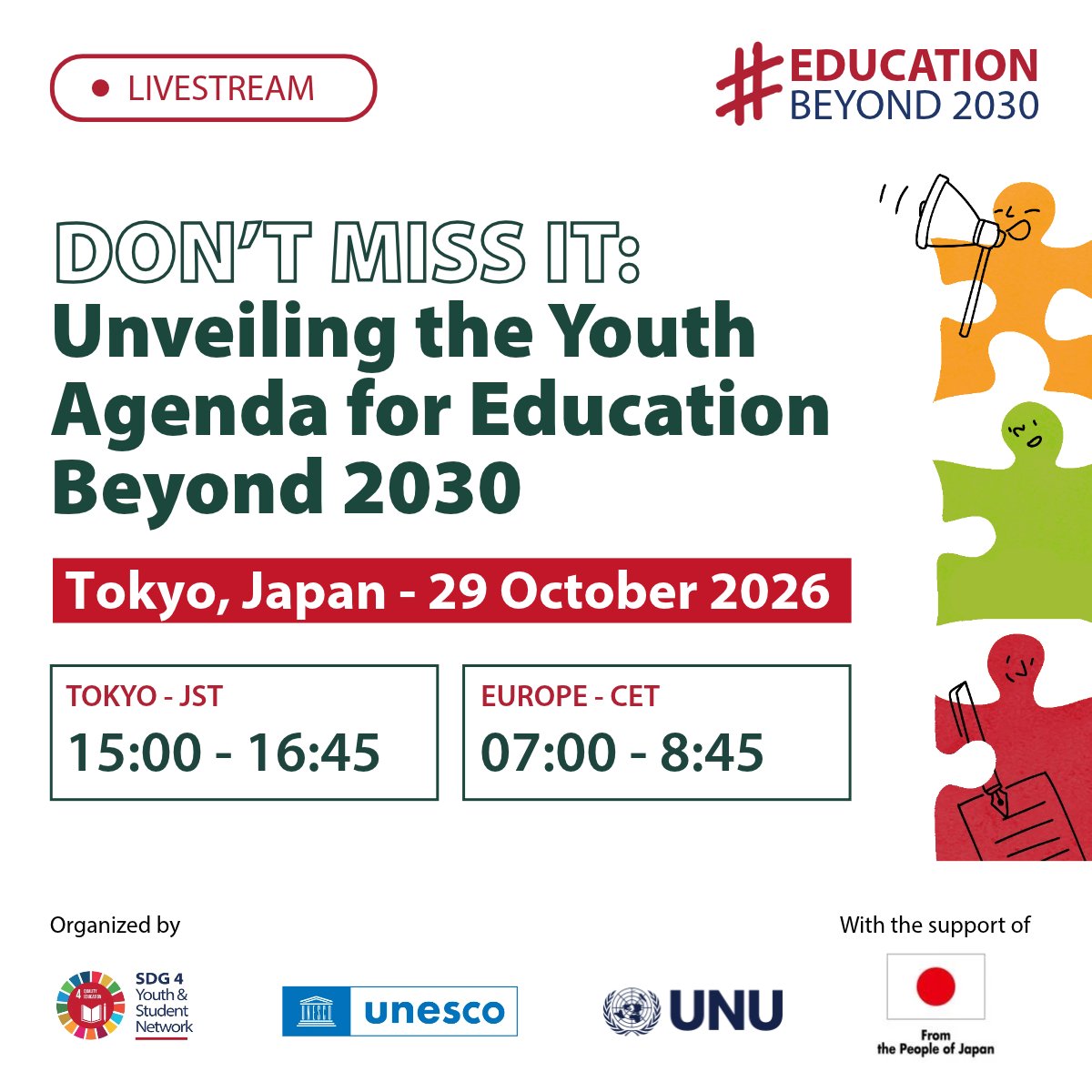
📣 Don’t miss it!
In just a few days, young people will unveil their Youth Agenda for Education Beyond 2030, live from Tokyo.
Hear what 200,000 youth from 194 countries want for the future of education, and what they are ready to do to make it happen. Their shared vision, priorities, and strategies will shape the next steps with governments, teachers, and education actors.
🗓️ Thursday 29 October 2026
🕒 15:00-16:45 JST / 07:00-08:45 CET
▶️ Learn more and watch live: https://t.co/XLp87zNckH
Set your alarm, tune in, and share with your network!
#EducationBeyond2030
In partnership with @UNUniversity and The Japan Ministry of Education, Culture, Sports, Science and Technology
Climate change. Conflict. Uncertainty.
How can education systems adapt and thrive in an increasingly complex world?
As part of the global consultation process on Education Beyond 2030, UNESCO and the SDG 4 High-Level Steering Committee invite you to join a global foresight consultation on the trends, risks and opportunities that will shape the future of education.
📅 26 October 2026
🕐 13:00-15:00 CET
💻 Online
Join the conversation and help shape the global agenda for education beyond 2030.
👉 Register now: https://t.co/M44JTd19EL
#EducationBeyond2030 #LeadingSDG4
@eduint@INEEtweets
📢 Teachers, learners, researchers, policymakers, civil society organizations and partners:
🌍 What should education look like beyond 2030?
Join the conversation and help shape the future of education.
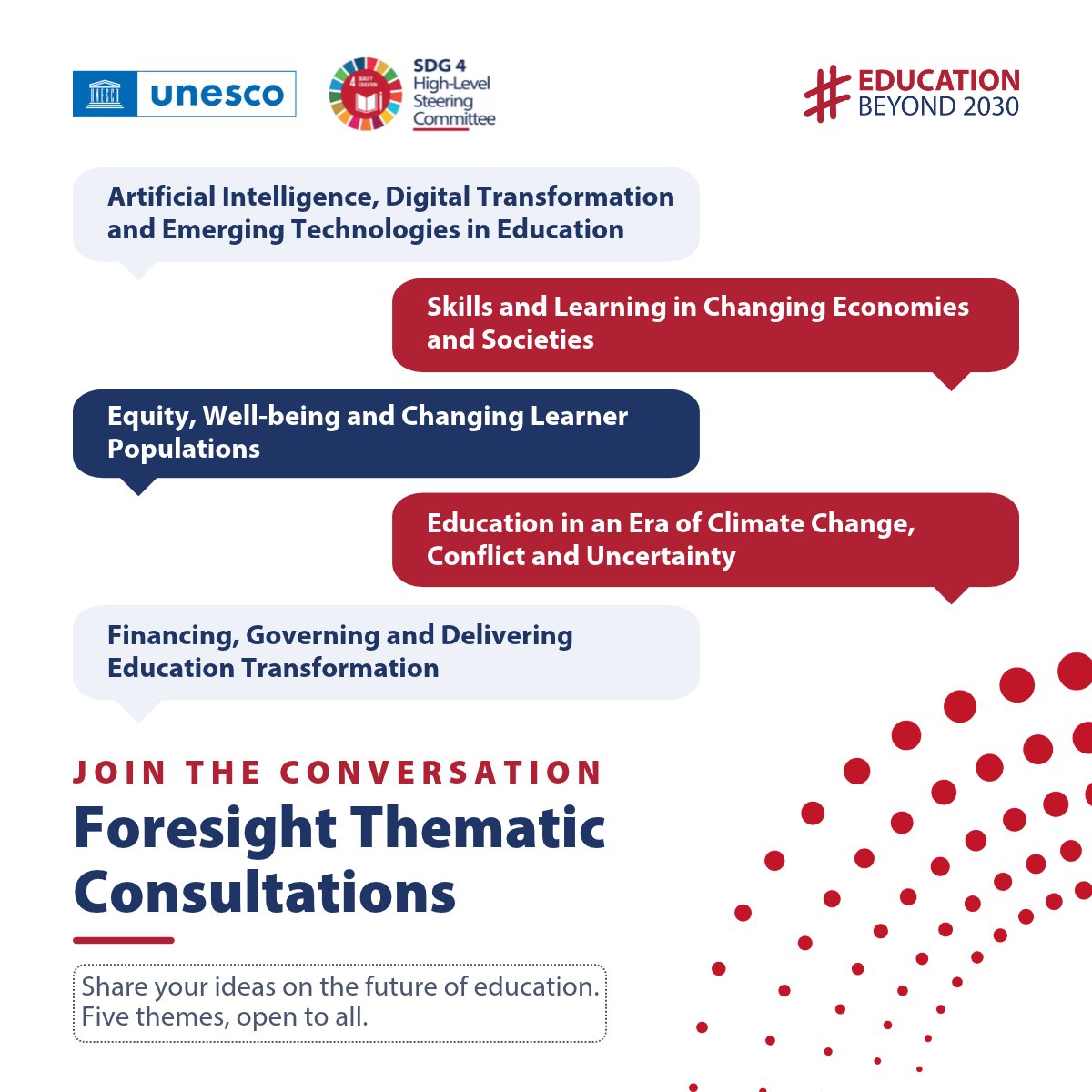
As the global education community looks beyond the 2030 Agenda, @UNESCO and the SDG 4 High-Level Steering Committee invite stakeholders from around the world to join five interactive thematic consultations exploring the trends, opportunities and challenges that could shape education between 2030 and 2045.
The consultations will focus on:
🔹 Artificial intelligence, digital transformation and emerging technologies in education
🔹 Skills and learning in changing economies and societies
🔹 Equity, well-being and changing learner populations
🔹 Education in an era of climate change, conflict and uncertainty
🔹 Financing, governing and delivering education transformation
Your perspectives, ideas and recommendations will inform discussions on the global education agenda beyond 2030.
📣 Register for one or more consultations and bring your voice to the conversation.
👇 https://t.co/M44JTd19EL
#EducationBeyond2030 #LeadingSDG4
From 200,000 voices to one agenda for change. 🌏
On 28-29 October in Tokyo, young people will co-create a Youth Agenda for Education Beyond 2030, building on the perspectives shared by 200,000 youth from 194 countries.
More than a statement of aspirations, the Youth Agenda will define:
🔮 The future young people want to see
🚀 The actions they are ready to lead
🛠️ The support needed to turn ideas into reality
It will inform the broader global conversation on education beyond 2030.
Learn more and follow the unveiling of the Youth Agenda: https://t.co/XLp87zNckH
#EducationBeyond2030 #YouthVoices
In partnership with @UNUIAS and the Japan Ministry of Education, Culture, Sports, Science and Technology
200,000 voices. 194 countries. One shared vision. 🌍
The Global Youth Survey on #EducationBeyond2030 is now completed! 🎉
With 2030 around the corner, UNESCO and the SDG 4 High-Level Steering Committee are gathering the views of all education actors on what education beyond 2030 should look like.
They started with youth, ensuring that their voices serve as the foundation for every conversation that follows.
Through a Global Youth Survey, regional and global consultations, 200,000 youth and students from 194 countries shared:
💭 Their visions for the future of the world and societies
💡 Their proposals to transform education
🤝 Their personal and collective commitments to make it happen
Thank you to every young person who participated, and to the teachers, educators and partners who helped ensure their voices were heard.
What comes next? These insights will be compiled into a Youth Agenda for Education Beyond 2030, to be drafted in Tokyo.
👉 Learn about the youth consultations and their outcomes: https://t.co/j6WLYTTmjo
#EducationBeyond2030 #YouthVoices
In partnership with @UNUniversity and the The Japan Ministry of Education, Culture, Sports, Science and Technology
258 million school-aged children and adolescents have their education affected by crises. Of these, 93 million are out of school.
Behind these figures are children determined to learn, teachers committed to teaching and communities working to keep education within reach.
UNESCO and the SDG 4 High-Level Steering Committee have made strengthening #resilient education systems a priority, underscoring the vital role of #financing in ensuring that learning continues, even in times of crisis.
Hosted by the government of Switzerland on 5 November in Geneva, Education Cannot Wait (ECW)’s High-Level Replenishment Conference will bring together donors and partners to support this determination with concrete commitments.
#HopeStartsHere
Together, we can help keep learning alive.
👉 https://t.co/aanaTZSPSQ
The future of education is being written now.
As the world looks beyond 2030, UNESCO and the SDG 4 High-Level Steering Committee are bringing together voices from across the globe to help shape the next chapter of the education agenda.
A new foresight consultation will explore how climate change, conflict and growing uncertainty could transform education in the decades ahead.
📅 26 October 2026
🕐 13:00-15:00 CET
💻 Online
🎙️ English & French
Register today and help shape education beyond 2030: https://t.co/BLq4k9z22j
#EducationBeyond2030
🌍 As the world prepares for the 2026–2027 #ElNiño phenomenon, UNESCO is calling for stronger, more resilient education systems that can withstand climate-related disruptions and keep learning on track.
Over 347 million children in nearly 100 countries are expected to be exposed to one of the strongest El Niño events on record. Floods, droughts and heatwaves can damage schools, disrupt classes and put children’s safety and access to learning at risk.
UNESCO is supporting countries to prepare. As part of the UNESCO x El Niño global campaign, UNESCO is providing technical assistance to help countries anticipate climate-related risks, strengthen preparedness and safeguard educational continuity before, during and after potential disruptions.
Innovation is also helping translate preparedness into action. In Latin America and the Caribbean, UNESCO is now piloting an AI-enabled multi-risk index to generate tailored reports for education institutions.
Preparedness today helps protect learning tomorrow.
More: https://t.co/GsGQjTyDad
#LeadingSDG4 #Education #DRRDay #ClimateResilience