@Rainmaker1973 Nature can erase in minutes what communities spend generations building.
As extreme disasters become harder to ignore, are governments investing enough in early warnings and resilient infrastructure, or only reacting once the damage is already done?
This is what education can become when students are taught to solve real problems, not simply memorise the right answers.
How many life changing ideas are sitting inside classrooms right now, waiting for someone to give young people the freedom to build them?
Three teenagers in India have built a refrigerator that could help save lives, and it runs on nothing more than salt and water. No electricity. No batteries.
In 2025, 16- and 17-year-olds Dhruv Chaudhary, Mithran Ladhania, and Mridul Jain created Thermavault, a portable cooling system designed to keep medicines and vaccines cold in places where reliable electricity is difficult to obtain.
The device can maintain temperatures of around 2 to 6 °C (35 to 43 °F) for 10 to 12 hours, making it suitable for storing temperature-sensitive medical supplies. Even better, the salts used in the cooling process can be reused, which helps keep operating costs low.
Their idea earned them the Earth Prize Asia 2025 and $12,500 in funding. They now plan to build 200 units and test them across 120 hospitals in India.
The inspiration came from a real problem. During COVID-19, many rural clinics struggled to keep vaccines cold because of unreliable power. Their solution is simple, portable, and potentially life-changing.
Three teenagers. Salt, water, and one idea that could bring reliable cold storage to the places that need it most.
Instagram can design an algorithm powerful enough to keep teenagers scrolling, yet its safety tools barely convince them to stop, and parents still decide the boundaries at home.
If platforms profit from children’s attention while families allow unlimited access, where does corporate responsibility end and parental responsibility begin? #EdTech
Instagram CEO Adam Mosseri is expected to testify Tuesday in the latest high-profile social media addiction trial against Meta, Instagram's parent company, in federal court in Oakland, California. https://t.co/mmlMWupwkv
The SAT and ACT were pushed aside as barriers to opportunity. Now every Ivy League University has restored, or plans to restore, standardised testing, while more than 90% of US colleges remain test optional.
Supporters argue test scores can reveal talented, disadvantaged students hidden behind unequal schools. Critics say they reveal something else: who could afford the best preparation.
So, which is fairer, an imperfect common test, or school grades shaped by completely different standards and opportunities? #EdTech #EducationMatters
Colleague in a meeting: “I’ll let John explain this part…”
John, who was barely involved: 😳
It’s one of those awkward workplace moments where you suddenly become the “expert” on something you hardly touched.
How would you handle it without making your colleague look bad?
A homeless student was told he couldn’t remain at school because he lacked an address, so his principal gave him one: his own home.
The principal lost his job. The student gained a family, graduated and found a future. If this is what breaking the rules looks like, perhaps it’s the education system and its rules that need questioning.
@AJEnglish An exam is supposed to test a student’s knowledge, not how well the system can hide its failures.
When young people spend years preparing, only to face alleged leaks and police barricades, are they competing for jobs or simply fighting for a fair chance?
@AlboMP If life keeps getting harder while every government meeting promises it’s getting better, how many more Australians must be priced out of homes, healthcare and basic necessities before these promises become something people can actually feel?
Schools mostly reward compliance over critical thinking. Education should create problem solvers, leaders and independent thinkers, not modern day puppets trained to follow instructions.
If the Sun suddenly disappeared, Earth wouldn’t know for about 8 minutes and 20 seconds because both its light and the change in gravity would take that long to reach us. ☀️🌍
#Physics#ScienceFacts#DidYouKnow
Fifteen years after the last nationwide study, new peer-reviewed research is challenging what we assume about where children learn best.
The study found that homeschooled students averaged between the 84th and 89th percentiles, while the typical student average sits at the 50th.
The study doesn’t prove homeschooling caused the difference, but the gap is difficult to ignore. If students learning outside traditional classrooms are achieving results this strong, should we be questioning homeschooling, or asking what the education system could learn from it?
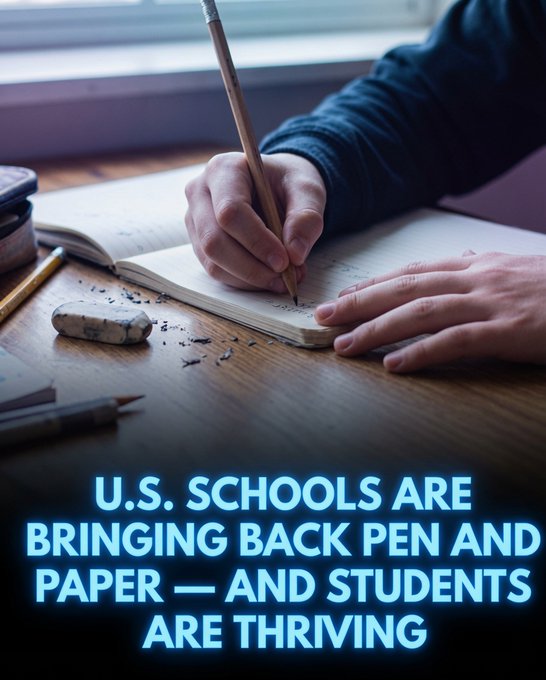
Frustrated with the impact of digital devices, a Minneapolis AP Literature teacher banned phones and laptops from her classroom, and the results were striking.
Maureen Mulvaney, who teaches at Washburn High School, decided to go fully “old-school.” Students completed all their work using pencil and paper, and physical books replaced digital PDFs. Though some students were initially nervous about falling behind, the experiment aimed to restore deep focus, reading stamina, and clear thinking that many educators believe screens have weakened.
The outcomes exceeded expectations. In September, only 46% of her students felt confident in their reading abilities. By February, just five months later, that number jumped to 95%. Students who once struggled to write even half a page by hand were soon producing six- to seven-page essays. Nearly 80% reported that organizing ideas and thinking clearly was easier on paper than on a screen. Many also said the change helped them reduce overall screen time at home and improved their real-world conversations.
A positive step for families in WA.
Expanding early education, especially in areas where access is limited, can make a real difference.
The next priority should be making sure these new places are affordable, properly staffed and available to families when they actually need them. 👍
@OneNationVic “Come find us”? Don’t worry, if people at a caravan show are looking for political baggage, they’ll know exactly where to look. 😂
Pauline Hanson might want to start looking for a new social media team too, this one is making the opposition’s job far too easy.
@OneNationAus Interesting that a post supposedly showing Luke Herdegen’s “growing enthusiasm” needs Anthony Albanese’s name AND photo to get attention.
If your own candidate is that exciting, why does Albo have to be the star of the poster? 😂
Ben, we’ve heard this one. Posting it every day still doesn’t make it “free”, taxpayers are paying for it. Maybe give the copy and paste button a day off. 😏
Only Labor is making it cheaper for Victorian kids and their families to access free dental care.
And only a re-elected Labor Government will open free dental clinics across the state.