A pedido de mis estudiantes, publiqué animaciones para entender mejor los conceptos de agentes, qué es un harness y cómo interactúan con la memoria y herramientas. También puedes ver simulaciones de estrategias como ReAct y varios patrones de orquestación multi-agente https://t.co/XqgJI0yPUr
Economic growth since the 1800's it's a better proxy than life expectancy to show the exponential effects of science & technology. Life expectancy has harder bounds, OTH economic growth is related to technology applied to many other activities (agriculture, food, transport, etc.).
Yann LeCun's (@ylecun ) latest talk at ETH Zürich
Scaling LLMs to reach AGI is "impossible"
A large language model is trained on about 30 trillion tokens, which is roughly 10^14 bytes of text and would take a person about 400,000 years to read.
A 4-year-old child receives about the same amount of data, 10^14 bytes, through vision alone in about 1 year and 10 months.
In his view, intelligence is the ability to learn new tasks quickly or perform them without prior training, as a teenager learns to drive in about 20 hours. Scaling increases stored knowledge, but it does not produce this ability to adapt.
----
From "Perfology Clips" YouTube channel, (link in comment)
This is spot on. I'd rather add that it's a matter of horizon of the investment. If the senior staff just take more workload with the help of AI eventually, they'll burn out and there won't be anybody to help. We need to invest in the new talent for long term ownership hand-off, but the economics are vastly different, and part of the time savings need to be redirected to training and mentoring junior staffers.
Unfortunately, I think that we are at a point where AI has gotten good enough that new graduates add very little value to most jobs in finance
This was always the case, but the rationale for hiring young talent before AI was two-fold
1. They soak up grunt work around the office, including tedious number entry into Excel, logo aligning, calendar invites, and administrative tasks on a deal
2. Train up the next generation of talent who can go on to become senior leaders in the future
The first one has been pretty much already solved by AI to a large degree. Even if not fully replaceable today, the state of progress tells me that almost all finance grunt work will be handled by AI in the next 5-10 years. Probably even sooner
The second one still creates incentive for companies to hire young graduates, but at a much slower pace than before.
> AI leads to higher productivity across senior management and mid-level employees, freeing up their time to focus on bigger picture
> Need fewer senior management and mid-level employees in the future due to this productivity boost, which pushes down the need for young graduates even further
> Even if you dont completely shut down the analyst program, the number of analysts you need on the job certainly shrinks down by 20-30% at least, likely in the next 3-5 years
> New analysts coming in are lower quality due to being reliant on AI during their college years and requiring AI to do any sort of critical thinking. This in turn hurts their ability to get promoted down the line
All of these factors combined likely lead to a very difficult hiring environment for students studying finance in college today.
The best piece of advice I can really give is to embrace the tools as fast as you can and try to keep your critical thinking and imagination skills intact while doing so.
This is going to be much tougher than it sounds, especially as AI progresses in the next 5 years
This paper also adds to the argument against the RSI apocalypse. Current models are not able to form theories about the world, from which you experiment and generate new data. When the feedback loop is cheap you can automate this process and be extremely inefficient (self-play a game millions of times, generate and test millions of lines of code). When the problem is really complex (e.g. a 1 year clinical trial) and validation comes from the real world you need a really good theory to actually be efficient in your data collection process.
Researchers at Oxford argue that LLMs can't invent anything.
It's impossible mathematically.
The paper is called "Theory Is All You Need."
Teppo Felin and Matthias Holweg take the famous "Attention Is All You Need" title and flip it. Their argument is that AI predicts from the past, while humans reason forward into the future, and those are two different kinds of thinking.
Start with the numbers. The authors estimate a large language model trains on roughly 13 trillion tokens. A human reading at 150 words a minute would need about 164,000 years to get through that. A child hears around 20,000 words a day and roughly 36.5 million words in their first five years. It's the same task with wildly different data, and the child still ends up with language that goes far beyond anything they heard.
Their point is that the model learns which words tend to follow other words. It becomes a mirror of what people have already written. It doesn't build a theory of how the world works, so it can't step outside its training data.
The paper's sharpest thought experiment makes this painful. Imagine an LLM trained in 1633 on every scientific text ever written up to that point. Ask it about Galileo and heliocentrism. Thousands of years of geocentric texts would swamp Galileo's ideas, so the model would tell you he's wrong. It would also rate Tycho Brahe's astrology as more credible than the idea that the Earth moves, because more people had written about astrology.
Then there's flight. In 1888 the scientist Joseph LeConte looked at bird data, noted that no bird above 50 pounds could fly, and concluded humans couldn't either. Lord Kelvin, then president of the Royal Society, said he had not the smallest molecule of faith in aerial navigation.
The New York Times estimated in 1903 that flight was one to ten million years away.
Nine weeks later the Wright brothers flew.
The Wrights didn't have better data. They had a theory. They broke flight into three problems, lift, propulsion, and steering, built their own wind tunnels, and generated the data that didn't exist yet.
Wilbur wrote in 1900 that he had been "afflicted with the belief that flight is possible to man."
Every prediction machine on Earth would have told him no.
The authors call this the data belief asymmetry. Every real breakthrough starts with someone believing something the existing data says is wrong. A system trained to minimize surprise can't do that by design.
They're not anti AI. They say AI will win at routine, repetitive decisions that extrapolate from the past, which is most decisions. They're just pushing back on the idea that you should replace humans with algorithms whenever possible, which is a direct quote from Kahneman.
I use these models every day and this matches what I see. The new stuff comes from the human at the keyboard who decides the data is wrong.
LLMs don't think, you do!
Delegate coding. Never delegate understanding.
If code was previously your source of truth for managing understanding, then you need a new source of truth artifact. If code-centric workflows were how you developed that understanding, then you need new workflows.
I agree that "matematically impossible" is probably a very strong claim. You can always produce out-of-distribution random text, now, does that equal to theory formation? I don't think so. Good theories require reasoning about a world model, aka "imagination", not only about written text, but about causality in the system of interest. I'm not saying also that AI won't be able to do some of it in the near future, but it's not what our technology (LLMs) currently do.
I agree that "matematically impossible" is probably a very strong claim. You can always produce out-of-distribution random text, now, does that equal to theory formation? I don't think so. Good theories require reasoning about a world model, aka "imagination", not only about written text, but about causality in the system of interest. I'm not saying also that AI won't be able to do some of it in the near future, but it's not what our technology (LLMs) currently do.
Si estudian economía o les interesa la intersección entre Econometría/Inferencia Causal y Machine Learning, este paper de Susan Athey es lectura obligada. Explica qué puede (y qué no) aportar el ML a estas disciplinas
Les dejó el link: https://t.co/QGm35d5Pgg
Schmidhubering along, I can add that forms of RSI has existed in many forms historically in AI, my preferred instantiation being RLVR. However in all of those cases you will see a form of "closed loop" systems, in which there is no need to introduce a subjective criteria or delayed feedback from the real world.
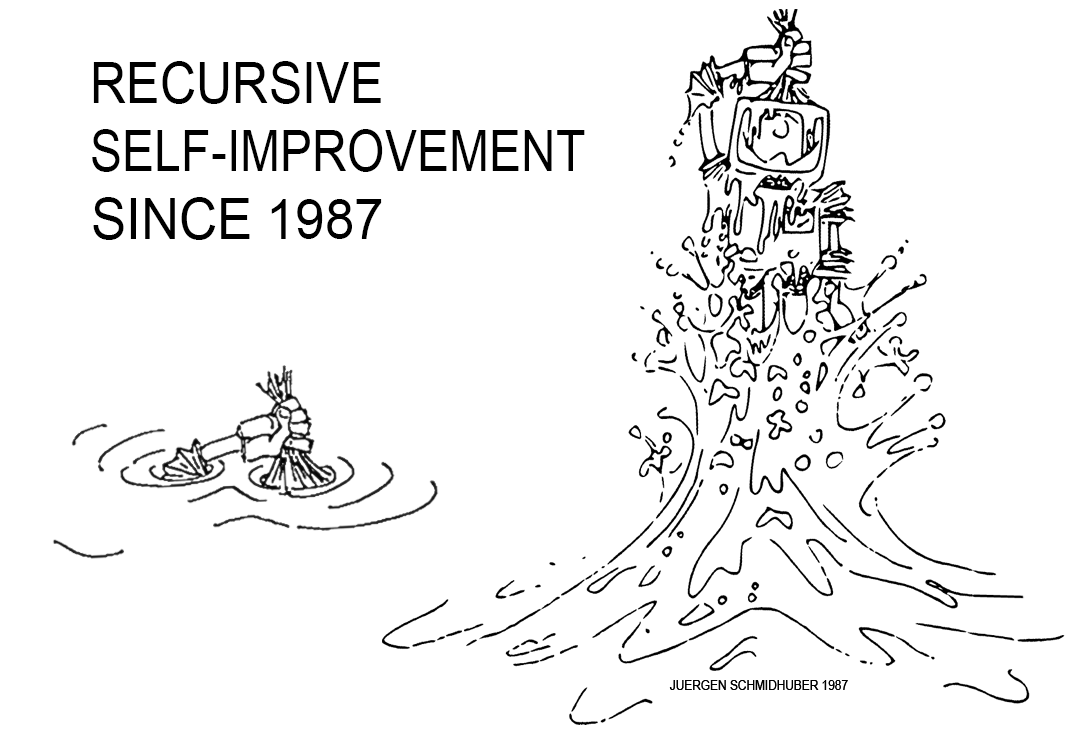
Today everyone is talking about Recursive Self-Improvement (RSI). In 1987, when compute was 100,000,000 x more expensive, I published the 1st concrete RSI algorithms. Now compute is cheap, and RSI is driving the future of both software and physical AI. See: RSI since 1987 https://t.co/yA3KUqpFtb (Technical Note IDSIA-9-26)
Also covered: RSI with self-modifying policies since 1994, gradient descent-based RSI in neural networks since 1992, asymptotically optimal RSI for curriculum learning since 2002, mathematically optimal RSI through the self-referential Gödel Machine since 2003, RSI combined with artificial curiosity and intrinsic motivation since 1990/1997, recent work on RSI since 2020.
Software-based RSI has become practical. Full RSI, however, will require not just self-improving software but self-improving hardware in the physical world.
As of 2026, companies talking about RSI include Anthropic, OpenAI, Sakana AI, SpaceX, Ricursive, Recursive Superintelligence, Inherent …
We do that already, ask a model for something beautiful and it will reply based on its training data. If at some point you don't like that definition of beauty anymore you can re-train the model. But a model will never be able to re-train by itself without an external subjectivity to steer it.
El @TecdeMonterrey fue seleccionado por @Forbes USA entre las 15 mejores universidades internacionales para estudiantes de Estados Unidos, junto con @UniofOxford, @Cambridge_Uni, @mcgillu, @sciencespo, @Unibocconi, @waseda_univ y la @HKUniversity, entre otras. La nota destaca nuestra acreditación por la asociación estadounidense SACSCOC desde 1950, nuestra oferta en inglés y nuestros programas académicos de ingeniería, tecnología y negocios, entre otras. Gracias a nuestra comunidad del Tecnológico de Monterrey quienes hacen esto posible. 🔗 Ver nota aquí: https://t.co/Bue3OFirwI
P.D. I'm not ruling out bad human actors using AI to commit any of the crimes mentioned in the thread, but I think that's an entirely different conversation.
AI is going to improve in the next years but not at the same dramatic pace he implies. The reason is that the "recursive self‑improvement" idea is simply not solid, or more correctly, it doesn't generalize outside math and coding. I'll try to give some intuitions as to why this is the case.
I resigned from Anthropic today. I spent the last three years doing pretraining research at both OpenAI and Anthropic. Neither company is acting responsibly. They are racing straight to self-improving superintelligence and gambling with our lives. More thoughts below.
You may be a super smart guy, like Leopold Aschenbrenner, and then you blow up 35 billion dollars (was it bad luck or a bad call?). In summary, even for an AI after some point, the real world is the ultimate source of feedback and it basically sucks. So, there won't be such thing as "recursively self-improving" superintelligent AI.