Conversations about declining learning outcomes should move beyond social media trends and focus on the education system itself.
Millions of Nigerian children rely on public schools, yet many continue to face challenges such as overcrowded classrooms, teacher shortages, and limited learning resources. Strengthening foundational education is essential if we want to improve critical thinking, creativity, and lifelong learning.
Read more:
https://t.co/TYOrGnkZ1E
Congratulations to the universities recognised in the 2026 Times Higher Education rankings.
Greater representation is an encouraging milestone for Nigeria's higher education sector. Beyond the headlines, the rankings also provide valuable insights into research performance, teaching, international outlook, and the areas where further progress is needed.
We examined the key trends and what they mean for Nigerian universities:
https://t.co/Ww3q5fMrl2
FEDERAL MINISTRY OF EDUCATION
PRESS RELEASE
26th June, 2026
RENEWED HOPE EDUCATION REFORMS DRIVE NIGERIA'S STRONGEST PERFORMANCE IN GLOBAL UNIVERSITY RANKINGS
The Federal Ministry of Education has welcomed Nigeria's strong performance in the 2026 Times Higher Education (THE) World University Rankings and the Times Higher Education Sub-Saharan Africa University Rankings, describing the achievement as evidence of the positive impact of reforms under President Bola Ahmed Tinubu's Renewed Hope Agenda and the Nigerian Education Sector Renewal Initiative (NESRI).
Nigeria increased its representation from 21 universities in 2024 and 2025 to 24 universities in 2026, making it the most represented country in Sub-Saharan Africa. The University of Ibadan, the University of Lagos, and Bayero University Kano ranked among the country's top-performing institutions, while 17 of the ranked universities are federal institutions.
The Honourable Minister of Education, Dr. Maruf Tunji Alausa, CON, said the rankings demonstrate that investments in education are yielding measurable results and strengthening Nigeria's global academic standing. He commended all ranked institutions and noted that an additional 27 universities also participated in the assessment process.
The Ministry reaffirmed its commitment to implementing reforms that improve quality, expand access, strengthen research and innovation, and position Nigeria's higher education system among the most competitive in Africa and globally.
Attached: 2026 Times Higher Education Sub-Saharan Africa University Rankings: https://t.co/GdA6Ym60Lw
Folasade Boriowo
Director, Press and Public Relations
This is a conversation Nigeria urgently needs.
The real measure of an education system is not how many certificates it produces, but whether graduates leave with the knowledge, skills, and competencies needed to succeed in the workplace.
A stronger feedback loop between employers, universities, polytechnics, and policymakers could help close persistent skills gaps and improve graduate outcomes.
Interesting perspective on aligning education with labour market needs:
https://t.co/qvhH5FY6SF
Many graduates leave school believing they are qualified because they passed examinations, while employers reject them because they cannot perform in real-world environments.
Employers complain daily about graduates who cannot think critically, solve problems, communicate effectively or demonstrate basic discipline.
Schools are factories where the workforce is manufactured.
Industry is where that workforce is consumed.
Perhaps the biggest problem in education is that the factories rarely hear directly from the people consuming their products.
Yet I've never seen a major forum where CEOs, HR leaders, university Vice Chancellors, secondary school principals and Ministries of Education sit together to discuss one uncomfortable question:
"What exactly is wrong with the graduates we are producing?"
Imagine a conference where industry leaders openly present the frustrations they face in recruitment and educators are forced to listen.
In manufacturing, if a factory keeps producing defective products, customers complain and the factory adjusts its process.
But in education, the "customers" (industry) complain continuously while the "factories" (schools and universities) rarely receive structured feedback from those consuming their output.
This is one reason skill gaps persist year after year.
In fact, Nigeria and much of Africa may need an annual Education-Industry Alignment Summit, where employers openly grade the quality of graduates and schools respond with concrete reforms.
HR professionals and CEOs should be able to tell schools the skills they wish could be taught to support modern changing workplace.
This could become one of the most important education initiatives on the continent.
What do you think?
Seun Kuti's comments highlight a challenge that starts long before the job market.
Millions of Nigerian children depend on public schools, yet many schools continue to struggle with inadequate infrastructure, teacher shortages, and limited learning resources. Building a pipeline of scientists, engineers, and innovators requires investing in the foundations of education.
More insights on Nigeria's education challenges:
https://t.co/TYOrGnkZ1E
There’s no hope for talented scientists and engineers in Nigeria, except they resort to Yahoo yahoo — Singer Seun Kuti laments
Singer Seun Kuti has criticised the lack of structures to support talented young Nigerians, arguing that many gifted individuals are left with few opportunities to develop their skills.
Speaking on the state of the country, Kuti said a young person can be highly talented in fields such as robotics, nuclear physics, rocket engineering, education, philosophy, or history, yet find no meaningful programme or support system to help advance their career.
According to him, the system places greater value on service-based professions and entertainment-related skills than on innovation, research, and intellectual development. He questioned where aspiring scientists, engineers, and academics can turn to for support, noting that many talented youths are left without pathways to succeed.
Kuti argued that society appears more focused on asking people what service they can provide whether sewing, shoemaking, baking, cooking, singing, dancing, acting, filming, or conducting interviews while neglecting those with talents in other critical fields.
He maintained that until adequate programmes are created to nurture diverse talents, many young Nigerians will continue to struggle to find opportunities that match their abilities.
There’s no hope for talented scientists and engineers in Nigeria, except they resort to Yahoo yahoo — Singer Seun Kuti laments
Singer Seun Kuti has criticised the lack of structures to support talented young Nigerians, arguing that many gifted individuals are left with few opportunities to develop their skills.
Speaking on the state of the country, Kuti said a young person can be highly talented in fields such as robotics, nuclear physics, rocket engineering, education, philosophy, or history, yet find no meaningful programme or support system to help advance their career.
According to him, the system places greater value on service-based professions and entertainment-related skills than on innovation, research, and intellectual development. He questioned where aspiring scientists, engineers, and academics can turn to for support, noting that many talented youths are left without pathways to succeed.
Kuti argued that society appears more focused on asking people what service they can provide whether sewing, shoemaking, baking, cooking, singing, dancing, acting, filming, or conducting interviews while neglecting those with talents in other critical fields.
He maintained that until adequate programmes are created to nurture diverse talents, many young Nigerians will continue to struggle to find opportunities that match their abilities.
How many Nigerian children are actually in public schools?
When discussions about education arise, private schools often dominate the conversation. However, the reality is that the majority of Nigerian children attend public schools.
These schools educate millions of children every day, yet many continue to face challenges such as overcrowded classrooms, inadequate infrastructure, teacher shortages and poor learning outcomes.
If we are serious about improving education in Nigeria, we must pay greater attention to the schools that serve most of our children. Strengthening public education is one of the most effective investments we can make in our country's future.
Read more: [https://t.co/TYOrGnkZ1E](https://t.co/TYOrGnkZ1E)
#Education #NigeriaEducation #PublicSchools #EducationReform #EduIntel #LearningForAll
Nigeria achieved a significant milestone in 2025, with more than one million students admitted into tertiary institutions.
However, admission numbers alone do not tell the full story.
Recent UTME admission data highlights deeper challenges within the education system:
• Many admitted candidates scored below 200.
• Demand for Medicine, Pharmacy and Law continues to exceed available spaces.
• Colleges of Education remain underutilised despite persistent teacher shortages.
These trends point to a larger issue: the quality of learning outcomes before students reach tertiary education.
Improving foundational literacy, numeracy, teacher preparation and school quality should remain a national priority.
The goal should not only be to expand access, but also to ensure that students are adequately prepared to succeed.
What reforms do you think would have the greatest impact on learning outcomes in Nigeria?
Read more: https://t.co/BIDB1h7b14
#EducationPolicy #NigeriaEducation #LearningOutcomes #HigherEducation #EduIntel
This year so far, nearly 1,400 books have been borrowed through our @ReadForGrowth community libraries.
Most of our library users are young, with 55% aged 11 to 13. We also registered 138 new members who hopefully will become regular users of our library services. It's awesome.
2.24 million candidates registered for the 2026 UTME, the highest number ever recorded.
That figure tells a story beyond admissions statistics. More Nigerian children are completing secondary school and arriving at the university entry point. The pipeline is working better than it used to.
The clearest evidence of this shift is what is happening to Direct Entry (DE). DE registrations have fallen from a peak of 168,472 in 2015 to just 52,632 in 2025. DE exists for candidates who could not get into university straight from secondary school and had to attend a polytechnic or a college of education first. Fewer people are taking that route because fewer people need to.
This means polytechnics and colleges of education are losing one of the functions that could justify their existence. If the secondary-to-university pipeline is now the norm, the institutional framework built around the detour needs to be reconsidered. Perhaps we should focus on degree-awarding institutions?
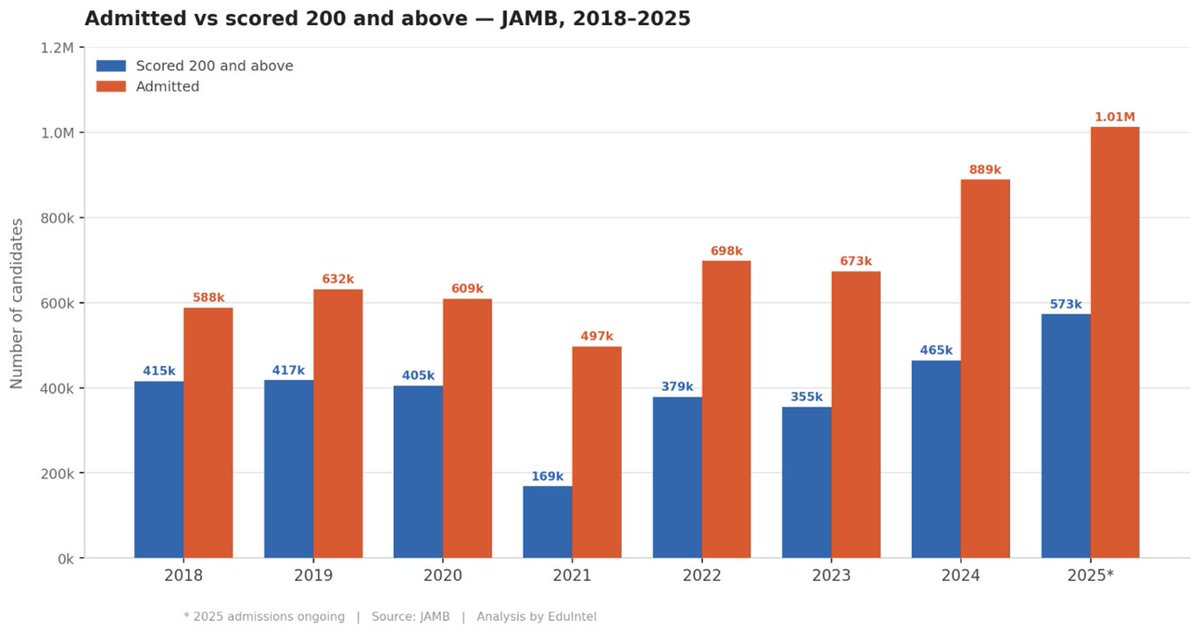
Of the 1M+ candidates admitted to higher institutions in 2025, over 60% scored below 200 in the UTME. Scores once considered mediocre or too low to mention (140–199) are now securing admissions.
We take a closer look at the UTME 2025/2026 report:
https://t.co/prDTkiMVVr
For years, Nigeria's tertiary institutions have admitted far more candidates than those who scored 200 & above in the UTME. And the gap is getting wider.
Our institutions now depend heavily on candidates who couldn't answer correctly half their UTME questions. Concerning.
The digital divide between urban and rural Nigeria is profound. While some urban schools benefit from ICT laboratories and reliable power, countless rural schools lack even basic instructional infrastructure.
https://t.co/RJC1sKymTf
Nigeria’s public schools account for only 54% of all school-age children. In much of the world, public school as share of children population exceed 80%, and that’s the level we should aim for. We have a long way to go.
Check how your state is doing:
https://t.co/WuYaVyI3Fn
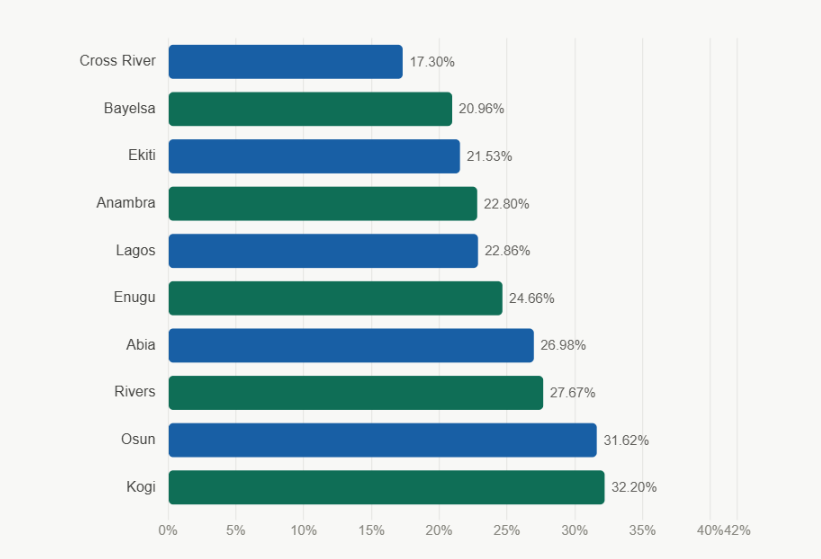
Which states enrol the fewest children in public schools in Nigeria?
Fewer than 1 in 3 school-age children (ages 6–14) are enrolled in public basic schools across Nigeria's 10 lowest-performing states. Cross River records the starkest gap, with just 17.3% enrolled.
Which states are you surprised to find on this list?