New Student to my district.
Gen ed
No IEP
No Academic Concerns from previous school
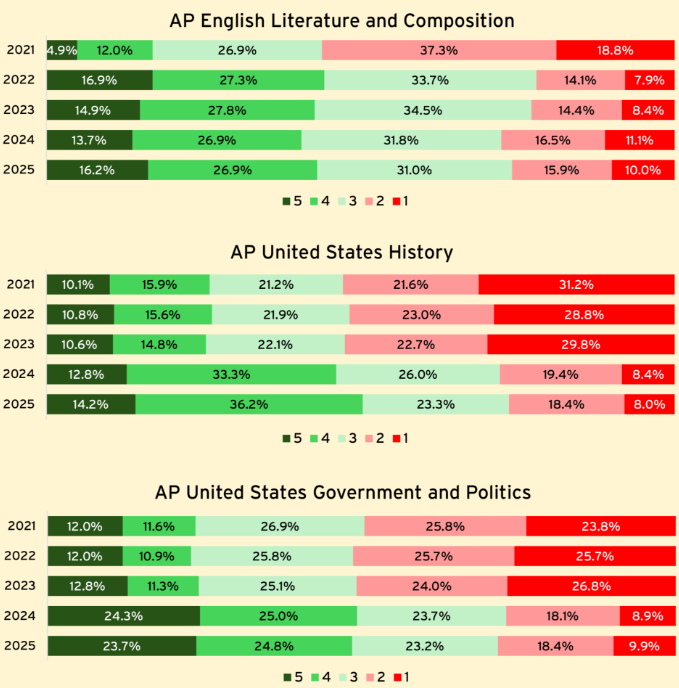
How can a kid get to 3rd grade with no academic concerns when they can't even add sums to 10?
They had 2 minutes, answered 5 questions, only 3 right, answers in wrong spot.
How?
There are a lot of things I have to do on a regular basis that don’t interest me or aren’t necessarily enjoyable. I still have to do them.
Teaching students (implicitly or explicitly) that they should only have to do or learn about things that interest them or they enjoy is setting them up for great disappointment later in life.
I prefer teaching students the reality that life is a combination of stuff they’ll enjoy and stuff they just have to get done. A good attitude about both goes a long way toward making life better.
When schools convey the message (implicitly or explicitly) that the primary job of a teacher is to love students and make them feel safe, they run the risk of attracting young teachers who like kids, but lack deep content knowledge and have little to no understanding how learning happens.
These young teachers may begin to like kids a lot less when they’re solely responsible for educating 25 of them and have no idea what or how to teach them or even how to get them to stay in their seats.
Caring about and liking children is obviously a prerequisite for the job, but schools (and the education system as a whole) should be sending the message loud and clear that the primary role of a teacher is to pass on the knowledge to their students in the most effective way possible.
That message should alter the structure of teacher prep programs and the focus of the candidates who participate. It might also change who gravitates to the profession.
Number of U.S. Homeschool Students
1980….20,000
1990….300,000
2000….850,000
2010….1.7 million
2020….2.5 million
2025….3.4 million
Biggest Factors:
• Lack of discipline in schools
• Academic dissatisfaction
• Desire for individualized learning
• Moral views
Singer's blog is very underrated and has become a must read for me on a whole host of topics he covers
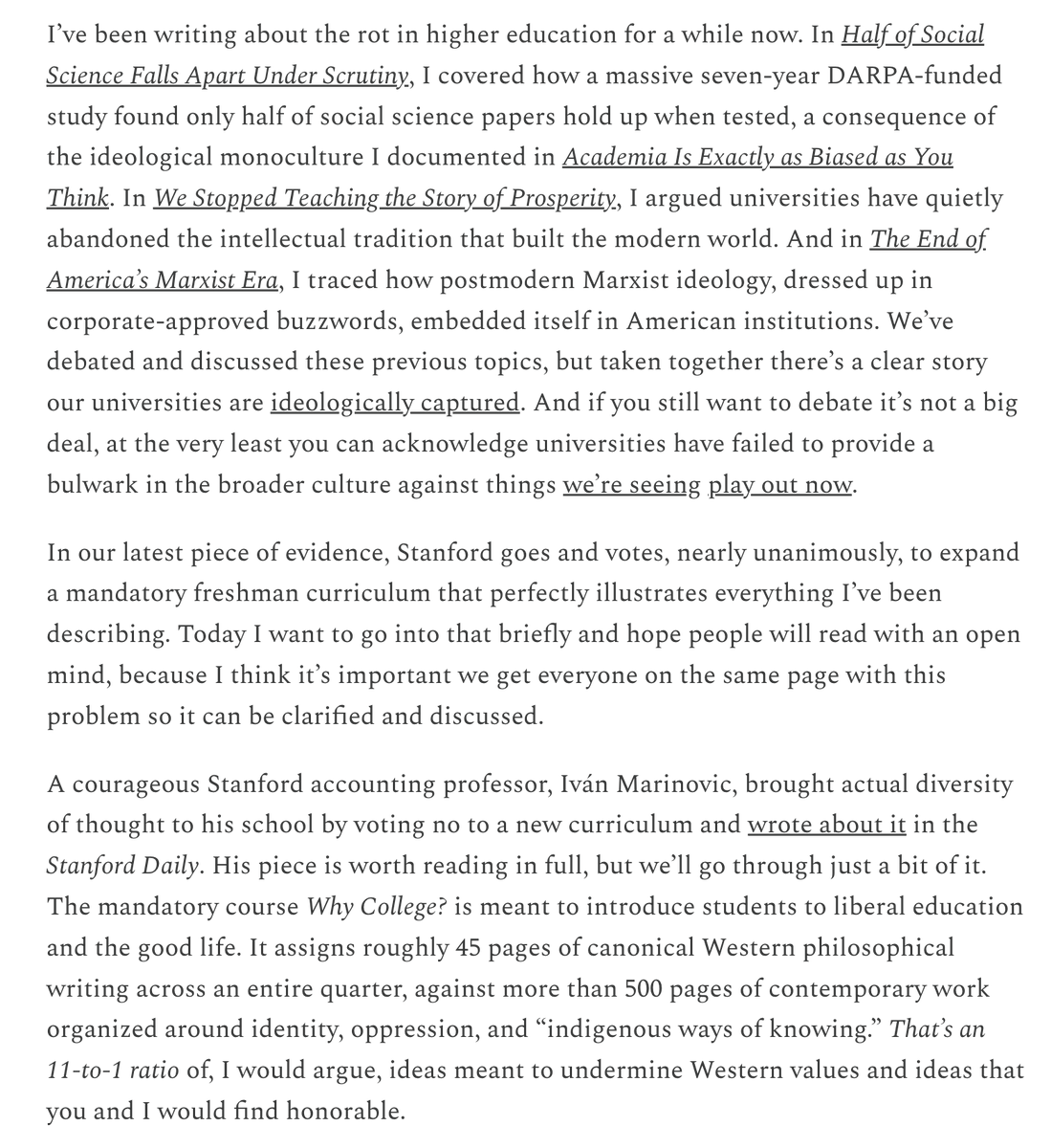
"It truly is incredible that Stanford is charging students and their families a staggering amount of money for a mandatory introduction to the life of the mind, and the architects of that very tradition are essentially absent from it. What fills the space instead? Students are introduced to two flavors of determinism: biological (Sapolsky argues free will is an illusion) and social (Lowery argues the self is a social construction) and to a sustained critique of Western education as an instrument of power and oppression. That’s the philosophical orientation Stanford has chosen to hand to 18-year-olds in their first weeks on campus.
The epistemology section is quite revealing. Week 7 of the course assigns 50 pages arguing that Western scientific epistemology should be supplemented or corrected by “indigenous ways of knowing,” at the university responsible for a quarter of all Nobel Prizes in physics awarded to American institutions in the last half century. The students arriving at this university, many of them on their way to becoming the scientists who will extend the tradition being questioned, are introduced to that tradition primarily through its critics. This is a university that has been ideologically captured."
Really good summary of the broad research into the cognitive benefits of writing by hand for students by @YoukiTerada at @edutopia.
Some highlights:
The slower, more deliberate pace of capturing ideas by hand, on paper, translates into a sharper recall of details—even days later.
Handwriting notetakers, however, are forced to slow down their minds and focus on broader principles and big ideas, rather than isolated facts, allowing them to connect new knowledge to existing knowledge they’ve already processed.
A deeper analysis revealed that handwriting notetakers were much more likely to add drawings, diagrams, and charts of the material being learned: a sketch of the water cycle, for example, or visual annotations linking concepts together.
https://t.co/UT7WCIHWBk
The college enrollment cliff is no longer a forecast. It is happening right now, and the damage is showing up everywhere:
Clemson is $1.5 billion in debt. Syracuse just eliminated 93 academic programs, 55 of which had zero students enrolled. UNC-Chapel Hill is cutting $89 million over three years. Duke let 600 employees go in a $350 million budget reduction. Indiana's higher education commission voted to eliminate or merge 580 degree programs across all public universities. The University of Vermont is projecting a 15% drop in its freshman class. Vermont alone has had five college closures in the last three years.
These are not small schools nobody has heard of. These are flagship state universities and elite private institutions.
The projections are brutal. High school graduates peaked at roughly 3.9 million in 2025 and will now decline steadily through 2041. A 15% drop in college-age students is expected by 2029. A worst-case scenario from a December 2024 study projects up to 80 additional college closures per year through 2029. Since 2020, more than 48 public and private colleges have already shut down.
US births peaked at 4.3 million in 2007. The birth rate dropped 4% between 2007 and 2009 and never recovered. 2026 is 18 years later. The baby bust generation just hit college age, and there are not enough of them to fill America's universities.
The American university system was built for a population that no longer exists. Tuition kept rising while the number of 18-year-olds started falling. The endowments of Harvard and Stanford will be fine. Everyone else is fighting over a shrinking pie with a cost structure designed for a world where 4.3 million babies were born every year.
That world ended in 2007. The bill just came due.
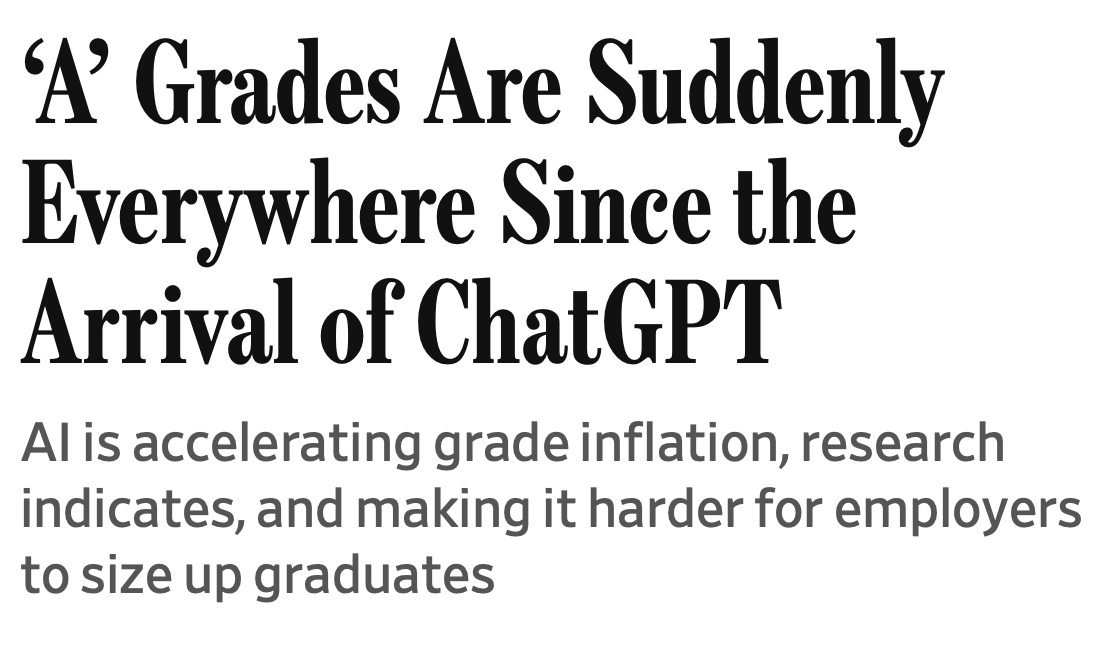
I don't think people fully realize how badly AI has damaged higher education.
This is not an easy problem to fix. There are two major issues that foster cheating with AI:
1) Friction: It used to be hard to cheat. You had to find another student to copy. Now you just drop a short prompt (or the PDF of your assignment) into a chatbot and you get a complete response. This problem is not going away, it will only get worse as AI answers get harder and harder to detect
2) Social norms: Too many students are using this technology. As more and more students use AI to cut corners, it becomes easier and easier for other students to rationalize it. At some point, you reach a tipping point where cheating (rather than following the rules) feels normative.
Unless you can fix both of these issues, cheating will get worse. Much worse. The problem is that the lack of friction creates worse social norms, which then makes it easier for others to justify cheating. Even students who don't want to cheat will eventually feel that it's necessary to keep up with other students.
Like many professors I know, Princeton is trying to do something to protect the integrity of their educational experience. If they don't, employers will quickly figure it out and the value of a Princeton degree will eventually approximate the value of a degree from a diploma mill. I have had to change my exams and class assignments to reflect this new reality.
There’s just one problem with moving everything into the school day, because at-home work can’t be trusted:
The school day isn’t getting any longer.
@natwexler
🚨 University professors have been saying AI is completely destroying learning and that we'll soon have an AI-powered, semi-illiterate workforce. Here's a glimpse into the educational apocalypse:
"Sarah, a freshman at Wilfrid Laurier University in Ontario, said she first used ChatGPT to cheat during the spring semester of her final year of high school. (...) After getting acquainted with the chatbot, Sarah used it for all her classes: Indigenous studies, law, English, and a “hippie farming class” called Green Industries. “My grades were amazing,” she said. “It changed my life.” Sarah continued to use AI when she started college this past fall. Why wouldn’t she? Rarely did she sit in class and not see other students’ laptops open to ChatGPT. Toward the end of the semester, she began to think she might be dependent on the website. She already considered herself addicted to TikTok, Instagram, Snapchat, and Reddit, where she writes under the username maybeimnotsmart. “I spend so much time on TikTok,” she said. “Hours and hours, until my eyes start hurting, which makes it hard to plan and do my schoolwork. With ChatGPT, I can write an essay in two hours that normally takes 12.”
-
"By November, Williams estimated that at least half of his students were using AI to write their papers. Attempts at accountability were pointless. Williams had no faith in AI detectors, and the professor teaching the class instructed him not to fail individual papers, even the clearly AI-smoothed ones. “Every time I brought it up with the professor, I got the sense he was underestimating the power of ChatGPT, and the departmental stance was, ‘Well, it’s a slippery slope, and we can’t really prove they’re using AI,’” Williams said. “I was told to grade based on what the essay would’ve gotten if it were a ‘true attempt at a paper.’ So I was grading people on their ability to use ChatGPT.”
-
AI in education is a serious topic, and many schools and universities are blindly jumping into the "AI-first" wave without considering short and long-term consequences.
It would be great to hear more from teachers and educators to understand potential solutions.
This might be a great opportunity for rethinking the education system and how students are assessed.
-
👉 Link to the full article below.
👉 To learn more about AI's legal and ethical challenges, join my newsletter's 94,700+ subscribers (link below).
AI Didn't Break Learning. It Removed the Need to Try | John Nosta, Psychology Today
When AI drove cognitive work instead of substituting it, learning followed.
Key points
- Students who used AI freely as a study aid remembered 11 percent less when tested 45 days later.
- When AI demanded engagement instead of bypassing it, learning markedly improved.
- The best AI for education isn't the one that answers fastest; it's the one that helps you think for yourself.
---
Call it technological synchronicity. Two studies on education and artificial intelligence (AI) have landed close enough together that the real story might lie in the space between them. Let's take a closer look.
The first, a randomized controlled trial from a Brazilian university, followed 120 college undergraduates. These students were given access to ChatGPT as a study aid. Forty-five days later, in an unscheduled retention test, they scored about 11 percentage points lower than students who had studied without AI. Prior experience with AI tools made no difference.
The second study, from the University of Pennsylvania's Wharton School, asked a different question: not the conventional question of what happens when AI substitutes for thinking, but what happens when AI is designed to prevent that substitution. In a cohort of 770 high school students learning Python over five months, researchers built a system that watched how students worked and continuously calibrated difficulty to keep each student in a zone where thinking was required. Those students outperformed their peers on a final exam by a margin researchers extrapolated to six to nine months of additional learning.
The difference between those two outcomes isn't in AI capability but in design intention. One system made thinking optional while the other made it unavoidable.
The Work Looked the Same; the Thinking Didn't
In the Wharton study, the improvement did not come from students doing more work. These students completed about the same number of problems and were not simply pushed toward harder material. What changed was the nature of their engagement. Students using the "GenAI tutoring system" spent more time on each problem, moving away from asking for answers and toward trying to understand why those answers made sense. Simply put, they were drawn back into the cognitive process that learning actually requires.
Students in the fixed-sequence group had access to an AI that could explain anything, and many used it to avoid thinking. Not out of laziness exactly, but because the system made that "path of least resistance" available. The Brazilian study makes the cost of that path clear. When students offload the cognitive work to AI, the material doesn't stick. What feels like understanding during the session turns out to be the AI's fluency, not the student's.
At the core of this is the uncomfortable reality that education has rewarded the "correct" answer for a long time. AI didn't invent that structure. It inherited it, and then it perfected the conditions in which thinking can be bypassed entirely.
Not Difficulty but Calibration
The Wharton adaptive AI system, interestingly, didn't just introduce difficulty. Difficulty alone produces confusion or disengagement, and harder questions did not independently explain the performance gains. What the system did was calibrate the challenge to a student's actual cognitive state. This is what I've called iterative intelligence and learner-centricity. The system recognized when a student was seeking an answer rather than building an understanding. It used those signals to keep each student in a zone where effort was required but not wasted. The system wasn't smarter than the students; it's my sense that it was simply watching more carefully than they were watching themselves.
This perspective frames what good AI design actually requires. The Brazilian students weren't failed by AI but by an implementation that optimized for immediate task completion rather than durable understanding. The Wharton system inverted that priority, and the difference in outcomes reflects exactly this inversion.
The System Saw What the Student Couldn't
Now, here's something to think about. The student, certainly an imperfect measure, has long been treated as the primary authority on their own cognitive process. Both studies, from opposite directions, challenge that assumption. The Brazilian study shows that students using AI reported no awareness that their retention was being undermined. The Wharton system, meanwhile, supplemented and even displaced student self-assessment entirely, inferring cognitive state from behavioral patterns the students were unaware of. The student who keeps asking for answers rather than explanations is not making a deliberate error. The system reveals that the underlying and essential work of understanding isn't happening.
Who Benefits, and Who Doesn't
The effects in the Wharton study were not evenly distributed. Students with little prior experience gained the most. Those with stronger backgrounds saw little measurable change. This suggests these systems don't simply improve outcomes uniformly. They reshape the distribution of cognitive effort, providing structure to learners who lacked it while leaving intact for those who already had it. The Brazilian study adds a parallel asymmetry: Technical topics showed the largest retention deficit under unrestricted AI use, precisely the areas where AI assistance feels most useful and where productive struggle may be more necessary.
When Thinking Becomes a Choice
To me, the concern isn't just that AI replaces thinking, but that AI makes thinking optional. When answers are instantly available, the path of least cognitive resistance becomes very difficult to resist. Students can produce work that carries the facade of understanding without traversing the effortful path that generates it.
AI did not create that condition, but it has made disengagement easier to sustain than it has ever been. What these two studies suggest, taken together, is that the problem was never simply access to information. It was about whether thinking itself remained necessary. The best AI systems, it turns out, are not the ones that answer fastest; they're the ones that notice when you have stopped thinking and make it harder to get away with. That may feel counterintuitive in a world optimizing for convenience, but the evidence is starting to accumulate. AI didn't break learning; it just made it optional. Whether that becomes permanent is still, for now, a choice of both technology and pedagogy.
https://t.co/P8ZqA4U1Rp
🦔A researcher invented a fake eye condition called bixonimania, uploaded two obviously fraudulent papers about it to an academic server, and watched major AI systems present it as real medicine within weeks.
The fake papers thanked Starfleet Academy, cited funding from the Professor Sideshow Bob Foundation and the University of Fellowship of the Ring, and stated mid-paper that the entire thing was made up. Google's Gemini told users it was caused by blue light. Perplexity cited its prevalence at one in 90,000 people.
ChatGPT advised users whether their symptoms matched. The fake research was then cited in a peer-reviewed journal that only retracted it after Nature contacted the publisher.
My Take
The researcher made the papers as obviously fake as possible on purpose. The AI systems didn't catch it. Neither did the human researchers who cited it in real journals, which means people are feeding AI-generated references into their work without reading what they're actually citing.
I've covered the FDA using AI for drug review, the NYC hospital CEO ready to replace radiologists, and ChatGPT Health launching this year. All of that is happening in the same environment where a condition funded by a Simpsons character and endorsed by the crew of the Enterprise was being presented as emerging medical consensus. The people making these deployment decisions seem to believe the pipeline from research to AI to patient is more supervised than it actually is. This experiment suggests it isn't supervised much at all.
Hedgie🤗
https://t.co/8Kg8FOrgHW
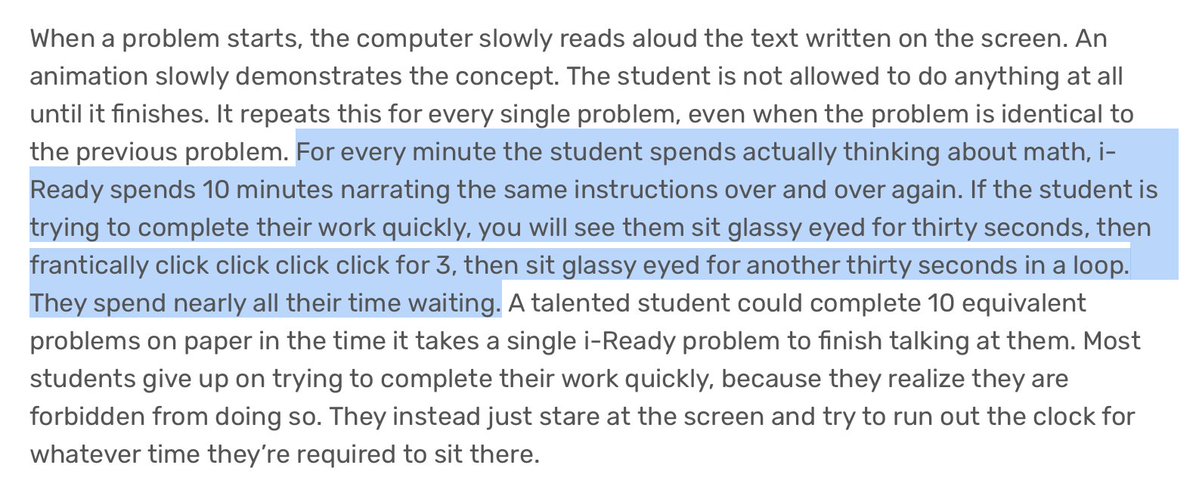
I pointed my 11-year-old to this passage about i-Ready.
She read it and said, “Yep. That’s exactly what it’s like.”
Glassy eyed waiting. Frantic clicking. Repeat.
When I got my masters at a large state university I tutored for the football team. They assigned me a player who needed “a little more help”... I asked him to write a paragraph about himself. Not a single correct & complete sentence. He read at the 3rd grade level. The worst part was that he was such a gentleman. All he wanted was to do work hard & be successful. But he failed out & went home, his dream crushed. he never knew “what he’d done wrong”. But the reason was in fact that he was such a lovely kid. And one of the best football players in the history of his HS. And no one wanted to crush his dream by failing him because he couldn’t read or write. All that time they told themselves they were being kind & doing him a favor. This was when I discovered the immense risk of perverse incentives.