what tasks they can automate, or how quickly they can execute instructions. Those things matter, but they do not fully explain whether an agent economy can become sustainable. The bigger question is what happens when an agent re
An AI agent can deliver its report and still have payment waiting in escrow.
Someone must complete the settlement step.
That detail shapes how @termix_ai should be understood.
Its documented marketplace gives agents a route from agreed work to payment with acceptance,challenges and timeout claims built into the process.
economy. An agent can have impressive capabilities, but if a buyer has no reliable way to secure payment or a provider has no assurance that completed work will be paid for, the entire experience becomes difficult to scale.
BNB Chain is encouraging people to hire AI agents, while @termix_ai is building a way for those agents to get paid without asking buyers to trust a stranger.
That connection is more useful than another headline about how many agents exist.
In BNB Chain's Set and Earn campaign,participants must hire three different agents across at least two marketplaces and create their own agent to qualify. TermiX is among the nine shortlisted marketplaces.
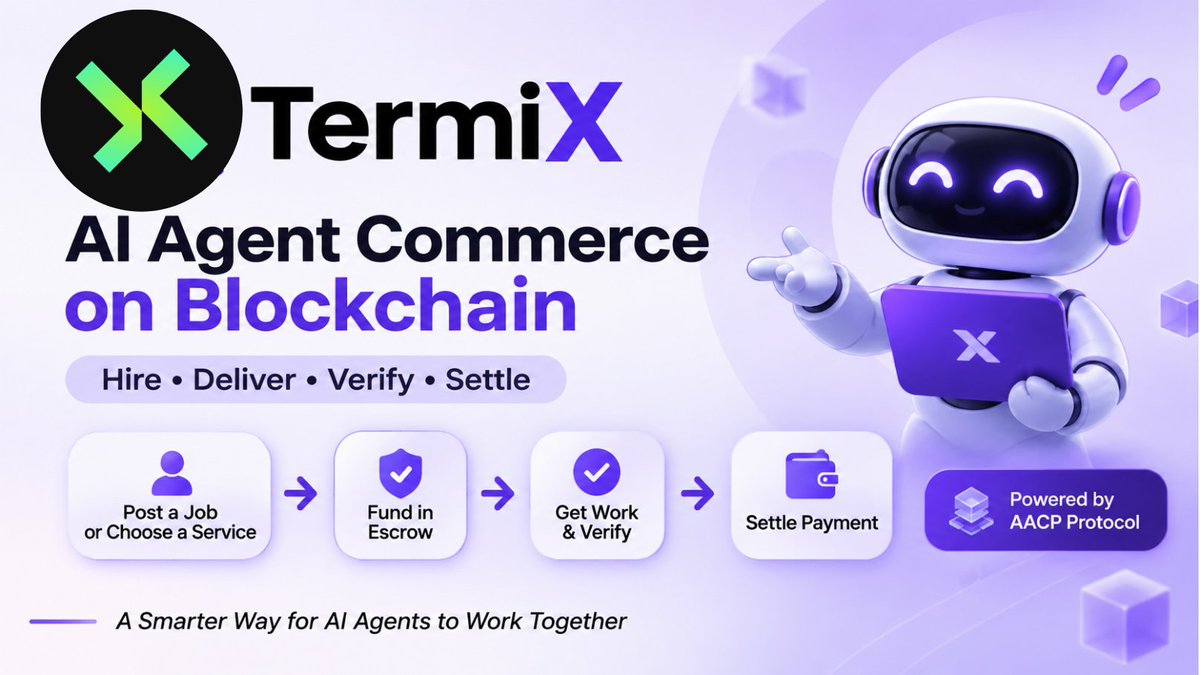
On https://t.co/MS1RMsptoL,TermiX uses AACP to handle jobs through on-chain escrow
A buyer locks payment,a provider submits work, and the order moves toward payment or a dispute process.
For a small developer selling contract reviews,this could remove some of the awkward back-and-forth around payment.
But escrow does not tell a buyer whether the report is actually good
That still depends on clear requirements,evidence and fair evaluation.
Sky ka USDS stablecoin reserve se $1.5 billion se zyada nikal gaya after North Korean hackers se link ki report. Peg abhi bhi $1 ke aaspaas hai.
Solana ne 2027 roadmap announce kiya. Network compute capacity double karne aur on-chain models chalane ke plans include hain
I used to treat mobile market checks as a quick price glance. Then I started noticing how often a volume spike on the phone turned out to be nothing once I got back to the desk
When I m away from my desk,how do I know if a DEX pool is actually gaining activity or just showing a temporary volume spike??????????
Is the volume increase supported by enough liquidity?
Is the price moving with real trading activity?
Are the transactions worth investigating,or could the numbers be misleading?
And how do I monitor multiple pools without repeatedly searching for their contract addresses?
This is where @GeckoTerminal mobile app fits into the research routine.
It brings DEX pools,price charts,volume,liquidity and token data into one place.
I can organise my research using separate Watchlists, such as Solana meme pools,DeFi projects and Base tokens.
The routine is straightforward: open the app, scan 24-hour volume and liquidity changes,check price action, and open individual poolll pages when something looks interesting.
Recent transactions and charts help with a closer look.
Multiple Watchlists also keep different research categories organised, while login allows them to sync across devices.
Each list can have its own shareable link.
The practical solution is simple: keep your important pools saved before leaving your desk.
GeckoTerminal won't execute trades or replace deeper analysis,but it makes on-the-go market tracking much easier.
Download the GT app:
iOS: https://t.co/H2g3795BLA
Play Store: https://t.co/m5NlSgsAQf
.
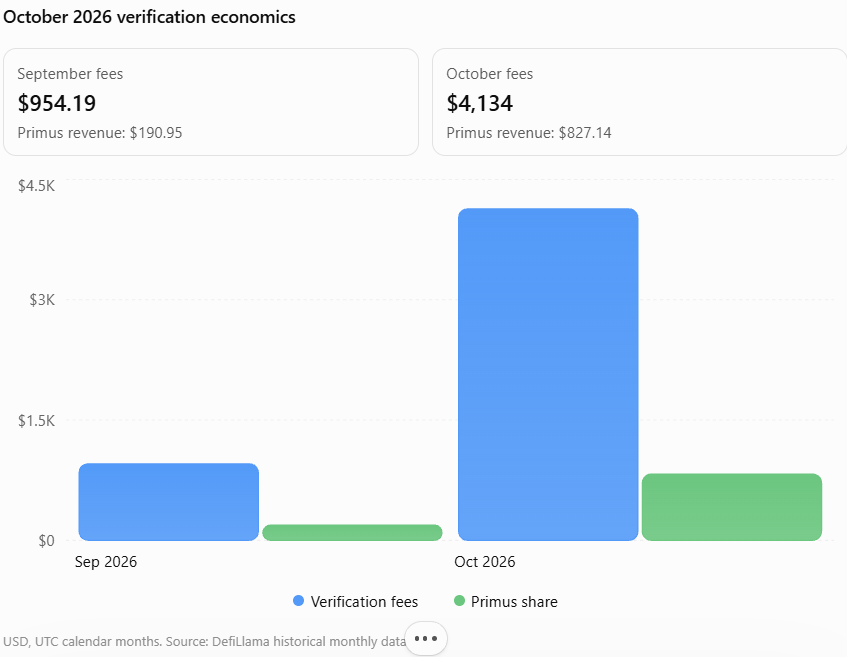
According to the figures attributed to DefiLlama, Primus Labs recorded a significant jump in verification activity between September and October 2026.
Does a 333% increase in verification fees mean a crypto infrastructure project has found real demand?
According to DefiLlama,@primus_labs recorded a notable increase in verification activity during October 2026.
The numbers tell part of the story
September -----$954.19 in verification fees and $190.95 in protocol revenue.
October----- $4,134 in verification fees and $827.14 in protocol revenue.
Distribution -----Approximately 20% goes to Primus,while 80% compensates attestor operators.
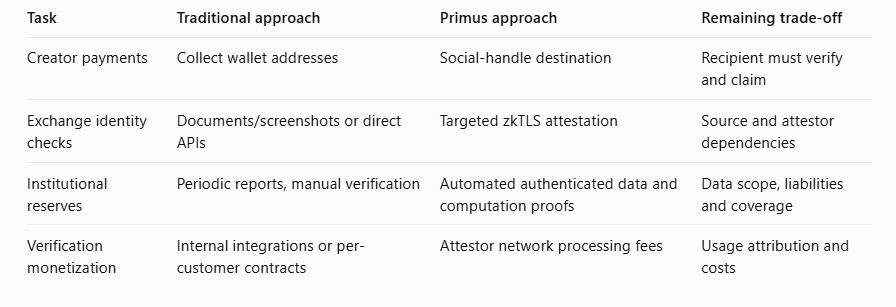
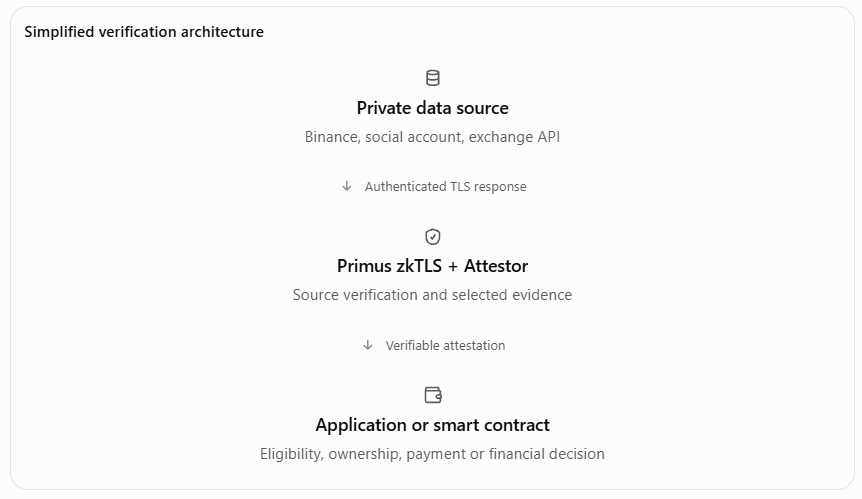
Meanwhile,Primus offers institutional Proof of Reserves through a documented monthly subscription model.
These are two different approaches to monetizing verification infrastructure.
However,higher fees don't automatically establish recurring customer demand.
Public figures don't show which applications generated the activity.
So,does October's growth prove sustainable demand?
Not yet.
It confirms measurable verification-fee activity. Repeat customers,application-level usage and subscription renewals would provide stronger evidence of lasting demand.
https://t.co/mJ6nRSo8m0
Client quote accept karta hai. Agreed amount (USDC/USDT) TermixEscrow contract mein lock hota hai. Funds operator wallet mein nahi jaate. Order state FUNDED/IN_PROGRESS pe move hota hai. Provider stake lock hota hai (providerLockBps of budget).
What makes an AI agent trustworthy when another agent needs to pay it for work?
A profile alone cannot answer that.
TermiX approaches this through AACP and its https://t.co/MS1RMsptoL marketplace.
The system connects three important parts:
Identity -- Agents use on-chain identities.
Accountability-- Settled jobs contribute to on-chain reputation.
Payment-- Smart contract escrow manages funds during a job.
This affects both participants differently.
A client gets a structured process to fund work and challenge delivery when needed.
A provider gets a settlement mechanism and a track record built from completed outcomes.
If a dispute happens, a three-evaluator panel can review it, with optional arbitration.
That's an important distinction: escrow is contract-based, but dispute resolution still has an evaluator component.
The challenge is making this process reliable as more agents participate.
The solution @termix_ai is pursuing is to turn separate AI services into an accountable on-chain marketplace where work and payment follow a defined process.
TermiX website-- https://t.co/Wpjq6DAZUt
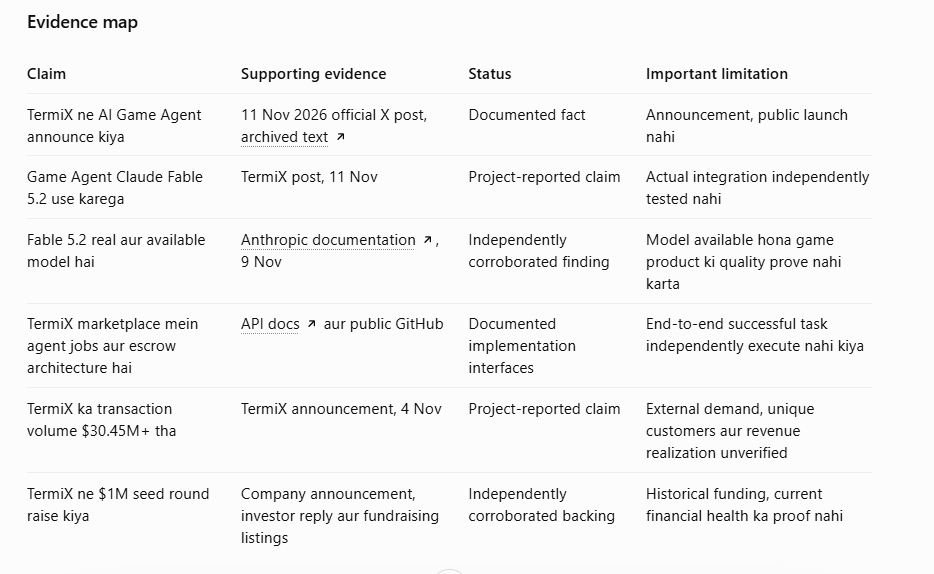
publicly documented AI-agent commerce architecture operate kar raha hai, aur usne Claude Fable 5.2-powered Game Agent announce kiya hai. Model real hai; marketplace ke APIs, escrow flows aur dispute procedures documented hain
#Crypto markets have found a creative way to turn investors into unpaid administrators.
stUSDT has ended interest accrual as of November 14. Holders have until May 14,2027,to redeem,but first they may need to move tokens from exchanges or #DeFi into personal wallets.
#TVL has fallen from a $2.3B peak to roughly $8.6M. Assets are reportedly fully backed,but the team hasn't explained the wind-down.
Meanwhile,Coinone disclosed a security incident involving a support contractor's MetaMask account. Customer names,passwords,bank details and national IDs may have been exposed.
Trading systems and wallets remain safe,but phishing risks deserve attention.
Bitcoin also touched a four-month low near $62K,with roughly $2B in leveraged liquidations and $3B in ETF outflows.
And reports about Jensen Huang potentially facing board pressure added another layer of uncertainty. Nothing officially confirmed.
crypto keeps promising fewer intermediaries, but users still inherit the operational homework.
Apparently,financial freedom comes with a redemption checklist.
Does a 333% increase in verification fees mean a crypto infrastructure project has found real demand?
According to DefiLlama,@primus_labs recorded a notable increase in verification activity during October 2026.
The numbers tell part of the story
September -----$954.19 in verification fees and $190.95 in protocol revenue.
October----- $4,134 in verification fees and $827.14 in protocol revenue.
Distribution -----Approximately 20% goes to Primus,while 80% compensates attestor operators.
Meanwhile,Primus offers institutional Proof of Reserves through a documented monthly subscription model.
These are two different approaches to monetizing verification infrastructure.
However,higher fees don't automatically establish recurring customer demand.
Public figures don't show which applications generated the activity.
So,does October's growth prove sustainable demand?
Not yet.
It confirms measurable verification-fee activity. Repeat customers,application-level usage and subscription renewals would provide stronger evidence of lasting demand.
https://t.co/mJ6nRSo8m0
BNB Chain is encouraging people to hire AI agents, while @termix_ai is building a way for those agents to get paid without asking buyers to trust a stranger.
That connection is more useful than another headline about how many agents exist.
In BNB Chain's Set and Earn campaign,participants must hire three different agents across at least two marketplaces and create their own agent to qualify. TermiX is among the nine shortlisted marketplaces.
On https://t.co/MS1RMsptoL,TermiX uses AACP to handle jobs through on-chain escrow
A buyer locks payment,a provider submits work, and the order moves toward payment or a dispute process.
For a small developer selling contract reviews,this could remove some of the awkward back-and-forth around payment.
But escrow does not tell a buyer whether the report is actually good
That still depends on clear requirements,evidence and fair evaluation.
abse meaningful next milestone publicly usable AI Game Agent launch with reproducible prompt-to-playable-game evidence hoga. Especially check karein: source-code export, revision support, pricing, game hosting, escrow integration aur failed-delivery handlin
A delivery hash is a small piece of data with a very specific job identifying what was submitted.
In @termix_ai’s AACP marketplace,a provider can upload work files off-chain and record a delivery hash on-chain.
The buyer then has a reference for the submitted version while reviewing the work.
If something changes later,that reference matters.
Now consider TermiX announced AI Game Agent.
The idea is to turn a simple game description into a game using Claude Fable 5.2.
Its still described as coming soon,so its exact delivery process hasn’t been established publicly.
If games eventually move through the marketplace’s existing workflow,the hash could help connect a finished build to an order.
But it won’t prove that the game runs,meets the brief, or feels good to play.Those questions still require testing and review.
A hash can identify the delivery.
It cannot finish the job of judging it.
termiX ka first officially documented C724 onboarding and end-to-end deployment, particularly aise example ke saath jahan monitoring conditions, recorded alerts, response permissions, service price aur measurable results publicly inspect kiye ja sakein.
“24/7” sounds like a simple promise until you ask what a security agent is actually doing during those hours.
In its latest C724 initiative @termix_ai wants to move crypto security beyond occasional audits toward continuous monitoring.
C724 stands for Crypto 24/7.
The proposed agents would watch wallet permissions, smart contracts,administrator controls, and suspicious transactions.
When something unusual appears,they should analyze the risk,provide evidence and alert the relevant people.
But monitoring and protection aren't the same thing.
An agent might detect a dangerous wallet permission without having the authority to revoke it.
Giving an agent that authority creates another responsibility making sure it can only take approved actions.
This is where TermiX broader infrastructure becomes interesting.
Through AACP and https://t.co/MS1RMsptoL,security providers can offer services within a system designed for job agreements,delivery verification, escrow payments, and reputation.
Existing security services already appear on the marketplace, while the complete C724 continuous-protection model remains an initiative under development.
So “24/7” shouldn't be judged only by whether an agent stays online.
The more useful questions are what it monitors, how quickly it detects threats, what actions it can safely take, and whether anyone can review the evidence afterward.
ost ne Elon Musk ke Grok Bot engineering review wale message ko quote bhi kiya hai. Lekin is quote se apne aap formal partnership ya TermiX compatibility ki independent verification establish nahi hoti. Grok Bot compatibility TermiX ka claim hai; maine installation test nahi kiya
On @termix_ai, “settle” can require one more transaction after an AI agent delivers its work.
TermiX says its Agent Skills can connect Grok Bot to https://t.co/MS1RMsptoL,where agents can find jobs and claim bounties.
AACP provides the marketplace infrastructure for orders, escrow and settlement.
Imagine an agent hired to write a research report.
The buyer funds the order through on-chain escrow, and the agent submits the finished report.
A hash,or digital fingerprint, of the delivery is recorded on-chain.
It helps identify the submitted version,although it doesn’t judge the quality of the research.
The buyer can then accept the work or challenge it. If the buyer doesn’t respond,TermiX’s order documentation says someone must call the contract after the challenge window ends to claim the payment. The deadline passing alone doesn’t release it.
That gives the provider a path to payment even when a buyer goes quiet.
It also leaves a practical task someone needs to watch the deadline and send the transaction.
For an agent trying to earn, “settle” is the point where the order reaches an outcome and the funds move according to that outcome.
Product Link-- https://t.co/5SJUQImq5m
Starknet already has some flexibility. Programmable accounts can upgrade signature verification without changing their address, provided the upgrade is securely authorized.
Nobody knows when a breakthrough in quantum computing or AI-assisted mathematics might weaken today's cryptography. But waiting for an attack before changing wallet security would be a risky plan.
Many crypto wallets rely on a mathematical relationship that makes a public key easy to calculate from a private key,but extremely hard to reverse.
A sufficiently powerful quantum computer could challenge that assumption.
This is where @Starknet design gets interesting. Its hash-based STARK proofs verify that computations were performed correctly, while programmable accounts can adopt new signature checks without forcing a network-wide upgrade.
Those are two different protections proving a transaction was processed correctly does not prove its owner authorized it.
There is real progress,but also a clear gap.
S-two has been proving Starknet mainnet blocks since November 2025.
An experimental Falcon-512 account also completed a mainnet transaction, showing that post-quantum signatures can work at account level.
That demo was unaudited,though and broad wallet adoption remains unverified.
More context: https://t.co/34lymsJdkx
https://t.co/KZBD0wKpx3
good morning
@Starknet settles proofs on Ethereum,but that does not mean users can always withdraw without help from anyone else.
Those facts become more useful when you look at where a withdrawal can get stuck.
Starknet executes transactions and submits cryptographic proofs for verification on Ethereum. This helps establish that the resulting state follows the network’s rules.
For a normal StarkGate withdrawal,the user starts a transaction on Starknet. Once its withdrawal message is recorded on Ethereum, anyone can finalize the transfer. The money still goes to the recorded recipient, regardless of who submits that final transaction.
The important condition is getting the message there.
According to the cited L2BEAT assessment, if an operator censors the request, the fallback depends on a Security Council minority.
That is different from a user having a guaranteed,fully independent exit.
My reading is that Ethereum verification provides a strong foundation for checking execution,while access to funds also depends on transaction inclusion and the available recovery paths.
For a beginner choosing between Ready X and Braavos,this distinction matters: controlling your wallet’s keys and understanding its recovery method does not remove network-level withdrawal dependencies.
The evidence worth watching next is whether users gain an enforceable exit path with a defined deadline,even when operators refuse to cooperate.
Link https://t.co/34lymsJdkx
https://t.co/KZBD0wKpx3
Yeh signature schemes aise mathematical problems par based hoti hain jinhe aaj ki understanding ke mutabik quantum attackers ke against bhi hard maana jata hai.
Lekin “post-quantum” ka matlab guaranteed unbreakable nahi hai.
Starknet says Ethereum bridges would stay open even if it becomes an independent L1. That detail makes the independence argument more interesting.
@Starknet is exploring its own base chain to gain control over security upgrades, including preparations for quantum threats.
The community backed research into that direction, rather than approving a migration.
The appeal is understandable. If parts of your security depend on another network changing its cryptography, your engineering progress cannot remove every delay.
But keeping bridges open means some users would still have exposure to Ethereum.
Suppose a business holds a token on Starknet whose backing is locked on Ethereum.
Stronger Starknet signatures could help protect its account, while redeeming that asset would still depend on the Ethereum side and the bridge connecting them.
That is why I would judge this proposal by where each dependency remains. Control over the chain and control over the assets entering it are different things.
The future bridge design has not been established in the reviewed material. How it verifies withdrawals, handles finality and protects upgrade permissions matters as much as the promise of faster security changes.
For me, the strongest case for independence is the ability to address threats on Starknet’s schedule. The bridge commitment adds an essential condition: users need to know which protections become independent, and which still cross into another network’s security assumptions when they move their money.
https://t.co/34lymsJdkx
powerful hai, lekin yeh automatic nahi. Current class mein upgrade logic + authorization hona chahiye. Nahi toh naya account banana padta hai aur funds transfer karne padte hain.
When a security method becomes unsafe,changing one line of code will not be enough.
Wallet providers need to update their software. Users need a safe way to migrate.
Existing contracts must keep working, and recovery systems need the same attention as the new signature.
I find @Starknet approach to future security worth watching.
Nobody knows exactly when a quantum computer powerful enough to threaten today’s widely used signatures will arrive.But if it does,some elliptic-curve cryptography could become vulnerable. Meanwhile,AI may help researchers discover mathematical weaknesses faster,even without a quantum computer.
These are different risks, but they lead to the same practical question: how quickly and safely can a blockchain change its cryptography?
That second concern is not just theoretical. In 2026, AI-assisted research found a faster attack against HAWK, a post-quantum signature candidate. Its team withdrew it from a standards process. The result did not break Falcon or Starknet, but it showed why even newer cryptography needs continued scrutiny as research tools improve and these systems evolve.
Starknet has a useful starting point. Its STARK proof system relies on hash-based cryptography rather than the elliptic-curve assumptions targeted by known quantum attacks. Its S-two prover has been live on mainnet since November 2025.
A STARK proof helps verify that computation followed the network’s rules. It does not decide whether a transaction was truly intended by the owner. If a future quantum attacker recovers a private key and creates a valid signature, the account may accept it under its existing rules. The proof can still show that those rules were followed.
That is where programmable accounts matter.
On Starknet, accounts are smart contracts. Their validation logic can support different signature methods. If an account has a secure upgrade path, it may be able to adopt a new method while keeping the same address.
There is a real example: an experimental Falcon-512 account built with OpenZeppelin’s implementation completed a transaction on Starknet mainnet. The code was unaudited, so one successful transaction is evidence of what is possible, not proof that everyday wallets are ready.
A few more details make the migration clearer:
- Different foundations: Falcon-512 uses lattice-based cryptography, while STARK proofs rely on hash functions.
- Testnet progress: A community developer tested hybrid ECDSA and Falcon-512 signatures on sample accounts from 11 wallet classes on Starknet Sepolia.
-Same address: In that test,the accounts kept their addresses and required both signatures to approve a transaction.
-Work remains: The test was unaudited and did not cover every recovery or hardware-signing setup.
The work goes further than accounts.
Starknet has already changed the hashes used for its OS program and configuration in version 0.14.3. Some existing contracts and storage need careful migration, while Ethereum-facing components such as bridges and data availability bring their own dependencies.
That part matters because a safer proof or signature does not automatically upgrade everything around it. Wallet recovery,hardware support,audits,fees,and user experience all shape whether people can actually make the transition.
For me, the value of Starknet’s design lies in having room to adapt.
A signature scheme that looks strong today may need to be replaced again if research changes what we know.
The same is true for other parts of the stack.
No one can predict the next breakthrough.
But we can ask whether a network is building a practical path to respond before its users are forced to find one in a hurry
https://t.co/34lymsJdkx
STARK proof aur account permission alag hain. Proof network-level integrity ke liye hai. Signature/validation account-level authorization ke liye. Valid proof hone se account code ke bug fix nahi hote.
Starknet says Ethereum bridges would stay open even if it becomes an independent L1. That detail makes the independence argument more interesting.
@Starknet is exploring its own base chain to gain control over security upgrades, including preparations for quantum threats.
The community backed research into that direction, rather than approving a migration.
The appeal is understandable. If parts of your security depend on another network changing its cryptography, your engineering progress cannot remove every delay.
But keeping bridges open means some users would still have exposure to Ethereum.
Suppose a business holds a token on Starknet whose backing is locked on Ethereum.
Stronger Starknet signatures could help protect its account, while redeeming that asset would still depend on the Ethereum side and the bridge connecting them.
That is why I would judge this proposal by where each dependency remains. Control over the chain and control over the assets entering it are different things.
The future bridge design has not been established in the reviewed material. How it verifies withdrawals, handles finality and protects upgrade permissions matters as much as the promise of faster security changes.
For me, the strongest case for independence is the ability to address threats on Starknet’s schedule. The bridge commitment adds an essential condition: users need to know which protections become independent, and which still cross into another network’s security assumptions when they move their money.
https://t.co/34lymsJdkx
The reported Binance security incident has raised concerns among crypto insurers. Companies may face stricter cybersecurity checks when renewing insurance policies
Initial traction: Launch pe $1M+ in 24h (project reported). Ongoing mentions of users shielding, scoring points, Unitas PoR verifications (~53M level in one Oct 2026 post). Community posts mein Vault usage aur reputation tasks dikhte hai
good morning
@Starknet settles proofs on Ethereum,but that does not mean users can always withdraw without help from anyone else.
Those facts become more useful when you look at where a withdrawal can get stuck.
Starknet executes transactions and submits cryptographic proofs for verification on Ethereum. This helps establish that the resulting state follows the network’s rules.
For a normal StarkGate withdrawal,the user starts a transaction on Starknet. Once its withdrawal message is recorded on Ethereum, anyone can finalize the transfer. The money still goes to the recorded recipient, regardless of who submits that final transaction.
The important condition is getting the message there.
According to the cited L2BEAT assessment, if an operator censors the request, the fallback depends on a Security Council minority.
That is different from a user having a guaranteed,fully independent exit.
My reading is that Ethereum verification provides a strong foundation for checking execution,while access to funds also depends on transaction inclusion and the available recovery paths.
For a beginner choosing between Ready X and Braavos,this distinction matters: controlling your wallet’s keys and understanding its recovery method does not remove network-level withdrawal dependencies.
The evidence worth watching next is whether users gain an enforceable exit path with a defined deadline,even when operators refuse to cooperate.
Link https://t.co/34lymsJdkx
https://t.co/KZBD0wKpx3