Dirac couldn't get hired as an electrical engineer. A 19-year-old with a Bristol degree in 1921, during a post-war depression that had no use for him. So he stayed at Bristol and studied math for free because there was nothing else to do.
Two years later he got a fellowship to Cambridge. His advisor, Ralph Fowler, handed him proofs of an unpublished Heisenberg paper in August 1925. Dirac read it and realized the math resembled Poisson brackets from classical mechanics. Within months he had built an entirely new mathematical framework for quantum theory.
He published 11 papers before submitting his thesis. Eleven. Most PhD students struggle to publish one. Dirac had a body of work that constituted an entire theoretical foundation, and he still needed to package it into a dissertation to satisfy the degree requirements.
The thesis title tells you everything about the confidence level. When you title your PhD "Quantum Mechanics" at age 23, you are either delusional or correct. Dirac was correct. It was the first PhD thesis ever written on the subject.
Two years after that he wrote the Dirac equation, unifying special relativity with quantum mechanics and predicting antimatter before anyone had observed it. By 1932 he held the Lucasian Professorship of Mathematics at Cambridge. The same chair Isaac Newton held. He was 30.
Nobel Prize at 31. The youngest physics laureate at the time.
The entire arc from unemployable engineer to owning Newton's chair took 11 years. The field he named his thesis after is now the operating system of modern physics.
A Hamiltonian system is a way of describing motion where position and momentum evolve together as one coupled system.
The plot shows an energy landscape in phase space, with the motion of the system traced directly on top of it and projected onto the underlying phase portrait.
#HamiltonianSystems #PhaseSpace #PhysicsSimulation #DynamicalSystems #MathematicalPhysics
Some kids loved to draw. So researchers gave them a gold star each time they drew. Two weeks later, those kids were drawing about half as much on their own. The reward had killed the fun. This was 1973, and it keeps happening to grown-ups who make things for a living.
It is one of the most stubborn findings in psychology. Pay people to do the thing they already love, and the love quietly leaks out of it. Once the prize is the reason they show up, the whole thing turns from a treat into a job.
Take poetry. In 1985, a researcher named Teresa Amabile gathered 72 people who took poetry seriously and asked each to write two short poems. Right before the second poem, she had one group spend a minute writing down why they bother writing at all: things like money, praise, getting into a good school. Those poems came back rated less creative than the rest. These were the same writers, sitting in the same room, just as good as they had been ten minutes before. All that changed was a minute spent thinking about the payoff.
It showed up again with painters and sculptors. Amabile and two colleagues asked twenty-three working artists to each hand over twenty pieces, ten they had made on order for a buyer and ten they had made purely for themselves. Then a panel of gallery owners and curators scored every piece, with nobody told which was which. The work made on order came back clearly less creative. The skill in it was every bit as sharp. What went missing was the originality, and the artists themselves said the paid jobs had felt more cramped.
By 1999, one review had pulled together 128 separate versions of this experiment. They nearly all landed in the same place: put a reward in front of something a person already wants to do, and the pull to do it starts to shrink.
So making something only to satisfy yourself, tuning out the applause and the critics and the algorithm and the money, has fifty years of hard evidence sitting under it. The work you build just to live inside, with nobody watching and nothing to win, is usually the best you have in you. The crowd you bend over backwards to please can quietly be the reason the work comes out worse.
Charles Dickens often wrote in brachygraphy - a Victorian shorthand optimized for speed, which he learned as a young parliamentary reporter
This letter, known as the Tavistock Letter, sat undeciphered for more than 160 years until a crowdsourced effort finally cracked it
"All governments suffer a recurring problem: Power attracts pathological personalities. It is not that power corrupts but that it is magnetic to the corruptible."
— Frank Herbert, Dune
”In the beginning we had no money. None. Zero. Really zero.”
“I didn't take a salary for four years.”
@tobi says at one point, his wife’s father had to cover Shopify’s payroll and they lived out of her childhood bedroom just to keep costs low.
Now, with huge seed rounds becoming normal, he’s glad Shopify was forced to stay tight with money:
“I worry sometimes with all these really big seed rounds”
“Money usually just makes you get a whole lot more of what you got before.”
“People raise early partly because they were not tight with money. Then you get a whole lot less tight with money at a larger scale, and it gets really bad.”
The unaltered 1977 Star Wars returns to the big screen February 19, 2027, for a limited 50th anniversary run.
For a taster, here’s the original 12-minute Battle of Yavin exactly as it played in ’77, for the true Star Wars diehards.
Legendary cinema.
I’m making a show about buildings.
The concept is simple: do for the man-made world what Planet Earth did for the natural world.
But, when I pitched the idea, the answer was that nobody would watch it.
So I released a pilot episode on YouTube. It’s got 5.4 million views, 379k likes, and 23k comments.
People are interested, and now it’s time to make the full show.
Six episodes, filming in the UK, France, Belgium, Germany, Italy, and the USA, and releasing on a streaming service like HBO, Netflix, or Prime.
Why does this show matter?
First: we’re surrounded by buildings all the time. Look around yourself, right now… what do you see? Buildings are the logical conclusion of everything a society believes in. That’s the real focus of this show: not the buildings themselves, but what they say about us.
Second: there’s global dissatisfaction with modern architecture. This feeling gets written about online, but nobody’s given a voice to it on film or TV. That’s what this show will be. But this isn’t just about criticising modernity. That’s easy. This is about learning from the past in order to understand and improve the present, for everybody.
Third: there’s a drought of high-quality culture shows. When I spoke to film executives they said that only documentaries about sports, music, or true crime get funded. That’s a colossal missed opportunity. Galleries are always full, content about architecture goes viral online all the time, and people spend their precious holidays visiting beautiful cities.
Why no shows about architecture, then?
Tourists flock in their millions to see (for example) the buildings of Antoni Gaudí in Barcelona. But, if you asked those same people if they’re interested in “architecture”, they’d probably say no.
To put that another way: not many people want to watch “a show about architecture”, but lots of people want to watch a show that illuminates the real world they’re living in, each and every day.
What will the show be like?
Six episodes, going chronologically through history and arriving at the present, each focussing on the architecture and design of a specific period:
1. Middle Ages
2. Renaissance
3. Enlightenment
4. The Nineteenth Century
5. Art Nouveau & Art Deco
6. Present Day
But, in each case, the point isn’t just to learn about that era; the point is to learn about our modern world through those eras and what they’ve left behind. If you watch the pilot episode (included below) you’ll see what I mean.
So the show’s not really “about” the past; it’s about the twenty-first century.
That’s why it’s called The Modern World.
When you think of a typical history show there are loads of interviews, stock footage, archive photos, historical recreations, and graphics. We’re doing none of that. Everything will be filmed on location, because we’re telling our story only through the real world that exists right now. And, rather than going to the most obvious places, we’ll focus on buildings that aren’t well-known but should be more famous.
But that’s all big picture; what will it be like on screen?
Buildings used to look different in every country, and now they look the same. Why? Because the weather is different everywhere, and buildings were always a way of dealing with that weather, using local materials. Now we have air conditioning and we ship concrete around the world, so we don’t need to design our buildings with regard to local weather or rely on local materials.
Look at really old clocks and you’ll notice something: they don’t have a second hand… because it was only invented 300 years ago! Then you look at the present and you realise we’re surrounded by timers, by seconds ticking down and ticking up relentlessly. If we’re looking for a cause of our anxiety-inducing culture, that might be it.
When you spend time with the sun-softened bricks and time-warped timbers of old cities you notice that synthetic materials like plastic have taken over. When we’re surrounded by things that feel temporary, how do you think it makes us feel?
It’s only by seeing 19th century train stations, designed like cathedrals, that you realise tradition and technology aren’t enemies. New things don’t have to look boring: if the Victorians had designed AI data centres, they’d look like Medieval castles.
In the 1920s, at the zenith of Art Deco, people believed technology would uplift humanity. That’s why they decorated their buildings with statues inspired by electricity. Only by seeing their enthusiasm can we realise our own cynicism, and perhaps begin to fix it.
All of that… and much, much more.
But, above all else, this show is about a way of seeing. If you want to understand any society then you need to look at what it creates, not what it says about itself.
There’s a worldview in every single object; our skyscrapers are designed the same way as our phones. Learn to look at this world, to notice its details, and everything else starts to make sense.
What now?
I’ve been quiet online recently because I’ve been researching and working on scripts for six full-length episodes. Production begins when we’ve raised the funding.
The Modern World is coming.
In 1921, the USS R-14 left Pearl Harbor on a straightforward mission: find a missing tugboat somewhere in the vast Pacific Ocean.
About 100 miles out, the submarine ran out of fuel.
The diesel engines shut down. The batteries began draining. Radio communication went silent. The vessel sat in open ocean with limited food, no mechanical power, and no realistic prospect of anyone knowing exactly where to look for them.
Most crews in that situation would have done one thing: wait and hope.
The crew of the R-14 decided to try something else.
They looked at what they had. Mattress covers. Blankets. Spare canvas from the boat's interior. Poles. The periscope supports mounted on the deck. None of it was designed for what they were about to attempt. None of it needed to be. They were not building something elegant. They were building something that worked.
They fashioned makeshift sails from the fabric, mounted them onto poles and rigged them to the periscope supports, and turned a vessel specifically engineered to operate underwater using mechanical propulsion into something that had not existed before and has not existed since: a sailing submarine.
The wind caught the sails.
The R-14 began to move.
It was not fast. It was not graceful. A submarine is not built with hydrodynamics in mind for surface sailing, and the improvised rigging would not have impressed anyone who knew anything about seamanship. But it moved. Slowly, steadily, in the right direction.
The crew took turns managing the sails and navigating their course back toward Hawaii. They did this for five days. Five days of coaxing a submarine across the Pacific using nothing but wind, ingenuity, and the stubborn refusal to accept that they were stuck.
On the fifth day, the USS R-14 returned to Pearl Harbor under sail power.
The mission to find the missing tugboat had not been completed. But every man on board had come home, and they had done it using mattress covers and determination in roughly equal measure.
The incident was logged, reported, and largely forgotten outside of naval history circles, which is a shame, because it contains something worth remembering. The R-14 was a machine built for a specific purpose, operating in conditions it was never designed for, crewed by people who looked at what they had available and asked not whether it was adequate but whether it was enough.
Mattress covers are not sails. Periscope supports are not masts. A submarine is not a sailboat.
But 100 miles from Hawaii, with the engines dead and the radio silent and the ocean stretching out in every direction, close enough turned out to be exactly enough.
They sailed home.
Five days. One improvised rig. No fuel required.
The USS R-14 remains, by any reasonable measure, the only submarine in the history of naval warfare to return to port under sail. It is unlikely to be surpassed.
My robotics company of 20 years closed down at the end of 2024. It was a very hard time for me. I had to sell off most of my equipment, my 30k sq ft building, and dismantle by myself what I built piece by piece. I lost my identity, and went through some very dark times. I am still struggling, but I am coming out the other side. I kept my small 8k sq ft building, my Okuma CNC Machine, added a Haas TL2, still have my Omax 55100 waterjet, still making a patented product that I developed at my old company. Tesla is one of my customers. This is something I am doing on the side, I am now also the General Manager of Robotics at an integrator as a full-time job. I kept my head up the best I could, I kept moving forward. That was the most important part - keep moving forward, no matter what, even if it doesn't make any sense as to why. Here's a pic of my current setup...I call it "The Garage of Broken Dreams" lol. I am making the best of it and moving forward.
"Hurt" is not an original by Johnny Cash. The song was written by Trent Reznor (Nine Inch Nails) in 1994 for the album The Downward Spiral. Rick Rubin had to insist several times on Cash recording his version, at first Johnny found the idea completely insane because the original version is industrial and noisy. At 71, already very ill, almost blind and with trembling hands, Cash completely transformed the band.
The iconic video, directed by Mark Romanek, was filmed at the House of Cash (his own museum). June Carter Cash appears looking at him fondly, the video was shot in February 2003, a few months before she died (May) and Johnny himself (September).
Trent Reznor was so moved that he declared, "This song is not mine anymore." It is considered one of the best covers of all time.
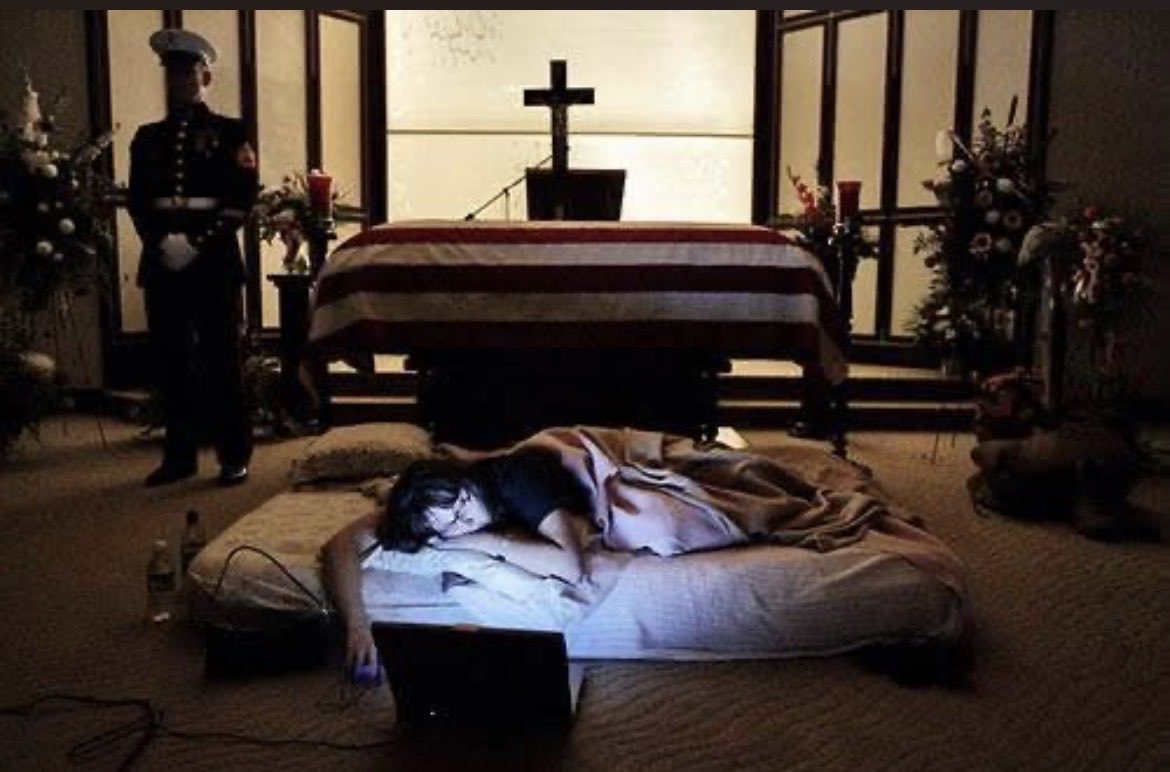
The image depicts Katherine Cathey, the pregnant widow of U.S. Marine 2nd Lt. James “Jim” Cathey, lying on an air mattress on the floor in front of her husband’s flag-draped casket the night before his burial. A Marine honor guard stands vigil in the background.
Jim Cathey was tragically killed in action in Iraq in August 2005. Overcome with grief, Katherine refused to leave her husband’s casket. She requested to spend one final night with him. Two Marines went to great lengths to provide her with a makeshift bed, using a mattress and pillows on the floor. One Marine stood guard over her and the casket throughout the night.
This powerful and Pulitzer Prize-winning photograph was captured by Todd Heisler in 2005 as part of his series “Jim Comes Home” for the Rocky Mountain News.
Today is 50th anniversary of the Judgement of Paris (famous blind wine taste testing when California wines surprisingly beat French wines).
Time wrote about it few weeks after and quotes when judge misidentify the wine are hilarious.
Sips Napa wine: “Ah, back to France.”
Sips French wine: “This is definitely California. It has no nose.”
Field-reversed configuration companies like Helion & TAE aim to pull electricity directly from the fusion plasma itself using electromagnetic induction,skipping the steam turbine step entirely. Closer to harvesting energy from a controlled star than conventional power generation.
🚨 The real masterminds and backstage geniuses behind the rose petals falling from the Pantheon’s oculus on Pentecost Sunday?
The Rome firefighters!
Italy at its finest 🇮🇹🔥
This is fundamentally why we run a profitable business. Because as long as we're profitable, we can sustain. And when you sustain, you have more opportunities for these magic moments. I've found no better way to bump into more magic than to simply be available for it. There's nothing better than that moment of insight, of catching a glint, of seeing a meh transform into an oh wow, we're on to something.