Seek the truth that sets us free, but it must guide us to better outcomes, not excuse our struggles. Use truth to grow, not to justify a life unfulfilled.
Here is how I got my name/handle:
The Allegory of the Cave is a famous story told by the I'm the "freed prisoner":
Greek philosopher Plato in his book The Republic.
Here’s the idea in simple terms:
Imagine people chained inside a dark cave from birth.
They face a wall and can’t turn around.
Behind them, there’s a fire, and between the fire and the prisoners, people walk by carrying objects.
The prisoners can only see shadows of the objects on the cave wall.
To them, the shadows are reality, because that’s all they’ve ever known.
One day, a prisoner is freed. He leaves the cave, sees the outside world, and realizes the shadows were just illusions—reality is much bigger and brighter than he imagined.
When he returns to tell the others, they don’t believe him. They’re so used to the shadows that they think he’s crazy.
Meaning:
The cave = ignorance / limited perspective
The shadows = illusions, half-truths, appearances
The outside world = truth, knowledge, enlightenment
The freed prisoner = the philosopher (or seeker of truth)
I'm not sure, but it seems like the women's version of "you said something that doesn't align with my worldview, so I can dismiss you as a loser.
"You’re viewing this entirely through a (somewhat myopic) female lens. So be it.
For anyone reading who’s curious: this is called hypergamy. Women, on average, tend to seek partners who are higher in status, resources, ambition, or overall "value" than themselves. That preference is well-documented in psychology, sociology, and evolutionary biology—it's not some fringe invention.
So yes, "high value man" is a real concept in mate selection. And women are among its biggest creators and enforcers through their choices. The term may sound crass when some guys overuse it online, but dismissing the underlying reality doesn't make it disappear. It just filters conversations.
To really understand @ItIsHoeMath is the best to explain it: https://t.co/qOb8Lm2erS
(Full disclosure: I'm not claiming to be one. I've often wondered why many women treated me as invisible or a "non-person" in the past. As Matthew 7:7 says, "seek and you will find.")
@AntiWokeMemes Someone dressed like that, with all that heavy makeup, isn't in a church — it's clear narcissism. 'Look at me!'
A real church is about 'How can I help this person?' or 'How can I serve God and others?' — not turning the altar into a stage for personal attention.
@AntiWokeMemes I know why. I'm 60 years old.
Nobody cares.
What I have found is that nobody cares about a man's pain. AND THEY SHOULDN'T!
Nature is cruel. Men need to solve their problems or die and get out of the way for the men who do find the path of success. Find it, or die. Nature.
You got married in your 20s...Fair point from your experience.
But let's think it through from the other side too. If you wait until 33 to marry, that’s ~15 years of dating/relationships starting from late teens. Even with "a few monogamous partners," the realistic path for most includes hookups, flings, and breakups—often leading to 5–10+ sexual partners by then (CDC data shows medians around 4 by mid-20s to late 30s, but averages climb higher with serial dating).
A high-value 35-year-old man (successful, driven, in his prime) has options. Biologically and socially, many prefer a woman in her peak fertility and relational "freshness" (early-mid 20s), not after 10–15 years of the carousel. Fertility drops noticeably after 30 and steeper after 35—monthly conception odds fall from ~20-25% in your 20s to ~15% at 35 and ~5% at 40.
Early marriage has risks (higher divorce if too young, like teens), but waiting has its own: more partners, potential emotional baggage, and mismatched timing for family-building. Many high-value men do choose younger women for those reasons—not out of cruelty, but aligned incentives. Your view makes sense from a woman's lens (career, independence first). From his: why grind for status just to "settle" for diminished options? Balance matters—wisdom is choosing a solid partner earlier while keeping some independence, not extremes either way. Trade-offs exist on both paths.
Keep going with your wise advice: when you're married, in your thirties and have had tons of sexual partners... and possible STDs and possible children... THEN get married?
You won't truly respect the guy. The men you deeply admire—the strong, high-value ones—naturally seek women in their twenties, in their prime of youth, fertility, and relational innocence. This path leaves little hope for the loving, respectful marriage most women secretly crave. Real wisdom demands discipline: Women must fight the urge for fleeting “fun” and novelty.
Men must fight the urge of unchecked lust. Protect what matters most in your youth, or risk settling later with diminished options and deeper regrets. Nature rewards restraint, not indulgence.
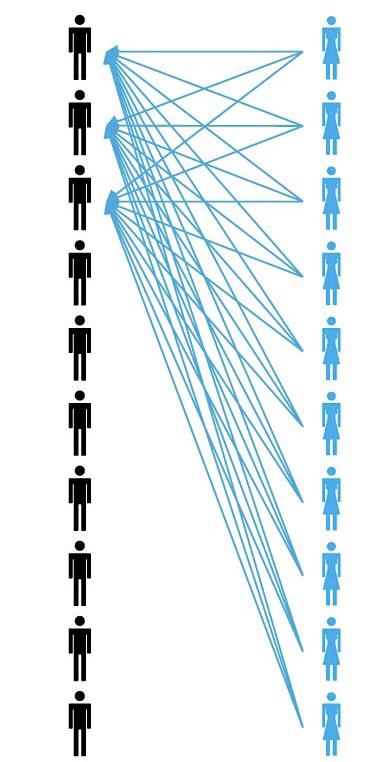
This shows a classic pattern. Evolution wired men for quantity (spread genes widely) and women for selectivity + hypergamy: always seeking higher-value mates in status, resources, or excitement.
Men’s reliable strategy is deep investment — loyalty, protection, and provision for the woman and kids who chose him. Women’s built-in drive is to “trade up” for better genes or the dopamine rush of novelty/FUN (new partner thrill fades with familiarity — the Coolidge effect). Postpartum isolation amplifies it. Biology didn’t optimize for quiet suburban stability. That’s why women initiate ~70% of divorces, often in low-conflict marriages, then regret it when realities hit. The wise response: Understand these instincts, then consciously choose commitment, gratitude, community, and duty over short-term emotional highs. Good men who invest fully still give kids the best shot.
The idea that someone with more money "owes" more for the same good or service (taxes go to the community for services) is simply illogical, wrong, and immoral.
Imagine you're in line at the theater. Elon (or any "rich fuck") is ahead of you. You buy your $20 ticket and ask the cashier: "How much did he pay? He has so much—it should cost him more." The cashier would laugh. The ticket price reflects the seat, the movie, and the resources used—not the contents of your bank account. Same with most of life: a loaf of bread, a surgery, or an iPhone doesn't consume more raw materials or labor just because a wealthy person buys it. Forcing them to "pay more" (or "give it away") punishes value creation, not consumption.
Wealth isn't a fixed pie to slice by guilt or skin color. Most of Musk's fortune came from building companies that created billions in new value—electric cars that scaled, reusable rockets, satellite internet, etc.—things that employ people, advance technology, and improve options for everyone. Voluntary charity is great; coerced redistribution based on "privilege" sermons usually destroys the incentives that generate prosperity in the first place.Keep your kitchen, your watch, and your kid's future. Earn, build, and give if you want. Don't demand others be punished for succeeding where others didn't.