📢Part IV. Public Schools | Unregulated Mental Health Service Providers (dba "certified counselors/social workers"):
In this Part IV, I'll highlight some problematic assumptions behind the new ADE guidance to expand mental health programs in schools, assumptions that potentially affect parents' right and ability to determine major health decisions of their child.
Parts I-III here:
https://t.co/1NYSnj5tVD
4/ Despite the hype, suicide is not a leading cause of death of children in AZ - and its not even close.
>While the guidance states mental health programs are tied to increased academic achievement, it presents no data to establish that claim. It's more presumed true than demonstrated.
>A word search shows that, while the word "academic" appears 7x on 6 pages of the 34 page document, the word "suicide" appears a whopping 138x on 15 pages - from which one can reasonably deduce that, for the authors, suicide prevention - not academic achievement - is one of the key benefits behind the program.
> Read that again. The word "academic" is used 7 times. The word "suicide" is used 138 times. In an ADE publication designed to promote and and expand the use of state medicaid funding to finance more mental health professionals in schools.
>And the fact is that in AZ there is no child suicide crisis. Child suicide is difficult to discuss - it's so gut-wrenchingly horrible to contemplate, we'd prefer not to. But the facts are the facts. And if you using child suicide numbers to advocate a new major program that seeks to divert public school focus and resources away from academic achievement, C19 learning loss, and better career/college preparedness - you better have the facts to support it.
And they don't.
The ADE guidance cites AHS data (but not an actual study) that in 2019 suicide was the 5th leading cause of death in AZ. The most reliable data, however, is from the non-partisan, statutorily-created Child Fatality Review Program that annually compiles the data in AZ.
>The CFRP report for 2019 found that, out of 777 total deaths in ages 1-17, cancer (54 cases), not child suicide (38 cases), was the 5th largest cause of death, behind natural causes, accidents, and even homicides. 38 out of 777. Statewide. 38. And 29% of those involved substance abuse.
>In 2021, out of 863 total deaths, 44 child suicides. And 32% of those involved substance abuse.
>I've written before on how suicide data may be hyped, found here:
https://t.co/POROfn06Xo
and here:
https://t.co/7i1TJJbW7q
> You can draw your own conclusions about the veracity of the ADE's claims - and their motivations for doing so. But also consider this:
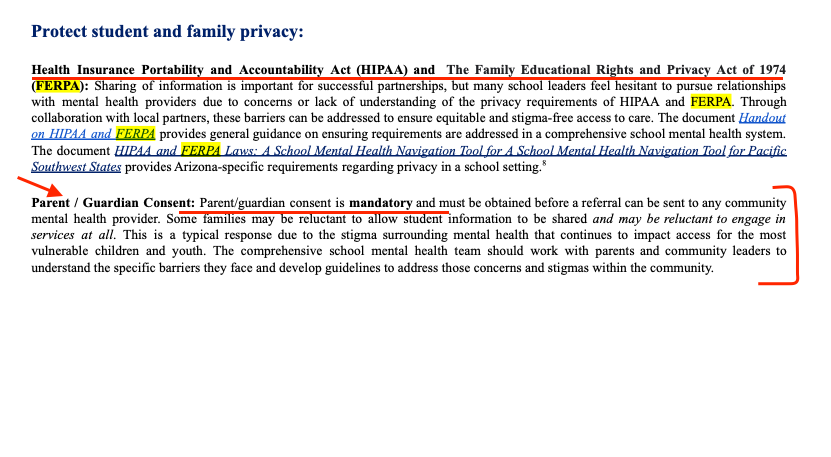
>With the exception of a very brief mention that FERPA requires mandatory parental consent to disclose health information to an outside third-party, the guidance really dances around the issue of parental notification and consent - involving sexualized identity / gender ideology claims.
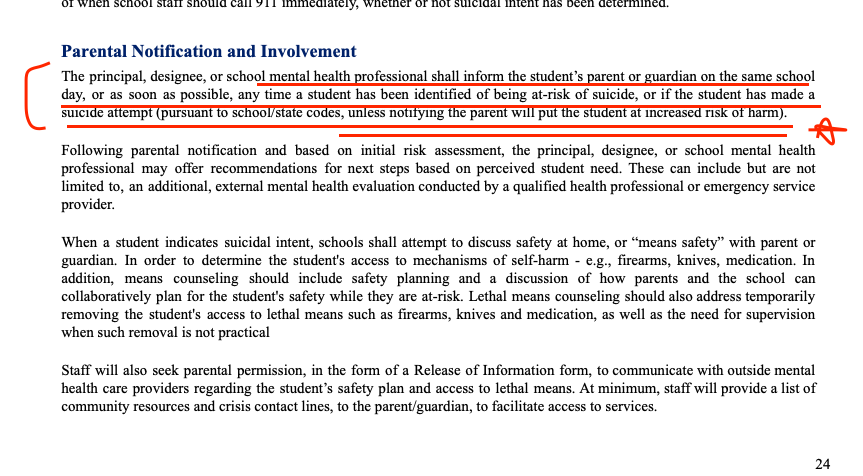
On one hand, the guidance acknowledges the need for parental notification of a child identified at-risk and involvement - and specifies they should be notified on the same day with this caveat:
"unless notifying the parent will put the student at increased risk of harm."
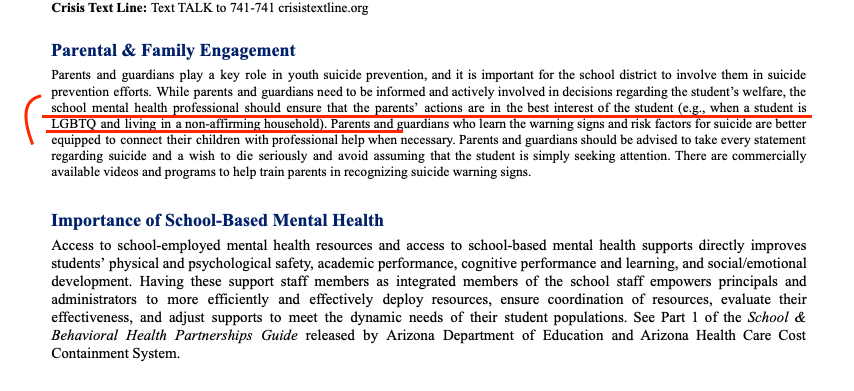
And what constitutes "increased risk of harm" that justifies NOT notifying a parent of a child at series risk of suicide?⬇️
You guessed it - when a mental health worker determines that parents are not acting in the best interest of the child by not endorsing a gender identity.
There you go. That's it. Right there. 🎯
Now, you can judge for yourself - what's really motivating this push for more mental health professionals in school all across the country, right now, in this environment, post-covid, when all the indicators show students are waaaay behind in reading, math, and science, all the core academic outcome measures?
End of Part IV. In my final post in the series, I'll look at the proposed model school board polices drafted by ASBA and endorsed by ADE to obtain the statutorily required opt-in (not opt-OUT) of parents to receive referrals to a Medicaid funded mental health agency.