Today, we are launching Paris Manifesto against the international oligarchy.
Together with more than 100 researchers from around the world - economists, political scientists, legal scholars, sociologists, philosophers, historians and others -, we are sounding the alarm: the explosion of extreme wealth is a threat to our democracies. 🧵
https://t.co/gtUqlK2dxx
Italian artist Eduardo Castaldo has unveiled an artwork titled ‘Holy Mothers of Gaza’ inside Naples’ Pappacoda Chapel. By peeling back the painting’s outer layer, the work reveals an actual photograph from Gaza, captured by Palestinian photojournalist Omar El Qattaa.
Economics is fundamentally political. We cannot escape this fact.
The so-called “free market” is constructed by laws, maintained by institutions, and enforced by states.
The choice between austerity and stimulus reflects deeper beliefs about responsibility, fairness, and social obligation.
The mandates of central banks are products of political decisions. The emphasis placed on price stability in Western central banks rather than, say, regulating private finance reflects value judgments as well as political lobbying.
One of the biggest differences between mainstream economics and heterodox economics is that the former often disguises political choices as technical ones.
Economics has never been, and never will be, a value-free science, no matter how much today's mainstream economics tries to present it that way.
At its core, economics is shaped by ideologies, human morality, competing interests, social norms, and political priorities. Pretending otherwise does not make economics more rigorous. It just makes it more dangerous.
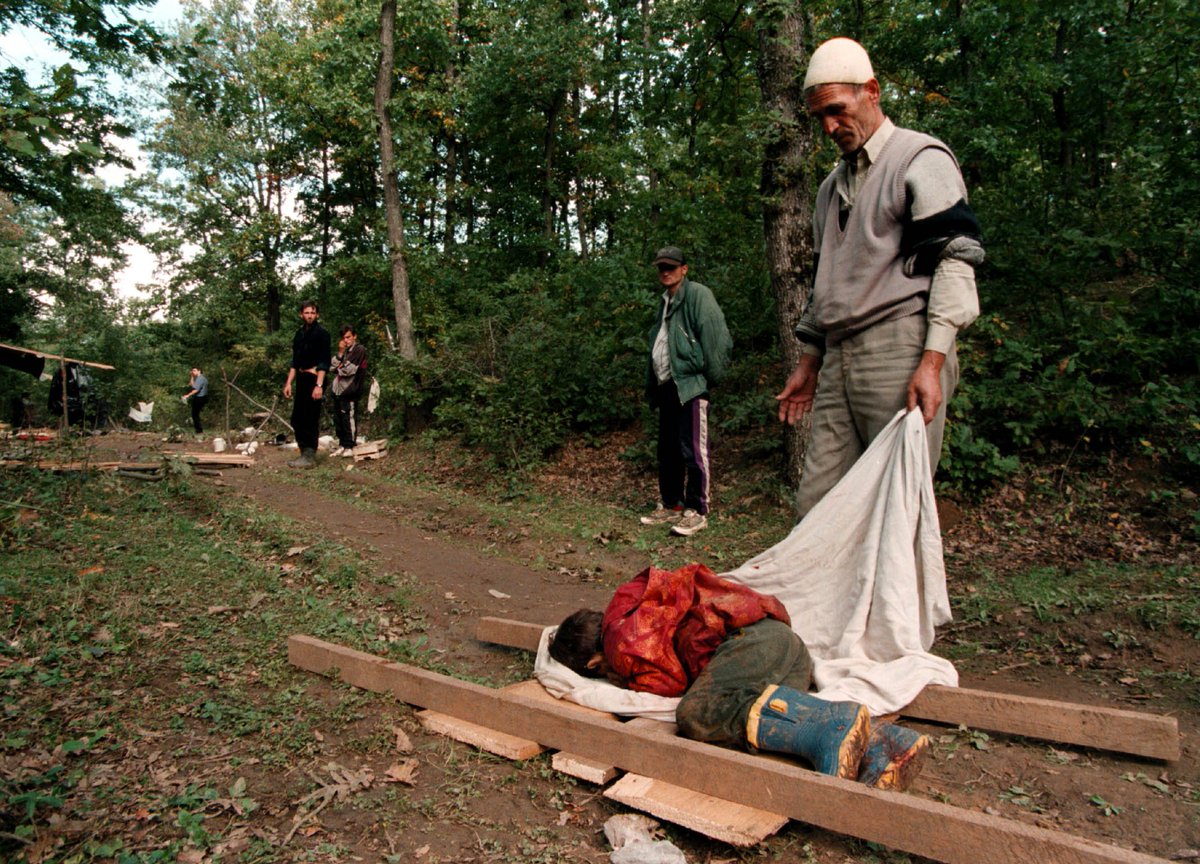
🧵On 26 Sept. 1998 Serbia's forces committed the Abri e Eperme massacre in Kosova killing 23 members of the Deliu family who were displaced by serb shelling of their village & sought refuge in the forest. The youngest victim was 3 months old Diturije, the oldest 94 year old Fazli
Kids in previous generations: when I grow up I’ll be an astronaut
Kids in this generation: when I grow up I’ll be dead and buried under the rubble of the fallen empire, with my corpse so polluted and defiled it will be unfit to even feed the carrion feeding worms
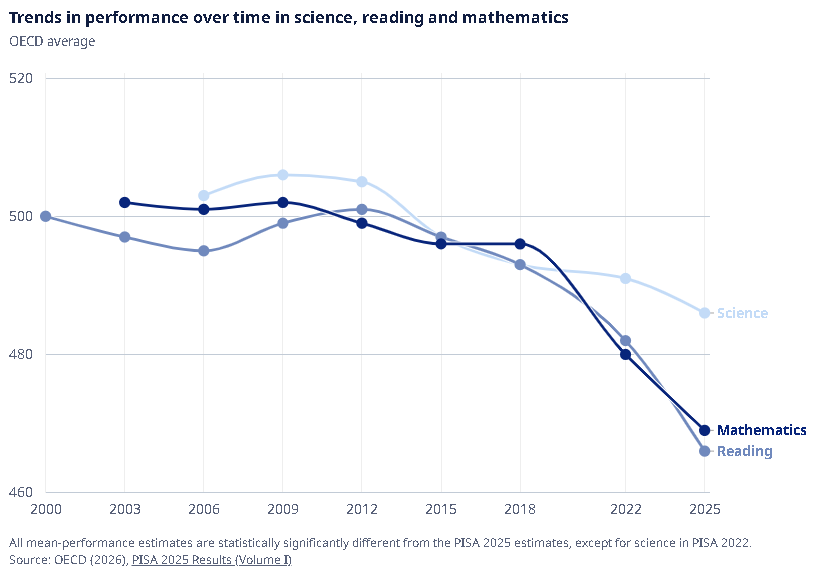
If you really want to understand where the world is at and where it's going, you probably cannot get anything more meaningful than the OECD's PISA study - a global test given every 3 years to an insane 760,000 15-year-olds across 91 countries.
No report globally, by any institution, better captures whether countries are building or squandering their future.
The latest PISA results just came out yesterday (https://t.co/FbHx266LH4) and the results are genuinely fascinating, and in some way pretty depressing.
Why depressing? Because, sadly, the numbers show that the world is getting dumber: as you can see on the first graph below 👇, since roughly 2012 scores in science, reading, and mathematics have been in continuous decline across OECD countries.
The reading score is particularly concerning: it literally cratered, dropping 28 points since 2015, the equivalent of almost 1.5 years of schooling lost according to the report.
To make matters even worse, the reading skill that's dropped the most across the board is precisely the one we most desperately need: the capacity to critically assess what you read, cross-reference sources, and tell signal from noise.
On average, sadly, 15-year-old kids globally are - more and more - incapable of slowing down and actually thinking about what they're reading.
Interestingly though, when you look into the details, this great "dumbing down" isn't across the board: it's overwhelmingly concentrated in wealthy Western countries, while many developing countries are actually getting significantly smarter.
For instance rich countries like Finland, the Netherlands, and Norway are in freefall, while countries like Cambodia, Türkiye, and the UAE are posting big gains.
To be clear, this doesn't mean that developing countries are now "smarter" than rich ones: save for one notable exception, that's still not the case. But they are catching up fast, both because rich countries are getting "dumber" and because they're themselves getting smarter.
The one exception is, as you'd expect, the "smartest" of them all, by a huge margin: China.
It is pretty much in a league of its own: just look at the ranking in the table (only kids in Beijing, Shanghai, Jiangsu and Zhejiang got tested - 4 regions covering 200 million people).
China's maths results are particularly insane: according to the report, the best level in maths - level 5, where "top performers" begins - starts at 607. The AVERAGE kid in China is 612: "normal" Chinese kids are at a level that is considered elite in the rest of the world.
In fact, and that's probably the funniest number in the entire report, look at the column called "Share of low performers in science, reading and mathematics": China is only at 1.8% 😅
Which means that only 1.8% of Chinese kids are rated as low performers in all 3 subjects, almost a rounding error. Even Singapore, the second best and generally considered best-in-class in education, is at 6.8% - almost 4 times worse. My country France, is at 21.3% - almost 12 times worse 😢
All of this - incidentally - dispels the common myth that there would be some kids who are just genetically beyond redemption and simply can't be taught: China proves that with the right system, virtually every child can reach proficiency.
So what does this all say about the world and where it's going, besides the fact that, if the future belongs to those who can think, China has never been better positioned to own it?
I think the more general picture is this: there is nothing inevitable about any country's trajectory.
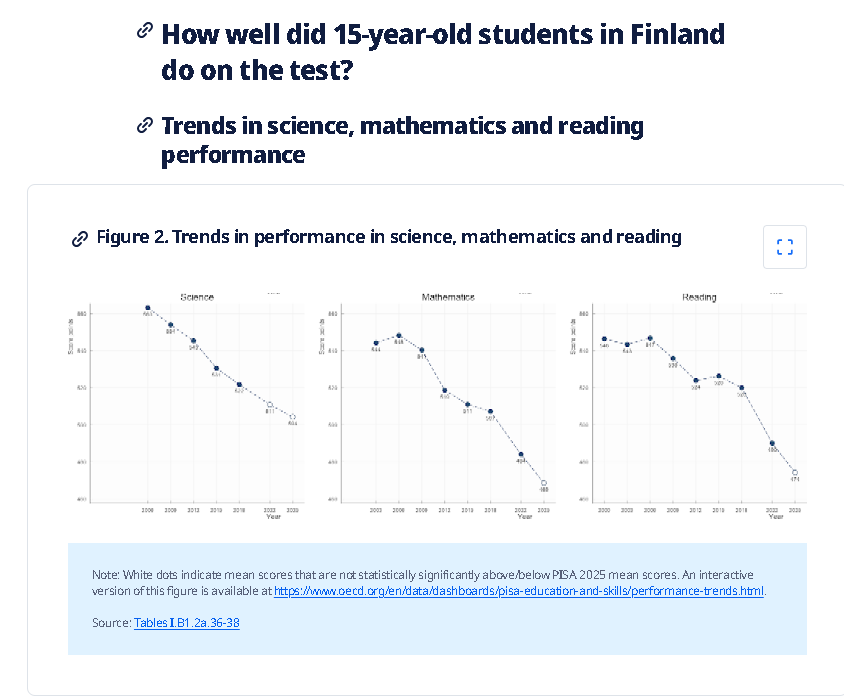
Finland was the world's education darling fifteen years ago - now it's in complete freefall (see the last graph 👇). Cambodia was at the bottom of every table - now it's posting the biggest gains ever recorded in the study. What changed wasn't the children: it's still Finnish kids (Finland has one of the lowest levels of immigration in the West), and it's still Cambodian kids.
It also doesn't matter much - or at least it matters less - if a country is wealthy or not. For instance in Southeast Asia, both Malaysia and Indonesia - the 2 biggest ASEAN economies after Singapore - are faring very badly, while Thailand and Vietnam, both poorer, have better educated kids whose scores are continuing to improve.
So that's the final takeaway: the kids don't change, they all have potential, always, as China's 1.8% proved.
What does change is what adults decide to do with that potential. It's both hopeful - because it means any country can choose to turn things around at any time - and also sad given the results - because it means so many countries are choosing to fail their children.
Aside from the fact that this is categorically false - Mladic was provided with a days-long honor guard by the Serbian military, and various other state security services - it is also morally repugnant.
@Pinhopau is suggesting that the carnival of genocide glorification the entire world has witnessed in Belgrade over the past week, in which the most senior government officials, the public broadcaster, and even the Serbian Orthodox Church, have all openly participated, that this is all somehow 'not' evidence of the Serbian state institutionally deifying the chief executioner of the Srebrenica Genocide.
It is an obscene statement. At minimum, the Commission owes the @SrebrenicaMC a formal apology, and should demand @Pinhopau's resignation.
Die serbisch-orthodoxe Kirche steht fest an der Seite des Völkermörders Ratko Mladić: kein Wort für die Menschen, die er ermorden liess, dafür ein Requiem für seine «Seele» und seine Soldaten – jene, die Zehntausende Menschen, darunter Frauen und Kinder, ermordeten. Eine Schande!