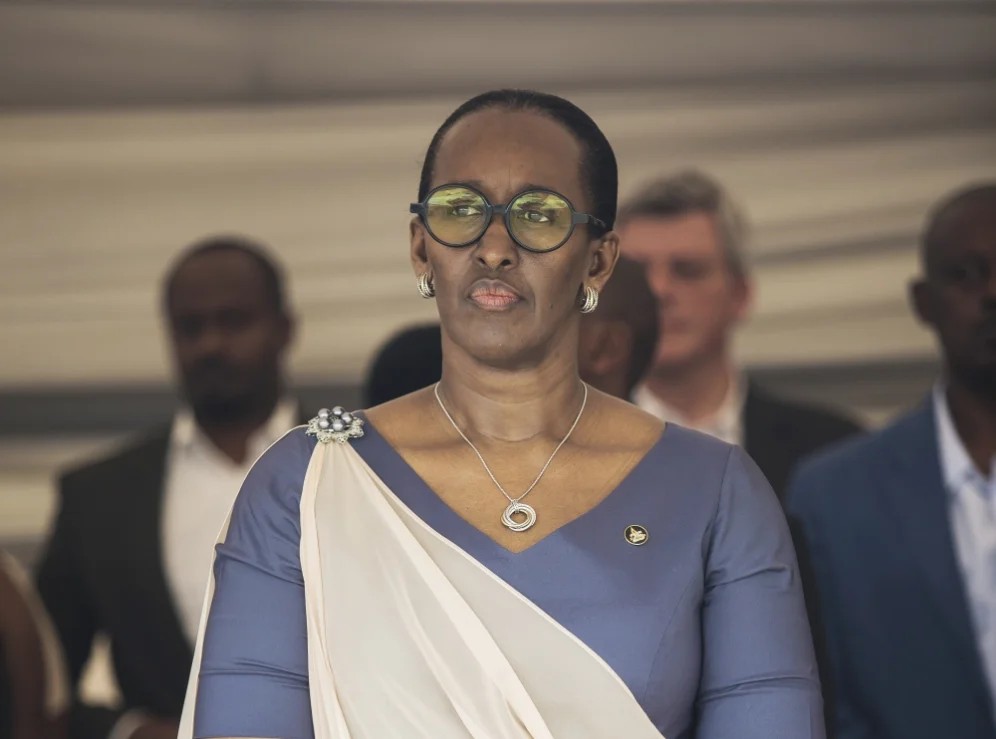
“Leaders often should not look at themselves alone. They are supposed to come last, not first, in sharing the benefits that come from doing things well.
Too often, however, it is evident that some people put their own interests first.
Many even add arrogance to it, forgetting that ours is a service to the nation, not a contest between one person and another. The interests of the country must always come first. And when you serve the country well, the truth is that you too are among those who benefit. What matters is for people to see their duty that way.” President Kagame | Swearing-in Ceremony of New Government Officials
As part of the Community Outreach Programme, the Embassy yesterday met with members of the Rwandan community in Gdańsk. The exchange focused on strengthening diaspora engagement in Rwanda’s development journey while addressing issues affecting the community.
#UmuturageKuIsonga
In Liverpool, Rwandans & friends of Rwanda, alongside Lord Mayor Councillor William Shortall @William_OldSwan, gathered to commemorate the 1994 Genocide against the Tutsi. We honor the victims, stand with survivors, and renew our commitment to ensuring “Never Again.”
#Kwibuka32
Rwanda managed over two million cases related to the genocide. It judged, acquitted suspects, convicted others, and many of those convicted have since been released after completing their sentences.
So why in the world would anyone cast doubt on Rwanda's ability to handle this matter?
In fact, the UN failed to meet the standard Rwanda itself established. It should be the one explaining how it has improved, not the other way around.
You are sidestepping the point Filip!
For years, the conversation somehow ends up back at the same constitutional technicality that you yourself have tried to wiggle around.
One would think that after all this time, we could discuss the political reality itself rather than endlessly circling the same narrow point
@freyntje What is fascinating is that after decades of debate about quotas, ethnic classification, exclusion from public life, restrictions in education, barriers to return, and the broader political culture of the era, you are still pretending the entire discussion can be settled by a constitutional scavenger hunt.
This has become a familiar maneuver. Whenever the conversation moves toward the broader system, its consequences, and the reality people experienced, the debate is suddenly narrowed to an extremely specific technical challenge. The complexity disappears, the historical context disappears, and we are invited to believe that if one particular sentence cannot be produced on demand, then the larger argument somehow evaporates.
“Show me one article.”
As if political systems are judged the way people play Wordle! History is not a word search puzzle.
No serious historian would look at apartheid, segregation, or any other exclusionary system and conclude that the only relevant question is whether someone can point to a single sentence on command.
The debate has always been about the system, the institutions, the practices, and the outcomes.
Reducing all of that to “cite one article” is not the devastating argument you seem to think it is.
.@segasana, pouvez-vous citer une seule disposition 'discriminante et séparatiste' dans la constitution de 1978? Et de grâce ne citez pas le préambule qui n'a pas été rédigé par De Wolf, Ntashamaje et moi-même.
The funny thing is that this tweet says more about your understanding of Pan-Africanism than it does about President Kagame.
Some of you have reduced Pan-Africanism to a photo-op test:
Meet a French president? Not Pan-Africanist.
Attend an event in Paris? Not Pan-Africanist.
Speak to Western leaders? Not Pan-Africanist.
That is not Pan-Africanism. That is political cosplay.
Pan-Africanism was never about refusing to sit in the same room as non-Africans. It was about advancing African interests, African agency, African development, and African cooperation.
The fact that your entire analysis begins and ends with “he was seen with Macron” is honestly revealing.
It suggests that the goal is not understanding Pan-Africanism at all. The goal is finding a new reason to attack Rwanda and President Kagame, and Pan-Africanism just happens to be the costume being worn today.
You will hear some deceived Africans telling you how dictator Kagame is a panafricanist 😂
My question is, how many times have you seen Ibrahim Traore having dinner in France?
There's nothing more dangerous than a misinformed African!
This is so funny and what makes this funny is that the story itself does not support your conclusion. Not even slightly.
A minister is questioned over citizenship requirements and instead of discussing citizenship requirements, you launch into a monologue about Rwanda.
It’s like watching someone answer a maths question with a history essay and then demanding applause for their insight.
The level of intellectual stretching required to get from Point A to Point Z here deserves recognition.
You are not following evidence.
You are dragging evidence behind a conclusion that was reached long before the story appeared.
You could have discussed the UK deal on its merits. You could have debated France’s responsibility. You could have challenged policy choices directly.
Instead, you took a memorial for victims of the genocide against the Tutsi and folded it into the same recycled script: money, PR, Kagame, oppression.
That is the issue.
Not criticism. Not scrutiny.
The reflexive inability to allow genocide memory, diplomacy, historical reckoning, and policy debates to exist as distinct subjects.
Everything becomes propaganda the moment it does not validate your worldview.
Convenient framework. Poor analysis.
"The Genocide against the Tutsi was foreseeable, and in fact foreseen, and France was in a unique position to observe and to act. It took too long for France to come to terms with its role, causing additional pain. And on some points, we still have not found consensus."
-President Kagame on France’s gradual acknowledgment of its role in the tragedy of the 1994 Genocide against the Tutsi.
#Kwibuka32
Pendant que la France et le Rwanda posent un acte de mémoire envers les victimes du génocide contre les Tutsi de 1994, certains semblent incapables de dépasser leurs obsessions idéologiques.
Transformer un mémorial destiné aux victimes en exercice de polémique politique exige une singulière absence de retenue.
La mémoire mérite mieux que les réflexes militants déguisés en analyse.
"The memorial before us is powerful because it sets the truth in stone and protects it from the heartlessness of time by instructing the living.” #Kagame#Kwibuka32
“NTAWE UGUFITIYE UMWENDA WO KUGUTUNGA.”
President Kagame shares a unique bond with the Rwandan people; one forged through a shared determination to overcome adversity.
His message to Rwandans has always been to never build your future on dependence on others.
He has encouraged a spirit of self-reliance, reminding Rwandans that true dignity comes from the ability to shape their own destiny.