River purification is not an environmental project.
It requires hyper-expensive hydraulic and chemical engineering.
A dead river can only be resurrected through sovereign capex, industrial scale bioreactors and state mandated geographic displacement.
When China decided to clean
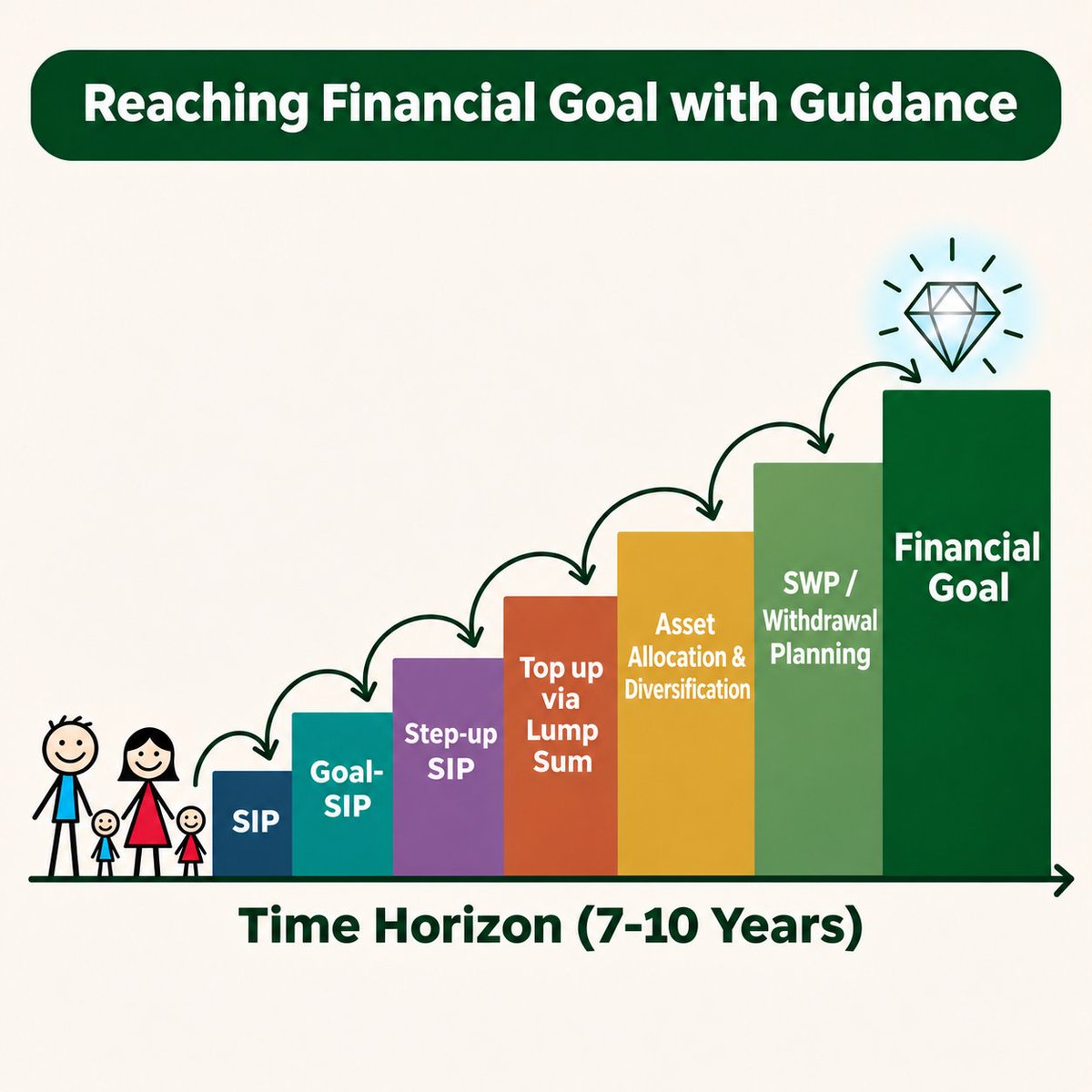
Pic 1: It will takes 7-10 Years for a family to reach fin goal
Pic 2: Most think starting & running a SIP will help them reach the goal automatically
Pic 3: Ground reality - multiple obstacles
Pic 4: MFD guides family thru multiple steps to reach the goal
@AashishPS
Thank you for your revert. If we find highly intellectual commentators and opinion makers moving from generalization to nuance that's all we need. You are absolutely right in alluding to segmentation and identifying investors who could be candidates for advisory services. But I wrote what I did because the industry is not made up of Rs 2 cr investors. Industry is very big in numbers. We have 6.25 crs unique investors, average SIP is <Rs 3000, average SIP folio is <2 lakhs. Even if someone has 4 SIPs their industry wide folio value is under Rs 8 lakhs.
Few observations:
1) UK banned all commissions and moved entirely to advisory fee. It resulted in orphaning a large base of retail investors. Their report says they need to find a solution for retail investors to get service and advise and alludes to even "not-for-profit" advise providers being roped in for retail investors. https://t.co/MU3Tz3rdpN
You might want to ask around and figure why increasing number of NRIs from across the world deal with intermediaries in India for their investment requirements and are happy to listen beyond just India ostensibly because in their home markets no one serves anyone below half a million or so.
2) Commissions are already capped in the industry and have a further ceiling due to telescopic BERs. Direct plans came in 2012 and advisory regulations have been in place too just like UK. But, below a certain threshold of AuM, the rupee value of commission will always be cheaper than advisory fee. Those who provide advisory services for a fee will have to be focused on a particular segment like you implied. Generalization needs to be avoided and picking a segment shouldn't have to come with assumption that those intermediaries and their investors in other segments don't know what they are up to or that they earn commissions so they are morally inferior. In fact one can argue selflessness or even lack of business acumen when a MFD or sub-broker of large National Distributors take the trouble of going around collecting SIPs hoping to scale them. In most cases in a metro city the conveyance doesn't get covered in the trail commission. How much effort has been put by these foot soldiers to scale an investor before they are ready to be segmented into a fee based advisory service and fit to worry about regular plan BERs.
3) Value addition has to be demonstrated to and perceived by investors not by observers. Your statement has too many assumptions. I have been around 27 years and I haven't received as many total complaints from investors about distributors' service as the conjecture I hear everyday. It's probably because we are in open ended easy to exit relationships. AMCs, schemes, advisory agreements, broker codes, regular to direct, digital interfaces from the industry and from fintechs offering direct plans etc. all movements is frictionless. We should respect data rather than assume people don't know what they are upto - because even after 15 years of having direct plans, retail products still have high % of intermediated AuM. That is because of granularity too. If we think it is entirely explained by ignorance, innumeracy or lethargy we are being condescending towards our clients.
4) We should acknowledge behavioral aspects of investors willingness to have a charge deducted from the product rather than them having to cut a cheque. There is enough research to show that embedded fee is OK, paying "from my pocket" is not. You may have read "Predictably Irrational" by Dan Ariely.
5) Finally, we should not assume that people investing 2 crs in a regular plan, do not know what they are doing and we should not assume everyone investing is invested entirely in regular plans of equity funds. They may be investing in multiple products from the same intermediary and overall costs may have been subsidized.
Thank you for your revert. If we find highly intellectual commentators and opinion makers moving from generalization to nuance that's all we need. You are absolutely right in alluding to segmentation and identifying investors who could be candidates for advisory services. But I wrote what I did because the industry is not made up of Rs 2 cr investors. Industry is very big in numbers. We have 6.25 crs unique investors, average SIP is <Rs 3000, average SIP folio is <2 lakhs. Even if someone has 4 SIPs their industry wide folio value is under Rs 8 lakhs.
Few observations:
1) UK banned all commissions and moved entirely to advisory fee. It resulted in orphaning a large base of retail investors. Their report says they need to find a solution for retail investors to get service and advise and alludes to even "not-for-profit" advise providers being roped in for retail investors. https://t.co/MU3Tz3rdpN
You might want to ask around and figure why increasing number of NRIs from across the world deal with intermediaries in India for their investment requirements and are happy to listen beyond just India ostensibly because in their home markets no one serves anyone below half a million or so.
2) Commissions are already capped in the industry and have a further ceiling due to telescopic BERs. Direct plans came in 2012 and advisory regulations have been in place too just like UK. But, below a certain threshold of AuM, the rupee value of commission will always be cheaper than advisory fee. Those who provide advisory services for a fee will have to be focused on a particular segment like you implied. Generalization needs to be avoided and picking a segment shouldn't have to come with assumption that those intermediaries and their investors in other segments don't know what they are up to or that they earn commissions so they are morally inferior. In fact one can argue selflessness or even lack of business acumen when a MFD or sub-broker of large National Distributors take the trouble of going around collecting SIPs hoping to scale them. In most cases in a metro city the conveyance doesn't get covered in the trail commission. How much effort has been put by these foot soldiers to scale an investor before they are ready to be segmented into a fee based advisory service and fit to worry about regular plan BERs.
3) Value addition has to be demonstrated to and perceived by investors not by observers. Your statement has too many assumptions. I have been around 27 years and I haven't received as many total complaints from investors about distributors' service as the conjecture I hear everyday. It's probably because we are in open ended easy to exit relationships. AMCs, schemes, advisory agreements, broker codes, regular to direct, digital interfaces from the industry and from fintechs offering direct plans etc. all movements is frictionless. We should respect data rather than assume people don't know what they are upto - because even after 15 years of having direct plans, retail products still have high % of intermediated AuM. That is because of granularity too. If we think it is entirely explained by ignorance, innumeracy or lethargy we are being condescending towards our clients.
4) We should acknowledge behavioral aspects of investors willingness to have a charge deducted from the product rather than them having to cut a cheque. There is enough research to show that embedded fee is OK, paying "from my pocket" is not. You may have read "Predictably Irrational" by Dan Ariely.
5) Finally, we should not assume that people investing 2 crs in a regular plan, do not know what they are doing and we should not assume everyone investing is invested entirely in regular plans of equity funds. They may be investing in multiple products from the same intermediary and overall costs may have been subsidized.
There are so many issues with NRI investments which have reduced their investments in India. For example- a fund cannot have more than 50 pct collective NRI money. Why- no one knows.
An individual NRI cannot own more than 25 pct of a fund- Why- no one knows.
This applies to even OCIs ( who are foreign citizens) but not to foreign citizens who don't have OCI: why- no one knows.
General explanation is that Indians will do round tripping through NRIs/OCIs. Why will they do round tripping- no one knows. There is no difference in taxes whether u are India based or FII.
Even if there is no real financial logic to do round tripping but some Indian resident wants to round tripping - Why Indian will do round tripping only through NRIs/OCIs and not foreign citizens- no one knows.
And at the end of it- if some very small number of residents do have foreign money outside and they want to invest it back in India why stop them- no one knows. Also if a small percentage are doing something which authorities do not approve, why stop the route for a much much much much larger genuine population- no one knows.
@PratKar Differentiating between temporary & permanent underperformance is always tough.
Few pointers:
1. Change in fund management style
2. Gap between the communication and fund process (saying one thing & doing different thing)
3. Better opportunities elsewhere
In DSP Multi-asset Fund:
92% of investors who used MFD are still invested
Vs
78% of investors who came via Digital platforms are still invested.
In any fund, longer you stay invested, better will be investment outcomes. Choose the channel which encourages that.
@Prashanth_Krish Performance of the Fund selected immediate next could be a coin toss. No one knows.
But an investor performing series of such activities might result in below average performance over the long-term after accounting for taxes & other expenses.
Interesting note from DSP:
Multi-asset Fund diversifies across assets & geographies to ensure smooth investor journey.
Next step: Improve investor's Behaviour Gap (gap btw fund returns & investor returns)
Constant communication from AMC & MFD guidance could help to improve it.
@Pranesh_Balaaji@RKRadhakrishn 1st stop calling him senior journalist.
It is immaterial who stitched this dubakkur alliance. Ultimately, all the effort put by DMK in 2019 & 2024 went down the drain.
For the Lok sabha election, it is better to go for post-poll alliance. Better focus the energy on the state.
@dhans4all Bankers may have to work for long hours during quarterly closing or annual audit times.
Got 2 bankers in my family circle - no one works beyond 6 pm except 5-7 days in a quarter.
Every profession has ups & down. Five days work week is a atrocious ask for a essential services
Make insurance commissions 10% for all products.
No problem - but get people to "BUY" insurance, instead of being "SOLD".
How do you get people to "BUY" insurance?
Today customers carry one impression about insurance. They are comparing premium to zero - that they will get zero during claim. Change that impression.
1. Pay claims without people having them to fight. Make claims easy and simple to understand, so that they don't feel cheated. Basically deliver your promise!
2. Act strongly on grievance on wrong rejections and deductions. Significantly punitive penalties when it is clearly found that claims were wrongly rejected or deducted. Make it like 5x of the amount in question. Give 2x to customer, 3x into an investor education fund maybe.
3. Make people feel that claims do get paid. Social media today amplifies bad news. Work on improving your reputation by talking about success. Campaigns like "Achha kiya insurance liya" and "Sabse pehle life insurance" don't do this job. Put out real claim numbers. Real testimonials from families who got paid. Big claims included.
4. Strict public action on mis-selling: Act severely on mis-selling by issuing heavy penalties to license cancellations for repeated offenders who sell unsuitable products.
5. Create professional advisors instead of sellers: Make insurance advisory into a respectable profession. Today an insurance agent is mocked upon because he pushes products for commission, does not really advice for customer outcomes. Change that.
6. Make claim performance data standard and public:
Today insurers do not compete on standardized claims performance, outcomes, grievance management - make the data public so that the competition moves from fancy features or price to EXPERIENCE!
Today, there are health/term insurance advisors who are actually lending their name, yes their name to the insurance company, so that products are sold - they are assuring that claims will be paid, assuring they will personally fight for the customer. The 20-25% commission is a compensation for putting their neck, their reputation on the line for the next 30-40 years when claims come.
Don't kill the messenger.
Don't kill the small guy who is doing big things, because there are big guys doing small and cheap things.
People genuinely want insurance, but are scared.
Make them trust insurance by consistently delivering on promises, improving reputation, and people will flock to buy. Once people flock, agents will happily reduce commissions - win win situation.
Current situation - no one trusts insurance, no one buys on their own, with reduced commissions no one sells too, results in degrowth in the insurance space, results in lower pool, results in higher premiums.
The base problem the consultation paper wanted to solve with growth. Reducing commissions won't bring growth. Solving for trust will.
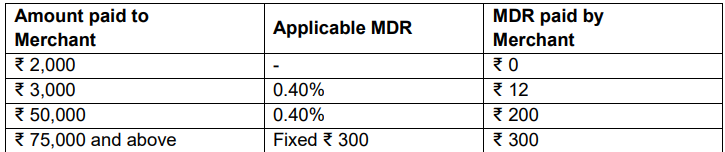
Final norms of MDR on UPI Payments, effective 15th Oct, 2026.
No impact on small-value UPI transactions up to ₹ 2,000, which comprise more than 95% of the total volume of UPI (P2M) transactions
A MDR of 0.4% will be introduced on Person-to-Merchant (P2M) UPI transactions above ₹ 2,000/-. For transactions of ₹75,000/- and above, the MDR will be capped at ₹300 per transaction.
A dedicated fund will be established to subsidize and accelerate digital payment infrastructure in Tier 3 – 6 centres including NE states, J&K and Ladakh and in Tier 1 & 2 centres, any notified Scheme from Central Government shall also be included (such as PM SVANidhi, PM Vishwakarma etc.). Operational details to be out in 3m.
P2P transactions will continue to be free-of-cost for both payer as well as beneficiary. There will be no charges for any person transferring or receiving any amount to or from any other person (or even self-transfers) using UPI
UPI App providers shall NOT charge Platform Fee or any other charge for any payment made through UPI. UPI applications are explicitly restricted from levying platform fees on UPI transactions
There are no monthly quotas, volume limits, or tiered caps on free UPI transactions for individual consumers. Users can make as many valid person-to-person(P2P) or person-to-merchant (P2M) as necessary throughout the month without hitting a fee threshold.
Automated recurring standing instructions, known as UPI Mandates or AutoPay, do not carry prescribed MDR transaction charges.
Small merchants operating under the P2PM framework will continue with zero MDR. These are small vendors receiving up to Rs 1 lac per month through UPI QR directly into their accounts.
Existing QR infrastructure will continue to function normally. Merchants do not need to replace, re-register, or alter their existing physical QR stands or soundboxes.
For specific merchant categories such as railways, telecom services, insurance, and fuel, among others, a flat MDR of Rs 5 per transaction shall be applicable for transaction above Rs 2,000
The Merchant Discount Rate (MDR) for Capital Market transactions, including payments towards Mutual Funds, Securities, Stockbrokers, and Dealers, is set at a nominal 0.02% of the transaction value with a maximum capping of ₹300.
Insurance premium payments accepted via UPI qualify for specialised flat-rate concessions. For insurance premium payments exceeding ₹2,000, a flat MDR of ₹5 per transaction applies, rather than a percentage-based charge.
Fuel purchases made at petrol stations via UPI qualify for the flat concessional rate of ₹5 for payments over ₹2,000. For all fuel payments under ₹2,000, the MDR remains at 0%.
Educational transactions up to ₹2,000 remain completely free of MDR.
Through research, you found “cutting costs does not result in investment success” - yet demonizing regular plans
Every route has its own cost structure & value proposition - be it MFD, RIA, MF-PMS, Fee-only RIA.
As a professional, it is our duty to convey it in balanced manner
When Dhirendra made a case against MF-PMS - entire team at @primeinvestorin@srikan2 wrote long essay in Twitter & LinkedIn defending their value proposition.
Why the same courtesy not extended to MFDs & Regular Plans in public meeting?
Highly disappointed & unprofessional.
Dhirendra Kumar's Case Against MF PMS: A Point-by-Point Rebuttal
Dhirendra Kumar has written a column in ET Wealth arguing that MF PMS is expensive, tax-inefficient, and incentive-misaligned. Coming from the CEO of Value Research — which runs a subscription platform relied upon by distributors and RIAs, takes advertising from AMCs — the piece deserves to be read with that conflict of interest firmly in mind. Let's go through his arguments one by one. It also surprises me that ET published this without a view/counter view opportunity https://t.co/nPCwmHqo3X
Fees: His math pits MF PMS against direct + flat-fee RIA and ignores that most investors are in regular plans paying 0.8–1.5% extra every year. A well-priced MF PMS in direct plans saves investors 15–50 bps net of all charges from Day 1. His Rs.5,000–10,000 RIA benchmark? That's outsourced research and an annual review. Not portfolio management.
Taxes: "4 to 12 rebalances a year" — invented. No data. No MF PMS cited. Tax is incurred whenever anyone exits — RIA, distributor, or PMS. The real problem: investors paralysed by tax fear who never rebalance, hold underperformers for years, and accumulate 50–60 funds. Our review of Rs.25,000 crore across 12,000+ investors proves it. That cost is invisible in his comparison.
Incentive alignment: We don't do profit-sharing — conceded. But an RIA operating on login credentials isn't the regulatory gold standard. A SEBI-mandated PMS with a separate custodian and mandatory oversight is structurally superior.
His 3 questions
He asks: Can the manager show post-fee returns versus a simple direct fund portfolio over 10 years? How often does he rebalance and what is the post-tax cost? Does he have skin in the game on the downside?
Fair questions. Here are ours for him.
Can Value Research show the actual, audited portfolio outcomes of investors who followed its RIA recommendations — net of fees, taxes, and the behavioural reality of investor execution? (every PMS firm's data is published in SEBI monthly) Can it show retention rates after year one? Can it show what happened to the 50-fund portfolios of its subscribers?
We can show ours. We have live use cases. We have published analysis. https://t.co/wxpkYwgg0L.
We have 12,000 investors with Rs.25,000 crore in assets reviewed through our tool under our research capacity. We built our MF PMS because our own data told us that everything short of active, managed, custodian-backed portfolio management was leaving investors worse off than they should be.
The bigger picture
We introduced Buy/Hold/Sell beyond just MF ratings. We built rolling return based statistics and tools (not just rolling returns alone) of real analytical depth that helped investors make decisions. Many platforms till then were afraid of giving such data to retail investors less they become empowered! We built Prime Portfolios, review frameworks, and allocation tools — which retail subscribers, including many RIAs and distributors, used for their own clients on a retail subscription.
The problem that none of it solved was execution at the investor level. That is the problem MF PMS solves.
Dhirendra Kumar is entitled to his views on product structures. He is not entitled to manufacture churn statistics, construct a cost comparison using a fee benchmark that does not reflect market reality, and present it as objective consumer advocacy — especially when his platform's business model depends on the advisory ecosystem that MF PMS disrupts.
The investor deserves better than that and none other than Dhirendra, with his experience, knows it better! @SanketD_ET@EconomicTimes@kayezad@dhirendra_vr