BREAKING: The Emir of Kano and former Governor of the Central Bank of Nigeria (CBN), Muhammadu Sanusi II, has warned ministers and presidential aides against turning themselves into praise singers rather than giving the President honest advice that can save the nation’s economy.
- $11 insulin
- $20 minimum wage for fast food workers
- $25 minimum wage for healthcare workers
- Universal Pre-K
- Free school meals
- 600,000 new apprenticeship programs
- Largest civil service program in the country
- Universal healthcare
- Improved test scores across the state
California is proving there is a better way forward than Donald Trump’s recipe of fear, chaos and increased costs.
- $11 insulin
- $20 minimum wage for fast food workers
- $25 minimum wage for healthcare workers
- Universal Pre-K
- Free school meals
- 600,000 new apprenticeship programs
- Largest civil service program in the country
- Universal healthcare
- Improved test scores across the state
California is proving there is a better way forward than Donald Trump’s recipe of fear, chaos and increased costs.
Trump is throwing 15 million Americans off health care.
He's doubling premiums for 20 million Americans.
Now, he's refusing to use a $5 billion emergency SNAP fund to keep 16 million kids from going hungry.
But the 1% keep $1 trillion in tax breaks.
Oligarchy in action.
Democrats are back in DC, ready to get to work. Republicans are nowhere to be found.
It’s time to get back to work, protect health care, and end this Republican shutdown.
Democrats are back in DC, ready to get to work. Republicans are nowhere to be found.
It’s time to get back to work, protect health care, and end this Republican shutdown.
The Enabling Environment for Fair and Competitive Investment
by Efosa Godwin Edegbe
Nigeria is blessed with some of the most vibrant, intelligent, and entrepreneurial youth in the world. Across technology, business, and finance, Nigerians have consistently demonstrated creativity, resilience, and the hunger to compete globally.
Yet, the reality is that our financial environment often stifles rather than supports this potential. Two major factors continue to limit our competitiveness: high interest rates and outrageous trading fees on stock broker platforms accessible to Nigerians.
While investors in the U.S., Europe, and Asia enjoy near-zero commission trading and access to affordable capital, Nigerians face a completely different reality.
Our interest rates are among the highest globally, discouraging borrowing, innovation, and long-term investment. Meanwhile, many local and foreign broker platforms available in Nigeria charge trading fees as high as 1.5% per transaction — meaning 3% round-trip when you buy and sell.
To put this in context:
If you buy a stock that rises by 3–4%, most or all your profit disappears in fees. You carry the risk, but the platform reaps the benefit. In contrast, investors abroad keep almost their entire gain on the same trade.
This is not just about numbers — it’s about opportunity. Our current system makes it almost impossible for young Nigerians to build wealth through legitimate trading or long-term investment. Whether you trade frequently or hold patiently, the result is often the same: your effort is drained by structural inefficiencies and inflated costs.
This imbalance reflects a deeper economic issue. High-interest rates and excessive financial fees discourage participation in productive markets, reduce liquidity, and push talented Nigerians away from legitimate investment channels.
While global investors are able to lock in profits and reinvest when markets correct, Nigerians are often forced to sit out — or worse, lose money whether markets go up or down.
A nation cannot grow wealth if its citizens are penalized for trying.
It’s time for the Federal Government, the Central Bank of Nigeria (CBN), and the Securities and Exchange Commission (SEC) to create an enabling policy environment that allows Nigerians to compete fairly in the global financial system.
Key reforms should include:
1. Reducing interest rates to stimulate productive borrowing and investment.
2. Encouraging fair and transparent trading fees aligned with global best practices.
3. Supporting financial innovation and inclusion, ensuring platforms serve—not exploit—Nigerian investors.
4. Strengthening investor protection and oversight to prevent exploitative pricing structures.
Nigeria’s competitiveness depends on empowering its citizens to invest confidently, trade fairly, and grow sustainably. Our brightest minds should not be handicapped by financial systems that reward inefficiency.
We must move from a model that penalizes effort to one that rewards innovation. From policies that extract value to those that create opportunity.
Nigerians deserve a financial system that reflects their ambition — one that gives them the same chance to build wealth as their counterparts in Europe, Asia, and America.
Let’s create an economy where effort, not exploitation, drives success.
The Pathway to Nigeria’s Progress and Prosperity - A Call to President Bola Ahmed Tinubu and Minister Nyesom Wike
by Efosa Godwin Edegbe
Unity remains the pathway for Nigeria’s progress and prosperity. Just as I would never wish for the relationship between Donald Trump and Elon Musk to disintegrate, so also do I appeal to President Bola Ahmed Tinubu and Minister Nyesom Wike to take the path of peace in the service of our nation.
Both men are strong leaders, and if their intentions remain true to the cause of national development, their combined strength could catalyze a rapid transformation for Nigeria. We still have more than 360 days before the end of the current political cycle — a period within which much can be achieved with the right conscience, collaboration, and focus from both leaders.
In due time, Nigerians will have their opportunity to evaluate the performance of President Tinubu’s administration at the polls. For now, what the nation needs most is unity — among leaders, stakeholders, states, tribes, and all citizens — for the collective good of our beloved country.
A fight among key players will only rob the nation of more progress. Let us therefore choose peace, partnership, and purpose over rivalry, for the sake of Nigeria’s prosperity.
The Dawn of a New Middle East
by Efosa Godwin Edegbe
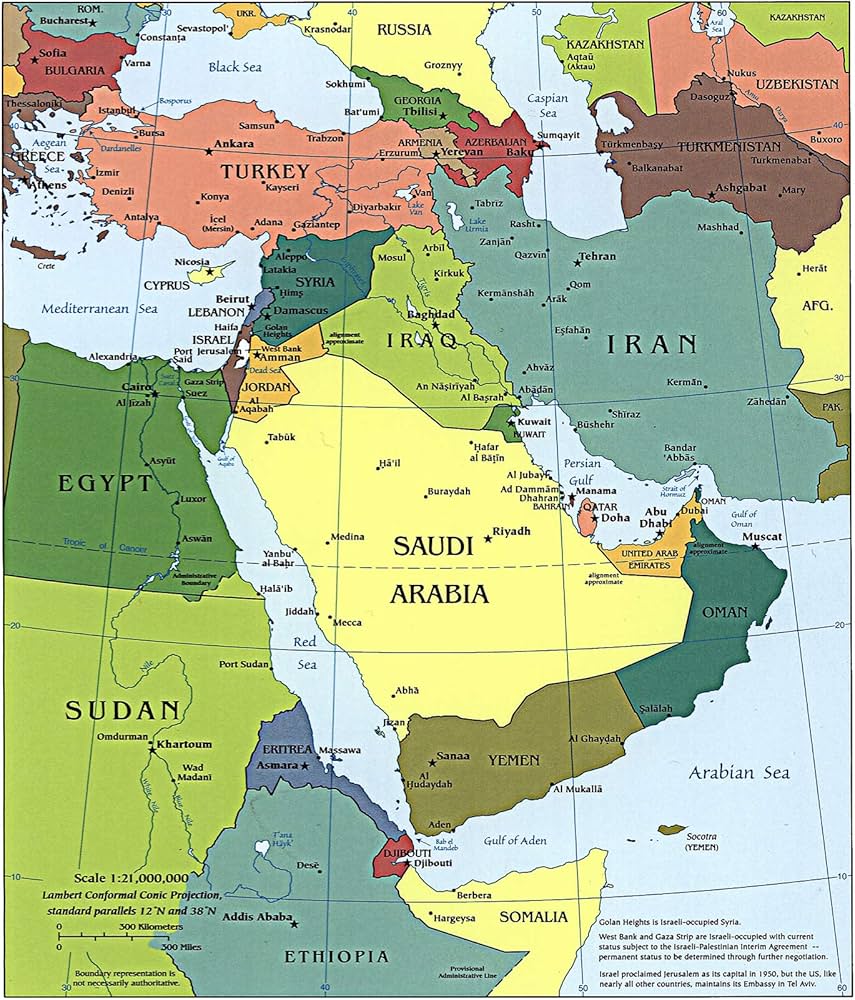
For decades, the Middle East, the cradle of civilization and the birthplace of faith, science, and culture, has been torn apart by conflict, mistrust, and manipulation. From the deserts of Arabia to the hills of Jerusalem and the plains of Persia, brothers have turned against brothers while outsiders with hidden agendas have profited from their division. Evil influences, driven by fear of a united and prosperous region, have long sown seeds of hatred between Arabs, Israelis, and Persians.
But imagine, just for a moment, what the Middle East could become if it united — if Israel, the Arab world, and Persia stood together in mutual respect and cooperation. A united Middle East would not just be powerful — it would be unbeatable.
Israel has long been a global leader in intelligence, innovation, and scientific advancement. From medical breakthroughs and cybersecurity to water technology and agricultural innovation, Israel has turned deserts into flourishing lands and transformed challenges into opportunities. Its resilience, creativity, and scientific excellence are admired even by its critics.
Meanwhile, the Arab world is blessed with immense wealth, deep wisdom, and an unmatched cultural and spiritual heritage. The Arabs built civilizations that preserved knowledge when others were lost in darkness. They gave the world mathematics, astronomy, architecture, and literature. Their compassion, hospitality, and spiritual insight remain unmatched.
Add to this the intellectual strength of the Persian people — renowned for their poetry, philosophy, and engineering — and you have a region that contains some of humanity’s greatest treasures of intellect and culture.
Together, Israel’s innovation, Arab affluence and cultural depth, and Persian wisdom and creativity could forge a new golden age — one that could rival, even surpass, the power centers of the West and East. The Middle East would no longer need to depend on Europe, China, or America for technology, security, or trade. Instead, the world would look to the Middle East for leadership, progress, and peace.
For too long, the region has mined oil and gas while neglecting its greatest asset — unity. Division has made the Middle East vulnerable to foreign control, economic manipulation, and endless wars. Every missile fired, every border dispute, and every act of hate only strengthens those who profit from regional instability.
But unity changes everything. A Middle East united in peace and purpose could become the world’s most dynamic powerhouse — controlling vital trade routes, pioneering technological and energy revolutions, and leading global dialogue on faith, justice, and sustainability. Such unity would not erase differences — it would celebrate them, blending strength with understanding and faith with freedom.
President Donald Trump once presented what may be one of the greatest opportunities of our time — a genuine push for peace and partnership in the region. Unlike the globalists and power brokers who thrive on endless chaos, his approach offered the Middle East a chance to chart its own destiny — based on mutual respect, sovereignty, and prosperity.
This is not about politics. It is about vision — the courage to look past the wounds of history and see the promise of tomorrow. The world has changed, and so must the Middle East. The time for division has passed; the time for destiny has come.
I pray that the leaders and people of the Middle East — Jews, Arabs, and Persians alike — see past the lies of the past and embrace the truth of unity. The future is not written in blood but in brotherhood. Together, this region can usher in a new golden age — an age where Jerusalem, Mecca, Riyadh, Tehran, and Dubai stand not as rivals but as pillars of progress and peace.
A united Middle East with Israel is not just a dream — it is destiny waiting to be realized.
Trump Should Reject the Nobel Prize: It No Longer Deserves His Attention
In my opinion, President Donald J. Trump should not give the Nobel Prize the attention it no longer deserves. Even if nominated, he should graciously reject it. What was once a prestigious symbol of peace has become increasingly politicized and ideologically tilted, favoring those who lean left. The prize has lost its moral balance and no longer stands as an impartial recognition of true global impact.
President Trump’s record speaks for itself. He ended wars, brokered peace agreements, and prioritized diplomacy over destruction. His administration achieved milestones that many thought impossible — from fostering unprecedented peace accords in the Middle East to bringing American troops home from prolonged conflicts. These are not small achievements; they are acts of courage, vision, and love for humanity.
President Trump does not need the validation of a Nobel Prize to be recognized as a man of peace. History will remember him not because of a medal but because of his actions — as a leader who dared to pursue peace when others preferred politics. He has shown that peace is not won through speeches, but through strength guided by compassion.
In truth, God and Heaven have a greater reward waiting for those who labor for peace. The Scriptures say: “Blessed are the peacemakers, for they shall be called the children of God.” President Trump has earned this heavenly acknowledgment — one that no committee or political institution can bestow or take away.
With some of the names we’ve seen honored by the Nobel Committee in recent times, it is clear that the prize no longer represents what it once did. President Trump should not stain his legacy by associating with an award that has lost its integrity. He deserves far better — the enduring honor of history, the love of the people, and the approval of God.
Blessed is Donald J. Trump, the Peacemaker, for he shall be called the Son of God.
No, Speaker Johnson:
The No Kings Rally on October 18 is not a “hate America” rally.
Quite the contrary.
It’s a rally of millions of people who believe in American freedom and are not going to allow you and President Trump to turn us into an authoritarian country.
Living in Denial: How Our Leaders Rebuff Truth While Nigerians Sink Deeper into Poverty
By Efosa Godwin Edegbe
When the Presidency recently dismissed the World Bank’s report estimating that 139 million Nigerians are living in poverty, calling it “unrealistic” and detached from the country’s economic realities, it wasn’t simply rejecting a statistic, it was rejecting the truth.
This reflexive denial has become our leaders’ default response when confronted with evidence of suffering. But numbers, unlike politics, do not lie. They are the mirror through which a nation’s true condition is reflected. Today, that mirror reveals a population gasping for breath under the weight of economic collapse.
When President Bola Ahmed Tinubu took office in May 2023, the naira traded at around ₦460 to one US dollar. Today, the same dollar exchanges for ₦1,470–₦1,500 in the official market — more than a threefold depreciation.
This freefall has devastated the value of every naira held by citizens. Consider a retiree who had ₦1,000,000 in savings in mid-2023. Then, that was worth about US$2,174. Today, it’s worth barely US$667. In simple terms, two-thirds of their life’s savings have evaporated in global value, without a single withdrawal.
For ordinary Nigerians, this is not abstract economics. It means imported goods, fuel, food, and even locally produced commodities have become unaffordable. It means the same ₦10,000 that could buy a bag of rice before Tinubu’s reforms now barely buys a few cups.
This is not “unrealistic.” It is the lived reality of millions
The government’s decision to remove the fuel subsidy — while perhaps necessary for fiscal reasons — triggered an unprecedented inflationary spiral.
Petrol prices shot from ₦185 per litre in early 2023 to ₦650–₦720 per litre by mid-2025. The cost of diesel and transportation followed suit. Every movement of goods across Nigeria now carries a heavier price tag, cascading down to market stalls and kitchen tables.
Food inflation has crossed 40%, according to independent trackers. What this means is stark: a bag of garri that cost ₦8,000 in 2022 now costs ₦25,000–₦30,000. Bread, rice, yams, and cooking oil — all staples — have more than doubled or tripled in price.
And yet, leaders tell us that poverty estimates are “detached from reality.”
Minimum Wage Arithmetic:
Nigeria’s minimum wage has risen from ₦30,000 to a proposed ₦70,000. At first glance, that sounds like progress. But convert it to dollars, and the illusion disappears.
At ₦460 per dollar, ₦30,000 was about US$65. Today, ₦70,000 at ₦1,500 per dollar is roughly US$47. So, while workers earn more naira, they earn less real value. Prices rise faster than paychecks, leaving people poorer despite higher nominal wages.
The tragedy is that Nigeria’s working poor are now indistinguishable from the unemployed. And those who once made up the middle class — civil servants, small business owners, professionals — are sliding rapidly toward the poverty line.
click to read the full article
https://t.co/8jBuyG5JeX
Living in Denial: How Our Leaders Rebuff Truth While Nigerians Sink Deeper into Poverty
When the Presidency recently dismissed the World Bank’s report estimating that 139 million Nigerians are living in poverty, calling it “unrealistic” and detached from the country’s economic realities, it wasn’t simply rejecting a statistic — it was rejecting the truth.
This reflexive denial has become our leaders’ default response when confronted with evidence of suffering. But numbers, unlike politics, do not lie. They are the mirror through which a nation’s true condition is reflected. Today, that mirror reveals a population gasping for breath under the weight of economic collapse.
The Naira’s Freefall and the Disappearing Value of Money
When President Bola Ahmed Tinubu took office in May 2023, the naira traded at around ₦460 to one US dollar. Today, the same dollar exchanges for ₦1,470–₦1,500 in the official market — more than a threefold depreciation.
This freefall has devastated the value of every naira held by citizens. Consider a retiree who had ₦1,000,000 in savings in mid-2023. Then, that was worth about US$2,174. Today, it’s worth barely US$667. In simple terms, two-thirds of their life’s savings have evaporated in global value, without a single withdrawal.
For ordinary Nigerians, this is not abstract economics. It means imported goods, fuel, food, and even locally produced commodities have become unaffordable. It means the same ₦10,000 that could buy a bag of rice before Tinubu’s reforms now barely buys a few cups.
This is not “unrealistic.” It is the lived reality of millions.
The Inflation Chain: From Subsidy Removal to Soaring Prices
The government’s decision to remove the fuel subsidy — while perhaps necessary for fiscal reasons — triggered an unprecedented inflationary spiral.
Petrol prices shot from ₦185 per litre in early 2023 to ₦650–₦720 per litre by mid-2025. The cost of diesel and transportation followed suit. Every movement of goods across Nigeria now carries a heavier price tag, cascading down to market stalls and kitchen tables.
Food inflation has crossed 40%, according to independent trackers. What this means is stark: a bag of garri that cost ₦8,000 in 2022 now costs ₦25,000–₦30,000. Bread, rice, yams, and cooking oil — all staples — have more than doubled or tripled in price.
And yet, leaders tell us that poverty estimates are “detached from reality.”
Minimum Wage Arithmetic: When More Naira Means Less Bread
Nigeria’s minimum wage has risen from ₦30,000 to a proposed ₦70,000. At first glance, that sounds like progress. But convert it to dollars, and the illusion disappears.
At ₦460 per dollar, ₦30,000 was about US$65. Today, ₦70,000 at ₦1,500 per dollar is roughly US$47. So, while workers earn more naira, they earn less real value. Prices rise faster than paychecks, leaving people poorer despite higher nominal wages.
The tragedy is that Nigeria’s working poor are now indistinguishable from the unemployed. And those who once made up the middle class — civil servants, small business owners, professionals — are sliding rapidly toward the poverty line.
From Middle Class to the Margins
Picture a family in 2022: a modest home, a small car, children in private school, steady income. They were not rich, but they were comfortable.
Today, that same family is struggling to pay rent, fuel their generator, and buy food. Their savings have lost value, their purchasing power has collapsed, and their dignity is being quietly eroded.
This is how the middle class dies — not with a bang, but with the slow grind of inflation.
And for those already poor, there is no floor left. They have fallen into abject poverty, surviving on one meal a day, walking miles to work, and facing despair as medicine, education, and transport slip out of reach.
BREAKING NEWS: Presidency rejects World Bank’s poverty report which estimated that 139 million citizens were living in poverty, describing the figure as “unrealistic” and detached from the country’s economic realities.
Democrat California Governor candidate Katie Porter says that her 12-year-old daughter was crying because Trump won the election, and she was afraid she wouldn't be able to get an abortion
Does anyone believe this?
Democrat California Governor candidate Katie Porter says that her 12-year-old daughter was crying because Trump won the election, and she was afraid she wouldn't be able to get an abortion
Does anyone believe this?
@SenWarren It is really destructive when leaders use their platform to tell half truth to suit their narratives instead of telling the whole truth that is beneficial to their country
Donald Trump is plotting to cut Social Security benefits for older Americans — after he promised during the campaign that he wouldn’t touch Social Security.
We must call it out and stop these cuts.