Honestly, I think it’s all connected.
Too many projects, too few products people actually trust , and once trust breaks users don’t come back easily.
A recurring point in research and media coverage is that most “crypto adoption” efforts ignore one basic reality:
normal people don’t want their money, habits, salaries or business activity exposed by default. And this isn’t theoretical.
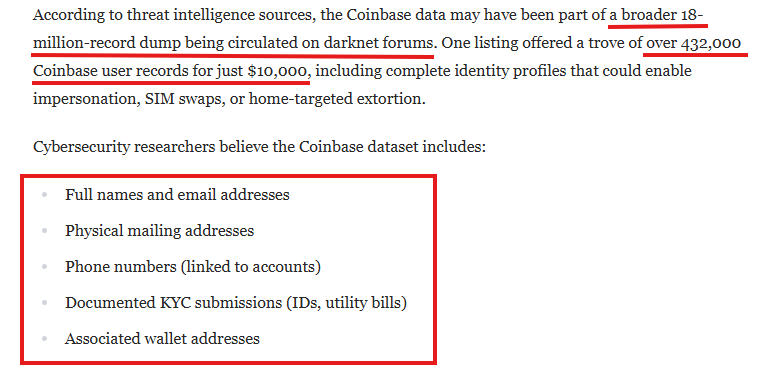
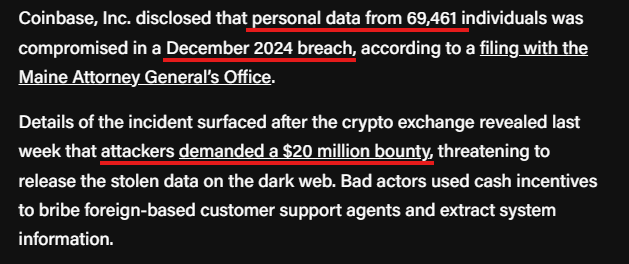
Last year, news reports confirmed that a major crypto exchange exposed personal user data, including names, emails and account-related information. After that incident, many users were targeted with phishing and identity-based scams. Nothing fancy just poor data protection breaking trust.
Let me show you some of articles and news reports the scary part:
1 / Major exchange Coinbase disclosed a data breach that exposed personal info (names, addresses, partial SSNs, account balances) of nearly 70,000 users from a 2024–25 incident and that leak sparked scams and identity theft fears.
2 / According to public disclosures and news reporting from the past year, major crypto platforms have exposed sensitive user data including names, emails, addresses and account-linked information after internal security failures. In several cases, users were later targeted with phishing, impersonation and identity-based scams. The technology worked but trust didn’t.
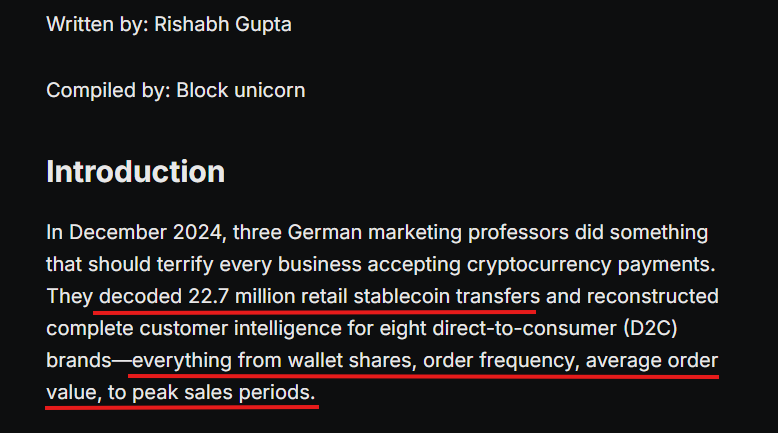
3 / According to Bitcoin insider on public blockchains, trillions in stablecoin flows are moved in the open, meaning every payment, treasury transfer or payroll transaction becomes permanently visible to anyone with a block explorer.
4 /A article from aicoin published that In December 2024, researchers decoded ~22.7M stablecoin transfers just from public blockchain data showing wallet patterns, order frequency, purchase behavior, and peak sales times for brands.
That’s why mainstream users hesitate.
Not because crypto is slow but because it doesn’t feel safe.
Real adoption needs products that work for real life:
•privacy by default.
•compliance where needed.
•infrastructure people can trust without constantly worrying.
This is exactly where projects in the @SeismicSys ecosystem start to make sense.
@brookwellapp is building private stablecoin infrastructure so balances and transfers aren’t exposed to the world.
@speciefinance is showing how a modern, global fintech account can run on-chain without leaking sensitive financial data.
@cred_protocol is exploring compliant, privacy-preserving financial rails designed for real institutions(private credit, access to private B2B lending etc) not just crypto native users.
Seismic isn’t trying to hype privacy as a buzzword.
It’s building privacy directly into the infrastructure encrypting transactions and execution by default, while still allowing compliance and regulation on top.
•Not hiding things.
•Not breaking rules.
•Just protecting users and businesses the way financial systems are supposed to.
To me privacy and compliance aren’t opposites anymore.They’re converging.
Seismic feels like the kind of product people can actually trust and actually need.
@NoxxW3@heathcliff_eth
@xealistt Yup.. Crypto has already built enough infrastructure.The next breakthrough won’t come from another chain it’ll come from solving everyday problems so well that users don’t care what’s running underneath…