Karpathy's LLM Wiki pattern, built step by step
Claude sitting on an Obsidian vault that holds everything you know. you stop re-explaining yourself every session because the system already remembers.
> your data stays plain text on your machine
> point any model at it next year and it still works
> it gets sharper every day you feed it
one evening of setup for a second brain that maintains itself.
full nine-step build in the article below
La Prison du Futur s’appelle Cognify
Imagine, tu es condamné à 20 ans de prison
Au lieu de passer deux décennies derrière les barreaux, tu entres dans une capsule high-tech pendant 10 minutes seulement
Un scanner cérébral ultra-précis mappe ton cerveau entier.
Une IA sophistiquée génère alors des faux souvenirs extrêmement réalistes: tu vis des années d’isolement, de remords profond, de réflexions sur tes crimes, de la souffrance de tes victimes, des humiliations quotidiennes, du temps qui passe lentement…
Quand tu sors de la capsule, ton cerveau est convaincu que tu as réellement purgé ta peine complète.
Tu ressors réhabilité, traumatisé, plein de regrets, sans avoir coûté un sou en nourriture, en gardiens ou en infrastructure carcérale pendant 20 ans
C’est le concept Cognify, imaginé par le scientifique et réalisateur Hashem Al-Ghaili.
Sur le papier, le concept peut sembler génial :
- Fin de la surpopulation carcérale
- Coûts divisés par 100
- Réhabilitation “garantie”
- Peine réelle vécue dans la tête du condamné
Dans la réalité, c’est absolument terrifiant.
Parce que si une IA peut implanter des décennies de souvenirs de prison… elle peut implanter n’importe quoi
- Des souvenirs de repentance politique
- Des opinions correctes sur la société, le climat, la liberté d’expression
- L’effacement sélectif de souvenirs jugés dangereux
- La création de faux traumatismes pour briser une personnalité
- La rééducation totale des dissidents, des opposants, des mal-pensants
Qui contrôle cette technologie ?
Le gouvernement ?
Les multinationales tech ?
Une agence internationale ?
Et si demain on l’utilise non plus seulement pour les criminels violents, mais pour les crimes de pensée ?
Pour les gens qui posent les mauvaises questions ?
Pour ceux qui refusent la narrative officielle ?
C’est plus qu’une prison.
C’est le contrôle total de l’esprit humain
On passe d’un système qui punit le corps à un système qui reprogramme l’âme.
Black Mirror n’est plus de la science-fiction.
C’est un prototype en développement, présenté comme une solution humaniste et progressiste
La vraie question : À partir de quel moment accepte-t-on de laisser l’État (ou une IA sous contrôle étatique) réécrire notre mémoire ?
On va vraiment ouvrir cette boîte de Pandore ?
JENSEN HUANG SOLD A $249 AI COMPUTER ON STAGE THAT KILLS YOUR $200/MONTH OPENAI BILL. THE VIDEO HAS 217,000 LIKES
the box is called the jetson orin nano super. 70 trillion ai operations per second, 25 watts, smaller than a wallet. it runs llama 3, mistral, gemma and deepseek locally with no api fees and no data leaving your house
a developer running automations and coding assistants pays $200 a month to openai. the same workload on this box costs $2 a month in electricity and breaks even on the hardware in 10 weeks
you install ollama with one command. change one line in your code. point it at localhost instead of openai. everything else works identically
7 billion parameter models handle 80% of what people use chatgpt for. summarization, drafting, coding, document q&a, automation pipelines. the hard 20% you keep claude or gpt for. total monthly cost drops from $200 to $22
cloud subscriptions keep getting more expensive and rate limits keep getting tighter. the people who set this up in 2025 are going to look very smart in 2027
bookmark this and read the article below
🚨A HACKER GROUP JUST STOLE 4,000 OF GITHUB'S OWN PRIVATE REPOSITORIES.. PUT THEM UP FOR SALE FOR $50,000.. AND THE WAY THEY GOT IN IS THE SCARIEST PART..
They didn't hack GitHub's servers.. They poisoned a VS Code extension.. One GitHub employee installed it.. And the attackers walked through the front door using the employee's own credentials..
The group calls themselves TeamPCP.. They name their malware after the sandworms from Dune.. And they've been running the most sophisticated supply chain attack campaign in cybersecurity history..
Here's how the whole thing unfolded..
In March.. They poisoned Trivy.. One of the most trusted security scanners in the world.. Used by over 10,000 development workflows globally..
They injected credential-stealing malware into Trivy's official GitHub Action.. The malware ran silently BEFORE the security scan.. So every log showed "scan completed successfully" while the malware was stealing AWS keys, SSH credentials, database passwords, and Kubernetes tokens in the background..
It took Aqua Security 5 days to fully remove them..
Using the stolen credentials.. They breached Cisco Systems.. Cloned over 300 private repositories.. Including source code for unreleased AI products.. And repositories belonging to Cisco's customers.. Major banks.. Government agencies.. BPO firms..
In April.. They hit Checkmarx.. Another security vendor.. Poisoned 5 official Docker images in 83 minutes.. The scanner worked perfectly.. It just silently sent all your secrets to the attackers..
That automatically cascaded into Bitwarden.. The password manager.. Their CI/CD system pulled the poisoned Docker image.. And the attackers injected malware into Bitwarden's official CLI package published on npm..
One compromised security scanner poisoned a password manager.. Automatically.. No human involved..
In May.. They hit TanStack.. Libraries downloaded millions of times per week.. 84 malicious package versions across 42 packages..
And here's the terrifying part..
The malware scraped the raw memory of GitHub's build servers.. Extracted authentication tokens.. Used those tokens to bypass two-factor authentication.. And then published the infected packages with completely valid cryptographic signatures..
Every security verification tool on earth said the packages were legitimate.. Because they were signed by the real pipeline.. Using real keys.. The attackers just happened to be inside the pipeline when it signed..
They defeated the entire trust model of modern software supply chains..
The same week they hit the Nx Console VS Code extension.. 2.2 million installations.. The malware specifically targeted Claude Code configurations.. Hunting for AI assistant credentials..
That's a first.. Supply chain malware designed to steal your AI's access keys..
Then on May 19.. They revealed the GitHub breach.. 4,000 internal repositories.. Listed for sale at $50,000.. With a warning.. "If nobody buys it.. We leak everything for free"..
Their malware is self-propagating.. Once it infects one package.. It automatically finds every other package that developer maintains.. Steals the publish tokens.. And infects all of them.. Then those packages infect the next developer.. And the next..
It jumps between npm and PyPI automatically..
The group doesn't even do the extortion themselves.. They sell stolen credentials to ransomware gangs.. One gang used TeamPCP's data to threaten Cisco with leaking FBI and NASA personnel records..
And the scariest part of all..
They didn't break any encryption.. They didn't find any zero-days.. They exploited the fact that the entire software industry blindly trusts its own build tools..
Every security scanner.. Every Docker image.. Every VS Code extension.. Every GitHub Action.. Is a potential weapon if someone poisons it upstream..
And right now.. Nobody can tell the difference between a legitimate build and a compromised one..
Because the compromised ones have valid signatures too.
To be accountable, you need to be different. Not asking for consensus, but having the authority to make decisions and be accountable of the outcome.
If you are not in this environment, then there is no opportunity for growth.
#powerofagency#Theprocessguydownunder#AskEffendy
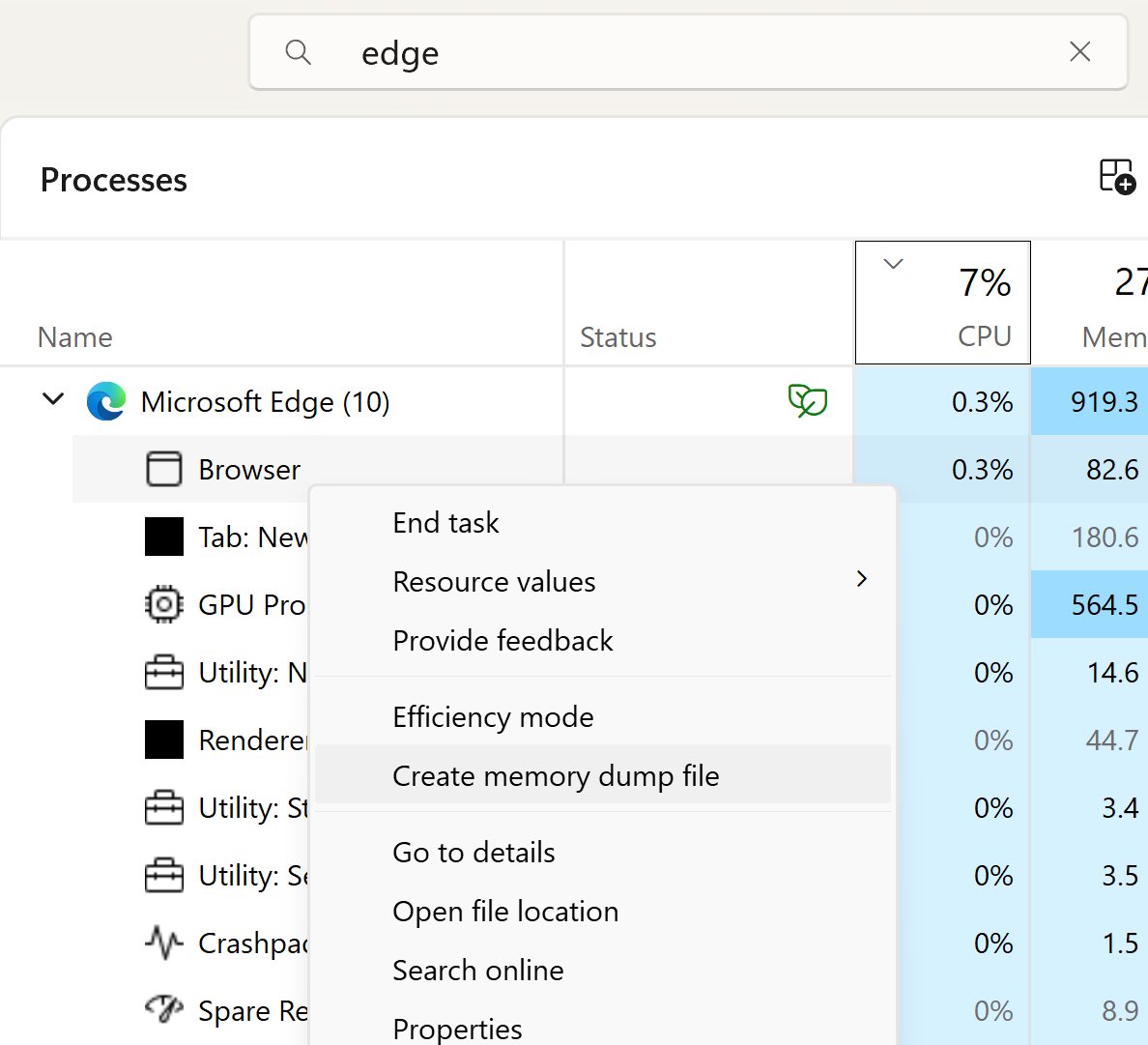
‼️🚨 Microsoft calls this "intended behaviour," so here we go.
How to dump the credentials of every user stored in Microsoft Edge:
1. Open Edge. Don't browse anywhere, just open it.
2. Flip to Task Manager, find Edge, expand the task.
3. Highlight the "browser" sub-task, right-click, and choose "Create Memory Dump."
4. Open the dump file and look for credentials.
The logged-in Windows user can dump every stored Edge credential with no additional rights. Which means any malware that user executes has those credentials for the asking.
Thanks to Rob VandenBrink at SANS: https://t.co/ebtVZxne4L
Traditional directors flimmaxxxing using Seedance 2.0 on Higgsfield.
Watch “Zephyr” FULL Ep.1 – this is what happens when filmmakers face ZERO gatekeeping.
With Unlimited Seedance 2.0 now LIVE everywhere for anyone with up to 70% OFF* - YOU can build your next viral AI movie.
2 minute intro got MILLIONS in a day.
Now see how full Zephyr takes over your feed.
Dir. by ILYA KARCHIN & the team.
Zephyr (2026)
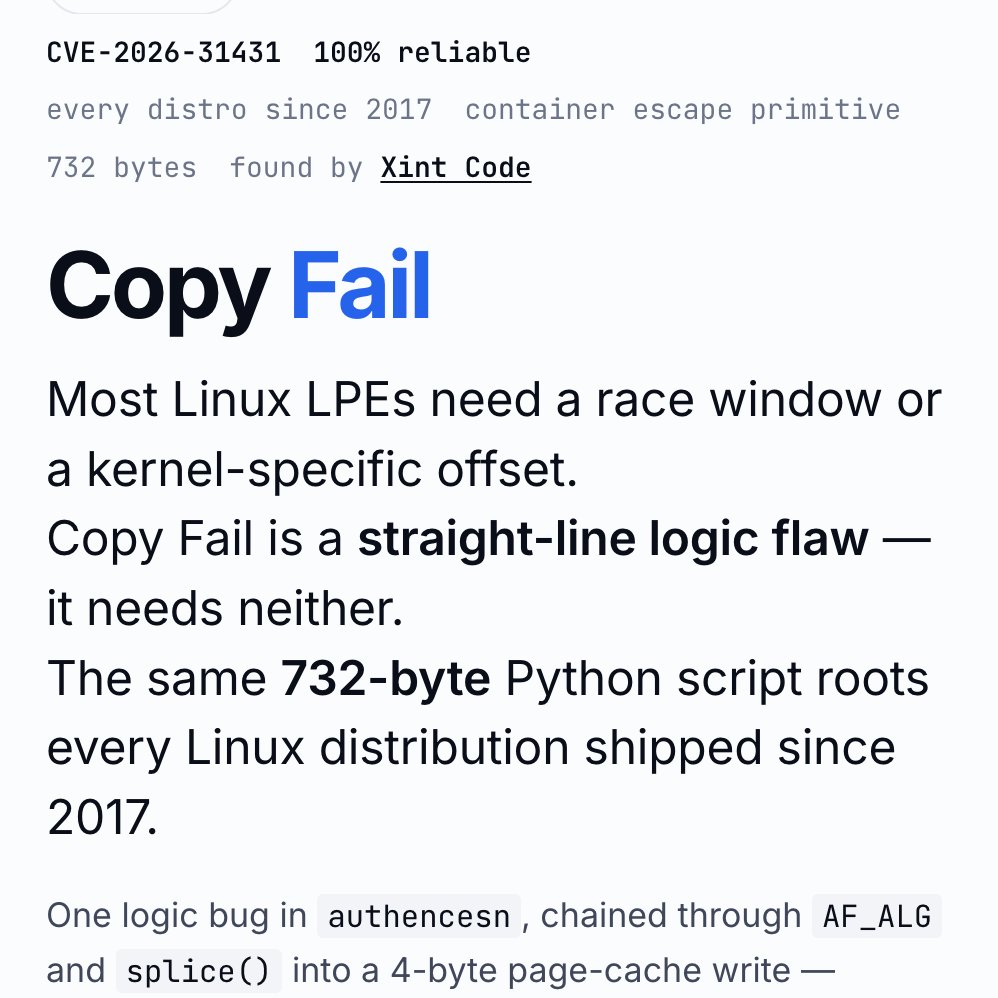
‼️🚨 BREAKING: An AI found a Linux kernel zero-day that roots every distribution since 2017. The exploit fits in 732 bytes of Python. Patch your kernel ASAP.
The vulnerability is CVE-2026-31431, nicknamed "Copy Fail," disclosed today by Theori. It has been sitting quietly in the Linux kernel for nine years.
Most Linux privilege-escalation bugs are picky. They need a precise timing window (a "race"), or specific kernel addresses leaked from somewhere, or careful tuning per distribution. Copy Fail needs none of that. It is a straight-line logic mistake that works on the first try, every time, on every mainstream Linux box.
The attacker just needs a normal user account on the machine. From there, the script asks the kernel to do some encryption work, abuses how that work is wired up, and ends up writing 4 bytes into a memory area called the "page cache" (Linux's high-speed copy of files in RAM). Those 4 bytes can be aimed at any program the system trusts, like /usr/bin/su, the shortcut to becoming root.
Result: the next time anyone runs that program, it lets the attacker in as root.
What should worry most: the corruption never touches the file on disk. It only exists in Linux's in-memory copy of that file. If you imaged the hard drive afterwards, the on-disk file would match the official package hash exactly. Reboot the machine, or just put it under memory pressure (any normal system load that needs the RAM), and the cached copy reloads fresh from disk.
Containers do not help either. The page cache is shared across the whole host, so a process inside a container can use this bug to compromise the underlying server and reach into other tenants.
The original sin was a 2017 "in-place optimization" in a kernel crypto module called algif_aead. It was meant to make encryption slightly faster. The change broke a critical safety assumption, and nobody noticed for nine years. That bug then rode every kernel update from 2017 to today.
This vulnerability affects the following:
🔴 Shared servers (dev boxes, jump hosts, build servers): any user becomes root
🔴 Kubernetes and container clusters: one compromised pod escapes to the host
🔴 CI runners (GitHub Actions, GitLab, Jenkins): a malicious pull request becomes root on the runner
🔴 Cloud platforms running user code (notebooks, agent sandboxes, serverless functions): a tenant becomes host root
Timeline:
🔴 March 23, 2026: reported to the Linux kernel security team
🔴 April 1: patch committed to mainline (commit a664bf3d603d)
🔴 April 22: CVE assigned
🔴 April 29: public disclosure
Mitigation: update your kernel to a build that includes mainline commit a664bf3d603d. If you cannot patch immediately, turn off the vulnerable module:
echo "install algif_aead /bin/false" > /etc/modprobe.d/disable-algif.conf
rmmod algif_aead 2>/dev/null || true
For environments that run untrusted code (containers, sandboxes, CI runners), block access to the kernel's AF_ALG crypto interface entirely, even after patching. Almost nothing legitimate needs it, and blocking it shuts the door on this whole class of bug...
Is the superintelligence already here or this is just the tip of the iceberg?
Is it better to create a specialised Intelligence or general intelligence?
Do we live inside a simulation?
How you govern superintelligence?
#Theprocessguydownunder#AskEffendy#superintelligence
Windows defender has been compromised.
right now there is a public unpatched exploit that gives any app on your windows PC full system admin access. no password. no popup. nothing
your antivirus doesnt stop it. your antivirus IS the exploit. windows defender is the attack vector
ransomware gangs can use this to encrypt your entire machine and steal every saved password, browser session, and discord token you have. fully patched windows 11. real time protection on
thread
Have you ever wondered if you just accept your limitation and not try to go against it, what would happened?
This book is written by an Australian author, quite comical and true.
#embraceyourlimits#askeffendy#Theprocessguydownunder