REGISTER: https://t.co/i2SPXZNA2x
The Rules We Live By
Making sense of the rule of law in today’s world.
November 19, 2026 | 6 - 8 p.m.
Toronto Reference Library - Bram & Bluma Appel Salon
Join the Lincoln Alexander School of Law's Dr. Alexandra Mogyoros @AlexMogyoros
Thanks for reading my article! Data centres are specialized buildings full of powerful computers called servers that store, process & transmit digital info. When you stream a show, use online banking, or ask an AI tool a quest, ur info is usually handled in a data centre somewhre
The @LCO_CDO has released its final report on AI in criminal justice, a first-in-Canada analysis of the uses, benefits and risks of AI systems across the criminal justice system. Read the Final Report and Executive Summary here: https://t.co/ysEOoy0AAW
My interview on Fairchild Television [in Mandarin]
Translation: Time Magazine, Oct 14, 2026: Data Pricing, City of Toronto moves to regulate AI surveillance-based pricing, sparking debate over consumer privacy and rights.
Full Video on YouTube.
Interesting to see that Canada's data centre rules prioritise WUE (Water Usage Effectiveness) and CUE (Carbon Usage Effectiveness), whereas Nigeria focuses only on PUE (Power Usage Effectiveness), with only passing mention of cooling techniques as a component of a wider criteria, not a standalone metric.
The current debate about data centres seems to offer a false binary: stop these facilities or accept them unconditionally. I think there is a better option, and I try to make that case in this article: https://t.co/RONCMUgICr
In the past 4 weeks, AI agents have probed Library Archives Canada, entered an Australian Medicare portal, and filed a fabricated homicide tip with U.S. police. This is a design defect, but it all boils down to CONTEXT!
This is what we tackled in my Data Science Law Class
Which groups in Nigeria are most vulnerable to algorithmic discrimination?
The International Law Association of Nigeria invited me to a dialogue to discuss how Nigeria should translate these global principles into practical standards that address Nigeria’s realities.
Which groups in Nigeria are most vulnerable to algorithmic discrimination?
The International Law Association of Nigeria invited me to a dialogue to discuss how Nigeria should translate these global principles into practical standards that address Nigeria’s realities.
Are you interested in higher education policy and research, or simply curious about education financing, student enrollment, and student affairs across tertiary institutions in Nigeria?
Here is an opportunity to contribute to our research and policy work at @iReadInitiative
We would love to hear from you: https://t.co/BupEj6Zcw9
iRead Initiative Announces Academic Advisory Council, Names Professor Sola Akinrinade as a Council Chair
iRead Initiative, a higher education policy think tank dedicated to producing rigorous, independent research and advancing evidence-based policy reforms in Nigeria, announces its Academic Advisory Council today.
The eight scholars and practitioners on the Council will steer and guide iRead’s research toward its vision: a Nigerian higher education system in which every student who qualifies for university admission can access it, afford it, thrive within it, and graduate into meaningful economic opportunity.
Prof. Sola Akinrinade, Professor of African Diplomatic History and International Relations at Obafemi Awolowo University and pioneer Vice-Chancellor of Osun State University, chairs the Council.
Joining him are Prof. Abel Idowu Olayinka, former Vice-Chancellor of the @ibadanuni ; Prof. Isaac N. Obasi, Professor of Public Administration; Asst. Prof. @effodu , Lincoln Alexander School of Law of Toronto Metropolitan University & @UNESCO Expert on AI and the Rule of Law; @GraceChiAlex , technology policy and data specialist; @Deborahtoluwase development communication specialist and journalist; Jamila Idris, policy strategist; and Adeoluwa Folami of Morgan State University, USA.
https://t.co/2cCLStHBUL
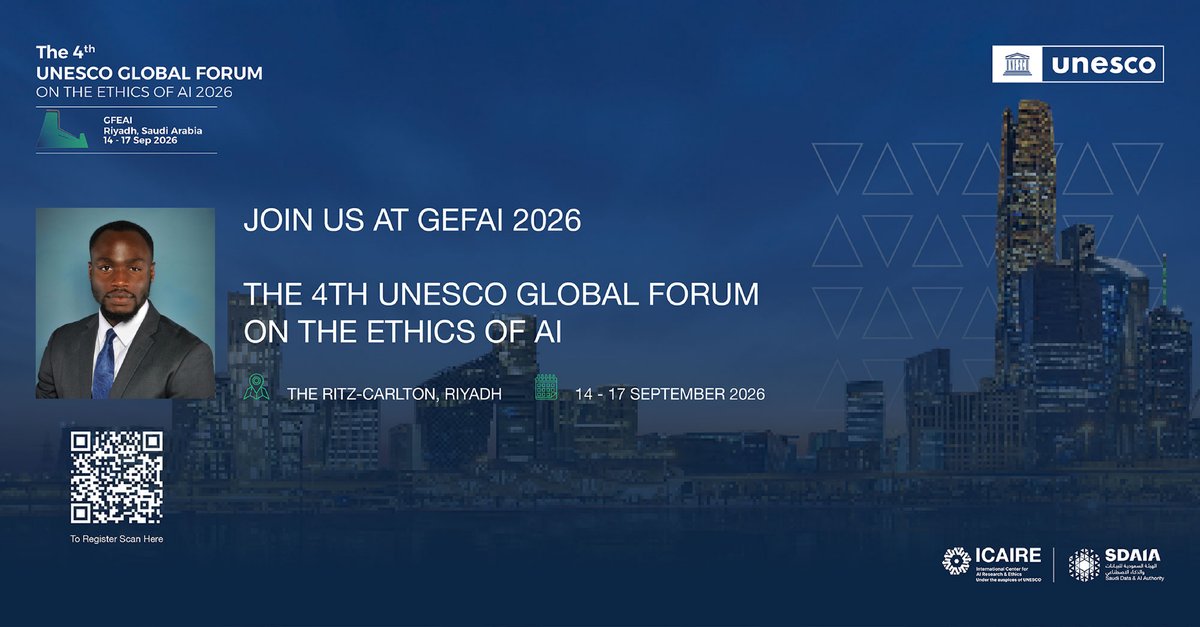
The 2026 GEFAI – the 4th UNESCO Global Forum on the Ethics of Artificial Intelligence.
📍 Riyadh
📅 September 14–17, 2026
Register now: https://t.co/2s2H2CI9x4
#SaudiAIYear#GFEAI
Most AI systems deployed across Africa are designed, owned, and updated abroad, so African govts meet it chiefly as buyers. This makes procurement the decisive lever of AI governance, and the one most overlooked. In my latest paper I propose a framework of Sovereign Procurement.
@Akin_Agunbiade Thank you bro. The NITDA policy is progressive for sure, but it does not set out directions for the procurement of AI systems, using the procurement contract as an instrument of statecraft to establish these responsible AI principles. We’ll need more than what we currently have
Most AI systems deployed across Africa are designed, owned, and updated abroad, so African govts meet it chiefly as buyers. This makes procurement the decisive lever of AI governance, and the one most overlooked. In my latest paper I propose a framework of Sovereign Procurement.