To jest mili państwo sedno problemu z pozbawieniem FSD speed-offsetu.
Sieć neuronowa mając dane z kamer i map doskonale wie z jaką prędkością pokonać dany zakręt, aby było jednocześnie bezpiecznie, komfortowo dla pasażerów i wystarczająco dynamicznie dla pozostałych uczestników ruchu drogowego.
Obligowanie NN do przestrzegania ograniczeń prędkości stworzonych DLA LUDZI jest nieefektywne i problematyczne.
Przy wyznaczaniu ograniczeń prędkości bierze się pod uwagę nie tylko fizyczne ograniczenia (droga hamowania), ale też ludzkie (czas reakcji).
FSD reaguje w 20 (!) milisekund. Kierowca F1 w 150-200ms, a przeciętny człowiek 200-300ms. Przy złożonych sytuacjach drogowych, gdzie mózg musi przeanalizować kilka sygnałów reakcja następuje dopiero po 700-1500ms.
To chyba jasno pokazuje kto tu ma przewagę. Nie dość, że FSD patrzy 360 stopni dookoła, 36 razy na sekundę to jego czas reakcji jest nadludzki - wniosek jest prosty.
Dajmy AI robić swoje, a człowiek (póki co) niech tylko tego pilnuje.
Każde kolejne ograniczenie sieci neuronowej pogorszy jej właściwości i w skrócie.. sprawi, że będzie MNIEJ bezpieczna.
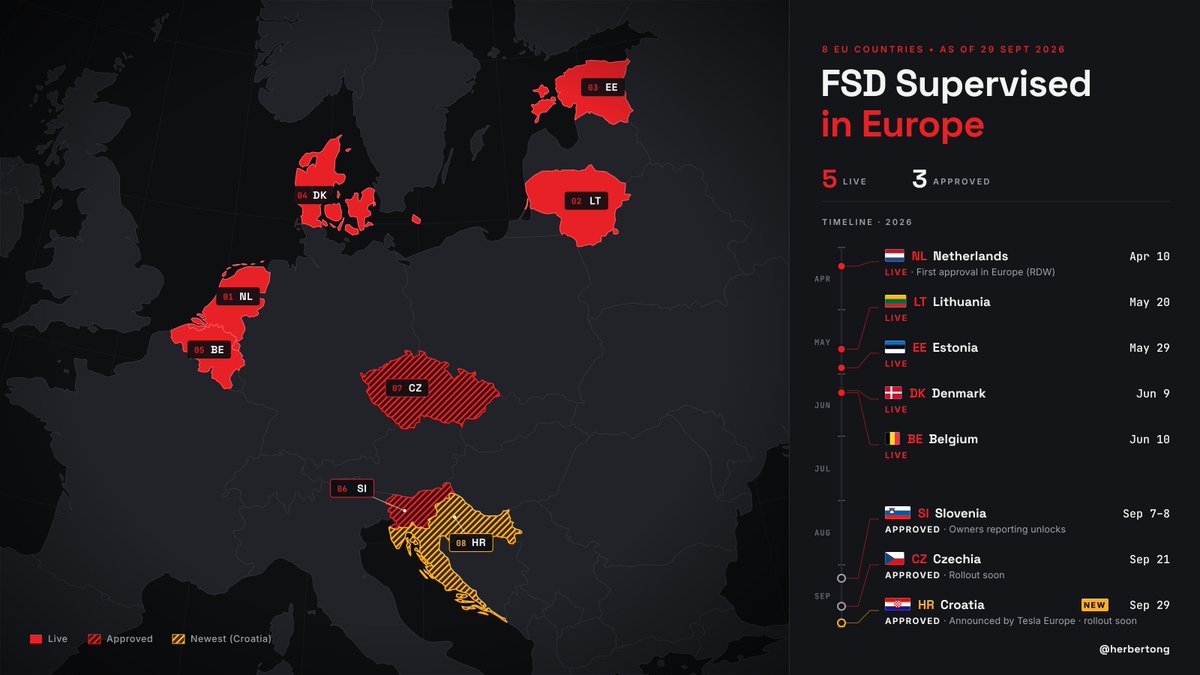
FSD Supervised is now approved in Croatia 🇭🇷
That's 8 European countries in under 6 months.
It started with the Netherlands in April. Lithuania, Estonia, Denmark, Belgium, Slovenia and Czechia followed, and now Croatia.
The Dutch regulator granted the approval, and each country decides on its own whether to recognize it. There's no single EU switch yet.
For EU-wide approval, you need 15 of 27 member states. Tesla is at 8 countries already, and that vote isn't expected before December. $TSLA
@jordihereub y @minturgob, tienen la oportunidad de dar un golpe en la mesa y aprobar el FSD supervisado de Tesla. No es un sistema nuevo. Está adoptado en EE.UU., Canadá, México, Corea del Sur, China, Australia, Nueva Zelanda y 8 países de la UE. Firmé ya la aprobación.
@jordihereub@steph_sejourne@EU_Commission@minturgob Que sí, que sí, que sabemos que lo hacen por nuestro bien y nos quieren mucho, pero por favor no nos quieran tanto, quiérannos mejor y aprueben de una vez el FSD de Tesla.
@jordihereub@steph_sejourne@EU_Commission@minturgob Es absurdo que quieran el acelerar el vehículo autónomo y por otra impidan que se pueda usar (bajo supervisión) el FSD de Tesla. Creo que los conductores y accidentes no les importa lo más mínimo, solo la foto y seguir en su poltrona.
Nieuwe technologie moet je kritisch opvolgen, maar ook eerlijk beoordelen op de cijfers.
En die zijn opvallend: buiten de snelweg ligt het ongevalsrisico met @teslaeurope FSD Supervised volgens de gerapporteerde data bijna 10 keer lager dan bij manueel rijden. Ook op de snelweg zien we een daling.
Verkeersveiligheid en innovatie kunnen perfect hand in hand gaan.
https://t.co/78X1VXIb88
Imágenes de pruebas de conducción autónoma de Tesla en España.
@oscar_puente_@jordihereub
La tecnología existe y salva vidas, ademas del ahorro de costes asociados a los accidentes de tráfico.
Próxima votación el 6 de Octubre, estamos pendientes de su votación favorable.
Quieres datos @jordihereub ?
Nos creemos mas inteligentes que el resto de países europeos que ya lo han aprobado, y que son MÁS seguros desde ese momento que España ?
Tesla has just open-sourced one of the key pieces of evidence used to support the Netherlands approval of FSD (Supervised) to try and push for EU-wide approval, saying that its safety benefit remains "locked behind bureaucracy."
Some highlights:
• Tesla conducted 230,000+ structured scenario tests across 6 European cities, achieving a 99%+ overall pass rate with zero safety-critical events.
• In Europe, Tesla accumulated 793,000+ FSD engineering miles across 8 countries with zero major or minor collisions attributed to FSD performance.
• Tesla reports zero major or minor collisions attributed to FSD performance across the European engineering-fleet validation cited in its safety case.
• Only 2.5% of FSD lane changes had a Driver Monitoring System warning during the preceding seven seconds.
• Only 0.6% of FSD lane changes had an escalation/driver-response request in the preceding seven seconds.
• In Tesla's European engineering fleet, FSD showed 77–97% lower AEB activation rates, depending on road class.
• Tesla analyzed nearly 2 billion FSD miles in North America in 2025, including 700+ million non-highway miles.
• FSD had 40–69% fewer major collisions than manually driven Teslas with active safety features, depending on road type.
• FSD had 48–59% fewer minor collisions than manually driven Teslas with active safety features.
• Compared with older Teslas without active safety features, FSD had 71–90% fewer major collisions.
• FSD had 74–84% fewer Automatic Emergency Braking (AEB) events, suggesting substantially fewer imminent-collision situations.
• FSD had 83–95% fewer harsh acceleration/braking events and 55–75% fewer high lateral-acceleration events than manual driving.
• During lane changes, FSD had 99% fewer minor collisions on highways and 95% fewer on non-highway roads than manual driving with active safety features.
• FSD drivers experienced 67% fewer highway fatigue events than manual drivers.
• European testing achieved 98.9% pass rates at roundabouts, 99.2% at intersections, 99.7% at crosswalks, and 99.9% when yielding to cyclists.
Tesla added that this exact dashboard was shared with all EU Member States in April 2026, shortly after RDW’s approval, and all data presented is from before that date.
Tesla: "European countries recorded 19,400 road deaths in 2025. That's around 53 deaths/day, with the vast majority of these crashes attributed to human error. These deaths are largely preventable with technology we have today. FSD Supervised is already saving lives where it’s approved – yet in much of Europe, that safety benefit remains locked behind bureaucracy."
https://t.co/JlmdGpMr38