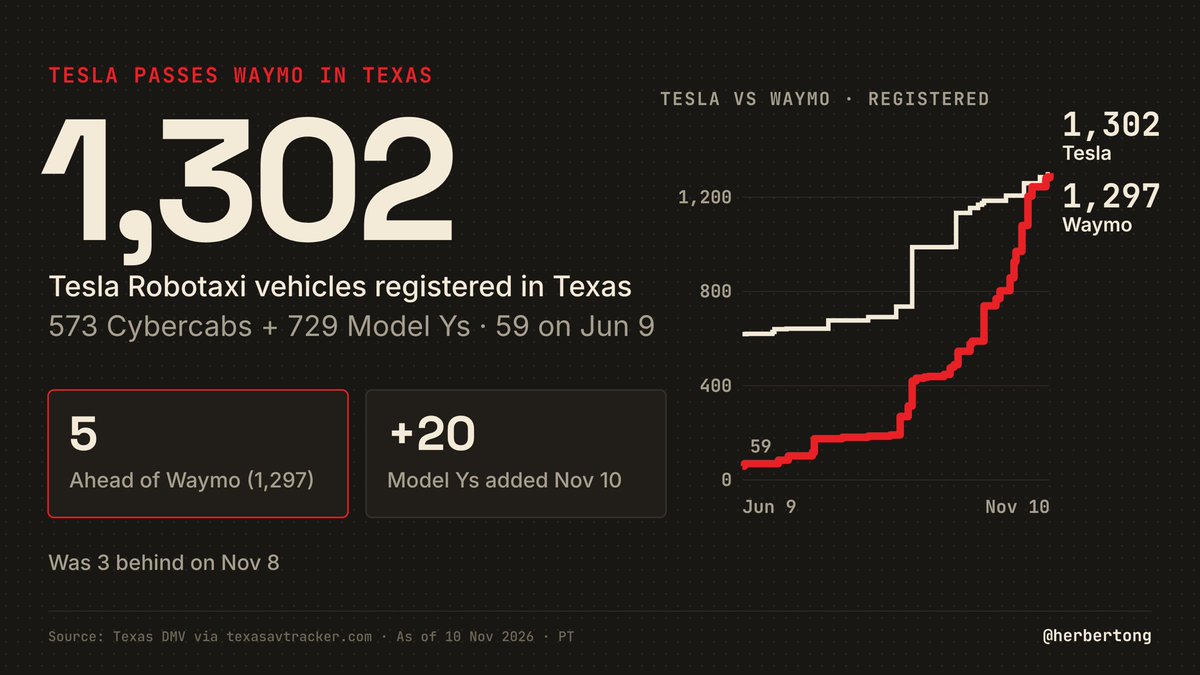
NEWS: Tesla has passed Waymo in Texas robotaxi registrations for the first time, 1,302 to 1,297, per the Texas DMV.
That's 573 Cybercabs and 729 Model Ys. In June, Tesla had just 59 registered. Two days ago it was still behind, and now it's in the lead.
Waymo took years to build its Texas fleet, and Tesla caught it in about five months.
With Cybercabs coming off the line, this lead has room to grow. $TSLA
Cybercab's ceiling may be set by how much people are willing to travel, not by the size of today's rideshare market.
@JOBhakdi argues that a much cheaper, frictionless ride grows total usage the way cheaper compute grew total computing. Elon is already saying Cybercab will do a majority of all passenger miles wherever it's legal.
That makes valuing Tesla against Uber's market cap backwards. The real comparison is the entire cost of moving people and goods, and that number grows every time the price per mile falls. $TSLA
Path Robotics has been on a tear over the last 18 months. They’ve grown revenue 17x in that time period and there’s no shortage of demand for welding.
There’s been many longstanding misconceptions around hardware solution businesses but that’s going to change.
We are seeing players in the space grow revenue at software pace with strong gross margins and revenue quality on par or higher than software/AI.
We think the space sees a lot more love as players like Path prove this out. Congrats to @AndrewLonsberry and the team.
Cybercab may not compete with rideshare so much as end it as a category, anywhere the law allows.
Elon says Cybercab will do a majority of all passenger miles in any jurisdiction where it isn't prohibited. That goes past Uber and Lyft trips to include personal driving, because a ride priced below the cost of owning a car pulls people out of their own driver's seat.
If that's the plan, Tesla's real fight is regulatory, not competitive, and every new jurisdiction that allows it becomes a market Tesla could own outright. $TSLA
@PalmerLuckey@carlhancock Cybercab will do a majority of all passenger miles in any jurisdiction where it is not prohibited by law.
Obvious to anyone with eyes and a brain.
If land and permitting become the limit on Earth, the strongest door may be the one no local board can close.
@thejefflutz lays out three ways around a data center crunch: a political rebrand to safe AI, federal land opened for national security, or hyperscalers building abroad. Each one still has to deal with local power, local politics or foreign borders.
Compute in orbit has to deal with none of them. If SpaceX can put AI data centers in space at scale, permitting stops being a ceiling and turns into an edge. $SPCX
@nymbusjp Giving Cybertruck's space to Cybercab only makes sense if Tesla expects way more than a few hundred thousand. Is the bigger limit by 2028 building them or getting cities to approve them?
NEWS: SpaceX's biggest AI advantage may be software it has already been running in orbit for years, not chips or power.
Elon says the Starlink software built to move vast amounts of data through space and to the ground is also very well suited to training superintelligence.
At frontier scale, the hard part of training is increasingly about coordinating data across huge numbers of chips, and Starlink already does that across a network spread over the planet.
If that software turns out to be the backbone of SpaceX's AI training, it's a moat nobody can buy off the shelf, and it would make the case for compute in space far more concrete. $SPCX
Turns out that the Starlink software, built for managing the movement of vast amounts of data through space and to the ground, is also very well suited to training super intelligence
Austin's Tesla Robotaxi area grew by 170 square miles to 442, the same weekend San Antonio launched.
@thejefflutz says every expansion like this comes down to two things moving at once.
The first is the performance of the system. As the cars drive more safely with fewer issues, Tesla can fill a bigger area with more vehicles.
The second is operational readiness. Each new city takes fewer people and less time to fully ramp, so every launch should hit volume and break even faster than the one before.
If that holds, expansion stops being a fixed cost Tesla absorbs one market at a time. It becomes a curve that speeds up, and the gap with operators still ramping city by city could widen quickly.
$TSLA