Don’t forget to follow us on all our social media channels!
LinkedIn: https://t.co/XTsW2IDlRx
BlueSky: @efpjournal.bsky.social
X: @EFPJournal
Don’t miss out! We’re sharing ideas, research, and updates across all platforms.
#EFP#FollowUs@aefpweb
#FridayFeature: April 2017, Spencer Foundation–funded study “Are Student Absences Worth the Worry in U.S. Primary Schools?” Gershenson, Jacknowitz & Brannegan find absences lower achievement, especially for low-income students & ELLs.
Read more: https://t.co/C6zsdJqd4R
#EFP
#FridayFeature: IES-funded study “ACT for All,” Joshua Hyman finds that requiring all students to take a college entrance exam increases four-year enrollment, especially for low-income students, and is more cost-effective than traditional aid.
🔗 https://t.co/BSf4Hdof08
#FridayFeature: April 2017, article “The Promise of Administrative Data in Education Research,” Figlio, Karbownik & Salvanes, one of the top NSF-funded research teams, highlight how administrative data is reshaping education policy research.
Read more: https://t.co/m8YBKNd2Je
From 2016, Seth Gershenson’s “Linking Teacher Quality, Student Attendance, and Student Achievement”—a top-cited Spencer Foundation study—shows that great teachers boost both learning and attendance, proving teaching is truly multidimensional.
Read more: https://t.co/0DiL6dxmzQ
Reber, Rünger & Wong’s “The Effects of Charter High Schools on Academic Achievement and College Enrollment” find that attending high-quality LA charter schools boosts test scores and 4-year college enrollment—especially at UC campuses.
Read more: https://t.co/vTVvovDLKF
#EFP
#FridayFeature: From 2017, Grissom & Loeb’s “Assessing Principals’ Assessments,” a top IES-funded study, shows that principals rate most teachers highly in both high- and low-stakes settings, though low-stakes evaluations reveal more nuance.
Read more: https://t.co/fZsBiWoXZu
#ThrowbackThursday: From 2023, Mokher, Park-Gaghan & Hu find that Florida’s developmental education reform benefitted most students—but ESOL and foreign-born students gained the most from flexible pathways and added support.
Read more: https://t.co/2gdV9IZ3Qd
#HigherEd
#FridayFeature: NSF-funded research by Michael A. Gottfried & Robert Bozick shows that high school students who take applied STEM courses like tech & engineering, are more likely to choose STEM majors in college.
Read more: https://t.co/O5xED1WymB
#STEMEducation#EdResearch
Rising pension costs are reshaping U.S. school districts. Sarah F. Anzia’s “Public Schools and Their Pensions” finds districts boost revenue but cut staff, mainly non-teaching, as pension spending grows.
Read more: https://t.co/3UjfQYw6Gd
#TakeawayTuesday#SchoolFinance
#FridayFeature: In “Does School District Consolidation Cut Costs?” Duncombe & Yinger find consolidation lowers per-pupil operating costs, but high adjustment costs—especially for capital spending, limit net savings.
Read more: https://t.co/1DWt2A7UOW
#EFP#SchoolFinance#K12
#TakeawayThrowback: In “Gaining, Losing, and Regaining Merit-based Scholarships,” Ribar & Rubenstein show that HOPE & Zell Miller awards are far from static—many students lose them, few regain them, and disparities by race, gender, and income persist.
🔗: https://t.co/Ax5l9X5JO7
#FridayFeature: New teachers are often placed in tougher classrooms with more disadvantaged students—raising turnover rates. @LiFengBetty’s “Hire Today, Gone Tomorrow” highlights how classroom assignments shape teacher mobility.
Read more: https://t.co/E03pNoeHSA
#EFP
#TakeawayTuesday: “Gifted & Talented Programs and Racial Segregation.” Owen Thompson found that G&T programs enroll more White & Asian students, modestly increasing within-school segregation.
🔗: https://t.co/TMRmG3iJcV
#EFP#EducationPolicy#EquityInEducation#Diversity
#FridayFeature: In “Assessed by a Teacher Like Me: Race and Teacher Assessments,” Amine Ouazad finds teachers assess same-race students more favorably, an effect seen as early as kindergarten through grade 5, even after controlling for test scores.
🔗: https://t.co/0EEWi4vx6J
#ThrowbackThursday: In EFP Volume 18, Issue 4, Fall 2023 article, Fuller, Lauen & Unlu find ECHS gains in college readiness & enrollment generalize beyond RCTs to all schools.
Read more: https://t.co/rDDko5eUEO
#EFP#EducationPolicy#CollegeReadiness
#FridayFeature: In “Teacher Quality and Teacher Mobility,” Li Feng & Tim R. Sass find that top- and bottom-quartile teachers leave at higher rates than average ones, and effective teachers are more likely to stay when surrounded by strong peers.
Read more: https://t.co/5HlBK9oDKT
#TakeawayTuesday: “Assessing the Relative Progressivity of the Biden Administration's Federal Student Loan Forgiveness Proposal,” Goss, Mangrum & Scally find up to $442B eligible, with younger, lower-credit, Black & Hispanic borrowers benefiting most.
🔗: https://t.co/UsiTQqTudG
#FridayFeature: In “Peaks, Cliffs, and Valleys” (EFP), Robert M. Costrell and Michael Podgursky show how nonlinear pension incentives affect when teachers stay or retire—raising questions of efficiency, equity, and reform.
Read more:https://t.co/8luYcCqvcA
#EFP
#ThrowbackThursday: In “Private Schools and Student Achievement” (Fall 2023), Ebrahim Azimi, Jane Friesen, and Simon Woodcock find Catholic and non-Christian faith schools raise scores, while others show smaller or negligible effects.
Read more: https://t.co/4NlfPvmJ9s
#EFP
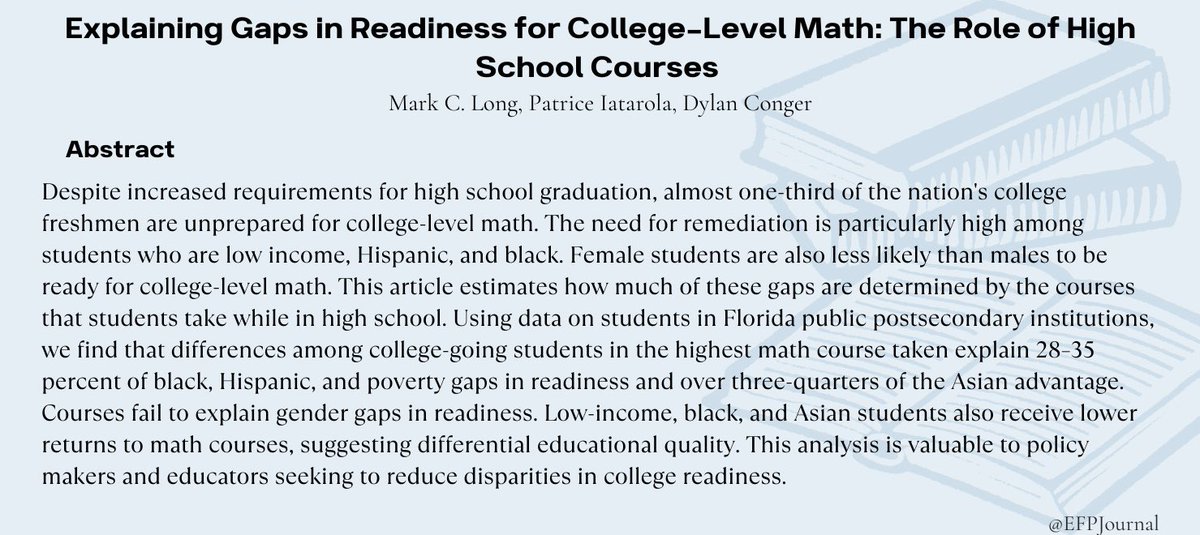
#FridayFeature: “Explaining Gaps in Readiness for College-Level Math: The Role of High School Courses” by Mark C. Long, Patrice Iatarola, and Dylan Conger.
Read more: https://t.co/NY0PZLaXsI
#EFP