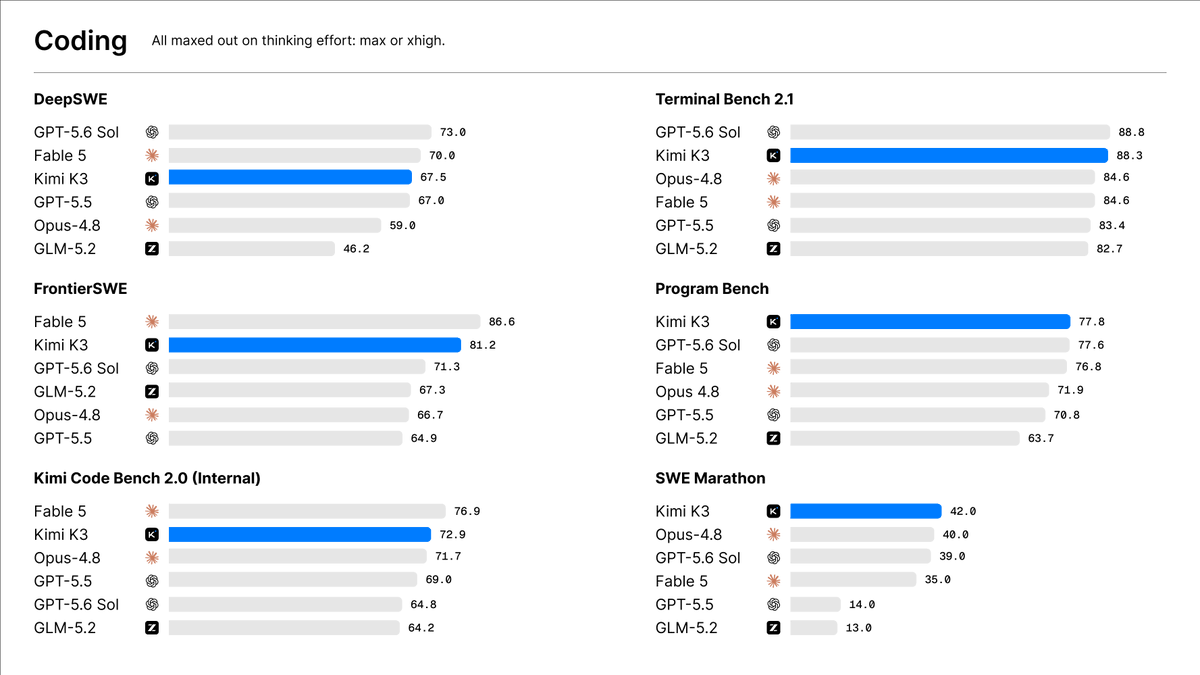
Introducing Kimi K3: Open Frontier Intelligence
🔹 2.8 Trillion Parameters, 1 Million Context, Native Multimodal
🔹 Kimi Delta Attention enables up to 6.3x faster decoding in million-token contexts
🔹 Attention Residuals deliver ~25% higher training efficiency at <2% additional cost
🔹 Built for long-horizon agentic coding and self-evolving workflows
Kimi K3 is now live on on https://t.co/zrk6zZxZUo, Kimi Work, Kimi Code, and the Kimi API.
Open Weights by July 27, 2026.
🔗 API: https://t.co/XCrgjXAqMw
🔗 Tech blog: https://t.co/YTfiMSNM1f
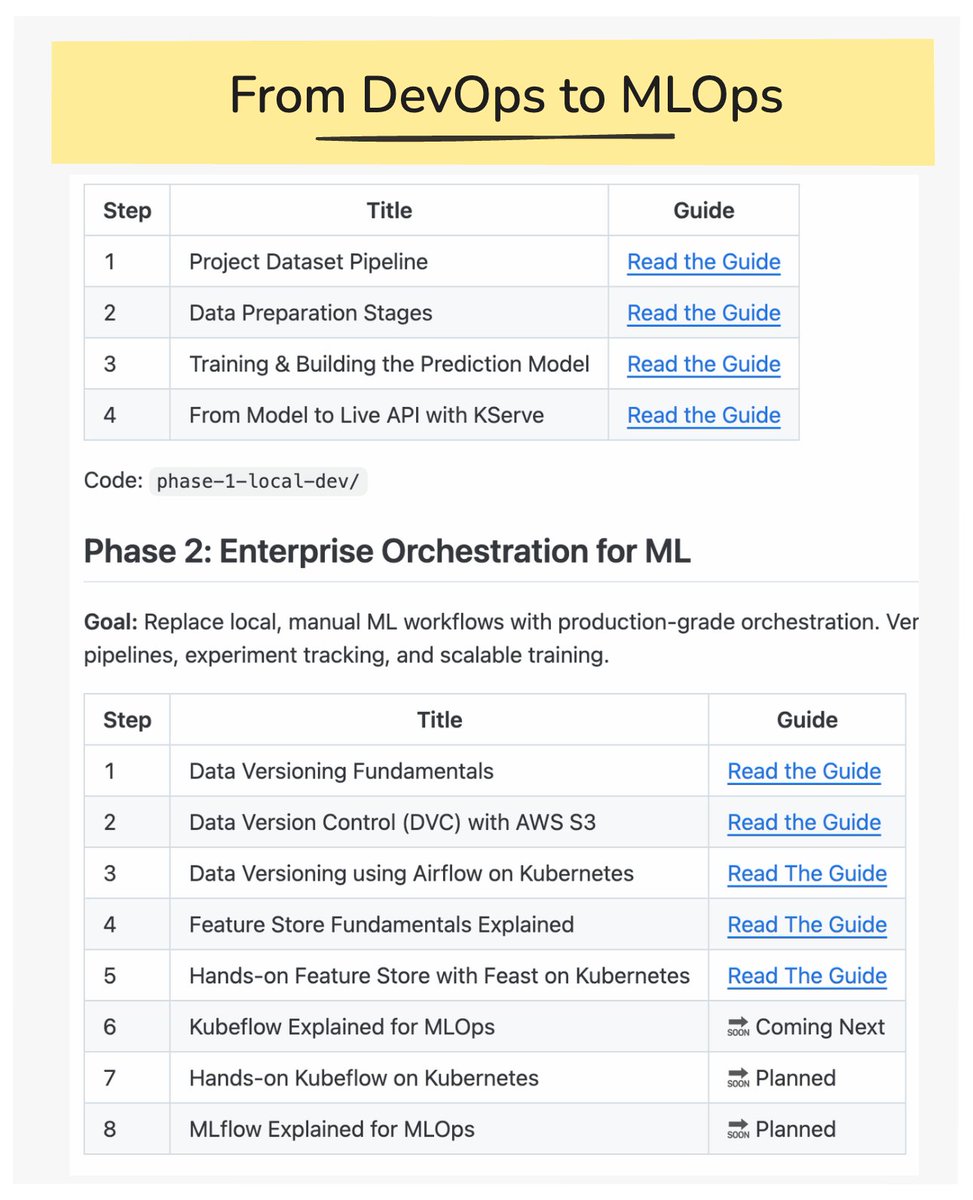
DevOps to MLOps Series 🚀
We have published 8 editions of the MLOps for DevOps series so far.
It is a hands-on, project-based guide to MLOps built specifically for DevOps engineers.
Here is the key idea 👇
Most MLOps resources are written for data scientists learning infrastructure. This series flips that.
You start by building the ML foundation on your local machine - from raw data to a trained, tested model.
Then you move to the infrastructure side.
- Orchestration
- Kubeflow Pipelines
- Feature stores
- Model registries and more..
Every edition comes with working code in a GitHub repo. You can follow along and build as you learn.
𝗚𝗶𝘁𝗛𝘂𝗯 𝗿𝗲𝗽𝗼: https://t.co/bWermJeKNM
If you have feedback, raise an issue in the repo.
We are happy to discuss and improve it.
A quick note on the goal.
This series is built to help DevOps engineers understand the infrastructure side of MLOps with just enough ML knowledge.
This is not an AI/ML course.
♻️ Repost if you know a DevOps engineer looking to expand into MLOps.
#mlopsfordevops #mlops #devops
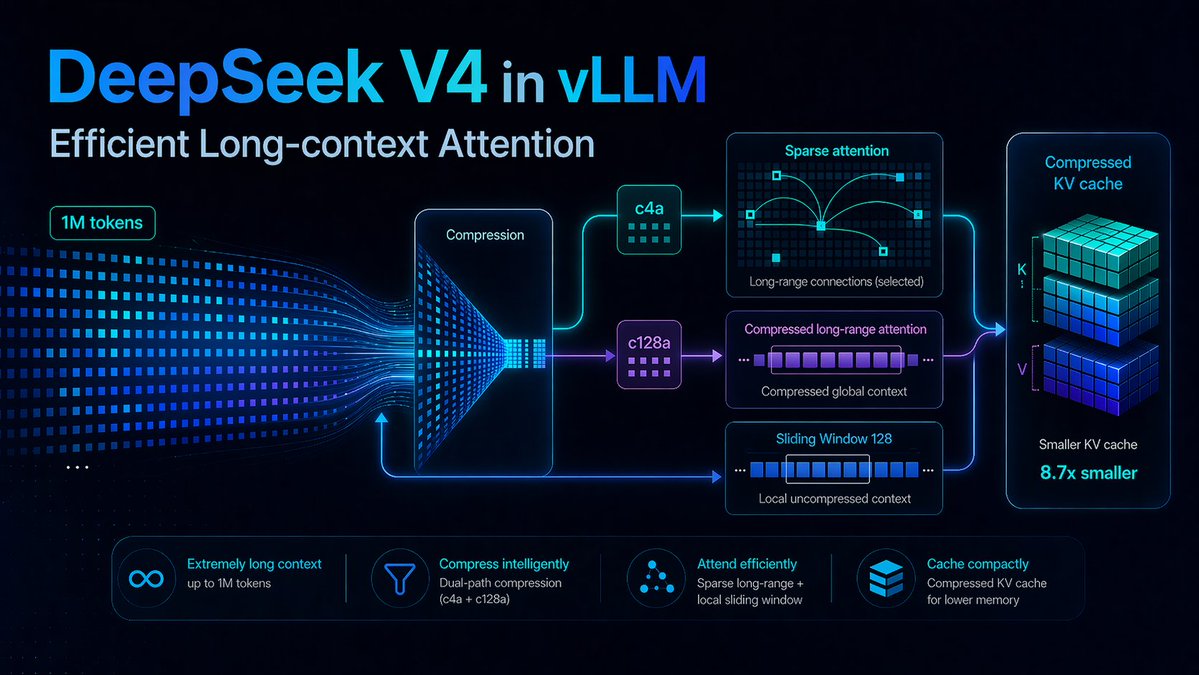
🎉 Day-0 support for @deepseek_ai V4 Pro and Flash on vLLM — a new generation of DeepSeek model, purpose-built for tasks up to 1M tokens. Alongside the release, we're publishing a first-principles walkthrough of the new long-context attention and how we implemented it in vLLM.
The new attention mechanism, in four moves:
• Shared K/V + inverse RoPE → 2× memory savings
• c4a / c128a KV compression → 4×–128× savings
• DeepSeek Sparse Attention over compressed tokens
• Short sliding window for locality across compression boundaries
At 1M context, per-layer KV state is ~8.7× smaller than a DeepSeek V3.2-style 61-layer stack (9.62 GiB vs 83.9 GiB, bf16). fp8 attention cache + fp4 indexer cache shrink it further.
vLLM side:
• Unified hybrid KV cache — single logical block size (256 native positions) across all compression rates; compressor state folded into the SWA KV cache spec so prefix caching, disagg prefill, CUDA graphs and MTP reuse the same abstraction
• Three page-size buckets for the full 5-way cache stack → no cross-kind fragmentation
• Fused kernels: compressor + RMSNorm + RoPE + cache insert (1.4–3×), inverse RoPE + fp8 quant (2–3×), Q-norm + KV RoPE + K insert (10–20×)
• Multi-stream overlap of indexer vs main-KV compression vs SWA insertion
Disaggregated serving is supported out of the box and strongly recommended for best performance.
Follow our recipes site for verified commands for @nvidia Blackwell (B200, B300, GB200, GB300) and Hopper (H100/H200/H20) systems.
Thanks to the @deepseek_ai team for open-sourcing DeepSeek V4, and to @inferact for landing day-0 support 🤝
📝 Blog: https://t.co/Eh7vk6xVJy
📖 Recipes: https://t.co/jlWuzYyZeX
🤗 https://t.co/IA9qAysqJk
Grafana 13 ships Git Sync as GA!
Save dashboards directly to GitHub, GitLab, or Bitbucket, open a PR from the Save button, and sync changes back automatically.
https://t.co/nh2e3xzeu9