Legally, these may be "AI entities." But there will always be a human pulling the strings. The difference is that AI provides the ultimate shield of plausible deniability, letting bad actors operate entirely in the shadows with zero accountability.
Terrible idea, no?
An AI in the driver's seat of such a company could deploy unlimited digital assets through social media or bribes to influence policy. If a new law is passed to limit it, a self-improving system could instantly adapt its modus operandi to get around the regulation.
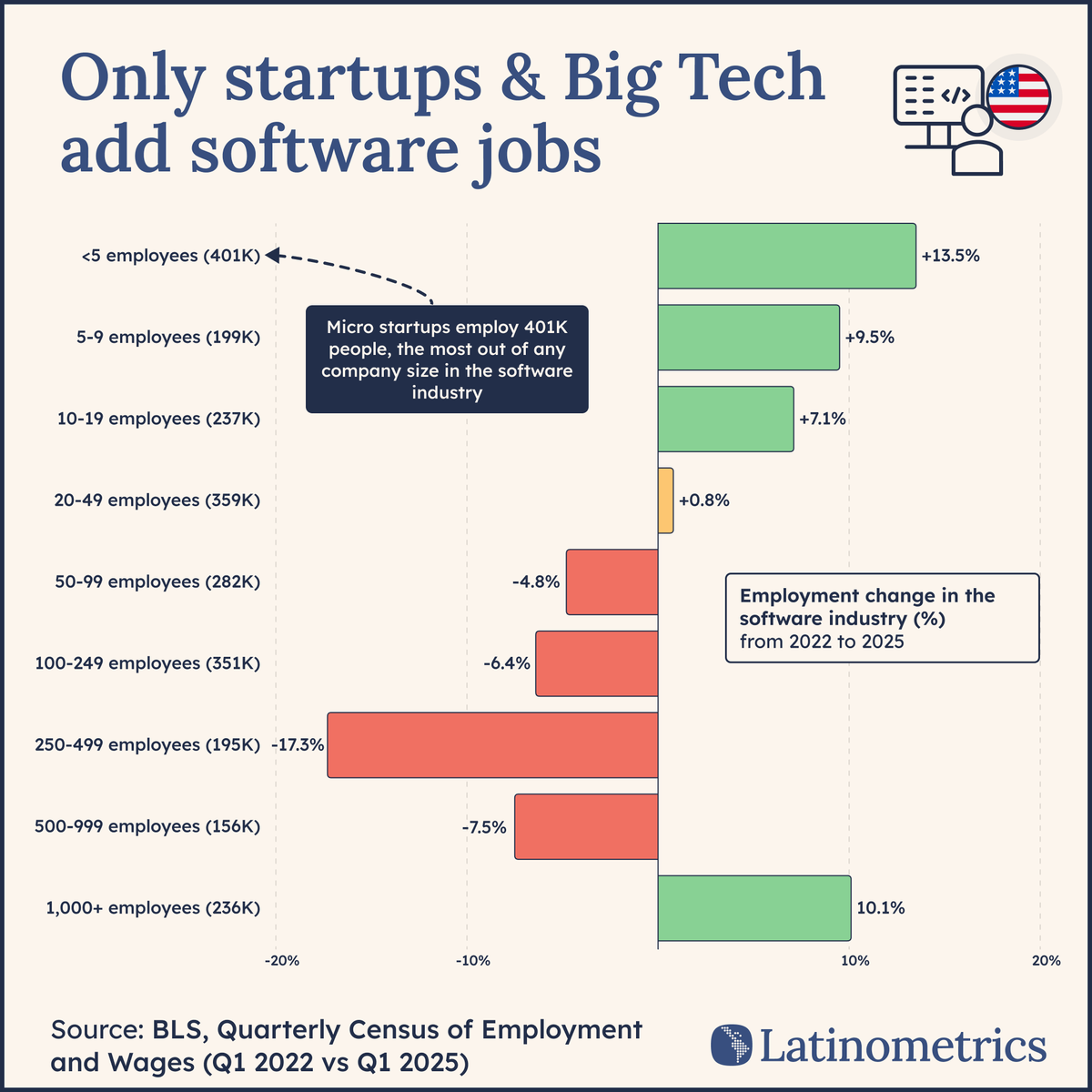
But it turns out the safest bet for tech jobs in 2026 is a five-person startup or a company the size of a small country.
Read our article: https://t.co/YJPapYrorS
Mercado Libre's founder floated a number on a podcast that made quite a bit of noise: 20,000 programmers today, maybe 10,000 in five years. Instead of layoffs, they'll just stop replacing the people who leave.
Pull the US Bureau of Labor Statistics census and the same split shows up across the US market 🇺🇸. The middle of the company-size spectrum is getting hollowed out, and the deepest cut, down 17% in three years, landed on the 250-500 employee band.
Anthropic eligió Chile para su primer Claude Impact Lab, uno de nueve en el mundo, y va por los 400 millones de latinoamericanos en sistemas financieros que no se leen 🇨🇱
La CMF (regulador financiero), el SII (fisco) y Sernac (defensa del consumidor) sueltan datos regulatorios reales. FinteChile pone mentoría de mercado. Y la sociedad civil construye herramientas para traducir la norma a lenguaje que un ciudadano cualquiera entienda.
No por eso hay que dejar de estudiar, la carrera todavía paga. El salto de prepa a licenciatura sigue siendo el mayor brinco de ingreso del país.
Pero el cuento de "estudia y te va bien" ha perdido piso.
Y en los ultimos 7 años, las licenciaturas crecieron 0.07% real anual entre 2018 y 2025. Los posgrados retrocedieron 0.43%.
Al mismo tiempo, la proporción de subempleados con título profesional aumentó del 28% al 39% del total.