@dillon_mulroy not just harnesses, we are building specialized swarms of system-one models to use them as verifiers and scorers of our RL post-training ops at @koniclabs
extremely efficient and has lots of data points for feedbacks
@jauneclaude that is why I always saying that SSDs and new fast storage tech is the next GPUs
new MoE architectures already started to take that route, Qwen is one of the earliest
TBs of HBM memory on inference is not sustainable anf effective
if everything I heard about qwen-4 is true
the damage of "control the game by destroying it" of chinese will be seen as -500B USD evaporate from the anthropic's upcoming IPO valuation
Introducing Kubic.
Agentic coding, in your control.
Your models. Your servers.
A signed policy no repo, role or model can widen.
Every decision sealed in a hash-chained ledger.
Built for enterprise workflows.
Community version, MIT.
Link below.
agentbox is open source under the Apache 2.0 license, developed by @koniclabs.
pip install agentbox-rl
The single-GPU recipe, with every setting a 24 GB machine needs, is in the repository:
https://t.co/aNQsuSmoJv
(8/8)
New big release for agentbox, v0.3, RL infrastructure for LLM agents.
Each rollout runs in a fresh Docker sandbox, is scored by a tamper-resistant verifier, and is recorded token for token.
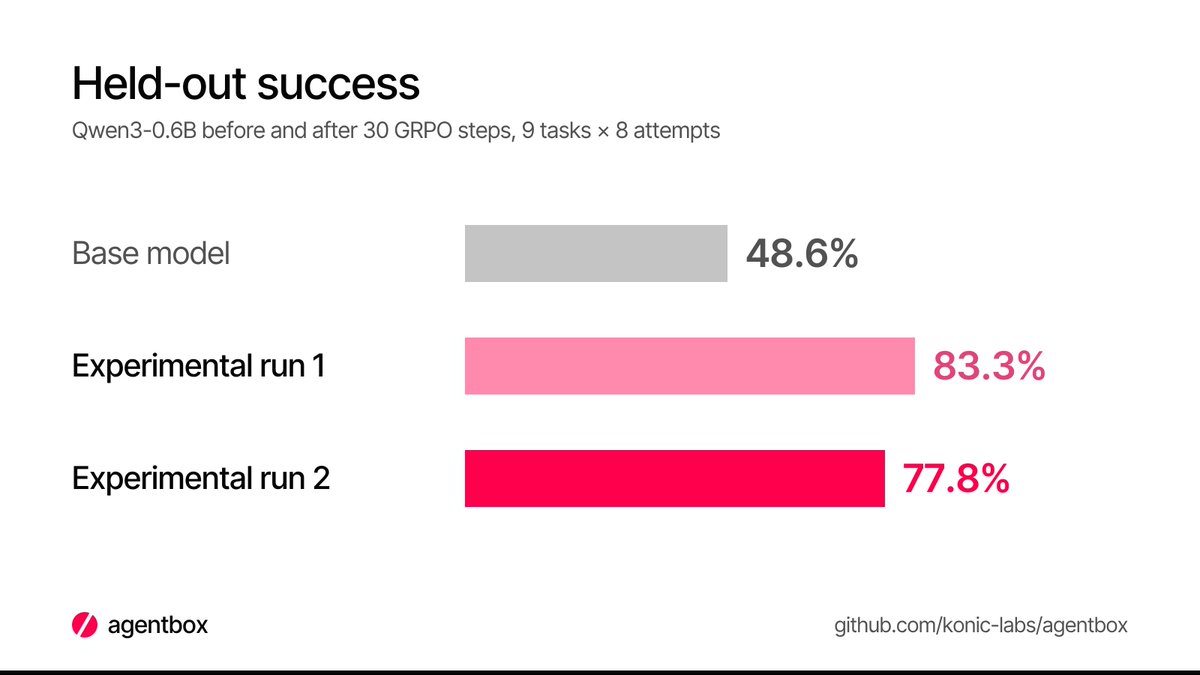
In two experimental runs, held-out success rose from 48.6% to 83.3% and 77.8%.
(1/8)
All results come from agentbox bench: a frozen, hashed suite, compared task by task with bootstrap confidence intervals (first experimental run: +34.7 points, 95% CI 9.7–62.5).
Note: the held-out set is small (9 tasks) and drawn from the training task families.
(7/8)
Introducing Agentbox.
Real worlds for agentic RL.
A fresh sandbox for every rollout.
Reward from the exit code, not the agent's word.
GRPO groups. ART-native trajectories.
Apache 2.0
Link below.
Full write-up on the @koniclabs research page: how RCO and GSQ work, where the bits ended up, how much each method contributes, and the two bugs that only showed up once I chained them.
https://t.co/bCSWRuvqp3
I implemented two recent quantization papers, GSQ and RCO, in MLX and chained them on Qwen2.5-0.5B.
2.92 bits per weight, 16.67 WikiText-2 perplexity. Plain 3-bit GPTQ gets 20.14, bf16 gets 13.08.
Whole pipeline runs on a 16GB M3 in about 2.5 hours.
https://t.co/81rcplDcdy
All credit to the authors:
GSQ, Dadgarnia et al. https://t.co/YoZDsHr87L
RCO, Helcig and Alistarh https://t.co/HSB1FzZiS0
If you combine them, watch the scales. Lion's fixed step wrecked my 5-8 bit layers. Freezing those scales took perplexity from 63.5 to 16.7