The Cultural And Economic War On Family Formation
Women did not suddenly stop wanting love, marriage, kids, or stability. The old economic and cultural bargain broke down.
In the 1950s, the median woman married around 20. A single middle class income could often support a house, a car, children, and a basic American life. That world had real limitations for women, but it also had something younger people today often do not have.
A clear path into adulthood.
Then everything started changing at once.
Birth control gave women far more control over timing. College and professional work became more available. No fault divorce changed the risk calculation of marriage. Second wave feminism challenged real constraints, but over time parts of the culture started treating homemaking, motherhood, and early family formation as small, backward, or oppressive.
At the same time, the economy quietly made the old model harder to afford.
After the 1970s inflation era and the end of the old dollar gold system, purchasing power kept getting eaten away. Housing, healthcare, education, childcare, and basic middle class life rose faster than many wages. The dual income household stopped being just liberation and became necessity.
That is the part people miss.
Women entering the workforce was partly empowerment, but it also expanded the taxable labor base, gave corporations a larger labor pool, and allowed the economy to reprice life around two incomes instead of one.
Once that happens, the old family model does not disappear because everyone hates it.
It disappears because people cannot afford to start it early.
Then culture reinforces the economics. Media, schools, advertising, and career culture tell people to find themselves first, maximize independence first, build status first, travel first, consume first, delay everything permanent until later.
Some of that is healthy. Nobody should be trapped in a bad marriage or denied opportunity.
But the overcorrection is obvious.
A society taught people to treat family as a capstone instead of a foundation. Something you do after the degree, after the career, after the house, after the perfect partner, after complete financial security.
The problem is life does not wait that long.
So the marriage age rises. Fertility falls. Dating gets more transactional. Men and women become more economically independent but more socially isolated. The state gets more workers and taxpayers. Corporations get more labor and consumers. But households get delayed, children become expensive lifestyle choices, and a lot of people realize too late that career achievement and personal freedom do not fully replace durable love, children, and a home.
This was not caused by one thing.
It was money, law, technology, culture, feminism, inflation, housing, media, and incentives all moving in the same direction.
The result is a society with more individual options, but fewer stable families.
Me tocó observarlo y entenderlo. Coincido en el fondo. El Estado solo debe encargarse de que no se rompan reglas básicas de convivencia (Estado de Derecho, fuerza pública) y generar/mantener la infraestructura para que se dé el proceso creador de la sociedad...
Elon Musk avait dit un truc qui m'avait marqué sur l'allocation de ressources. En substance : passé un certain niveau de richesse, l'argent n'est plus de la consommation, c'est de l'allocation de capital.
Cette phrase change tout.
L'économie, dans le fond, c'est juste un problème d'allocation. Tu as des ressources finies et des usages infinis. Qui décide où va quoi ?
Imagine une cour de récré. 100 enfants, des paquets de cartes Pokémon distribués au hasard. Tu laisses faire. Très vite, un ordre émerge. Les bons joueurs accumulent les cartes rares, les collectionneurs trient, les négociateurs trouvent des deals. Personne n'a planifié. Et pourtant chaque carte finit dans les mains de celui qui en tire le plus de valeur. Le système maximise le bonheur total de la cour. C'est ça, la main invisible.
Maintenant fais entrer la maîtresse. Elle trouve ça injuste. Léo a 50 cartes, Tom en a 3. Elle confisque, redistribue, impose l'égalité. Trois effets immédiats. Les bons joueurs arrêtent de jouer, à quoi bon. Les mauvais n'ont plus de raison de progresser, ils auront leur part. Les échanges s'effondrent. La cour est égale, et morte. Elle a maximisé l'égalité, elle a détruit le bonheur.
Le problème de la maîtresse, c'est qu'elle ne peut pas avoir l'information que la cour avait collectivement. C'est le problème du calcul économique de Mises, formulé en 1920. L'URSS a essayé de le résoudre pendant 70 ans avec le Gosplan. Résultat : pénuries, queues, effondrement. Pas parce que les Soviétiques étaient bêtes, parce que le problème est mathématiquement insoluble en mode centralisé.
Quand Musk a 200 milliards, il ne les consomme pas, il les alloue. SpaceX, Starlink, Neuralink, xAI. Chaque dollar est un pari sur le futur. Et lui a un track record. PayPal, Tesla, SpaceX. Il a démontré qu'il sait identifier des problèmes immenses et y allouer des ressources avec un rendement spectaculaire.
L'État aussi a un track record. Hôpitaux qui s'effondrent, éducation qui décline, dette qui explose, services publics qui se dégradent malgré des budgets en hausse constante. Le marché identifie les bons allocateurs, la politique identifie les bons communicants.
Le profit n'est pas une finalité, c'est un signal. Il dit : tu as alloué des ressources rares vers un usage que les gens valorisent suffisamment pour payer. Plus le profit est gros, plus la création de valeur est grande. Quand Starlink est rentable, ça veut dire que des millions de gens dans des zones rurales ont enfin internet. Quand un ministère est en déficit, ça veut dire qu'il consomme plus qu'il ne produit. L'un crée, l'autre détruit, et on appelle ça redistribution.
Dans nos sociétés il y a deux catégories d'acteurs. Les entrepreneurs et les bureaucrates. L'entrepreneur prend un risque personnel pour identifier un problème, mobiliser des ressources, créer une solution. S'il se trompe il perd. S'il a raison, ses clients gagnent, ses employés gagnent, ses fournisseurs gagnent, l'État collecte des impôts. Il est la cellule de base du progrès humain.
Le bureaucrate ne prend aucun risque personnel. Son salaire est garanti. Au mieux il maintient une rente existante. Au pire il la détruit par excès de réglementation, mauvaise allocation forcée, incitations perverses qui découragent ceux qui produisent. Mais dans aucun cas il ne crée.
Regarde les 50 dernières années. iPhone, internet civil, SpaceX, Tesla, Google, Amazon, Stripe, mRNA, ChatGPT. Toutes des inventions privées, portées par des entrepreneurs, financées par du capital risque. Pas un seul ministère n'a inventé quoi que ce soit qui ait changé ta vie au quotidien.
La France est devenue le laboratoire mondial de la dérive bureaucratique. 57% du PIB en dépenses publiques, record absolu. Une administration tentaculaire, une fiscalité qui pénalise la création de richesse. Résultat : décrochage face aux États-Unis, à l'Allemagne, à la Suisse. Fuite des cerveaux. Désindustrialisation. Dette qui explose.
Et le pire c'est que la mauvaise allocation s'auto-renforce. Plus l'État prélève, moins les entrepreneurs créent. Moins ils créent, moins il y a de base fiscale. Plus l'État s'endette et taxe. Boucle de rétroaction négative parfaite. La maîtresse pense qu'elle aide, et chaque année la cour produit moins.
Dans nos sociétés, ce sont les entrepreneurs, toujours, qui font avancer la civilisation. Les bureaucrates au mieux maintiennent une rente, au pire la détruisent. Aucune société n'a jamais progressé en taxant ses créateurs pour subventionner ses gestionnaires.
La question n'est jamais qui a combien. C'est qui alloue le mieux la prochaine unité de ressource pour maximiser le futur de l'humanité. La réponse depuis 200 ans n'a jamais changé. Ce ne sont pas les fonctionnaires.
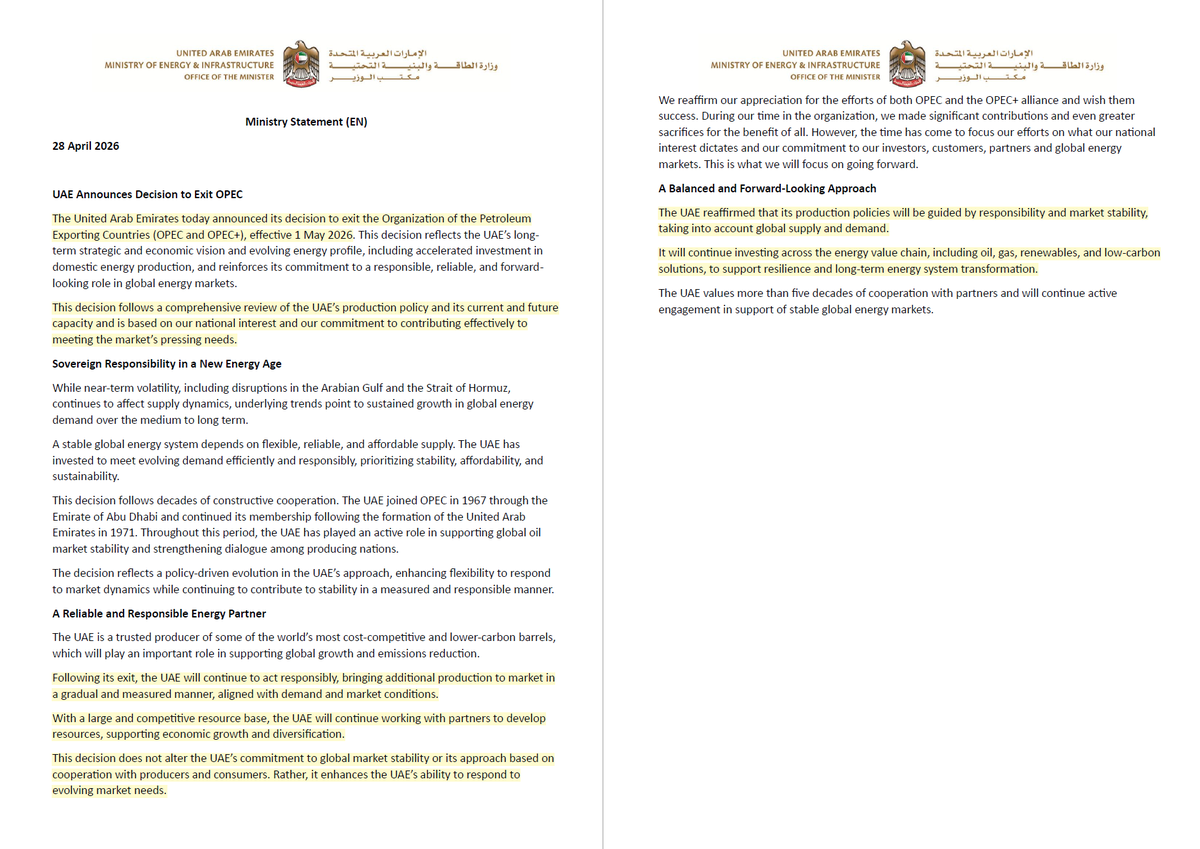
🚨🚨🚨🚨FULL STATEMENT:
UAE says it's leaving the OPEC oil cartel from May 1.
"... Following its exit, the UAE will continue to act responsibly, bringing additional production to market in a gradual and measured manner, aligned with demand and market conditions..."
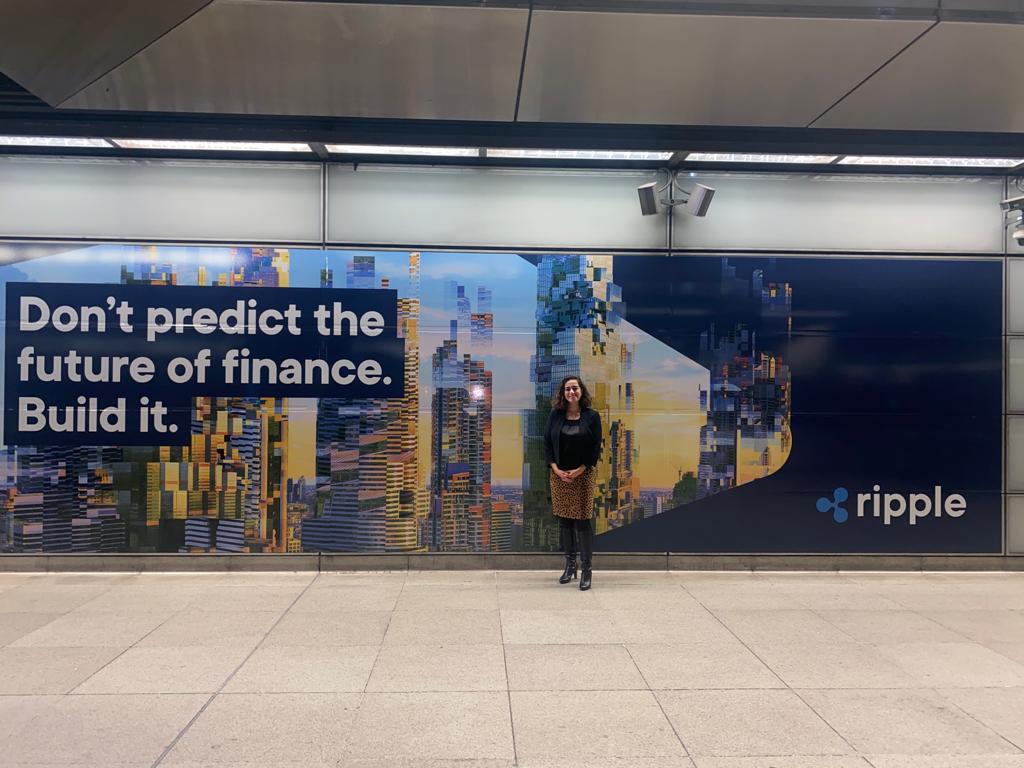
@DemonSoldiers90 Creo que es Canary Wharf, en Londres. Un centro financiero que se distingue por la pirámide de One Canary Square y la Reuters Plaza con sus relojes de piso, no colgados como en Basel. El 589 en ellos es extra 😉
45 incidents last 45 days ... refineries are blowing up all around the world.... not only war zones but in Australia, Indonesia.... today Mexico....
If you think these are all some absurd coincidences, you trully deserve a collar and a leash. While someones are blowing up world's energy sources, stocks are reaching all time highs every day.
Did I miss a few days when they injected some sort of a shot to make men turn completely into sheep or was that part of the Covid shots I did not take.
Whoever is behind this is doing a great job to destroy energy sources everywhere while sleep walking people to a never seen chaos before.
🚨 Saudi Finance Minister EXPOSES the oil price :
“You see $90 on the screen… good luck buying a barrel at that price.”
Real price? $120–$160/barrel.
The biggest gap between perception and reality in energy markets — ever.
Who’s controlling the narrative? 👀
Today, Treasury’s @FinCENnews amended an order to enable the liquidation of Mexico-based financial institution CIBanco. Treasury previously cut off CIBanco’s access to the U.S. financial system after finding that the bank facilitated the laundering of illicit opioid proceeds, and the Government of Mexico assumed control. This resolution underscores the United States and Mexico’s shared commitment to protecting our financial systems from cartels and narcotraffickers, and to hold accountable those who enable them.
https://t.co/Fg0IXB2leu
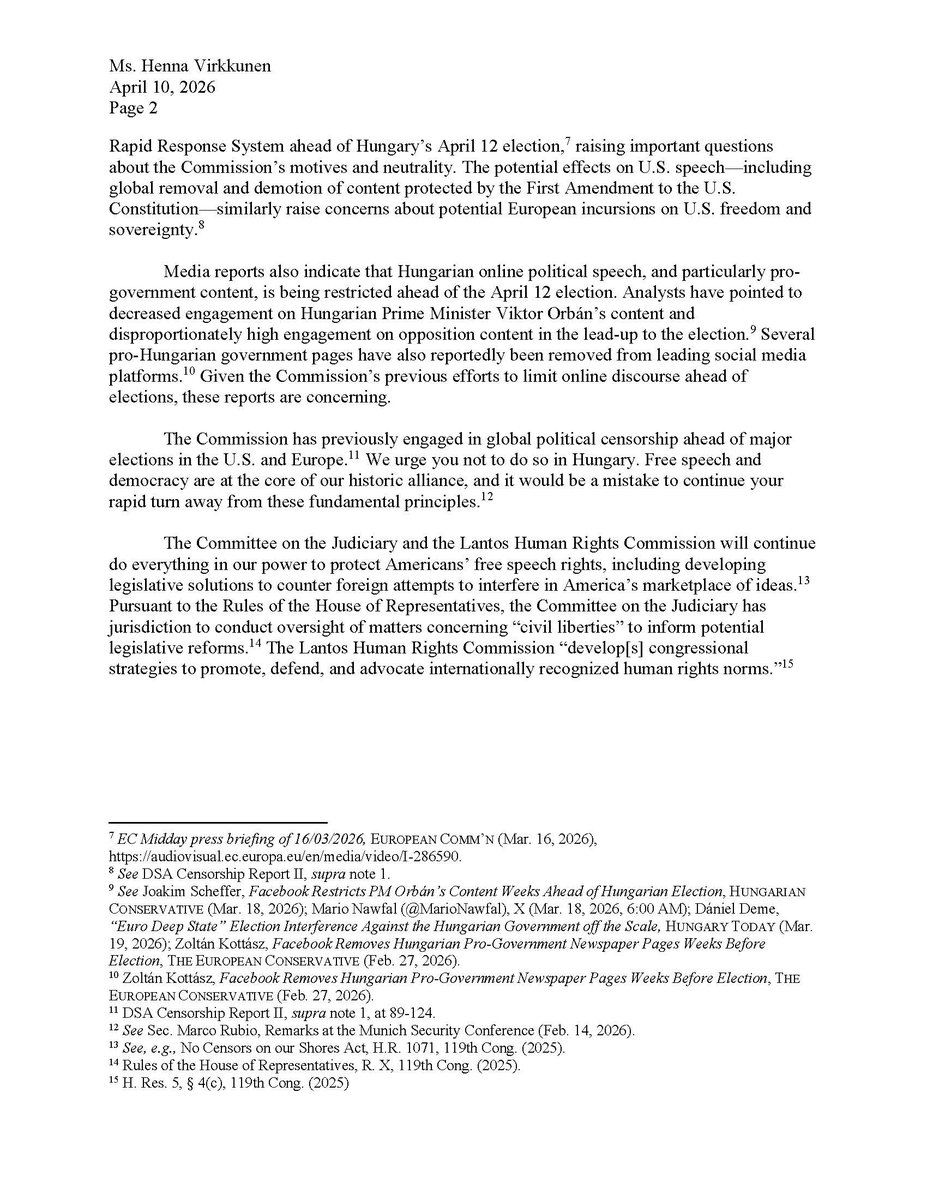
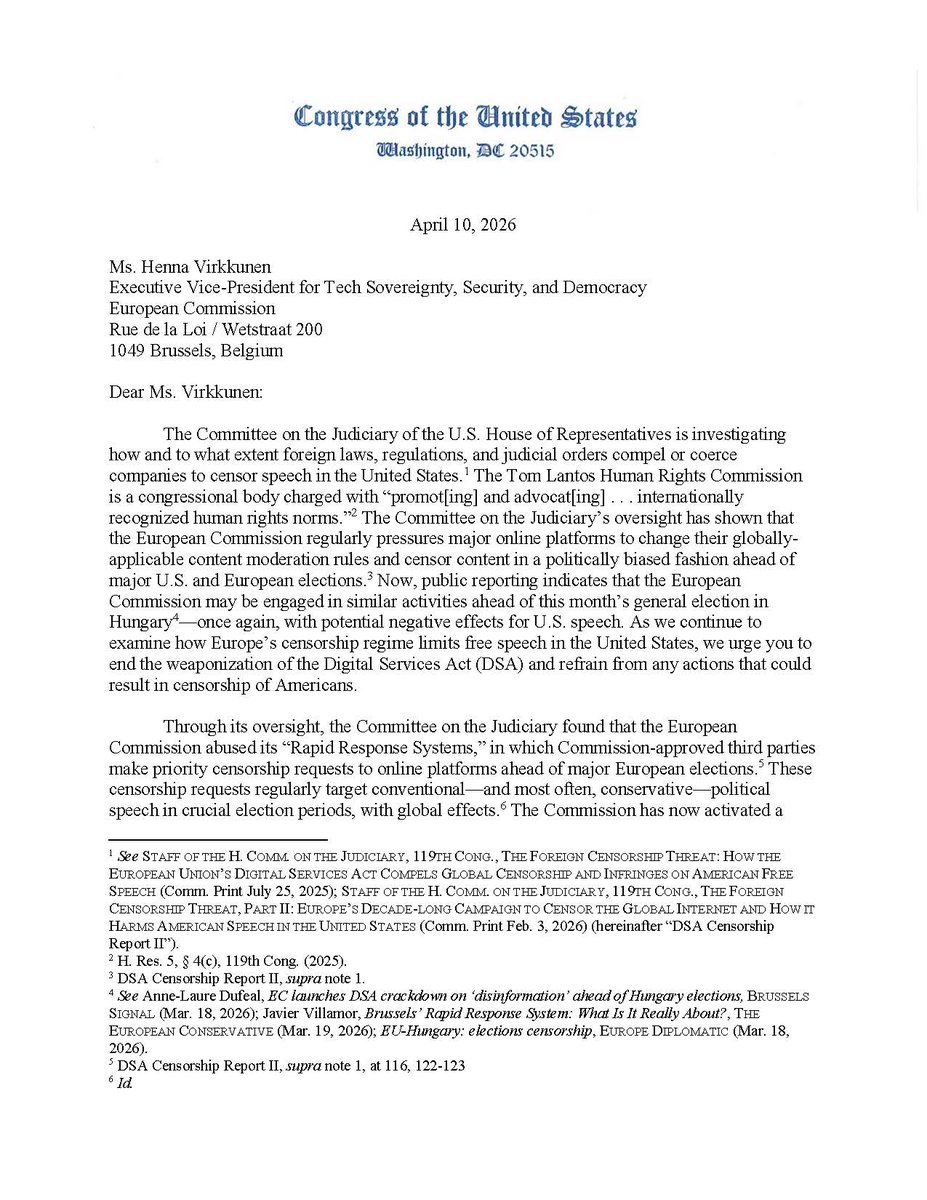
#NEWS: The European Commission uses its vast power to limit online discourse ahead of major elections in the U.S. and Europe.
Its actions could affect U.S. speech—including the global removal and demotion of content protected by the First Amendment.
Ahead of tomorrow's Hungarian election, Chairman @Jim_Jordan and Rep. Chris Smith wrote to @HennaVirkkunen urging the Commission to refrain from any interference.
Read the full letter here ↓
El sistema financiero de los EEUU ya está tomando nota. ¿Acá observamos a alguien haciendo algo para proteger los programas de cómputo que sustentan al sistema bancario, financiero, eléctrico y gubernamental?
https://t.co/DovRmURtJe
A short notice meeting was just held by the US Treasury, the Federal Reserve and Central Banks on a powerful new AI model called Anthropic
CEOs of the following major US banks were in attendance:
Bank of America (Brian Moynihan)
Citigroup (Jane Fraser)
Goldman Sachs (David Solomon)
Morgan Stanley (Ted Pick)
Wells Fargo (Charlie Scharf)
JPMorgan Chase’s Jamie Dimon was invited but could not attend
The model is reportedly capable of identifying and exploiting vulnerabilities in every major operating system and web browser when prompted by a user
Top independent US oil refiner Valero Energy Corp., the largest buyer of Mexican crude, has cut purchases from the country to a trickle in April as it struggles to restart its Texas refinery following an emergency total shutdown.
The company has agreed to buy one cargo from Mexico of less than 200,000 barrels this month, according to a document seen by Bloomberg. That compares with an average of 4 million barrels a month last year.
The majority of Valero’s imports go to the Port Arthur refinery, one of the largest on the US Gulf Coast. In late March, the refinery faced extensive damage from a diesel hydrotreater fire. The explosion and fire were so severe that the unit’s blast-resistant control room was destroyed.
#oott https://t.co/o5F4PEdWiu
Invito a empresas mexicanas de todos los sectores a participar en SelectUSA Investment Summit 2026, el principal evento de inversión extranjera en los 🇺🇸. Como el principal destino mundial de inversión—con una economía de 30 billones de dólares—los Estados Unidos ofrecen oportunidades únicas para crecer, invertir y prosperar.
@Bird_XRPL I think lower. To much liquidity downstairs and no velocity, when time comes things will move fast. .77 is the number I think will mark the bottom...
@DemonSoldiers90 Yeap, Canary Wharf...
https://t.co/MEOwZBxEjZ
En la foto de Ripple aparecen el toro de Wall Street y Canary Wharf, como centros financieros globales.
@DemonSoldiers90 Yeap, Canary Wharf...
https://t.co/MEOwZBxEjZ
En la foto de Ripple aparecen el toro de Wall Street y Canary Wharf, como centros financieros globales.
Passing through Canary Wharf yesterday I couldn't help but get some photos of @Ripple's fantastic new #CryptoMeansBusiness ad campaign!
We launched it to highlight that #crypto solutions are here to stay and are already making a real impact on businesses around the world.
@DemonSoldiers90 Creo que es Canary Wharf, en Londres. Un centro financiero que se distingue por la pirámide de One Canary Square y la Reuters Plaza con sus relojes de piso, no colgados como en Basel. El 589 en ellos es extra 😉