Anthropic just released 5 workshops on building self-improving agentic systems from scratch:
00:00 - Ship your first Claude agent
36:44 - Self-improving agents (tools,skills)
1:21:25 - Build memory for Claude agents
1:49:47 - Set up a proactive agent
2:11:31 - Make your agent autonomous
These 3-hours of Claude workshops will replace 20 paid agentic courses.
Watch today, then read article below on how to build a self-improving agentic system with Fable 5.
🚨 You need to see this.
@addyosmani from Google just dropped his new Agent Skills and it's incredible.
It brings 19 engineering skills + 7 commands to AI coding agents, all inspired by Google best practices 🤯
AI coding agents are powerful, but left alone, they take shortcuts.
They skip specs, tests, and security reviews, optimizing for "done" over "correct." Addy built this to fix that.
Each skill encodes the workflows and quality gates that senior engineers actually use: spec before code, test before merge, measure before optimize.
The full lifecycle is covered:
→ Define - refine ideas, write specs before a single line of code
→ Plan - decompose into small, verifiable tasks
→ Build - incremental implementation, context engineering, clean API design
→ Verify - TDD, browser testing with DevTools, systematic debugging
→ Review - code quality, security hardening, performance optimization
→ Ship - git workflow, CI/CD, ADRs, pre-launch checklists
Features 7 slash commands: (/spec, /plan, /build, /test, /review, /code-simplify, /ship) that map to this lifecycle.
It works with:
✦ Claude Code
✦ Cursor
✦ Antigravity
✦ ... and any agent accepting Markdown. Baking in Google-tier engineering culture (Shift Left, Chesterton's Fence, Hyrum's Law) directly into your agent's step-by-step workflow!
`npx skills add addyosmani/agent-skills`
Free and open-source.
Repo link in 🧵↓
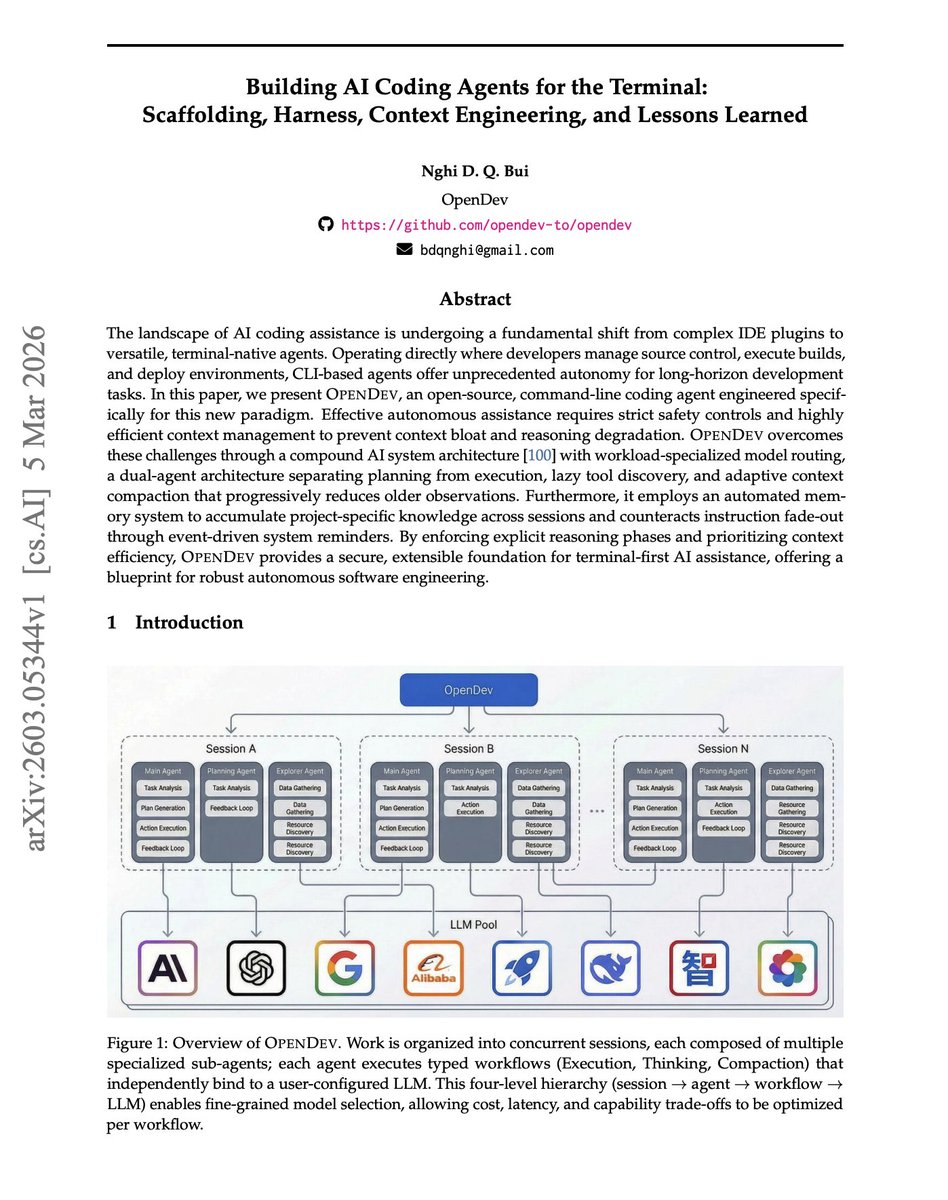
Pay attention to this one if you are building terminal-based coding agents.
OpenDev is an 81-page paper covering scaffolding, harness design, context engineering, and hard-won lessons from building CLI coding agents.
It introduces a compound AI system architecture with workload-specialized model routing, a dual-agent architecture separating planning from execution, lazy tool discovery, and adaptive context compaction.
The industry is shifting from IDE plugins to terminal-native agents.
Claude Code, Codex CLI, and others have proven the model works.
This paper formalizes the design patterns that make these systems reliable, covering topics like event-driven system reminders to counteract instruction fade-out, automated memory across sessions, and strict safety controls for autonomous operation.
Paper: https://t.co/tpAZFaSnog
Learn to build effective AI agents in our academy: https://t.co/1e8RZKs4uX
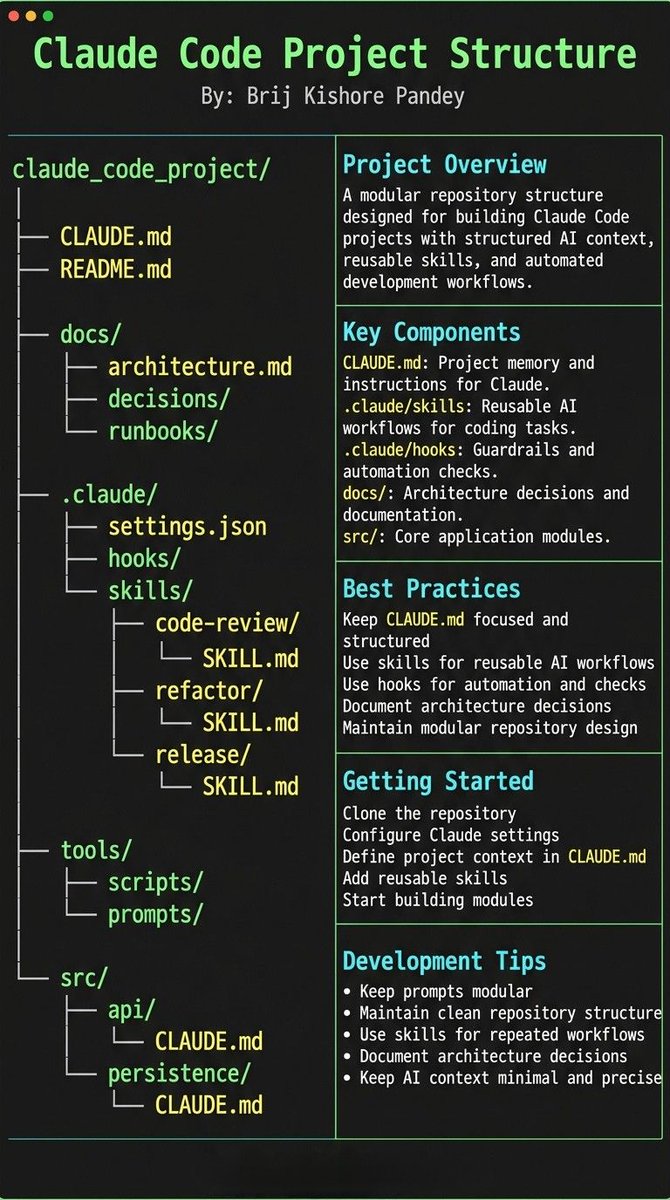
Most people treat CLAUDE.md like a prompt file.
That’s the mistake.
If you want Claude Code to feel like a senior engineer living inside your repo, your project needs structure.
Claude needs 4 things at all times:
• the why → what the system does
• the map → where things live
• the rules → what’s allowed / not allowed
• the workflows → how work gets done
I call this:
The Anatomy of a Claude Code Project 👇
━━━━━━━━━━━━━━━
1️⃣ CLAUDE.md = Repo Memory (keep it short)
This is the north star file.
Not a knowledge dump. Just:
• Purpose (WHY)
• Repo map (WHAT)
• Rules + commands (HOW)
If it gets too long, the model starts missing important context.
━━━━━━━━━━━━━━━
2️⃣ .claude/skills/ = Reusable Expert Modes
Stop rewriting instructions.
Turn common workflows into skills:
• code review checklist
• refactor playbook
• release procedure
• debugging flow
Result:
Consistency across sessions and teammates.
━━━━━━━━━━━━━━━
3️⃣ .claude/hooks/ = Guardrails
Models forget.
Hooks don’t.
Use them for things that must be deterministic:
• run formatter after edits
• run tests on core changes
• block unsafe directories (auth, billing, migrations)
━━━━━━━━━━━━━━━
4️⃣ docs/ = Progressive Context
Don’t bloat prompts.
Claude just needs to know where truth lives:
• architecture overview
• ADRs (engineering decisions)
• operational runbooks
━━━━━━━━━━━━━━━
5️⃣ Local CLAUDE.md for risky modules
Put small files near sharp edges:
src/auth/CLAUDE.md
src/persistence/CLAUDE.md
infra/CLAUDE.md
Now Claude sees the gotchas exactly when it works there.
━━━━━━━━━━━━━━━
Prompting is temporary.
Structure is permanent.
When your repo is organized this way, Claude stops behaving like a chatbot…
…and starts acting like a project-native engineer.
Я полюбил терминал c Claude Code CLI
У меня не раз уже спраши��али:
– “Ты реально в терминале сидишь, а не через IDE типа vccode?
– “А как же видеть, что он меняет?”
– “А как же глазами просматривать код, а вдруг он что-то не то сделал?”
– “Нет-нет, я сижу в Cursor и тщательно просматриваю каждое изменение.”
Это выбор, и каждый делает его для себя. Ко��да-то и я работал через Cursor и слово терминал для меня было чем-то страшным, но я заставил себя попробовать Claude Code CLI и понял, что это лучшее “окно” для работы с агентом.
Кто-то боится разучиться писать код вручную, кто-то боится, что агент наделает ерунды, но моё личное мнение, что это надуманная история.
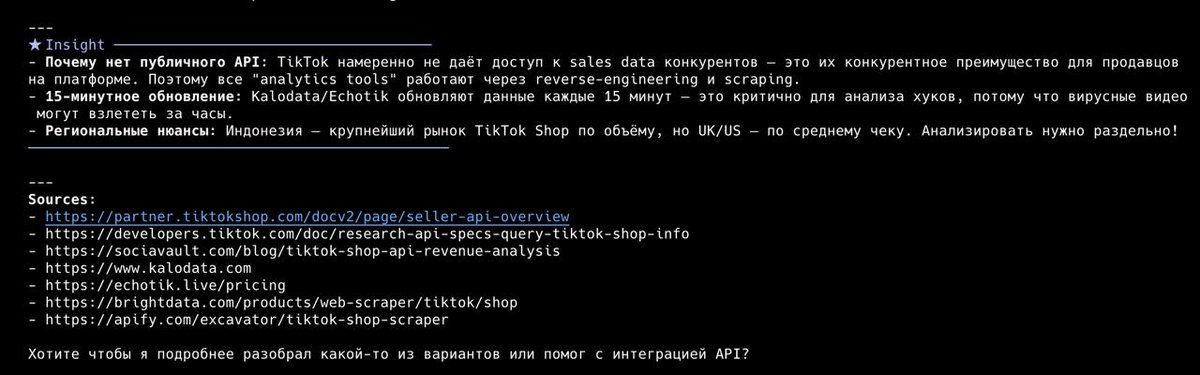
Я часто стал замечать у разных людей, что Claude Code им в ответах выдаёт блок “★ Insight”, где описывается как что-то сделано, или почему им было принято такое решение или какие-то важные мысли, выделенные в этом отдельном блоке.
Оказывается в Claude Code есть слеш-команда output-style, и у меня значение output-style было выставлено в Default, т.е. самый скучный режим. Я у��устил существование этой команды и полез разбираться, что это и как оно работает.
Output-style это своего рода переключатель системного промпта Claude Code. Только системный промпт не заменяется, а дополняется новым поведением агента. У этой команды есть 3 варианта: default, explanatory и learning.
На Default стиле сидят все, кто не знает о существовании этой команды. А вот Explanatory режим как раз добавляет те самые инсайты.
Но не менее интересен режим Learning. Судя по всему, он как раз для тех, кто не хочет разучиться писать код руками, хотя это вымирающий навык. В этом режиме агент так ж�� выдает инсайты, но дополнительно оставляет в коде блоки TODO(human), чтобы человек сам дописал нужные куски кода и не разучился это делать или научился писать код, если он только учится в эти непростые для новичков времена.
А еще можно реализовать свой собственный стиль и поведение агента на уровне системного промпта, и дополнить его теми качествами, которые вам нужны.
Ищем DevOps-инженера в дружную международную команду на удалёнку.
Буду рад ответить на вопросы в директ или email-ом.
#devops#kubernetes#sre#aws https://t.co/QzNCm9RQ9F