Por qué el segundo cerebro de Karpathy, el padrino de la IA moderna, no usa Notion ni Obsidian en absoluto.
Porque construyó para sí mismo, y desde cero, una galaxia de conocimiento en 3D capaz de pensar.
Alguien replicó por completo este sistema, introdujo solo 378 notas, y el sistema generó automáticamente 1854 nodos y 3856 conexiones.
No es un simple archivador inerte: puede descubrir activamente conexiones ocultas y darte un feedback revelador como si fuera un segundo sistema neuronal.
Creo que este es el verdadero golpe letal (un ataque de reducción de dimensionalidad) para todas las herramientas tradicionales de toma de notas:
Si usas Notion, estás construyendo un archivador.
Si usas Roam, estás construyendo una hoja de cálculo.
Si usas Obsidian, estás construyendo un cementerio.
Los mejores expertos en IA están construyendo galaxias.
La experiencia que se ve en el video cambia por completo la forma en que todos entendemos la toma de notas:
Contra un fondo de espacio profundo, innumerables orbes brillantes y líneas de conexión forman un universo completo.
Haz clic en cualquier nodo y la IA desenterrará al instante todas esas conexiones ocultas que habías olvidado hace tiempo.
Aleja el zoom para ver el panorama completo de tu pensamiento, acércalo para ver cómo dos ideas aparentemente inconexas están vinculadas entre sí.
De forma proactiva, te dice dónde faltan enlaces y dónde hay ideas transversales de las que no te habías percatado.
Miau, miau, miau, esto es prácticamente una revolución en la forma de pensar. En el pasado, tomar notas consistía en introducir, organizar y buscar.
Al final, todo se queda en el disco duro acumulando polvo; nunca lo vuelves a mirar.
El segundo cerebro de hoy es una red neuronal dinámica y en crecimiento.
Lo alimentas con tus ideas y te ayuda a capitalizar, conectar y generar cosas nuevas.
Te entiende mejor que tú mismo, recuerda todas tus trayectorias de pensamiento e incluso puede darte inspiración cuando estás atascado.
La parte más impactante es la última frase de la publicación: La brecha en el interés compuesto del conocimiento nunca ha tenido que ver con el talento, se trata de arquitectura.
Quienes empiecen con este sistema 6 meses antes, siempre llevarán a los demás una ventaja de 6 meses de interés compuesto de pensamiento.
Porque tu segundo cerebro pensará por ti 24/7 sin parar, mientras que las notas de los demás simplemente se quedarán ahí pudriéndose.
Por supuesto, la gente común no necesita empezar desde cero a escribir código para construir una galaxia 3D.
Empieza con una configuración automatizada de Obsidian + Claude: deja que la IA extraiga contenido automáticamente, encuentre conexiones y te genere informes diarios.
Pero la dirección a seguir ya está muy clara: el futuro de la gestión del conocimiento no consiste en almacenar cosas, consiste en criar a una IA pensante que sea exclusiva para ti.
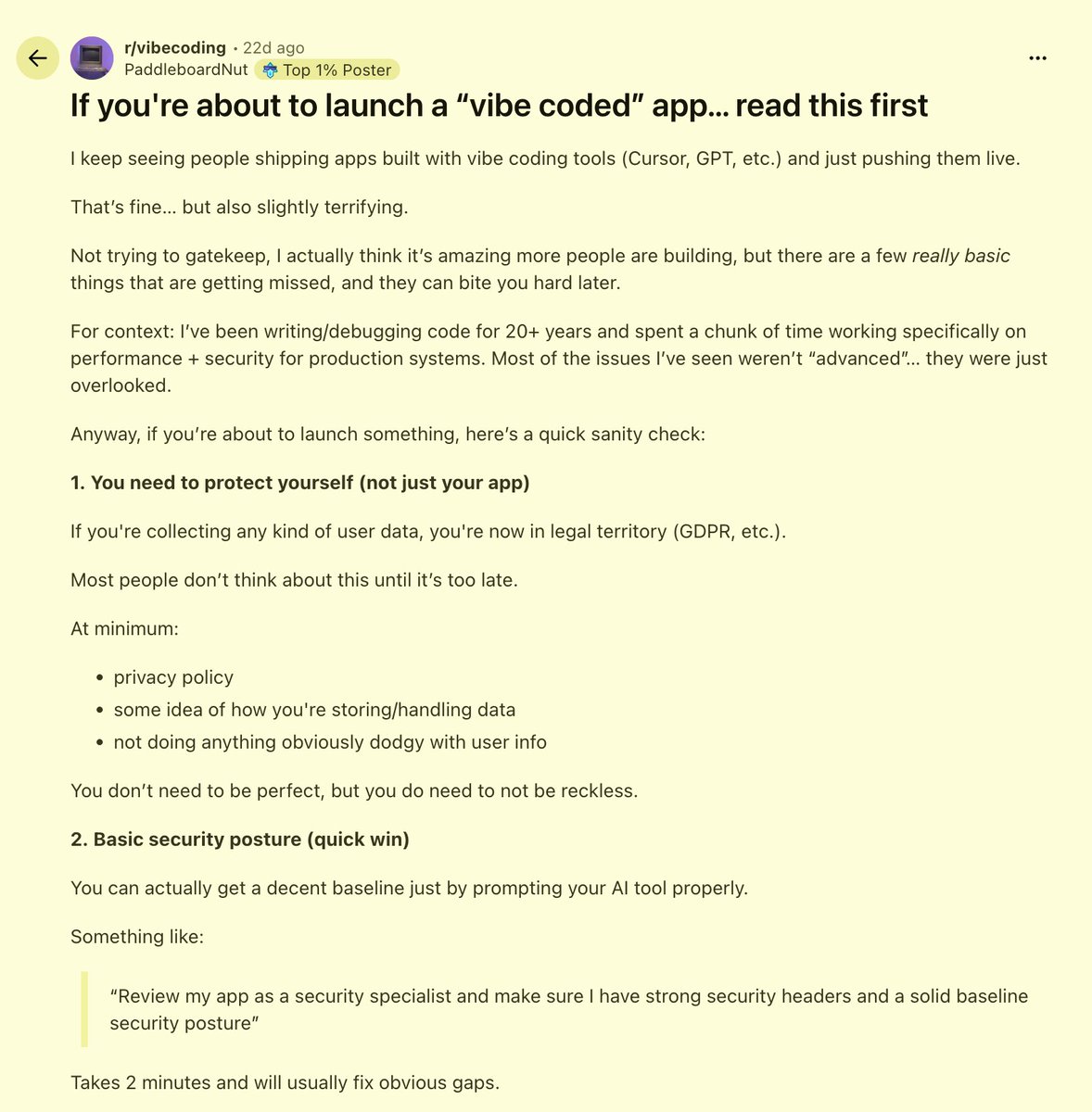
Vibe coders are getting sued.
People are launching apps with real users but skipping the boring stuff that can actually kill the product.
A developer with 20+ years of experience just shared the pre-launch checklist every AI builder should run:
→ privacy policy if you collect user data
→ know where user data is stored
→ check security headers
→ scan against OWASP basics
→ look for SQL injection / XSS / auth issues
→ make sure .env values are not leaking
→ check API responses for sensitive data
→ remove secrets from logs
→ never expose API keys in frontend code
→ move keys server-side or behind a proxy
→ add rate limits before someone burns your API bill
This is what most vibe coders are missing.
AI can help you build the app.
But if you launch without security, privacy, and abuse checks...
you didn't ship a product.
you shipped a liability.
A sperm cell contains about 37.5 megabytes of information and there is about 100 million cells per milliliter.
The average ejaculation is about 2.25 milliliters and takes about 5 seconds.
This makes the average bandwidth of the human penis 1,687 terabytes per second.
I know....thats a lot of information to swallow.
🚨DID THIS STUDENT RESEARCHER JUST SOLVE SCHIZOPHRENIA?
A young woman is going viral after breaking down her research paper claiming modern psychiatry has been focusing on the wrong part of the brain for decades.
She argues schizophrenia isn’t primarily a dopamine disorder, but a “leaky thalamus” — the brain’s sensory filter — that fails to block out irrelevant information, causing the brain to hallucinate and create its own reality to fill in the gaps.
Her theory also suggests antipsychotics only mask symptoms, questions Big Pharma’s funding priorities, and even links the same mechanism to ADHD.
She questions why the thalamus has been so neglected in psychiatric research.
Activist: "Your cows are putting carbon into the atmosphere."
Farmer: "Where did they get it?"
Activist: "What?"
Farmer: "The carbon. Where did the cow get it before it put it anywhere."
Activist: "From... eating?"
Farmer: "From eating grass. And where did the grass get it."
Activist: "The soil?"
Farmer: "The air. The grass pulled it out of the air last spring. The cow ate the grass. The cow breathed some of it back out. It went back into the air it came from."
Activist: "But it's still going into the atmosphere."
Farmer: "It's going back. There's a difference between a thing going somewhere and a thing going back. You've described a circle and you're frightened of it."
Activist: "Then just don't have the cow."
Farmer: "The grass still dies in autumn. It rots where it falls. The carbon goes back into the air either way, just without anyone getting fed in the middle."
Activist: "It's not that simple."
Farmer: "It's grass, cow, breath, grass. Or it's grass, rot, air, grass. Same circle, fewer dinners. If that's complicated for you I'd stay away from the water cycle. That one's got clouds in it."