🔥 Reusing waste heat in the #textile industry and convert it into #energy! ⚡️
This is the EHAWEDRY solution aimed to provide a solution for an efficient use of low grade-waste heat in the textile sector.
Discover our technology🔗https://t.co/p1q8hY2Zz7
#HorizonEU#EUresearch
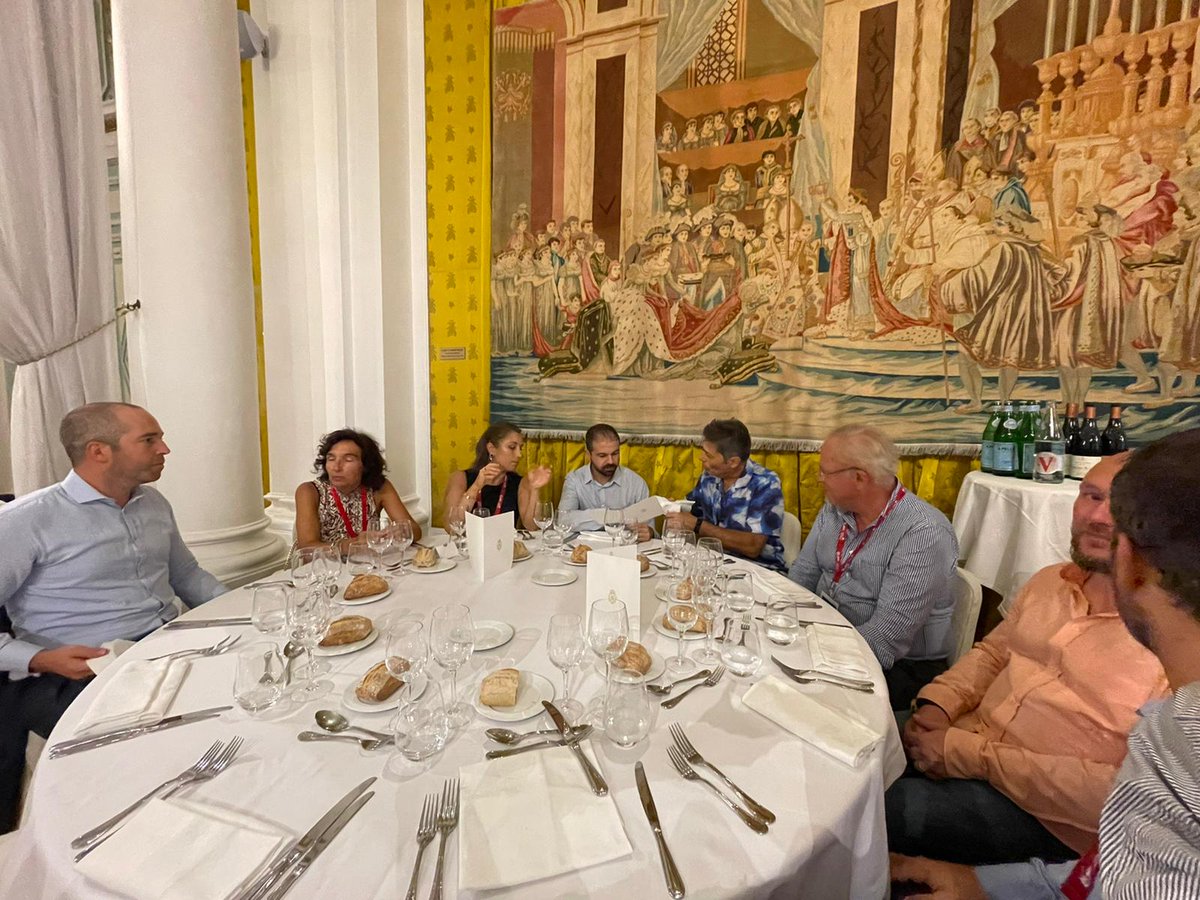
EHAWEDRY's Project moves on – we joined in Hamburg at the @TUHamburg, Germany for the regular #GA where we discussed the progress of the final prototype
The EHAWEDRY groundbreaking technology is moving forward!
Discover the project👉https://t.co/wHqs7V7CJC
#H2020#EUresearch
In EHAWEDRY we are revolutionising the waste heat recovery processes. How? 👇
The EHAWEDRY technological system will overcome the feasibility limitation of #thermoelectric devices by using #electrochemical capacitors.
More 👉https://t.co/440xRrDDRk
#EUresearch#Horizon2020
NEW #STUDY| @TUHamburg introduces a method to create porous #silicon wafers mimicking biological structures.
Combining chemical etching & photolithography with silver nanoparticles, it yields high-porosity wafers suitable for #energyStorage & #sensors.
👉https://t.co/XQqwTMSDIV
🔎 NEW RESEARCH | Osmotic pressure and diffusion of #ions in charged nanopores
In our latest publication, we studied the ionic diffusion dynamics which is of interest for several natural and technological processes.
Read more: https://t.co/sAtiokBHa3
#horizon2020#EUresearch
Fluids in porous materials: from fundamental physics to engineering applications.
This is the title of the workshop we are attending in June. #ehawedry#innovation#eu
to the experimental characterization of their behavior with respect to capillary imbibition, drying, and the occurrence of cavitation and/or salt crystallization. It will also contribute to modeling and prototype design.
@CNRS will contribute to the fabrication of model, transparent nanoporous media using various techniques (e.g. porous silicon anodization, photolithography, anodic bonding),
Producing particles and porous electrodes, treating their surfaces and characterizing them. assembling and testing a prototype and contributing to the definition of application scenarios.
#OurConsortium@IREC_Energia will be involved in the dissemination and exploitation of the project results. Numerically optimizing the coupling wetting/drying and charging/discharging cycles.
advanced interpretation of electrokinetic and electrochemical properties of nanoparticles and optimization of particle-by-particle deposition methods (WP3). It will also take part in the development and testing of bench-scale integrated system (WP5).
#OurConsortium@la_UPC will carry out scientific and administrative coordination of the project (12PM). It will also play a crucial role of facilitator of information flows and knowledge exchange between partners of this multidisciplinary consortium. It will be the leader of WP1.
Its main technical tasks will be planning and implementation of particle-by-particle deposition methods, electrochemical characterization of nanoparticles and nanoporous layers using impedance spectroscopy and current switch-off method,
@la_UPC Is the Project Coordinator for EHAWEDRY. Its main technical tasks will be planning and implementation of #particle-by-particle deposition methods, electrochemical characterization of #nanoparticles and #nanoporous layers.
EHAWEDRY proposes a paradigm shift from the energy harvesting strategies previously used: it will change the electrode/electrolyte contact area by modifying the electrolyte level within nanoporous electrodes through drying/wetting cycles. Read more at https://t.co/GOtRNAiS0L