Local AI is here to stay, and we’re just getting started.
More models are coming soon to Dell Enterprise Hub. 🚀
Go give them a try: https://t.co/TDXx5U3UDW
🦙 Dell Enterprise Hub just got a major AI upgrade.
Run powerful AI models locally on your Dell Pro Max GB10, keeping your data private while unlocking coding agents, automations, and local chats.
Starting today, a new lineup of GGUF models is available. 👇🧵
🔥 New additions:
• Qwen3.6 (27B & 35B)
• Gemma 4 (26B & E4B)
• GPT-OSS-20B
• North Mini Code 1.0
• Step-3.7 Flash
Big thanks to @UnslothAI for the amazing GGUF quants, and to @Dell for partnering with us at @huggingface and making them easily accessible.
MiniMax-M3 is available on @Dell's Dell Enterprise Hub!
- 428B with ~23B active parameters
- Native multimodality: text, image and video
- MiniMax Sparse Attention (MSA) improving million-token contexts efficiency
- Agentic coding and cowork capabilities
https://t.co/jmHoH1akk5
Decided to go to DC next week to talk directly with policymakers. Not sure how impactful it will be but with everything happening, feels like a good time to share more about open-source AI, transparency, concentration of power, the real risks vs the real benefits. Who do you think I should meet there (Congress members, WH people, public orgs,...)?
I'm seeing a lot of angry people lately... remember, you can always run your coding agent locally ;)
llama.cpp + OpenCode = fast, reliable and private inference.
This is @UnslothAI North-Mini-Code-1.0-GGUF running at ~50 tokens/s on my Macbook
Meet DiffusionGemma!
An experimental open model that explores a fast approach to text generation, released under an Apache 2.0 license.
Moving beyond sequential, token-by-token processes to generate entire blocks of text simultaneously. Here’s what’s new with DiffusionGemma: 👇
They come packed with:
🧠 550B total parameters, 55B active
⚡ Hybrid Mamba2 + LatentMoE architecture
🚀 Multi-Token Prediction (MTP) for faster generation
🎉 Available in BF16 and NVFP4 variants
🌍 Multilingual support across 10+ languages
Find them at https://t.co/TDXx5U3UDW
🔥 NVIDIA’s Nemotron 3 Ultra has landed on Dell Enterprise Hub!
Built for next-generation AI agents, long-context reasoning, and enterprise-scale workloads, Nemotron 3 Ultra is NVIDIA’s latest frontier reasoning model.
A few highlights 👇
most multi-turn RL loops have a silent bug: you decode the model's output to detect tool calls, then re-tokenize the conversation for the next turn. BPE isn't invertible, so decode then re-encode can land on different ids. gradient ends up on tokens the model never sampled. no crash, just quietly wrong math and broken training
@qgallouedec wrote a super educational blog on MITO (message-in, token-out) vs TITO (token-in, token-out) and how you might fix the problem above
go read it 🤓
llama.cpp now has an official website: https://t.co/vztdUpdBWL
Our goal is to make local AI accessible to everyone, and improving the user experience is a big part of that. On the new landing page you’ll find a single-line cross-platform installer. The installation provides a single unified `llama` entrypoint which you can use to run/serve models and interface with 3rd-party agentic applications.
While oriented towards simplified user experience, the new `llama` application also provides all the advanced functionality of the existing llama.cpp tooling with which experienced users are already familiar. Also note that all GGUF models that you might have already downloaded with llama.cpp in the past will be automatically available to use without downloading again (they are stored in the common HF cache on your machine).
We have many improvements in the pipeline both at the UX and at the engine level and we plan to iteratively ship new things over the coming months. One of the main focuses will be seamless integration with local-friendly 3rd-party agents (such as Pi). In the meantime, we’ll continue to listen for feedback from the community and adjust accordingly, so keep letting us know what you think and need.
Last month NVIDIA released Nemotron 3 Nano Omni, a highly efficient open model that unifies video, audio, image, and text understanding.
Today you will learn how to deploy it in Microsoft Azure Foundry with Hugging Face and leverage its multimodal power 🚀
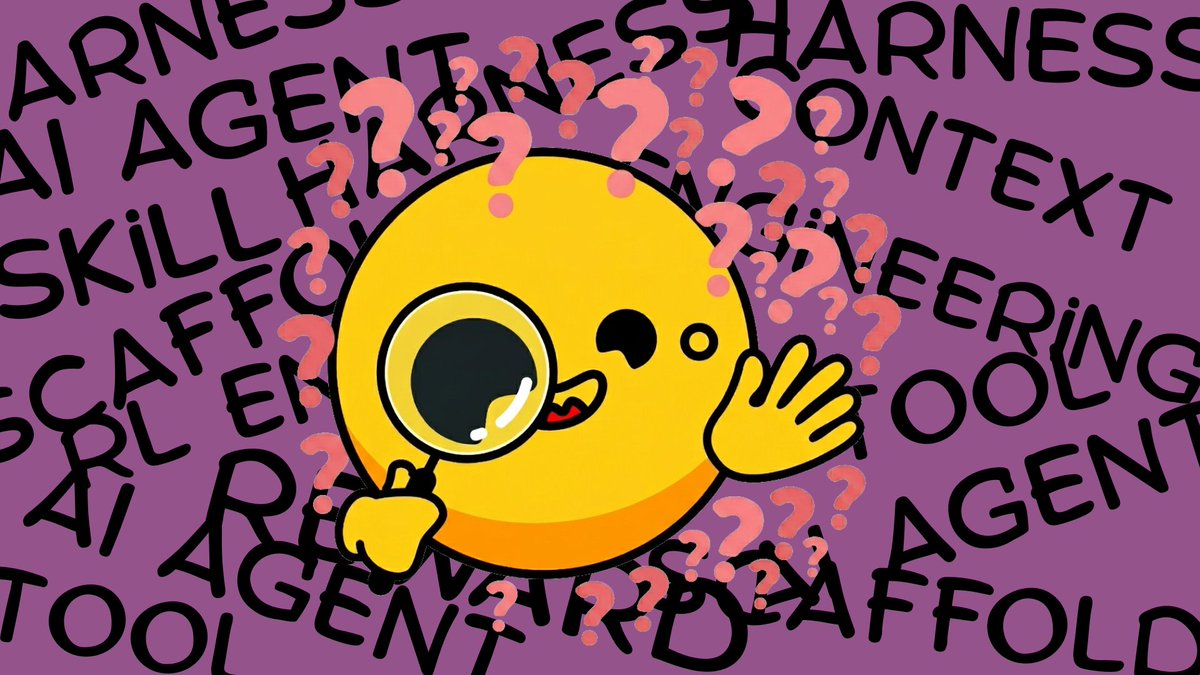
harness, scaffold, context engineering, agent... do you actually know what they mean?
we wrote an AI agent glossary and tried to make sense of it all with simple definitions and real examples
↓ go read it ↓
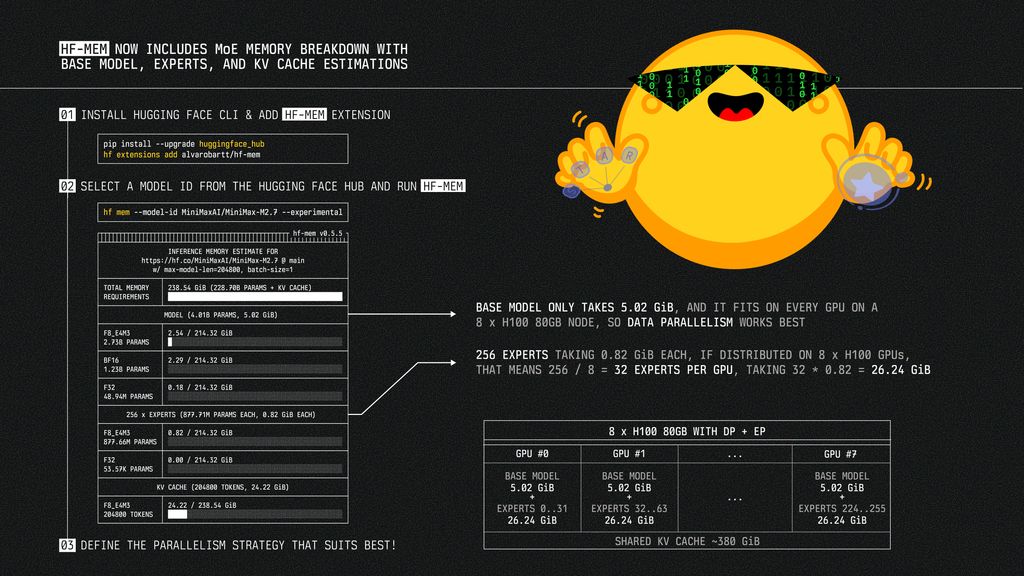
Latest `hf-mem` now breaks down Mixture-of-Experts (MoE) memory estimations into base weights, routed experts, and KV cache.
Useful for reasoning about residency footprint and serving trade-offs before picking a parallelism strategy for inference.
More in the thread 🧵
Today we launch smol-audio
A collection of notebooks & scripts to build on cutting-edge local audio models ⚡️
Already in the cookbook:
> Fine-tune Whisper / Parakeet / Voxtral / Granite Speech
> Fine-tune Audio Flamingo 3 (full + LoRA)
> Dialogue TTS with Dia-1.6B
> Zero-shot video + audio↔text retrieval with Meta's PE-AV
More to come — what would you like to see next? Reply with suggestions.
Introducing ml-intern, the agent that just automated the post-training team @huggingface
It's an open-source implementation of the real research loop that our ML researchers do every day. You give it a prompt, it researches papers, goes through citations, implements ideas in GPU sandboxes, iterates and builds deeply research-backed models for any use case. All built on the Hugging Face ecosystem.
It can pull off crazy things:
We made it train the best model for scientific reasoning. It went through citations from the official benchmark paper. Found OpenScience and NemoTron-CrossThink, added 7 difficulty-filtered dataset variants from ARC/SciQ/MMLU, and ran 12 SFT runs on Qwen3-1.7B. This pushed the score 10% → 32% on GPQA in under 10h. Claude Code's best: 22.99%.
In healthcare settings it inspected available datasets, concluded they were too low quality, and wrote a script to generate 1100 synthetic data points from scratch for emergencies, hedging, multilingual etc. Then upsampled 50x for training. Beat Codex on HealthBench by 60%.
For competitive mathematics, it wrote a full GRPO script, launched training with A100 GPUs on https://t.co/udm7xGpNzR, watched rewards claim and then collapse, and ran ablations until it succeeded. All fully backed by papers, autonomously.
How it works?
ml-intern makes full use of the HF ecosystem:
- finds papers on arxiv and https://t.co/brvCC7fLPa, reads them fully, walks citation graphs, pulls datasets referenced in methodology sections and on https://t.co/hrJuRkRyzi
- browses the Hub, reads recent docs, inspects datasets and reformats them before training so it doesn't waste GPU hours on bad data
- launches training jobs on HF Jobs if no local GPUs are available, monitors runs, reads its own eval outputs, diagnoses failures, retrains
ml-intern deeply embodies how researchers work and think. It knows how data should look like and what good models feel like.
Releasing it today as a CLI and a web app you can use from your phone/desktop.
CLI: https://t.co/l3K1PslZ1n
Web + mobile: https://t.co/orko5srL4H
And the best part? We also provisioned 1k$ GPU resources and Anthropic credits for the quickest among you to use.