He Never Gave the Crowd a Break
On a brightly lit floor at the Red Bull Dance Your Style Midwest qualifier, a man in a plain grey t-shirt, baggy jeans, and a simple beige beret stepped into the circle and refused to let the room stay quiet. He did not rely on elaborate costumes or a string of the most difficult moves. Instead, he brought something rarer: an unbroken current of energy that turned every person watching into part of the performance.
What made the moment special was not technical perfection alone. It was the way he treated the crowd as active partners rather than distant spectators. He pointed, grinned, dropped low, spun, rose again, and locked eyes with people sitting only a few feet away. His face stayed fully alive—eyes wide, mouth open in exaggerated surprise or pure delight—translating pure movement into emotion the audience could feel and return. The boundary between stage and seats dissolved. Laughter, shouts, and raised phones became part of the same shared rhythm.
In the culture of dance battles, especially formats like Red Bull Dance Your Style that prize originality and personal style, the ability to “own the room” carries real weight. Strong technique provides the foundation, and this dancer clearly possessed it: clean floorwork, sharp changes of direction, controlled drops, and fluid transitions. Yet those elements never existed in isolation. Each one was delivered with the clear intention of keeping the energy circulating. He understood timing in a deeper sense—not only the beat of the music, but the pulse of the people around him. He knew when to push harder, when to pause for effect, and when to invite the crowd in with open arms.
There is an honest risk in this approach. Prioritizing connection and showmanship can sometimes be dismissed as surface-level entertainment, especially by those who value complexity above all else. A performance built too heavily on facial expression and audience interaction can feel thin if the movement itself lacks substance. Sustaining that level of intensity also demands serious physical and emotional control; not everyone can give so freely without eventually running empty. Still, the risk is worth taking when the alternative is a technically impressive but emotionally distant routine that leaves the room cold.
What lingered longest was the human quality of the exchange. In a world increasingly mediated by screens and distance, watching someone stand in the middle of a crowd, open himself completely, and invite everyone to play felt unexpectedly warm. He did not try to appear flawless. He chose presence, playfulness, and generosity instead. That choice created a rare atmosphere in which the entire space felt alive and collective.
The deeper lesson is simple yet difficult to master. Technique earns respect. The ability to connect earns memory. When a person dares to give energy without holding back, the space around them changes. On that night in the Midwest, one dancer proved that the most powerful performances are not always the ones that dazzle with difficulty. They are the ones that refuse to let anyone remain a passive observer, turning a few minutes of movement into a living conversation no one wanted to end.
🙏 Lord, please help me with my financial situation. You know all my needs, struggles, and worries. Please open the right doors, provide for me, bless my work, and give me wisdom to handle my money well. Take away my financial stress and give me peace and hope. I trust that You will make a way for me when I cannot see one.
In Jesus’ name, Amen. ❤️🙏
NVIDIA was $10 in 2022. Palantir was $8 in 2023. Both went up 20x.
While everyone’s buying the same popular tech stock, there are 7 companies NOBODY is talking about that could hit similar returns.
Here’s what they are + why I believe this:
1) Infleqtion (INFQ)
The most important SpaceX detail nobody is talking about: the lockup is staggered.
There is no single 180-day cliff. Insiders get to sell in tiers, starting MUCH earlier than a standard IPO.
Here’s exactly when insiders can start selling:
After Q2 2026 earnings (around August 11): Up to 20% unlocks. Another 10% on top if SPCX trades 30%+ above the $135 IPO price (so $175.50+) for 5 of the prior 10 sessions.
Five time-based tranches at 70, 90, 105, 120, and 135 days post-IPO. Each releases 7% of eligible shares.
After Q3 2026 earnings (late October to early November): Another 28% unlocks.
180 days post-IPO (around December 9): Everything else unlocks.
Elon and certain major investors get a longer 366-day lockup. They stay locked until around June 2027.
Some context on the size:
The IPO sold around 555.6M shares, representing roughly 4.2% of total shares outstanding. The other 95.8% was locked pre-IPO. The staggered pool (employees and early backers) is where the early releases happen.
The structure is smart. It spreads selling pressure instead of concentrating it on one day.
Still, watch August earnings closely. That is the first real wave of potential selling, up to 30% of eligible shares. After that it drips steadily through fall.
Float is tiny right now, so volatility cuts both ways.
Not financial advice. This is the lockup mechanics from the S-1 and reporting.
🔥🚨EXCLUSIVE: I have recovered footage of Diddy praising Jay-Z as his brother deeper than blood and even admitting that Jay-Z is ‘the one he calls when he gets in trouble’ after he brought him out on the Bad Boy reunion tour in Brooklyn.
This comes after Jay-Z attempted to distance himself from Diddy by dissing his Roc Nation brunches last night in addition to claiming Diddy was just an ‘associate.’
Diddy: “And this is extended family. He's been there with me through my ups and downs.”
Jay-Z: “Straight up.”
Diddy: “Whenever I get in trouble, this is the one I call. This is my strategist right here. This is my brother.”
🚨 SPACEX MAY BE THE BIGGEST INSIDER CASHOUT IN MARKET HISTORY!!!
SpaceX is expected to go public on June 12 at a valuation of $1.75-$2 TRILLION.
That would instantly make it larger than Microsoft and second only to Apple and Nvidia in the US market.
Yet the company lost $4.28 BILLION in Q1 2026 alone and has accumulated deficits of $41.3 BILLION since founding.
The real story is what happens after the IPO.
Insiders currently own 95% of all shares.
The public float is only 5%.
And insiders are sitting on $1.66 TRILLION of paper wealth that cannot currently be sold.
Most IPOs lock insiders up for 180 days.
SpaceX isn't doing that.
Just 60 days after listing, 20% of eligible insider shares can unlock.
If the stock rises 30% above the IPO price, another 10% unlocks.
Then five separate 7% unlocks hit between days 70 and 135.
By November 2026, 93% of early-release insider shares could already be free to sell.
This isn't just an IPO.
It's one of the biggest liquidity grab events Wall Street has ever seen.
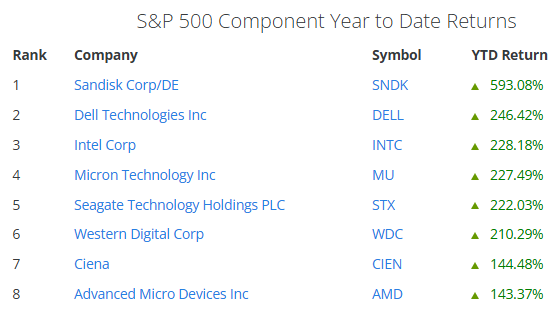
When you go buy a Dell laptop bundle only to find out that the CPU is Intel, the RAM is Micron, the GPU is AMD, the internal Hard Drive is Seagate, the external Hard Drive is Western Digital, and they toss in a bonus SD Card that is SanDisk.
It all makes sense now...
It all makes sense.
2024 gave you:
- $RKLB from $3.50 to $138 (3942%)
- $LITE from $40 to $1085 (2712%)
- $BE from $9 to $310 (3444%)
Now, in 2026, Leopold Aschenbrenner is giving you:
- $TE at $9
- $APLD at $39.50
- $CLSK at $15.40
- $CRWV at $101
- $IREN at $53
- $KEEL at $4.20
- $BW at $19
- $CORZ at $23
- $BTDR at $13
- $WYFI at $24
Don’t miss out again.
Not financial advice. Do your own research.