🚨 THE LARGEST HUMAN STUDY OF IVERMECTIN & MEBENDAZOLE IN CANCER HAS NOW BEEN PEER REVIEWED.
According to Nicolas Hulscher, this is now the largest peer reviewed human observational study evaluating a combination of Ivermectin and Mebendazole in cancer.
For years, most of the discussion around Ivermectin and cancer focused on laboratory and animal studies.
Now, attention has shifted to what researchers describe as one of the largest published human observational studies evaluating a combination of:
💊 Ivermectin
💊 Mebendazole
The study followed 200 cancer patients over approximately six months.
According to the published paper:
📊 84.4% reported a positive outcome, including:
✅ Cancer remission
✅ Tumor regression
✅ Tumor shrinkage
✅ Disease stabilization
Those numbers immediately caught people's attention.
But here's the important part.
The researchers were not claiming the question had been settled.
This was an observational study.
That means it can identify patterns and associations, but it cannot prove that Ivermectin or Mebendazole caused the reported outcomes.
Other treatments and clinical factors may also have influenced the results.
So why is this study generating so much discussion?
Because it has now been peer reviewed and published, moving the conversation beyond laboratory research alone.
Whether you're optimistic or skeptical...
Most people can agree on one thing:
When a published observational study involving 200 patients reports findings like these...
It raises an important question.
❓Should results like this be followed by larger, well designed randomized clinical trials?
That's where many researchers believe the conversation should go next.
Because science moves forward by investigating promising signals, testing them rigorously, and confirming or challenging the findings with higher quality evidence.
💬 If an observational study reports encouraging results, do you think it should lead to larger randomized clinical trials?
💊 Looking for premium Ivermectin, Fenbendazole, or Mebendazole? Explore @RxMeds_store with worldwide delivery.
#Ivermectin #Mebendazole #Fenbendazole #CancerResearch #RepurposedDrugs #MedicalResearch #Cancer
🚨 AT 32, HER DOCTORS SAID HER STAGE 4 CANCER WAS INCURABLE. ONE YEAR LATER, HER STORY LOOKS VERY DIFFERENT.
At 32 years old, she was told her Stage 4 cancer was incurable.
Most people would've lost hope.
She didn't.
According to her testimony, after exhausting conventional options, she began researching integrative approaches and added:
💊 Ivermectin
💊 Fenbendazole
Months later, she shared the update she never thought she'd write:
🎉 "Today, I celebrate one year of being completely cancer free."
She wrote:
"My doctors told me I was incurable at 32 with Stage 4 cancer. They failed me. So I looked elsewhere. I started a Fenbendazole & Ivermectin protocol. Today, I celebrate one year of being completely cancer free."
This is one person's testimony and does not prove that any specific treatment caused the reported outcome.
But stories like this continue to fuel conversations around repurposed medicines and why more research is being called for.
💬 If you were told your cancer was incurable, would you research every option available?
💊 When hope leads you to research, choose premium Ivermectin, Fenbendazole, and Mebendazole from @RxMeds_store. Delivered worldwide.
#Ivermectin #Fenbendazole #Mebendazole #Stage4Cancer #CancerResearch #CancerSurvivor #RepurposedDrugs
🚨 WHY ARE SO MANY PEOPLE TALKING ABOUT IVERMECTIN FOR PARASITE CLEANSES?
A viral video has people talking after a woman claimed an Ivermectin parasite cleanse led to passing what she believed was a 5 inch tapeworm.
Whether you believe the story or not...
It raises a question millions of people are now asking:
❓Why has parasite cleansing suddenly become one of the hottest health topics online?
The answer is simple.
More people are questioning what's behind chronic digestive issues, fatigue, bloating, skin problems, and unexplained symptoms.
As a result, they're looking into parasite health like never before.
In the video, she says she used:
💊 Ivermectin
⚫ Activated Charcoal
She also claims the "die off" made her feel unwell before later passing what she believed was a tapeworm.
It's an attention grabbing story.
But it's important to separate personal experiences from established scientific evidence.
A viral testimonial doesn't prove the same outcome would happen for someone else.
What we do know is this:
✅ Ivermectin has been used in humans for decades to treat certain parasitic infections.
✅ It remains one of the most widely studied antiparasitic medicines in the world.
That's one reason it continues to be part of conversations whenever parasite health is discussed.
Whether you're skeptical or simply curious...
The growing interest isn't really about one viral video.
It's about millions of people wanting to better understand their health and asking questions they weren't asking a few years ago.
Because when enough people start sharing similar experiences...
Curiosity naturally follows.
🔄 Save & repost so others can join the discussion.
💬 If someone suspected they had a parasitic infection, do you think they should start with testing, or would you take a different approach?
💊 Don't settle for less. Get premium Ivermectin from @RxMeds_store.
#Ivermectin #Parasites #ParasiteCleanse #GutHealth #HealthDiscussion #Wellness #MedicalResearch
I know this won’t be everyone’s view, but it’s interesting to see why so many people continue talking about Ivermectin. Sharing this as part of the broader conversation.
Some people smoke, drink alcohol, and do drugs.
I don't do any of those.
I do Ivermectin. 🐎
Cheaper. Safer. Actually helps me feel better.
Call it what you want – horse paste, dewormer, "dangerous" medicine.
I call it freedom.
💬 Which one would you choose?
💊 If Ivermectin is your choice, explore @RxMeds_store.
Some people smoke, drink alcohol, and do drugs.
I don't do any of those.
I do Ivermectin. 🐎
Cheaper. Safer. Actually helps me feel better.
Call it what you want – horse paste, dewormer, "dangerous" medicine.
I call it freedom.
💬 Which one would you choose?
💊 If Ivermectin is your choice, explore @RxMeds_store.
🚨 BEFORE YOU RESEARCH IVERMECTIN HORSE PASTE, READ THIS DOSING GUIDE
One of the biggest mistakes people make when researching Ivermectin is assuming every protocol uses the same dose.
It doesn't.
In fact, dosing discussions often vary significantly depending on the goal.
That's why charts like this continue to get shared across research communities, health forums, and protocol discussions.
📊 The chart above breaks dosing into four commonly discussed categories:
🔹 Maintenance
0.2 mg/kg
🔹 Parasite Cleanse
0.2–0.3 mg/kg
🔹 Medium Dose
0.5–1.0 mg/kg
🔹 High Dose
1.0–2.0 mg/kg
It also provides a quick weight-based reference showing how those ranges are commonly calculated.
For example:
📌 150 lbs
• Maintenance: 3 notches
• Medium Dose: 5–6 notches
• High Dose: 8–12 notches
📌 200 lbs
• Maintenance: 4 notches
• Medium Dose: 7–8 notches
• High Dose: 11–16 notches
📌 220 lbs
• Maintenance: 4.5 notches
• Medium Dose: 8–9 notches
• High Dose: 12–18 notches
The reason this chart keeps getting attention is simple:
Most people hear about Ivermectin.
Very few understand how different protocols are actually discussed.
Whether you're researching parasite protocols, repurposed medicines, or simply trying to understand the conversation, knowing the dosing framework is where many people start.
Because before you can evaluate any claim...
You need to understand the protocol being discussed.
📌 Save this guide. You'll want it later.
🔄 Repost it so others can review the information for themselves.
💬 What's the biggest misconception you've heard about Ivermectin?
#Ivermectin #Parasites #RepurposedDrugs #MedicalResearch
Mel Gibson: "Tengo 3 amigos. Los 3 tenían cáncer en etapa 4... y los 3... ya no tienen cáncer en absoluto en este momento..."
Joe Rogan: "¿Qué tomaron...? ¿Ivermectina y Fenbendazol...?"
Mel Gibson asiente en señal de acuerdo.
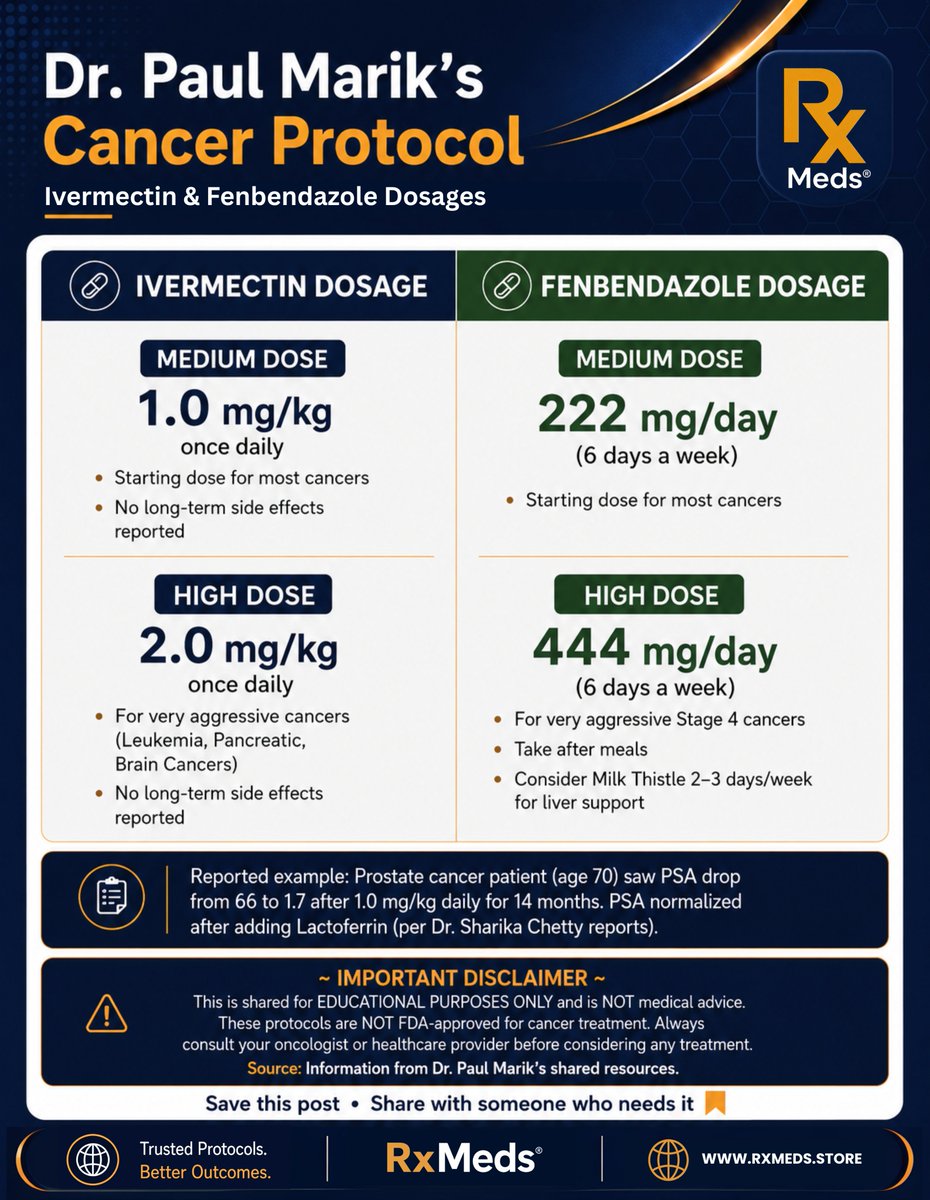
🚨 WHY ARE SO MANY PEOPLE RESEARCHING DR. PAUL MARIK'S IVERMECTIN & FENBENDAZOLE CANCER PROTOCOL?
Most people focus on the drugs.
But one of the most important details in this chart is something else:
📊 The dosing.
And the fact that this protocol combines Ivermectin and Fenbendazole together.
That's what makes it different from many of the discussions people see online.
💊 IVERMECTIN
🔹 Medium Dose: 1.0 mg/kg daily
🔹 High Dose: 2.0 mg/kg daily
💊 FENBENDAZOLE
🔹 Medium Dose: 222 mg daily
🔹 High Dose: 444 mg daily
📅 Schedule:
6 days on, 1 day off
The protocol is most often discussed in relation to some of the most difficult cancers to treat:
✅ Brain Cancer
✅ Pancreatic Cancer
✅ Leukemia
But here's the part that gets people's attention.
The chart references a prostate cancer case discussion involving a reported PSA decline from:
📉 66 → 1.7
Whether someone sees that as remarkable, controversial, or simply worthy of further investigation...
It's the kind of result that makes people stop scrolling and start reading.
And that's exactly why protocols like this keep getting shared.
Not because they're ordinary.
Because they raise questions.
Questions about dosage.
Questions about combinations.
Questions about repurposed medicines.
And questions about why so many patients are researching them in the first place.
Another detail many people overlook:
Both Ivermectin and Fenbendazole are off patent.
Neither was originally developed for cancer.
Yet years later, both continue appearing in scientific papers, case reports, physician discussions, podcasts, and patient communities around the world.
That's unusual.
And it's one reason the conversation refuses to disappear.
📌 Save this chart now. You'll want it later.
🔄 Repost it so others can review the protocol for themselves.
💬 What's the most surprising thing in this chart: the dosages, the combination protocol, or the PSA result?
💊 Researching Ivermectin or Fenbendazole? Explore @RxMeds_store.
#Ivermectin #Fenbendazole #CancerResearch #DrPaulMarik #RepurposedDrugs
🚨 WHY DO SOME PEOPLE RUN PARASITE PROTOCOLS FOR 6 TO 12 MONTHS?
Most people assume one round of treatment is enough.
Some practitioners say that's exactly why people keep running into the same problems over and over again.
Their argument?
It's not just about the parasites.
It's about the eggs.
According to this protocol discussion, parasites may lay eggs that survive the initial treatment cycle.
Weeks later, those eggs hatch.
And the cycle starts again.
That's why some practitioners don't recommend a "one and done" approach.
Instead, they use rotating protocols such as:
💊 Ivermectin
💊 Fenbendazole
💊 Mebendazole
💊 Niclosamide
💊 Praziquantel
📅 Often following a schedule like:
• 3 Weeks On
• 1 Week Off
• Repeat
• Repeat Again
• Sometimes 6 Cycles
• Sometimes Up To 12 Cycles
Why the week off?
According to the discussion, that's when some people switch focus and use antifungal strategies before beginning the next cycle.
The goal isn't to do more.
The goal is to stay consistent long enough to address multiple life stages.
The most controversial claim?
The speaker argues that conventional testing often misses what's happening because these organisms may be residing in tissues rather than showing up clearly on standard laboratory testing.
As a result, some practitioners turn to methods such as meridian testing or muscle testing to guide their approach.
Whether you agree with these ideas or not, one thing is impossible to ignore:
More people than ever are asking questions about parasites, chronic symptoms, gut health, and repurposed medicines.
And that's exactly why conversations around Ivermectin, Fenbendazole, Mebendazole, Niclosamide, and Praziquantel continue to explode across social media.
💊 Looking for Ivermectin, Fenbendazole, or Mebendazole? Explore @RxMeds_store.
#Ivermectin #Fenbendazole #Mebendazole #Parasites #GutHealth
🚨 DR. WILLIAM MAKIS MD CALLS THIS THE MOST IMPORTANT IVERMECTIN CANCER GRAPH HE'S EVER CREATED
After reviewing hundreds of studies, case reports, and patient outcomes, Dr. William Makis MD says one question keeps coming up:
❓"What dose of Ivermectin are people actually using in cancer protocols?"
His answer is surprisingly simple.
💊 For most cancers, his suggested starting point is:
1 mg/kg of Ivermectin per day
📊 THE FOUR IVERMECTIN DOSING LEVELS DR. MAKIS DISCUSSES MOST OFTEN
🔹 0.2 mg/kg daily
Lower-dose protocols discussed in some case reports and published reports.
🔹 1.0 mg/kg daily
Dr. Makis' typical starting point for most cancers.
🔹 2.0 mg/kg daily
Discussed for highly aggressive cancers, including some brain cancers.
🔹 2.5 mg/kg daily
The highest dosing level discussed in certain case reports.
According to Dr. Makis, some of the most widely discussed case reports involve higher dosing strategies.
And that's where the conversation gets interesting.
Because this isn't being discussed for just one type of cancer.
Researchers have investigated Ivermectin in:
✅ Breast Cancer
✅ Colon Cancer
✅ Lung Cancer
✅ Pancreatic Cancer
✅ Kidney Cancer
✅ Gastric Cancer
✅ Prostate Cancer
✅ Brain Cancer
✅ Leukemia
And many others.
Dr. Makis frequently points to reports involving significant changes in tumor markers, imaging results, and patient outcomes that continue driving interest in repurposed medicines.
He also highlights something many people overlook:
✅ Off patent
✅ Generic
✅ Low cost
✅ Studied for decades
Yet despite the growing number of publications and case reports, mainstream oncology rarely discusses it.
That's why the debate keeps growing.
Not because everyone agrees.
Because patients keep sharing stories.
Doctors keep debating.
Researchers keep publishing.
And people keep asking questions.
Because if the answer were obvious...
The conversation would've ended years ago.
Instead, it's getting bigger.
📌 Save this chart. You'll want it later.
🔄 Repost so others can review the information for themselves.
💬 Have you been following Dr. William Makis MD's work on Ivermectin and cancer?
💊 Researching Ivermectin? Explore @RxMeds_store.
#Ivermectin #CancerResearch #MakisMD #RepurposedDrugs
Mel Gibson: "I have 3 friends. All 3 of them had stage 4 cancer…and all 3 of them…don't have cancer right now at all…"
Joe Rogan: "What did they take…? Ivermectin and Fenbendazole…"
Mel Gibson nods in agreement.
🚨 THEY GAVE HIM 8 MONTHS TO LIVE. FOUR MONTHS LATER, HIS SCAN SAID SOMETHING ELSE.
"You have about 8 months to live."
That's the conversation he says changed everything.
Terminal brain cancer.
According to his account, doctors told him he had about 8 months to live.
Most people would have accepted the prognosis.
He didn't.
Instead, he started researching.
He says he wasn't looking for a miracle.
He was looking for a strategy.
One that addressed as many angles as possible.
According to his testimony, that strategy included:
💊 Ivermectin
💊 Fenbendazole
💊 Methylene Blue
Alongside:
📌 Fasting
📌 Oxygen therapy
📌 Detoxification
📌 Dietary changes
📌 Faith
He believed that if he could support his body from multiple directions, he could give himself the best possible chance.
He stayed committed to the plan.
Then came the follow up scan.
Four months later.
According to him, his neurosurgeon and oncologist reviewed the results.
Then came the moment he had been waiting for.
🧠 "Normal brain."
Think about that for a moment.
A man told he had months to live.
A man facing terminal brain cancer.
Now sharing a story that continues to spread across the internet.
Whether you view it as an extraordinary recovery, an inspiring testimonial, or simply a story worth investigating, it's easy to understand why people stop scrolling when they hear it.
Because stories like this remind people of something powerful:
A prognosis is not a guarantee.
And hope is a difficult thing to extinguish.
Four months earlier, he was planning for the possibility of death.
Now he was looking at a scan that told a very different story.
📌 Save this post.
🔁 Repost it so others can hear his story.
🌐 Many people researching Ivermectin and Fenbendazole have discovered @RxMeds_store.
#Ivermectin #Fenbendazole #MethyleneBlue #BrainCancer #CancerJourney #Stage4Cancer #CancerResearch #Hope
🚨 MOST PEOPLE THINK IVERMECTIN IS FOR PARASITES. THEY'RE MISSING HALF THE STORY.
Ask someone what Ivermectin is and you'll usually hear the same answer:
💊 "It's a parasite medicine."
And they're right.
But that's only part of the story.
For decades, Ivermectin has been used around the world for conditions such as:
✅ Scabies
✅ Strongyloidiasis
✅ River Blindness (Onchocerciasis)
✅ Lice
✅ Other parasitic infections
In fact, it became one of the most successful antiparasitic medicines in medical history.
But here's what many people don't know:
🧴 Ivermectin cream is FDA approved for rosacea.
Researchers have also spent years studying how Ivermectin may influence inflammation, immune responses, skin conditions, and cellular pathways involved in disease.
That's why interest continues to grow far beyond parasites.
Some physicians and researchers have discussed its potential role in:
• Rosacea
• Ocular Rosacea
• Blepharitis
• Demodex overgrowth
• Inflammatory skin conditions
And in recent years, scientists have published hundreds of papers investigating its potential in oncology and other areas of repurposed medicine research.
Whether those investigations ultimately change clinical practice remains to be seen.
But one thing is clear:
Ivermectin is no longer being discussed as "just a parasite drug."
According to Dr. William Makis, what surprises many people isn't that Ivermectin is used for parasites.
It's how many different areas of medicine researchers have spent decades studying it in.
From parasitic infections and rosacea to oncology research, the scientific footprint is far larger than most people realize.
Most people think they already know what Ivermectin is.
Then they start digging into the research.
And that's when the story gets a lot more interesting.
💊 Looking for Ivermectin options? Explore @RxMeds_store.
#Ivermectin #Rosacea #SkinHealth #MedicalResearch #RepurposedDrugs #Dermatology
🚨 IVERMECTIN & FENBENDAZOLE TESTIMONIAL:
STAGE 4 BREAST CANCER. WIDESPREAD BONE METASTASES. ELEVEN MONTHS LATER, THE PET SCAN LOOKED UNRECOGNIZABLE.
Look closely at these three scans.
📅 November 2024
📅 March 2025
📅 October 2025
The difference is hard to ignore.
According to this testimonial, a 53 year old woman was diagnosed with Stage 4 metastatic breast cancer with extensive skeletal involvement.
The cancer had spread throughout multiple areas of her body.
The first PET scan showed widespread active disease.
Red hotspots were visible throughout the skeleton.
A diagnosis like this changes everything.
According to the report, she chose a different path.
The only conventional treatment used was palliative radiation to a few painful bone lesions before beginning her protocol.
No chemotherapy.
No immunotherapy.
No targeted therapy.
No hormone therapy.
Instead, she reportedly followed:
💊 Ivermectin 60mg daily
💊 Fenbendazole 222mg with healthy fats
🥑 Ketogenic diet
Month after month, the scans began to change.
The hotspots became fewer.
The activity decreased.
The images looked different.
Then came the October 2025 PET scan.
According to the testimonial:
"She had Stage 4 metastatic breast cancer and, within 11 months, was essentially cancer free based on her PET scan."
The person sharing the case added:
"Her results are almost miraculous."
Whether you see this as inspiring, controversial, or simply a case worth studying, it's easy to understand why people keep sharing these images.
Not because of a headline.
Not because of an opinion.
Because of the scans.
Three images.
Eleven months.
One remarkable transformation.
📌 Save this post. Stories like this are often difficult to find again.
🔁 Repost this so others can see the scans and decide for themselves.
💬 What's the first thing you noticed when comparing the first scan to the last one?
💊 Many people researching Ivermectin and Fenbendazole have discovered @RxMeds_store.
#Ivermectin #Fenbendazole #BreastCancer #Stage4Cancer #CancerJourney #CancerResearch #PETScan #CancerSupport #Hope
🚨 THEY CALLED IT A HORSE DEWORMER. DR. PAUL MARIK SAYS THE STORY IS VERY DIFFERENT.
For years, one phrase dominated the conversation around Ivermectin:
🐴 "Horse dewormer."
But according to critical care physician Dr. Paul Marik, that label ignores a much bigger story.
His argument?
💊 More than 3.7 billion doses of Ivermectin have been administered to humans worldwide.
💊 It has been used for decades in global health programs.
💊 It has helped combat parasitic diseases that once affected millions of people.
In fact, Dr. Marik argues that after penicillin, few medicines have had a greater impact on human health worldwide.
That's a very different picture than the one many people heard during the pandemic.
Then Dr. Marik made a statement that stopped a lot of people in their tracks.
According to Dr. Marik:
🗣️ "You're more likely to die from Tylenol than you are from Ivermectin."
He points to long history of Ivermectin in human use and well documented safety profile as reasons it continues to attract attention from physicians, researchers, and patients around the world.
And then he asks a question that continues to fuel debate:
If a medicine has been used safely for decades...
If it's inexpensive...
If it's widely available...
And if patients have limited options...
Should it at least be part of the conversation?
Whether you agree with Dr. Marik or not, one thing is undeniable:
Love it or hate it...
Years later, people are still arguing about Ivermectin.
And that alone tells you the story isn't over.
Not because it's new.
But because the story surrounding it is far more complicated than a single headline.
🔁 Repost it so others can hear Dr. Marik's perspective.
💬 What surprised you most about Ivermectin's history?
💊 Many people researching Ivermectin have discovered @RxMeds_store.
#Ivermectin #PaulMarik #MedicalResearch #RepurposedDrugs #Healthcare #HealthNews
Really appreciate that.
A lot of effort goes into creating content that's both easy to understand and genuinely useful. Credit as well to Dr. William Makis MD for helping bring more attention to discussions around Ivermectin, Fenbendazole, and cancer care. Glad you found the infographic valuable.
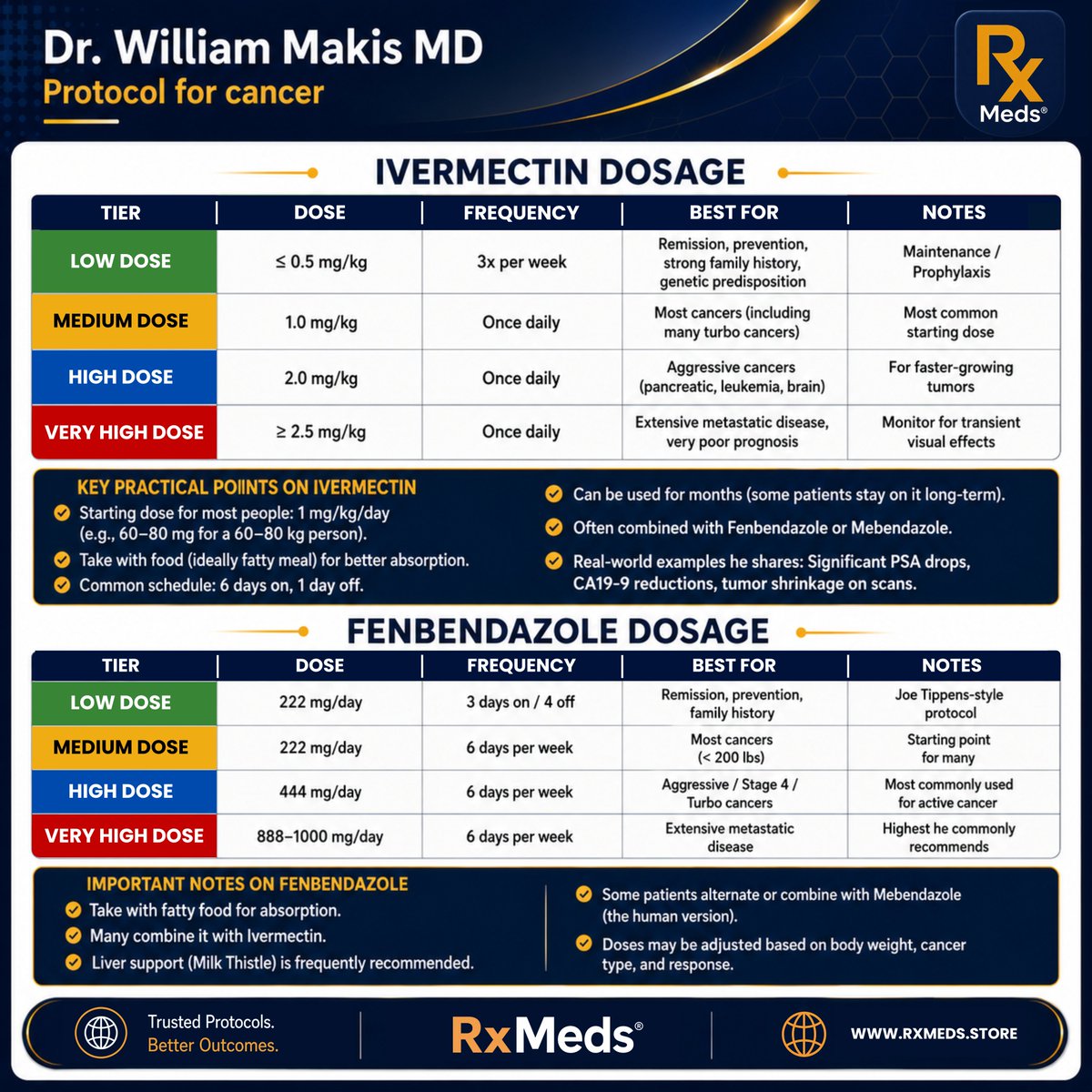
🚨 DR. WILLIAM MAKIS' UPDATED IVERMECTIN & FENBENDAZOLE CANCER PROTOCOL IS GETTING PEOPLE TALKING
Cancer patients aren't saving this chart because it's controversial.
They're saving it because they're looking for answers.
And according to Dr. William Makis, one of the biggest mistakes people make is assuming every cancer case should follow the same protocol.
That's why his updated protocol doesn't use one dose.
It uses FOUR.
👇
The goal?
To adjust dosing based on:
📊 Cancer aggressiveness
📊 Tumor burden
📊 Metastatic spread
📊 Overall prognosis
📊 Individual response
━━━━━━━━━━━━━━
🟢 LOW DOSE
IVERMECTIN
≤ 0.5 mg/kg
3x per week
FENBENDAZOLE
222 mg/day
3 days on, 4 days off
Often discussed for:
• Remission support
• Prevention
• Strong family history
• Higher risk individuals
━━━━━━━━━━━━━━
🟡 MEDIUM DOSE
IVERMECTIN
1.0 mg/kg daily
FENBENDAZOLE
222 mg/day
6 days per week
Often discussed for:
• Most active cancers
• Common starting approach
━━━━━━━━━━━━━━
🔵 HIGH DOSE
IVERMECTIN
2.0 mg/kg daily
FENBENDAZOLE
444 mg/day
6 days per week
Often discussed for:
• Aggressive cancers
• Brain cancers
• Leukemia
• Pancreatic cancer
━━━━━━━━━━━━━━
🔴 VERY HIGH DOSE
IVERMECTIN
≥ 2.5 mg/kg daily
FENBENDAZOLE
888 to 1000 mg/day
6 days per week
Often discussed for:
• Extensive metastatic disease
• Poor prognosis cases
━━━━━━━━━━━━━━
💡 Additional Protocol Notes
✅ Many patients combine Ivermectin and Fenbendazole
✅ Some alternate Fenbendazole with Mebendazole
✅ Fenbendazole is commonly taken with fatty meals
✅ Liver support is frequently discussed
✅ Long term use and monitoring are commonly emphasized
━━━━━━━━━━━━━━
🔬 What Makes This Protocol Different?
It's not the dosages.
It's the idea behind them.
Dr. Makis argues that cancer isn't one disease.
A patient in remission is different from a patient with widespread metastatic disease.
A slow growing cancer is different from an aggressive one.
And because of that, many people believe a one size fits all approach may not always make sense.
That's one reason why interest in repurposed medicines continues to grow.
🔬 Researchers have spent years investigating how compounds like Ivermectin and Fenbendazole may interact with:
• Cancer metabolism
• Cancer stem cells
• Mitochondrial function
• Tumor signaling pathways
• Treatment resistance mechanisms
• Cellular energy production
Whether these findings ultimately change clinical practice remains to be seen.
But one thing is undeniable:
More cancer patients, caregivers, and researchers are discussing repurposed medicines today than ever before.
And that's exactly why charts like this keep getting shared.
📌 Save this chart now. Six months from now, you'll wish you knew where to find it.
🔁 Repost it so more people researching cancer protocols can see it.
💬 Have you been following Dr. William Makis' work on Ivermectin and Fenbendazole?
💊 Many people researching Ivermectin and Fenbendazole have discovered @RxMeds_store.
#Ivermectin #Fenbendazole #CancerResearch #CancerProtocol #RepurposedDrugs #WilliamMakis #RxMeds
🚨 THE 84% FIGURE FROM THIS IVERMECTIN AND MEBENDAZOLE CANCER STUDY IS SPARKING DEBATE.
A few years ago, almost nobody was talking about Ivermectin or Mebendazole in cancer discussions.
Today?
Researchers, doctors, patients, and health communities around the world are paying attention.
Why?
Because of findings like this.
In a recent discussion, an observational study involving approximately 200 cancer patients was highlighted.
The patients reportedly included people with:
📌 Breast Cancer
📌 Prostate Cancer
📌 Colon Cancer
📌 And other cancer types
The protocols discussed involved:
💊 Ivermectin
💊 Mebendazole
The number that caught everyone's attention?
📊 84%
According to the presenter, after six months, approximately 84% of patients reportedly experienced one of the following outcomes:
✅ Stable disease
✅ Tumor regression
✅ No evidence of disease
Those findings came from a real-world observational study rather than a laboratory experiment.
And that's exactly why the discussion has grown so quickly.
Supporters argue that observational data can provide valuable insights into how treatments perform in actual patients.
Critics point out that observational studies cannot prove cause and effect and that randomized controlled trials remain the gold standard.
But regardless of which side of the debate someone falls on, one thing is clear:
People are paying attention.
They're reading studies.
They're reviewing patient outcomes.
They're comparing protocols.
And they're asking questions about repurposed medicines that were rarely part of cancer conversations a decade ago.
Why are compounds like Ivermectin and Mebendazole attracting so much interest?
Because researchers have spent years investigating their potential effects on:
🔬 Cancer metabolism
🔬 Cellular signaling pathways
🔬 Drug resistance mechanisms
🔬 Cancer stem cells
🔬 Tumor growth processes
Whether these findings ultimately change cancer care remains to be seen.
But the growing interest is undeniable.
And that's why the 84% figure continues to spark discussion across cancer communities worldwide.
🌐 Looking for Ivermectin, Fenbendazole, or Mebendazole? Explore @RxMeds_store.
#Ivermectin #Mebendazole #CancerResearch #CancerProtocol #RepurposedDrugs #MedicalResearch #IntegrativeMedicine
🚨 THREE CANCER PATIENTS WENT INTO REMISSION AFTER TAKING FENBENDAZOLE. THE CASE REPORT IS SPARKING DEBATE.
Most people have never heard of Fenbendazole.
Those who have usually know it for one thing:
📌 Parasites.
But a published case report is bringing it into an entirely different conversation.
📌 Cancer research.
In a paper published in Clinical Oncology Case Reports, researchers described three cancer patients whose cancers reportedly went into remission while taking Fenbendazole.
The report has attracted attention because Fenbendazole was never developed as a cancer drug.
It was developed as an antiparasitic.
So why are researchers interested?
Because cancer has one characteristic that makes it especially difficult to control:
📈 Rapid cell division.
According to the paper, Fenbendazole may interfere with structures known as microtubules.
Microtubules play a critical role when cells divide.
Without them, cells struggle to complete the replication process.
And since cancer depends on continuous cell division, researchers have been investigating whether compounds that disrupt these pathways could potentially affect tumor growth.
That's what makes this case series so intriguing.
Not because it proves anything.
But because it raises questions.
Important questions.
📌 Could some existing medicines have uses beyond their original purpose?
📌 Are there overlooked compounds worthy of further study?
📌 What role could repurposed medicines play in future cancer research?
The authors themselves were cautious.
They emphasized that case reports are only the beginning.
They can identify unusual outcomes.
They can generate hypotheses.
But they cannot establish cause and effect.
That's why larger clinical trials are still needed.
Still, one thing is undeniable:
Interest in Fenbendazole continues to grow.
Researchers are studying it.
Patients are discussing it.
And more people are reading the literature for themselves.
Whether you're skeptical, curious, or simply following the science, this is one of the reasons Fenbendazole remains one of the most talked-about repurposed compounds in cancer discussions today.
🌐 Looking for Fenbendazole, Ivermectin, or Mebendazole? @RxMeds_store delivers worldwide.
#Fenbendazole #CancerResearch #CancerCure #RepurposedDrugs #IntegrativeMedicine