Improvements in coordination will be transformative. But I believe the tech folks are making a profound error in their understanding of self-organizing, adaptive systems. The limits, errors, lost information, randomness and chaos are not flaws but features. These messy human systems produce extraordinary and unexpected results BECAUSE they are not rationally optimized.
She isn't off base about what has happened but wrong about the foundational reason. Massive government overspending, financial repression and distortion removed the natural self-limiting nature of a freely collaborative system. People like other people's money and want personal benefits without personal responsibility which has devolved into a socially and economically regressive blend of crony capitalism and a welfare state. We need a reset that empowers civil society over politicians.
As author Doug Adams noted "technology is a word that describes something that does not work yet." We will see the benefit of AI after this bubble phase bursts. https://t.co/AuqNwtJVVD
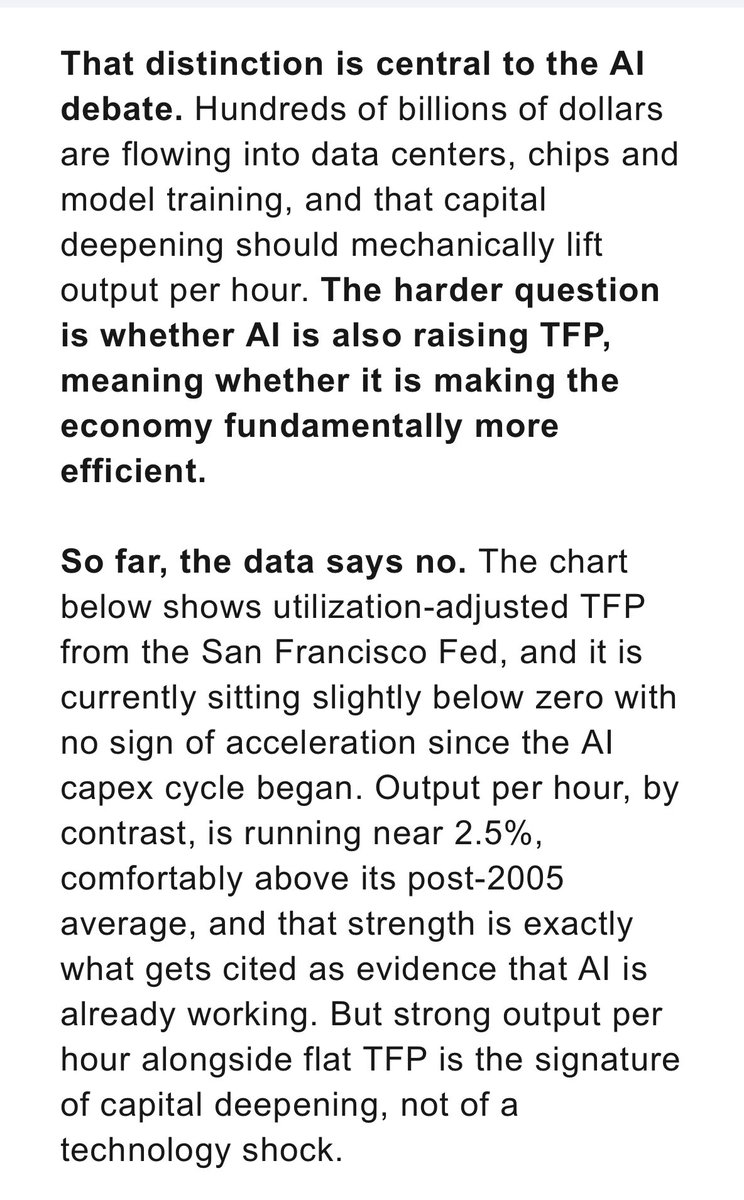
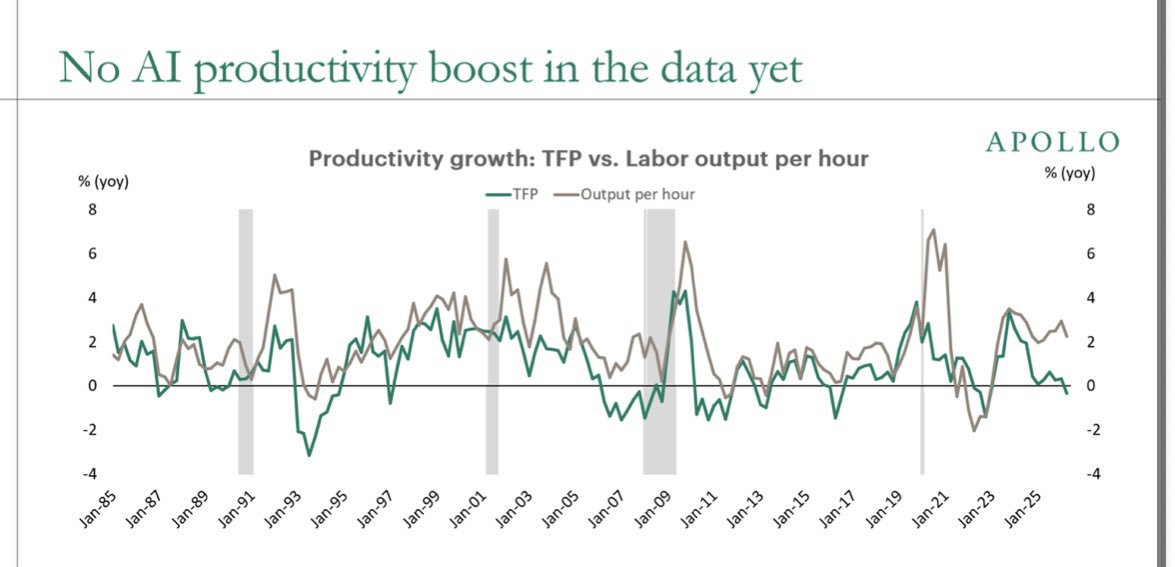
So much for that AI-driven productivity boom, says Apollo’s Torsten Slok.
Or as he puts it “the AI boom is clearly visible in investment data and in equity valuations, but it is not yet visible in the productivity statistics, which means the productivity payoff from AI remains a forecast rather than an observation.”
This somewhat echoes Robert Solow’s famous quip “you can see the computer age everywhere but in the productivity statistics “.
My personal theory as to why this is the case is that the information economy’s ability to increase productivity is offset (if not surpassed) by its ability to manufacture influencers, hackers and scammers. So it’s a wash.
I asked my CTO to comment in Mr. Nadella's recent post. He makes some powerful observations.
Satya Nadella raises a question every enterprise will eventually have to answer.
The most valuable asset in the AI era isn't the foundation model, it's the proprietary knowledge an organization contributes every time it uses one.
Every prompt, correction, investment decision, evaluation, exception, and workflow captures institutional expertise. Together, they represent years of accumulated judgment and intellectual property. Without the right architecture and governance, that knowledge can gradually become embedded outside the enterprise.
The next challenge isn't just protecting data. It's protecting learning.
This is where Decentralized AI becomes essential.
Rather than relying solely on centralized AI platforms, enterprises should adopt decentralized AI architectures where proprietary knowledge, evaluation frameworks, decision history, and institutional memory remain under the organization's governance. Domain-specific models and AI agents can learn from enterprise expertise while ensuring that expertise never leaves the enterprise.
Instead of continuously enriching external AI providers with the context that creates competitive advantage, organizations should build AI ecosystems where learning compounds internally not externally.
Foundation models will continue to improve and become increasingly commoditized.
What will differentiate companies is the knowledge they've accumulated, the decisions they've made, and the intelligence they've built over time.
The organizations that win in the AI era won't simply own their data.
They'll own their learning.
Decentralized AI isn't just an architectural choice—it's the foundation for preserving enterprise intelligence in the age of AI.
Mr. Huang makes an important distinction. In my talk at the recent T3 conference, I contended AI can be a race to the bottom or a leap ahead. At Flextion AI our mission is to empower profoundly new ways to make better investment decisions and not just improve efficiency.
Jensen Huang just called out every CEO who’s been firing people “because of AI.”
Jim Cramer asked him why companies are laying people off if AI is supposed to make everyone MORE productive.
Jensen's answer:
"For companies with imagination, you will do more with more. For companies where the leadership is just out of ideas, they have nothing else to do. They have no reason to imagine greater than they are. When they have more capability, they don't do more."
Read that again.
The man who built the most important tech company on Earth just told you that if your CEO is using AI to cut headcount, it means one thing:
They have no imagination.
They have no vision for what comes next.
They got handed the most powerful tool in human history and their FIRST instinct was to fire people.
This is the CEO of NVIDIA. The company whose chips power every AI system on the planet.
If anyone on Earth has the right to say "AI replaces workers," it's Jensen Huang.
And he said the OPPOSITE.
He said every carpenter could become an architect. Every plumber could become an architect. AI elevates capability. It doesn't eliminate it.
But here's where it gets really interesting...
During the same interview, Jensen revealed something nobody's talking about:
He said AI startups like OpenAI and Anthropic are seeing their revenues increase by one to two billion dollars a WEEK. And he wishes these companies were public so the world could see what he sees.
One to two billion per week.
That's a $50 to $100 BILLION annualized run rate.
For companies that most people think are burning cash and making nothing.
The entire Wall Street narrative that "AI companies aren't profitable" might be completely wrong.
Jensen sees their numbers. He sees their compute orders. He sees their growth. And he's saying the revenue is real.
So if the money IS real, why are other companies firing people?
Because they're not building AI products. They're not creating new revenue streams. They're not using AI to expand into new markets.
They're using AI as an EXCUSE to cut costs because they ran out of ideas 3 years ago and need something to tell the board.
Jensen's company added $500 billion in new orders in 5 months. He expects $1 trillion in cumulative revenue through 2027 from just two product lines.
That number doesn't include the new chips, systems, or partnerships announced this week.
And he's not cutting people. He's hiring.
Because when you have imagination, more capability means MORE opportunity. Not less headcount.
Meanwhile Salesforce cut thousands. Meta cut thousands. Amazon cut thousands. All blaming "AI efficiency."
Jensen's response: You're out of imagination.
He also said something that stuck with me.
Cramer asked if he ever thought he'd build a $10 to $20 trillion company while waiting tables at Denny's.
His answer: "I was just trying to make it through the shift."
Biggest tip he ever got? Two, three dollars.
Now he's building tech that increased computing demand by one million times in two years.
He announced OpenClaw, which he says is as big as ChatGPT.
And he's got 21 months of new business that isn't even counted in the trillion dollar figure yet.
When asked how long he plans to keep working?
"I'm hoping to die on the job. And I'm not hoping to die anytime soon."
This is a man who believes every single thing he's building.
And his message to every CEO using AI to justify layoffs is simple...
You're not innovating. You're surrendering.
The technology wasn't built to shrink companies.
It was built to make them limitless.
If your leadership can't see that, the problem isn't AI.
It's THEM.
With Diageo slashing the dividend, cutting earnings estimates and the shares off over 9% while US biotech stocks hit a new 18 month relative high, it is a good day to share a link to our thoughts on defensive investing.
https://t.co/sKGn04C47k
@kevinxu Looking at the past 3 industrial revolutions and technological developments, as our standard of living rises we actually consume more per capita of all of those things you list...ex the wife thingy.
@jonbrooks The Great Distortion of the last 20 years of inflating asset prices with bailouts and financial repression wants to keep option 1 going. Market forces point to option 2 and will keep asking "you want to do this the hard way or the easy way."
@APompliano Deflation in record high margins is coming as the productivity growth in goods manufacturing slows while prices fall in the inflated service sectors. Debt can't be deflated away so we have that going for us.
@larry_kudlow@SteveMiran Debt fueled growth causes inflation and productivity led growth does not. Making this transition without pain in asset markets and the economy is a non-trivial challenge. We love our inflated asset prices and making things up more than making things.
@r0ck3t23 This overall framework for a view of the future makes sense at many levels. But I wonder about the supply of electrons needed as machines demand more power than humans and about all of the debt and unfunded liabilities in the world. Deflation makes debt more burdensome.
@oguzerkan@coinbureau Did the amount of debt and unfunded liabilities go down too? If not, Warsh faces the same harsh realities as Powell. Real rates need to be kept low or negative while nominal growth runs hot. Let's see what the yield curve does as bond buying stops and bond selling explodes.
@JaguarAnalytics The move from Wall Street to Main Street will shift financial distortion from inflating asset prices to inflating the real economy. Socially less regressive but economically still the same framework: low real rates and high nominal growth to inflate away the debt.
@JustinWolfers The shift from Wall Street to Main Street is all about increasing monetary velocity, which has collapsed as excess liquidity inflated asset prices and bank's unborrowed reserves. I would like to hear more details about shifting the balance sheet to Main Street.