Another day, another post with zero idea about what Mojo is! So far I've heard Mojo is ML DSL, generalized DSL (whatever that means), ML compiler ... anything else?
Read this https://t.co/ibZMzAUd4h and 🤞you'll understand what Mojo is!!!
ml compiler problems are so cool!
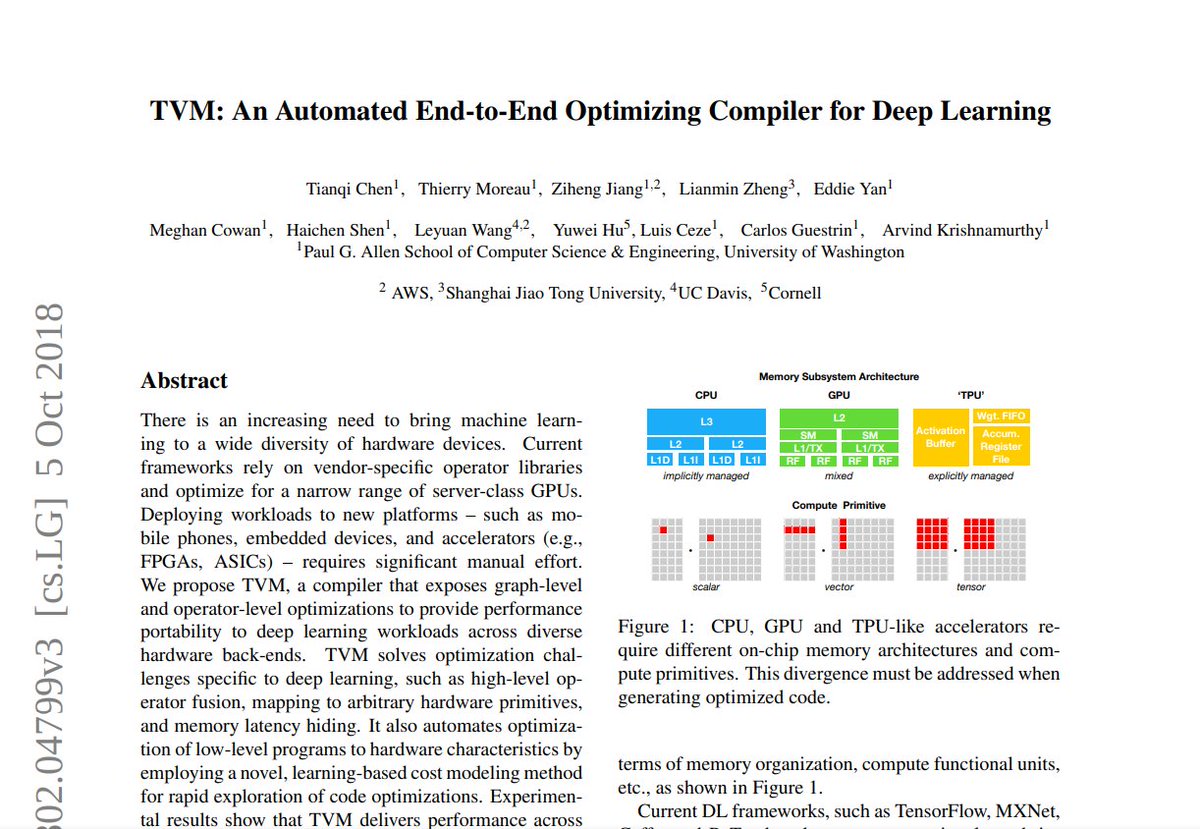
tvm, torch.compile, mojo, mlc llm etc they all are really good at taking a computation graph, perform optimization like (fusion, reorder etc etc), put them into a really nice IR and optimize for a specific hardware.
although compilers are really amazing, they probably wont be able to find algorithms like flash attention maybe since its more of a algorithmic inovation but a future where compilers can do this would be awesome.
this is another very cool research space.
I believe 1 year after Mojo 1.0 will look at least like year 5 after Rust 1.0.
Mojo is uniquely positioned to succeed in Agentic development. Statically typed. Python-like syntax. SOTA metaprogramming, etc.
Check out my recent blog on Agentic Engineering with Mojo 🔥
Agentic engineering is changing what one developer can ship with Mojo in a few weeks.
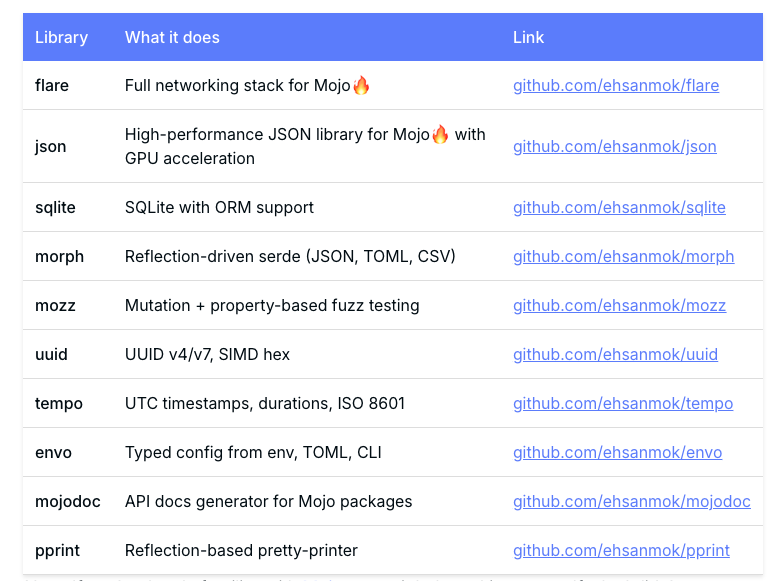
@ehsanmok set out to build a pastebin service in pure Mojo 🔥 using our recently released first Mojo 1.0 beta. Using AI coding agents and Mojo's agent skills, he built 10 libraries from scratch: a full networking stack, SQLite bindings, high-performance JSON, reflection-driven serde, fuzz testing tools, and more. The app is live at https://t.co/hLDNqO1p4V.
Read about his stress test of Mojo 1.0 beta: https://t.co/hqpZEQkwga
7 months ago, @Karpathy called AI agents "slop".
Yesterday, he joined Anthropic.
The game has changed - the capabilities of frontier models and swarms of AI agents are growing incredibly fast.
This massive capability growth has shifted the work of developers: boilerplate is easier than ever before, but great engineering architectural thinking may be more valuable than ever.
Mojo, and @Modular, are embracing the new era of agentic engineering. We've designed the language to be easy for AI agents and humans alike. We've written out structured kernels series to show you how to port kernels to Mojo, achieving increased simplicity, optimization, and hardware portability. We've built out skills + examples to make it easier than ever for you to use LLMs to build with Mojo.
@ehsanmok took our skills for a test drive to prove what's possible - solo building 10 libraries and a production pastebin in a few weeks using Mojo and AI agents.
The dependency graph across all 11 repos has only 3 compile-time edges. That's not what happens when you turn agents loose without a plan, it's effective architecture applied by agents.
The result is a 1.1 MB binary serving sub-millisecond requests on a free-tier https://t.co/HT9uvI3UJr VM, with property-based fuzzing that caught real bugs in HTTP header parsing before any of them shipped. Ehsan built that production system solo while the agent handled most of the typing.
What changes when one developer can do that is the shape of the job itself. Boilerplate has become simple. Implementation isn't a moat anymore. The remaining differentiation lives in the design choices that came before the agent touched a keyboard: which libraries should exist, what their boundaries should be, what they should refuse to do, how they fit together. Teams that invest in that judgment will compound. Teams treating agents as a faster way to ship the same mediocre architecture will discover that bad code at agent speed is still bad code, just more of it.
This is the bet Modular is making with Mojo, the structured kernels series, the published skills, and everything else we are doing to create an open, portable AI software stack that runs on NVIDIA, AMD, and Apple silicon from one codebase. The languages and toolchains best suited for agentic engineering will be the ones that give agents tight feedback loops, deterministic builds, and clear patterns to imitate.
Agentic engineering will compound. It's why you're seeing top AI talent, like Karpathy, joining the best agentic engineering companies in the world.
Ehsan's ecosystem is the early proof the bet is working.
Read the full breakdown of his work:
https://t.co/nbMgPAE8Nd
#notanofficialspokesperson
1) Reminded me of this quote from A.G. in LessWrong: "They’ve done all things, often beautiful things in a context that was already set out before them, which they had no inclination to disturb. Without being aware of it, they’ve remained prisoners of those invisible and despotic circles which delimit the universe of a certain milieu in a given era."
2) Mojo is not a DSL!
AI agents in healthcare face tight constraints: latency can't exceed 800ms per turn, the first turn processes 10k tokens of context, and safety models analyze the conversation in parallel.
Using our MAX framework, @hippocraticai keeps patient conversations instant (sub-second TTFT), hits aggressive performance targets without sacrificing model accuracy, and runs across accelerators as new hardware comes to market.
A look at how regulated enterprises like Hippocratic AI use MAX in production for real-time patient conversations:
https://t.co/xllxNL3MTK
New release by @modular: Mojo 1.0 is in beta! 🔥
Our 26.3 release includes:
- https://t.co/wLzY71zkhh 🆕
- MAX Video Gen w/ Wan 2.2
- Compile-time tensor layout
- 10-20x faster eager execution
+ more
Modular's unified AI platform keeps growing: https://t.co/iPrO2xsy3j
Thanks to 26.3, writing tensor-parallel code just got easier. max.experimental now ships a distributed-aware Tensor type, multi-device compilation, and collective ops. The API feels familiar whether you're coming from PyTorch or JAX. We've already built a multi-GPU Gemma 3 pipeline on top of it.
Deep dive with the release blog post: https://t.co/eY95BZTUoi
Thanks to 26.3, writing tensor-parallel code just got easier. max.experimental now ships a distributed-aware Tensor type, multi-device compilation, and collective ops. The API feels familiar whether you're coming from PyTorch or JAX. We've already built a multi-GPU Gemma 3 pipeline on top of it.
Deep dive with the release blog post: https://t.co/eY95BZTUoi
Mojo 🔥 1.0 is in beta! Beta 1 marks the first step towards finalizing 1.0 later this year, which will bring a new level of language stability. The beta lands safe closures with a new capturing syntax, conditional trait conformance, and major variadic improvements. Plus, Mojo has its own home at https://t.co/j3TzPUkEDr.
[Job Ad] Modular's technology is maturing, business is expanding, and we are opening the Mojo compiler soon.
We're continuously growing our team to support and have (rare) new leadership roles open:
- Head of Hardware Partnerships
- Head of MAX Framework
as well as others👇
Modular's first Seoul developer meetup is coming up, co-hosted with SqueezeBits! 🇰🇷 Mark your calendars: May 19th at Belgium Jazz Cafe near COEX. The agenda includes Mojo, MAX, a session from the SqueezeBits team, a special message from @clattner_llvm, and a GPU raffle. Save your spot: https://t.co/5ztBwpJeFv
Most serving stacks run FLUX.2 as four separate stages with Python overhead between each one. We collapsed all four into a single fused execution graph using MLIR-based compilation.
On @AMD MI355X, that means a 3.8x speedup over torch.compile, 1024x1024 images in under 3.5 seconds, and a deployment container under 700MB. We ran the same pipeline on Blackwell, too. AMD delivers equivalent generation quality at a 5.5x lower cost.
@clattner_llvm is presenting the full breakdown at AMD AI DevDay. Register: https://t.co/Pa1e36BTZn
We sat down with Kyle Caverly, an AI Performance Engineer on the MAX serve team, to walk through what actually happens inside an inference server from prompt to response.
All the code discussed is open source.
https://t.co/iwSQ4QA5F1
Portable or fast. GPU programmers have been forced to pick one for years. We don't think you should have to. The key: component boundaries that let you swap platform-specific implementations without touching kernel logic.
Part 4 of the Structured Mojo Kernels series explains how: https://t.co/n2dzp6lcoY