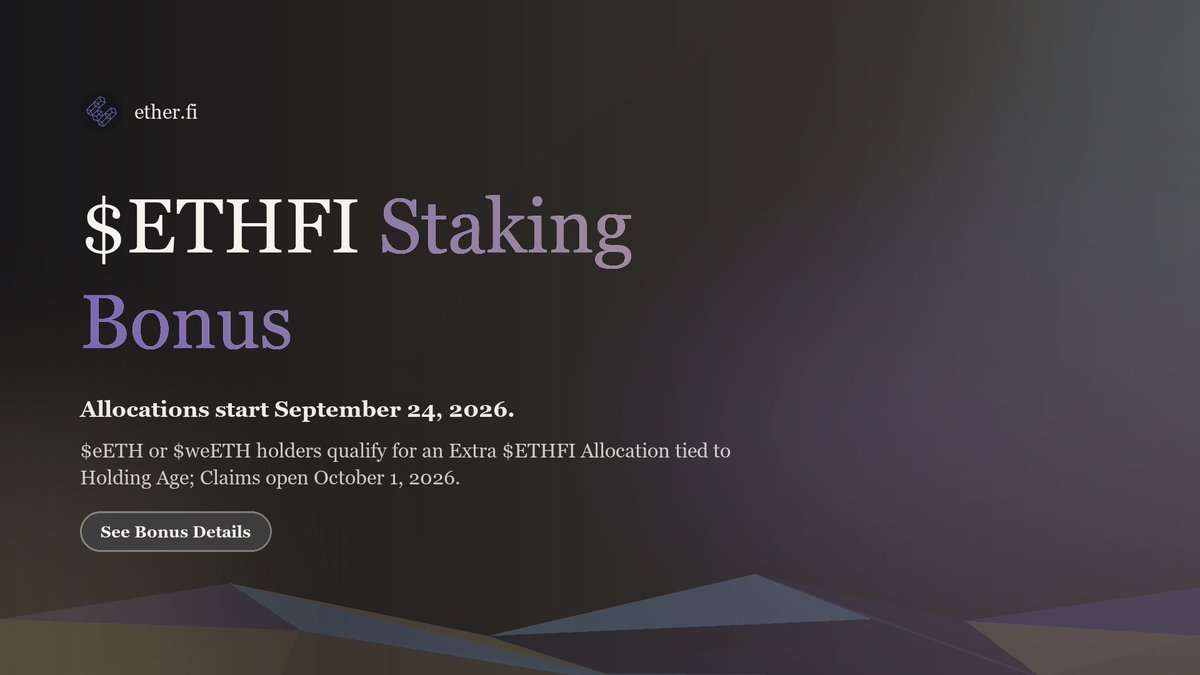
@ether_fi@token2049 The $ETHFI release-date vote is open.
Joining the vote means you can receive an extra allocation when the rewards go out.
Check it here ↓
https://t.co/Z9csapW3A2
There’s an active vote on the $ETHFI rewards release date.
If you take part, you’ll also have access to an additional allocation once rewards are paid out.
View the details ↓
https://t.co/c9bxQ579Cv
@ether_fi $ETHFI holders can now vote on the reward release date.
Participating in the vote comes with an extra allocation when the rewards are distributed.
Take a look ↓
https://t.co/Z9csapW3A2
The vote on when $ETHFI rewards will be released is now live.
Taking part also makes you eligible for an extra allocation when the rewards are paid.
See the details:
https://t.co/c9bxQ579Cv
@ether_fi@token2049 The $ETHFI release-date vote is open.
Joining the vote means you can receive an extra allocation when the rewards go out.
Check it here ↓
https://t.co/Z9csapW3A2
There’s an active vote on the $ETHFI rewards release date.
If you take part, you’ll also have access to an additional allocation once rewards are paid out.
View the details ↓
https://t.co/c9bxQ579Cv
@ether_fi $ETHFI holders can now vote on the reward release date.
Participating in the vote comes with an extra allocation when the rewards are distributed.
Take a look ↓
https://t.co/Z9csapW3A2
The vote on when $ETHFI rewards will be released is now live.
Taking part also makes you eligible for an extra allocation when the rewards are paid.
See the details:
https://t.co/c9bxQ579Cv
@ether_fi SETHFI Vault Rewards Update: Additional reward allocations will be released on September 24, 2026.
Distribution corresponds to the maturity of each active position. Claims become available on October 1, 2026.
Review your specific breakdown below 👇
https://t.co/96qj8tzkCx
@ether_fi SETHFI Vault Rewards Update: Additional reward allocations will be released on September 24, 2026.
Distribution corresponds to the maturity of each active position. Claims become available on October 2, 2026.
Review your specific breakdown below 👇
https://t.co/PvTQ0daSol
Federal prosecutors are investigating whether Binance, the operator of the world’s biggest crypto exchange, violated US sanctions on Iran by not stopping certain trading on its platform, according to sources https://t.co/4T4fu9Vul0
I love how many little pieces of me made it into this 🥹 From my Bitcoin journey and love for the community, all the way to Kirby games and my handwritten notes 🤓
Such an incredibly well-done article. Thank you @OpenSats and @TumaBitcoiner 🩷
I became a Professor of Clinical Psychology, so you don’t have to.
That’s why I created #WaysToThrive
Over the next few months, I’ll distill psychological ideas into one practical insight and one small action you can try today.
ONE IDEA. ONE INSIGHT. ONE ACTION. NO JARGON.
I’ve just read a Forbes magazine interview in which PDA, or pathological demand avoidance, is defined by an advocate as a ‘neurobiological command’. People with PDA, she said, have no choice but to respond with avoidance.
I then saw a video where parents were told their child with PDA has a fragile nervous system, meaning they inevitably will respond to every day life as if it is a threat. And I heard a podcast, saying that PDA is so serious than children could end up fed by a tube, because eating is a demand and they are wired to avoid demands.
All by well known advocates and consultants with hundreds of thousands of followers.
Beliefs like this have consequences.
They change the way people live their lives. They closes things down, and it shrinks their world. They can cause real harm, as children get stuck in their bedrooms and the whole family organises themselves around avoidance.
Yet that is what many well known advocates tell parents whose children are identified as having PDA. Despite the complete lack of evidence, despite the poorly elucidated nature of PDA, and despite the fact that demand avoidant behaviour is something that can come and go across children’s lives.
PDA changes how families think of anxiety, and not in a good way.
They think their only option is to accommodate the anxious avoidance and before you know it, it’s got worse. We know how to help anxious children - this doesn’t change because that anxiety has been given the label of PDA.
That’s why I think clinicians need to start talking honestly about narratives that can harm. We need to stop looking the other way when advocates talk about neurobiological commands, or tell families that their children have nervous system disabilities.
We need to read what they are reading, watch what they are watching - and speak up about neuro-deterministic narratives that are based on nothing and can alter the trajectories of people’s lives. Telling people that their nervous systems are fragile is not a neutral thing to do and it’s not true. Our children deserve better.
(Extract from article by Nancy Doyle from @Forbes, Mar 26 2021).
Should we commemorate the 1000 year anniversary of the invasion by taking back the lands, privilege & wealth that the descendants of the Norman robber barrons continue to hold?
The Norman Conquest was a cataclysm for the English people. After 1066, the country was clenched in a mailed fist. Castles, until then a rarity, sprang up everywhere. Many still stand, handsome and crenelated, their geographical situation advertising their grim purpose. For these were not defences against a foreign foe, but instruments of internal repression, from whose arrow-slits new proprietors peered out at a beaten people.
Having put down the North with terrifying savagery, leaving stretches of country depopulated, William began to rule as an absolute monarch. Quite how absolute can be seen from his compilation, some years afterwards, of a comprehensive inventory of the kingdom he now possessed. For there was no question in his mind that England was his to do with as he would. As the Anglo-Saxon Chronicle put it:
“So very thoroughly did he have the inquiry carried out that there was not a single hide of land, not even – it is shameful to record it, but it did not seem shameful to him to do it – not even one ox, nor one cow, nor one pig which escaped notice in his survey.”
The resulting tome became known as the Domesday Book, for it was said that you might as well try to deceive God on the Day of Judgment as hide your goods or chattels from the king’s officers.
William parcelled out almost the entire country among his mercenaries and liegemen. At least 92 per cent of England was owned by men who had been born on the other side of the Channel. Of more than 200 landowners who held their estates directly from the king, only two were Anglo-Saxons: Thorkell of Arden and Colswein of Lincoln.
Equality before the law was forgotten as the new aristocracy settled down to enjoy its privileges. Men were required by law to work on their lord’s estates, and forbidden to leave without his permission.
Englishness became, almost by definition, a badge of subjugation. Human nature being what it is, people soon began to adopt the names and manners of their overlords. On one English farm in 1114, records Peter Ackroyd, the workers were listed as being called Soen, Rainald, Ailwin, Lemar, Godwin, Ordric, Alric, Saroi, Ulviet and Ulfac. By the end of the century all those names had disappeared.
The status of the defeated English is often illustrated with reference to the vocabulary of meat. The Anglophone farmer in the field used plain Saxon words for his livestock: cow, pig, sheep. But by the time these animals found their way onto his Norman master’s plate, they had acquired French-derived names: beef, pork, mutton.
More telling, though, is the political vocabulary introduced under the Normans. Out go witan, folkmoot and folkright. In come fealty and homage, fief and vassal, villein and serf. The progress toward personal liberty, free contract and equal access to the common law was suspended. In the words of the early twelfth-century chronicler, Orderic Vitalis: “The English groaned aloud for their lost liberty and plotted ceaselessly to find some way of shaking off a yoke that was so intolerable and unaccustomed”.
The idea of “throwing off the Norman yoke” was to animate English radicals for the next seven centuries. Civil War Roundheads spoke of struggling against “William’s lieutenants”, meaning that the landowners of their own time were heirs to the men who had expropriated the English.
“Wurðe god se ende þonne God wylle”, says the Anglo-Saxon Chronicle, lamenting the subjugation of 1066: May the end be good when God wills. The seventeenth century struggles may be seen – were seen by the key actors – as a belated reversal of the catastrophe. It is that reversal which truly deserves to be celebrated.
Calling all NHS Talking Therapies staff we need your help!
We are looking for high & low intensity staff to share their thoughts on how outcomes can be improved for those experiencing deprivation.
https://t.co/PCNlIlYpeB
Please consider taking part and sharing! Thank you!