Anyone should be able to use @claudeai for building.
This release brings vibe coding to designers, PMs, and other non-developers working on existing products where access to the codebase is restricted by complexity or security policies.
Introducing Chordio Workbench, a design workbench for Claude Code.
Built for teams to prototype new experiences on top of their existing product - even when they don't have access to the product source code.
When we first set out to learn about batteries the first thing everyone in the space said was "Do you read Intercalation Station?!"
We've admired the amazing research and writing of the team since the first time I visited the Substack. Beyond grateful that Isabella Stephens gave an early listen to our episode and wrote essentially a book review on our 4 hour podcast on the long, wild, and important story of batteries.
If you want to nerd out on batteries I highly recommend subscribing to Intercalation. And if you want a broad 101 and wind through history, come spend 4 hours with us on the way!
Thank you @IntercalationSt for the deep review.
There has never been a bigger gap between what is technologically possible and what the world understands to be possible.
For AI-native builders, the world has fundamentally changed. Things that once required months of effort and millions of dollars can now be built by one or two talented people in hours or days.
Business leaders outside the AI bubble know that AI can radically change their business, from how they run it to what they offer their customers, but they have no idea where to begin, or even who to trust to help them find out.
I don’t blame them. AI is accelerating so fast right now that if you aren’t actively building and learning at the frontier, your entire strategy is almost certainly built on wrong assumptions.
To use an analogy from history, right now some people are flying jets across the country while others are still dying of dysentery on the Oregon Trail.
It doesn’t have to be that way.
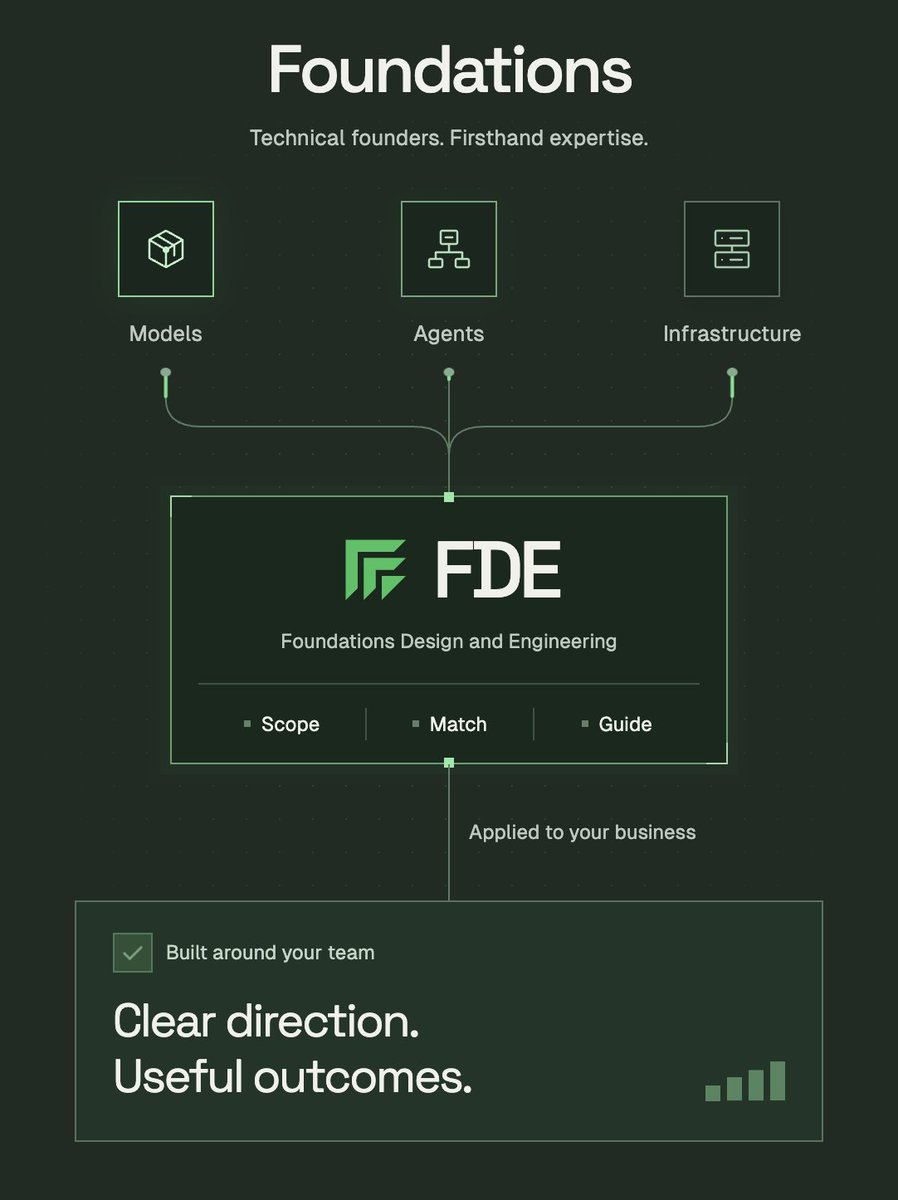
Today we’re launching Foundations Design & Engineering (FDE) to bridge that gap.
Over the past two years, Foundations has grown into a community of 300+ committed AI builders across Seattle and SF. Increasingly, the scarce resource for many of them isn’t the ability to build.
It’s finding great problems worth solving.
FDE is our attempt to connect these two worlds.
For existing companies eager to embrace AI, FDE should feel like magic. You express a business problem in plain English. We analyze your problem through an AI-native lens, assign the right team in our community to solve it, and help you get to the best outcome for your business as quickly and cheaply as possible.
No armies of junior consultants. No incentive to maximize billable hours. Just founder-grade technologists applying hard-fought lessons from the edge of what’s possible today.
Sometimes the answer is a few hours of expert help or a product that already exists. Sometimes it’s a full build. Sometimes it’s “the tech isn’t there yet, let’s find another way”.
You have problems. We have builders looking for them.
Let’s make the connection.
https://t.co/OGfMEsuVwm
Flying to NY for Climate Week? Queue up for your flight: https://t.co/twWYuXVp7x
We've got 4.5 hours on the grid, 4 hrs on the history of compute, or 6+ on the story of coal.
There’s a strange trap in how cities think about themselves.
Seattle vs. SF. SF vs. New York. This place vs. that place. For many, your identity as a resident becomes about positioning yourself in opposition to somewhere else.
The World Cup is the perfect reminder of how silly that is. The countries of the world literally compete against each other, but what makes it beautiful is how much everyone shares: the same game, the same stakes, the same joy, the same heartbreak, the same belief that where you come from matters… but does not have to limit where you belong.
The best founders think the same way.
Seattle is an amazing place, but your ambition should not fit inside one city.
With that, there could not be a better time to announce that we’ve now officially opened Foundations SF at 142 Minna to all https://t.co/wWURMtCAmS members, right in the heart of San Francisco.
But wait, Foundations is not moving on from Seattle. In fact, we are going deeper: we just took over our entire building in Capitol Hill. 15,000 sqft of startup goodness, right in the heart of the city.
The point is not to turn Seattle founders into SF founders. Nor is it to create a new Foundations community in SF. It’s to make geography irrelevant.
Build from Seattle. Plug into SF. Do the opposite. Move between both. Belong in both. Who cares.
No permission.
No provincialism.
No “visiting someone else’s ecosystem.”
Foundations is heart to heart. Of the cities and of the spirit. And yes, this is a Starship reference. The band… I’m old 😭
Like with the World Cup, we’re about our own universally shared beautiful game. Entrepreneurship.
All that matters is that you build something that matters, and we just gave over 250 of the best Seattle founders a superpower to do more.
You have a home in both cities, even if you’ve never visited SF before.
LFG.
If you’re in SF on the 30th, we’re doing a small, private office-warming during the AI Engineer World Fair.
https://t.co/zo9Yp0fqa3
No promises on getting accepted, and please don’t just show up.
Someone just shared a step-by-step playbook for building a hardware LLM harness.
But 99% of people are still sleeping on it. Steal it for your next weekend project.
From early design to volume manufacturing, our computational lithography software enables chipmakers to optimize the chip patterning process.
Layer by layer, chip by chip, wafer by wafer, computational lithography is helping push microchip technology to new limits.
Researchers, including a team from MIT, created a new algorithmic approach that pinpoints the minimum dataset required for optimal solutions, frequently needing much less data than standard techniques assume.
tells you the smallest set of measurements needed to guarantee the exact best decision.
The big deal is that it turns “how much data do we need” into a provable design problem, so you can measure only what can change the optimal choice and still get certainty.
challenges the usual habit of collecting lots of data to estimate everything, since the method only targets the information needed to separate competing optimal solutions.
The research gives a guarantee, because it is not an average-case or best-effort claim, it is a mathematical proof that the chosen small dataset is enough.
It matters so much because in settings like routing, supply chains, and power grids, each measurement can be expensive, slow, or risky, and this gives a principled stop rule.
---
news. mit .edu/2025/bigger-datasets-arent-always-better-1118
Trying to put a finger on what I find so troubling about the current anti-capitalist lean of both national and state level #Democratic policy efforts - and I'm on the team, so this is offered with nothing but love. https://t.co/KchlUb6eWH
Starlink has done more than any NGO to lift people out of poverty by connecting them with a means of education and a market for their good & services via the Internet
Anyone should be able to use @claudeai for building.
This release brings vibe coding to designers, PMs, and other non-developers working on existing products where access to the codebase is restricted by complexity or security policies.
Introducing Chordio Workbench, a design workbench for Claude Code.
Built for teams to prototype new experiences on top of their existing product - even when they don't have access to the product source code.