Liberty - for its own sake - is enough for me. I am: husband, father, son, brother, CFL4, hunter, singer/player. RDT! I was: Naval Aviator (23 years), Patrolman
@luisbaram For all the geniuses who want to leave their mark - Find a way to teach thousands of people at a time how to dream a life plan aligned with the golden rule, and live it. Going to Mars would be a tiny event compared to giving every living human the capacity to max their potential
Rapeseed oil lubricated the steam engines of the Industrial Revolution.
It lit the lighthouses. It kept the train lamps burning before gas arrived. It was burned in the early Canadian lighthouses, cheaper than whale oil.
Then petrochemicals arrived and the machinery moved on. Nobody needed it anymore. Rapeseed had done its industrial duty.
The FDA formally banned it for human consumption in 1956. Erucic acid. Toxic to the heart in animal studies. The scientists were fairly clear about this.
In the 1970s, Canadian plant breeders reduced the erucic acid content and needed a new name, because "rapeseed" was both unglamorous and commercially lethal. They called it "canola." Can-ada. O-il. L-ow-acid. A portmanteau built in a marketing meeting. In Britain they sidestep the problem by calling it "vegetable oil" and printing a picture of a sunflower on the bottle.
So where are we now. On the supermarket shelf, the oil that greased the Industrial Revolution is bottled in amber plastic with a green leaf on the label and a "heart healthy" claim on the front.
The machinery it once lubricated has been replaced by diesel engines and electric motors. The stuff itself has been replaced on your dinner plate by nothing, because apparently once you're in, you're in.
Lamp oil. Machine lubricant. Banned by regulators. Rebranded. Repositioned. Drizzled on salads and baked into supermarket bread and ladled into hospital canteen fryers.
Someone at some point made a series of decisions about what belongs on a dinner table and what belongs in an engine room, and got them completely the wrong way round.
The lighthouse still stands. You can visit it. It runs on electricity now.
Communism through (my) ages:
1) When I was 15, a teacher told me "It isn't as bad as they say, and makes a lot of sense."
2) At about 19, college friends, "Socialism isn't communism."
3) At 20, on meeting my grandfather-in-law, "They are evil. We escaped in 1949."
4) At 30, "China is a wonderful developing Democracy"
5) At 35, I was sent to communist China on business. It was a crowded, smelly, dirty, factory of despair and hopelessness. This I saw with my own eyes.
6) At 36, "China doesn't count. Successful socialism is in northern Europe."
7) I moved to northern Europe when I was 40. It was much nicer than China, but also felt like I was living in the past. I had to wait 6 months for a hernia operation.
8) When I was about 45, the migrant crisis began. The socialist/globalist/pacifist allowed them entry into every country, regardless how many crimes they committed along the way. Just 20 minutes from my house, in Calais, I was shocked to see migrants jumping onto trucks, breaking open the doors, scattering the contents across the highway, then climbing in. They went through the Chunnel and got out in England.
9) At 52, the soft socialism around me had transformed into globalism. I was told I had to call people by their preferred pronouns, though it was a lie, and even if I didn't know what the preferences were. I quit.
10) I returned to the US, and am now 60. "Socialism" is no longer a dirty word here. People openly espouse the virtues of it. Politicians run as socialists and win.
Socialism has taken many forms, from the Bolshevism of Russia, to the CCP in China, the Nazis in Germany, Fascists in Italy, and the many forms of it found in Latin America. It is one of the two most destructive ideologies on earth. It is designed to deprive, despirit, and murder everything that comes in contact with it.
Socialism is a great lie at every level. It helps no one, not even those who benefit the most. This is because the cost is the imposition of one's will on everyone else, and that destroys the soul of the usurper and the life of the oppressed.
Socialism always fails on its own, but only after destroying almost everything in its train. It can also be conquered. Those are the options.
Red meat gets called the centrepiece of carnivore so often that newcomers assume it's just dogma. In fact it earns the spot, and here's exactly why.
First, what red meat actually means here. Not simply any mammal, but ruminant meat: beef, lamb, mutton, goat, bison, venison. Animals built around a rumen, a great fermenting forestomach that does something no pig or bird can. It takes whatever fat the animal eats and biohydrogenates it, turning fragile polyunsaturated fat into stable saturated and monounsaturated fat before it's ever laid down. Feed a cow badly and its fat barely flinches. The rumen sorts it out.
That's the first reason it sits at the centre. Ruminant fat is stable by design. Largely saturated and monounsaturated, low in linoleic acid, slow to oxidise, the very opposite of the fragile stuff you've spent good effort cutting out. Fat you can cook hot and eat every day without building yourself out of something prone to turning rancid.
Then the density. Heme iron in the form your body actually absorbs, not the token amount in spinach that barely makes it across the gut wall. B12, which you will find nowhere in the plant kingdom. Zinc, selenium, complete protein with every amino acid in the right ratio, plus creatine, carnitine and taurine, the compounds that run your muscles and your brain and turn up in almost nothing green.
And it's gentle. Ruminant protein is among the most digestible food there is, complete and clean, asking very little of a gut that's spent years wrestling fibre and antinutrients. Most people feel it settle within days.
So it's non-negotiable, but it isn't a dress code. If you can't face a steak yet, don't. Ground beef counts. Burger patties count. A brisket left in the oven all afternoon until it falls apart counts, and frankly outshines most steaks anyway. Start wherever you can stand it.
Beef, lamb, the ruminants. Stable, dense, digestible, and doing what no other food on earth quite manages. That is the centre of the plate. Everything else is a guest.
This should stop every parent in their tracks.
In 1994 Japan ended all mandatory vaccines for babies under two years old.
The outcome? Japan now has one of the lowest infant mortality rates on the planet.
America? Highest infant mortality of all industrialized nations.
When the dermatologist was just on Fox News debunking the idea that some chemicals in sunscreen aren't good for us, it sounded illogically dismissive of the studies and research.
I took a quick look.
I didn’t hear her disclose her paid relationships with big sunscreen makers. ☀️
This is part of a trend that I discovered decades ago. It permeates our news media landscape.
I learned that nearly every member of the national board of experts that lowered cholesterol guidelines and basically recommended that people should take more statins, worked for the statin makers.
I learned that many members of the board set up during Covid that restricted hydroxychloroquine... were paid by the companies that made other controversial treatments for Covid like remdesivir that were then prioritized over hydroxychloroquine.
It doesn’t stop there.
When the government and the cosmetics industry tried to falsely debunk the scientific studies linking antiperspirants and breast cancer, they referred me to the American Cancer Society for an interview. I learned that the expert at the American Cancer Society hadn’t even read the relevant studies, and yet was claiming the link was a myth. I asked and found out that the American Cancer Society takes money from the antiperspirant industry and other allegedly cancer, causing industries. However, they wouldn’t tell me how much.
When the nonprofit “every child by" was illogically denying the proven vaccine autism link, I dug in and found out the nonprofit was actually started by a vaccine maker in order to defend vaccine companies, and to controversialist those of us exposing the risks.
I was the first journalist to ask and report that the expert the government kept referring us to in order to debunk the vaccine autism link, Dr. Paul Offit, was not an independent expert at all, but was a vaccine inventor and vaccine industry insider… though that was never disclosed in the media at the time. He was always presented falsely as if he were an independent expert.
When I saw a lead dietary group giving questionable advice about nutrition, I learned that the group takes money from the sugar, cola, fast food, and preservative snack industry.
In short, whenever I’ve looked for a tie between experts defending a chemical or risk that could impact an industry's bottom line... I’ve always found one. Food for thought.
"Dr. Jody Levine has financial and professional relationships with several prominent consumer product companies that manufacture and market sunscreens.
Because sunscreen is legally regulated as an over-the-counter drug and is a core component of commercial skincare lines, her consulting roles inherently create potential conflicts of interest when she recommends sun protection or reviews skincare products in the media.
Her specific ties to major corporate sunscreen manufacturers include:
1. Johnson & Johnson / Kenvue
Dr. Levine has served on the Medical Advisory Board for Johnson & Johnson. Johnson & Johnson’s consumer health spin-off, Kenvue, owns Neutrogena and Aveeno, two of the largest and most widely distributed sunscreen brands in the United States. In her media and print features, she has regularly recommended product categories or specific options overlapping with these brands, such as recommending Neutrogena Sport Face in broad consumer media interviews.
2. Galderma (Cetaphil)
She has acted as a consultant and advisor for Cetaphil, a brand owned by Galderma. Cetaphil produces a substantial line of daily facial moisturizers with SPF, mineral sunscreens, and broad-spectrum sun protection lotions marketed heavily toward sensitive skin and pediatric care.
3. Beiersdorf (Eucerin)
Dr. Levine has maintained consulting arrangements with Eucerin, a brand under the Beiersdorf corporate umbrella. Eucerin manufactures a wide range of daily anti-aging lotions with SPF, sensitive skin sunscreens, and body sun protection products.
Impact on Media Appearances
When Dr. Levine appears on networks like Fox News or in print publications to deliver general public health messages—such as advising viewers to apply sunscreen 15 minutes before going outside or warning against the dangers of tanning beds—she is providing standard medical advice aligned with the American Academy of Dermatology. However, because she does not routinely issue on-screen financial disclosures listing her corporate partners during short news segments, viewers are generally unaware that she is paid by the parent companies of the very products sitting on drugstore shelves."
Grass-fed or grain-fed? People agonise over the omega-6 in their beef. Here is what that worry actually looks like on a scale.
Omega-6, per 100 grams:
Sunflower oil: 65,000 mg
Corn oil: 55,000 mg
Soybean oil, hiding in everything: 50,000 mg
Walnuts: 38,000 mg
Chicken thigh, skin on: 3,000 mg
Grain-fed beef: 285 mg
Grass-fed beef: 142 mg
Look at the bottom two. That is the whole grass-versus-grain question, right there: a difference of about 140 mg.
One tablespoon of soybean oil carries 7,000, fifty times the gap you are losing sleep over. Your fried chips lapped the entire debate before you so much as touched the steak.
So paying double for grass-fed, then frying it in sunflower oil, is walking past a burning building to blow out a candle. Grass-fed wins on omega-3 and CLA, no argument. On omega-6, you are sweating the decimal while the headline number laughs at you.
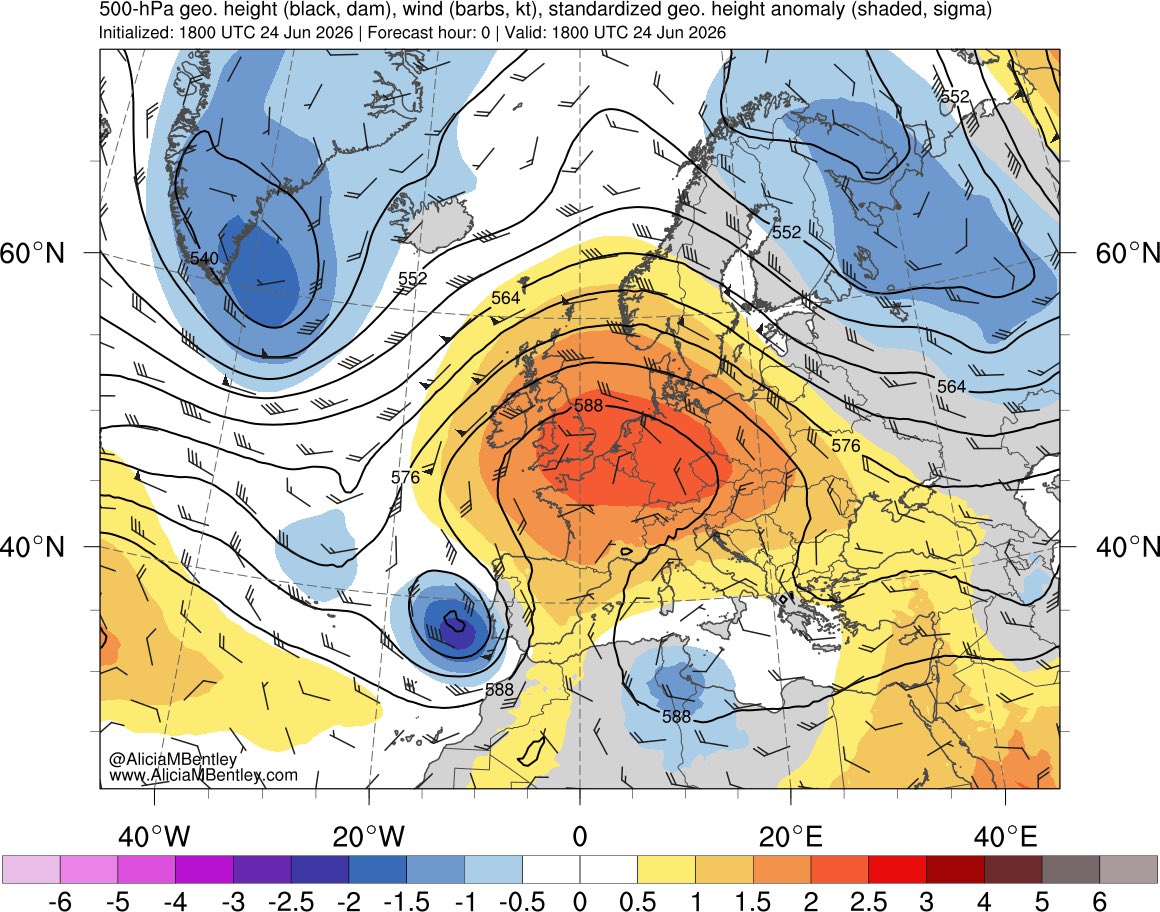
Why is it hot in Europe this week?
Well, it has to do with the “omega block” in the jet stream. Omega blocks get their name because they resemble the Greek uppercase letter omega, Ω.
You can see that in the synoptic setup. The map below on the left shows the 500 mb geopotential height anomaly at 18z. The contour lines resemble the Ω shape due to an enormous high-pressure ridge in the mid-troposphere that is sandwiched between two low-pressure systems to its east and west.
Hot Saharan air has been advected—that is, horizontally transported—northward into western Europe due to anticyclonic (clockwise) airflow, and as that air mass moves north, it is compressed adiabatically beneath the ridge where air is sinking.
This process is natural and has nothing whatsoever to do with climate change or greenhouse gas emissions. In fact, there are quite a few studies suggesting that reduced latitudinal baroclinicity (north-to-south temperature gradient) caused by Arctic amplification could reduce the frequency of mid- and high-latitude blocking events (e.g., Hassanzadeh et al., 2014; Woollings et al., 2018).
🔗 https://t.co/NGsFsRKpEt
🔗 https://t.co/M7h3vg232H
There is, however, debate about this.
Europe has seen an unusual amount of these extreme heat events since 2019, but most other areas of the globe have not. The notable exception was the June–July 2021 Pacific Northwest heatwave in North America, but even that wasn’t as rare as previously thought.
🔗 https://t.co/rNRFfJohs4
The most likely explanation for this boils down to a combination of two things:
1️⃣ Undiagnosed changes in atmospheric circulation patterns.
2️⃣ Increased absorbed solar radiation at the surface due to reduced stratiform low- and mid-level cloud cover (increased sunniness), some of which is likely due to reduced atmospheric aerosol concentrations from the EU’s strict pollution regulations.
The overall increase in the “global mean temperature” (which mostly affects overnight lows) has very little to do with this event. Even in a “pre-industrialized” climate, a record-breaking heatwave would still be happening. Heck, the “global mean temperature” fell today despite the heat cranking up in Europe.
This is mostly weather systems moving around. When you have a chaotic system with two turbulent fluids interacting with each other (the atmosphere and ocean), wild things can happen.
Get your weather information from real meteorologists, not sensationalistic clickbait news outlets like BBC News or the Daily Mail.
The Guardian says a study shows Greenland is losing 30 million tons of ice per hour. Sounds terrifying until you add scale.
If, for argument's sake, we accept the questionable headline rate, that works out to roughly 263 gigatons lost per year. But Greenland holds 2.8 million gigatons, meaning total loss would take over 10,000 years.
And the study itself adds important context. Much of its newly counted loss comes from glacier retreat in fjords where ice was already below the sea, so it does not raise sea levels in the way the headline implies.
This is how climate fear works: Huge number. No denominator. No time scale. Just blind panic.
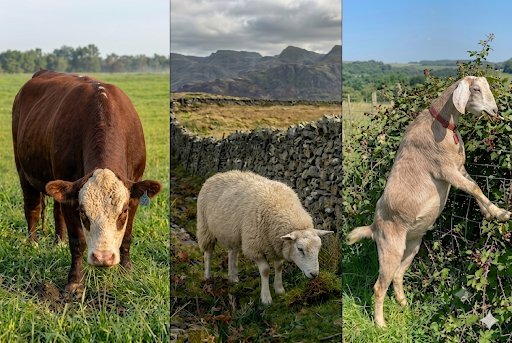
A pasture grazed by cattle alone is a good pasture. Put cattle and sheep on it together and it becomes something else.
The cattle take the long grass, the coarse stems, the rough patches. The sheep come behind and clear what the cattle left: the short regrowth, the wildflowers, the plants a cow won't touch. Two heights, two mouths, two patterns. Twice the use, none of the waste.
Add a goat and the bramble line retreats. Add a pig on the woodland edge and the parasite cycles break. Add a few geese and weeds you never knew you had quietly vanish. Each animal eats what the others refuse and breaks the worms the others carry. The system tunes itself.
The result is about as biodiverse, productive and low-input as farming gets. More carbon in the soil. More birds. More wildflowers. Less disease. Less spent on feed, wormer and fertiliser. Ground that would grow no crop at all turns into meat, milk and wool.
This is the oldest idea in farming. Nearly every working agricultural culture has done it since the beginning: Roman estates, medieval manors, Mongolian camps, Welsh hill farms.
The single-species, single-field, single-product model that shoved it aside is barely a century old, and it is running out of road on every measure you can name.
The fix is older than the problem. A Welsh farm with cattle on the low pasture, sheep on the high, a goat on the bramble line and a couple of geese in the orchard.
The farmer would explain the whole thing in four minutes, if anyone asked.
The policy paper never has.
By 2050, the world is forecast to face 43 million tons of decommissioned wind turbine blades.
These blades are built from high-strength composites made to survive years of weathering.
Still, every single turbine standing today will age out before 2050. Most are difficult to recycle, so most are likely to be buried. But Europe now has a landfill ban for blades coming into force. Nations like Germany, Finland and the Netherlands are already blocking landfills. But they still have blades to dispose of. So the waste is pushed elsewhere. Blades are exported to countries where burial is still allowed, such as the UK.
Net zero creates a mountain of composite waste. And then has the audacity to call it green.
For over twenty years, an engineer named Richard Bernstein did precisely what his doctors ordered.
He ate the diet the American Diabetes Association blessed, close to half of it carbohydrate, and chased the resulting flood of sugar with large doses of insulin. It was killing him. By his mid-thirties his body was breaking down: failing kidneys, nerve damage, the early wreckage of a Type 1 diabetic who had been told in 1946 he would be lucky to reach forty.
The treatment was textbook. The patient was dying on it.
In 1969 he got hold of a machine that blew the whole thing open. It was a blood glucose meter, a three-pound box sold only to hospitals to tell an unconscious diabetic from a drunk. Bernstein could get one at all only because his wife was a doctor and it was bought in her name.
He began measuring his own blood sugar several times a day, the first patient in the world known to do it. What the numbers showed was damning. His levels were swinging violently outside any safe range, on the exact diet the experts had sworn by.
So he ran the experiment they never bothered to run. He cut the carbohydrate hard and swapped the big insulin doses for small, precise ones. His blood sugars flattened to near normal. His complications began to reverse.
He had cracked tight control for Type 1, the type the profession insisted diet could never touch, and the very same approach worked for Type 2.
Then came the most telling part of all. When he tried to publish what had just saved his life, the journals turned him away, not on the evidence, but because he was an engineer and not a physician. So at the age of 45 he enrolled in medical school, for the sole purpose of earning the right to be heard. He qualified, opened his own practice, and spent the next several decades proving the establishment wrong one patient at a time.
The profession never really thanked him for it. It had spent years handing a high-carbohydrate diet to people whose defining problem is that they cannot handle carbohydrate, and then blaming those same people when they fell apart.
Bernstein lived with Type 1 diabetes for 78 years and died last year at 90. He outlived a great many of the experts who swore it could not be done, and a great many more of the patients who were simply given the official advice and told to trust it.
The reason you can't lose body fat has nothing to do with calories.
Your mitochondria are the engines. Fat is the fuel. But without a transport molecule called carnitine, the fat never makes it inside the engine. It just circulates. It sits. It waits. And you stay stuck.
Carnitine is made in your body from two amino acids, lysine and methionine. But the richest direct source by a significant margin is red meat.
A four-ounce serving of beef delivers between 56 and 162mg of carnitine.
Chicken breast contains around 3 to 5mg per 100 grams.
Plants contain virtually none.
This matters because most people trying to lose body fat are eating less red meat than ever. They switched to chicken. They went plant-based. They followed the advice. And then they wondered why their body composition stopped responding no matter how little they ate.
Low carnitine means fat cannot be oxidised efficiently. Energy drops. Hunger increases. The body looks for glucose instead. You eat more carbohydrate to compensate. Insulin rises. Fat storage increases. The cycle locks in.
The diet that was supposed to make you leaner systematically removed the very nutrient your body needs to burn fat in the first place.
I eat red meat every day. I do not count calories. I am not hungry between meals. At 58 my body composition is better than it was in my thirties.
That is not a coincidence.
Why do you think we are told to eat less red meat?
Many significant periods in human and geological history have experienced temperatures that exceed modern levels—entirely independent of human activity.
These periods occurred under lower atmospheric carbon dioxide levels, and driven primarily by Milankovitch orbital cycles. The Holocene interglacial period, beginning roughly 11,700 years ago, features several prominent climate fluctuations.
During the Holocene Climate Optimum (9,500 to 5,500 years ago), enhanced summer solar radiation pushed Northern Hemisphere temperatures 1°C to 2°C above pre-industrial baselines, creating a sustained period of ecological vitality.
Similarly, regional warm currents during the Roman Warm Period (250 BC to AD 400) and the Medieval Warm Period (1,100 to 1,300 AD) allowed agriculture to flourish in the Mediterranean and enabled Norse settlement in green Greenland. In Europe, Roman-era summer averages reached heights that provided the agricultural stability necessary for imperial expansion.
These eras contrast sharply with the Little Ice Age (1,300 to 1,850 AD), a period of severe polar cooling and glacial expansion triggered by volcanic clusters and solar minimums, demonstrating that cold—not warmth—historically brought societal hardship.
Looking further back to the Eemian Interglacial (130,000 to 115,000 years ago), global averages were roughly 1°C to 2°C warmer than pre-industrial levels, with high-latitude spikes of 4°C to 8°C. This natural warmth caused significant polar melt and raised sea levels by 6 to 9 metres. Crucially, Eemian atmospheric CO₂ remained stable at roughly 285 ppm.
If the planet’s most profound warming intervals were driven by natural orbital mechanics, while CO₂ remained low and stable, it raises serious doubts about the fundamental honesty of the United Nations net zero campaign.
What is the possible justification for a global energy transition project that will cost the global economy a colossal $275 trillion by 2050?
IMAGE: The stone ruins of Hvalsey Church in southern Greenland, from around 1300 AD. The last written record from the Norse settlement here was a wedding in 1408, before the onset of the Little Ice Age rendered these farming communities untenable.
As animals go, we are frankly a joke.
No claws. No fangs worth the name. Skin you can open with a thumbnail. We cannot outrun a labrador, cannot out-climb a housecat, cannot out-wrestle a creature half our weight. A chimp shorter than you would take your arm clean off. Drop a naked human into any wilderness on earth and the smart money is on the wildlife.
And yet we run the planet. We put the lions in enclosures and charge schoolchildren to come and look at them.
The whole trick sits behind your forehead. Three pounds of tissue, around 60 percent fat, burning a fifth of your energy while you sit perfectly still doing nothing whatsoever. That organ is the entire reason a soft, slow, fangless ape ended up at the top of every food chain it ever wandered into.
So ask the obvious question. What builds and fuels a brain like that?
Not leaves. Leaves bought the gorilla a quiet life in the forest and a belly the size of a space hopper. Our ancestors took the other road. They went after fat. Bone marrow, brain, organs, the rich greasy parts of large animals. Dense fuel for a hungry organ, so the brain grew, and the better it grew the better they hunted, and round and round it went.
You are the soft, slow, fangless thing that worked out how to kill whatever it pleased, and you managed it on a diet of fat. Then, a few decades ago, we decided fat was the enemy. The very substance that built the organ now making the decision.
Fauci CALLED RFK Jr. a LIAR for telling the truth about untested vaccines — then got SUED and FORCED to ADMIT RFK was RIGHT!
Fauci smeared RFK Jr. for exposing that NOT ONE of the 72 mandated CHILDHOOD VACCINES has ever been properly safety-tested. RFK sued. After a year of dodging, Fauci’s own lawyers caved: RFK was 100% correct.
No liability. No real testing. Just a government-mandated gold rush for Big Pharma — pumping billions into schoolkids while chronic disease, autism (1 in 31 now!), ADHD, and neurological disasters exploded in our children.
This isn’t “public health.” This is criminal negligence — a profit machine disguised as medicine, with our kids as the collateral damage.
Fauci lied. Kids suffered. RFK fought back.
How many more children have to be harmed before we demand accountability?
ENOUGH.
Let me walk you through the terrifying journey of a single carbon atom, since the people panicking about cows clearly never have.
It begins in the air, as carbon dioxide. A blade of grass, powered by sunlight and watered by the rain Britain so generously provides, pulls it down out of the atmosphere and builds itself out of it. The carbon is now grass. Hold that thought.
Two endings.
Ending one, no cow. The grass lives, dies, and rots where it stands. Fungi and bacteria take it apart, and within a few weeks or months the very same carbon drifts back up into the air as CO2. Curtain falls. Atmospheric carbon: unchanged.
Ending two, with cow. The grass gets eaten. The cow's rumen ferments it and burps out methane. The methane floats up, hangs about for ten to twelve years, gets broken down by atmospheric hydroxyl radicals back into CO2, and the next season's grass promptly inhales it to build itself all over again.
Trace the two routes.
Without the cow: air, grass, air. With the cow: air, grass, cow, air, grass.
Same start. Same finish. The cow added a scenic detour and precisely nothing else. Not one new atom of carbon entered the system, because the carbon was already there, sitting in the grass, on its way back to the sky whether the cow turned up or not.
The cow is a lay-by on a journey that was always going to happen. She is borrowing the carbon and handing it straight back.
This is the biogenic carbon cycle. It is GCSE-level science. It has a Wikipedia page, with diagrams and everything. The only reason nobody has sat you down and explained it is that it quietly ruins a very profitable headline.
Vitamin D is a steroid hormone wearing the wrong label.
What it actually does:
- Made in your skin from cholesterol when sunlight hits it
- Switched on by the liver and kidneys
- Then runs gene expression in nearly every tissue you own
It got filed under 'vitamin' because we discovered it studying deficiency in people who never saw the sun. The name stuck.
Modern life is almost perfectly built to suppress it:
- Seed oils instead of animal fat
- Factor 30 to walk to the car
- Days spent under strip lighting
You make it from two cheap, ancient things. Cholesterol, which means eating fat. Sunlight, which means going outside.
We have managed to pathologise both.
In 1965 Malaysia kicked Singapore out of the Malaysian federation, and Tunku Abdul Rahman thought he had won. He had dumped a port city with no oil, no farmland, no fresh water, and two and a half million people crammed onto an island smaller than Lake Tahoe. Sixty years later Singapore's GDP per capita runs past $84,000 while Malaysia limps along under $12,000. The man who got expelled built the richest patch of dirt in Asia. The man who did the expelling built the New Economic Policy.
Let's study what happened.
Start with what Singapore lacked. No resources. No hinterland. No domestic market worth the name. By every theory that says a nation needs raw materials to prosper, Singapore should have starved. Instead Lee Kuan Yew made his country a place where capital felt safe. Low tariffs. Easy entry for foreign firms. Courts that enforced contracts instead of shaking down the parties. Corporate tax dropped to 17 percent, personal rates capped at 22, no tax on most capital gains. Money flowed in because money is not stupid.
Malaysia chose the opposite. The New Economic Policy was racial central planning dressed up as fairness. Bumiputera quotas demanded that ethnic Malays hold 30 percent of corporate equity, that government contracts favor Malay-owned firms, that universities admit by race rather than ability. The state picked winners by bloodline. Predictably, the productive Chinese and Indian minorities took their capital and brains elsewhere, much of it to (where else) Singapore. You distort prices and incentives long enough, the talented people leave. They always leave.
Lee Kuan Yew was not perfect. The man jailed opponents, sued journalists into poverty, and ran a soft authoritarian state with a fondness for caning. He banned chewing gum, which is the kind of thing a control freak does when he runs out of real problems. Singapore is no libertarian paradise. The government owns Temasek and GIC, sovereign wealth funds sitting on close to a trillion dollars combined, and public housing covers 80 percent of the population. Plenty there for a free market thinker to dislike.
But here is the lesson Malaysia missed. Lee understood the difference between an interventionist government and a parasitic one. Singapore's state stayed mostly out of the price system. It kept inflation low, the currency credible, the bureaucracy clean, and trade open. Transparency International ranks it the fifth least corrupt country on earth. Malaysia sits at 57th, with a former prime minister, Najib Razak, currently serving time for looting 1MDB to the tune of billions. One country treated public office as a trust. The other treated it as a buffet.
Capital responds to incentives, not slogans. When Singapore guaranteed property rights and kept the rules predictable, Exxon and Shell built refineries, banks set up regional headquarters, and the port became the busiest transshipment hub in the world. When Malaysia told investors that race would override merit and that the rules could change whenever a minister felt like it, the smart money discounted everything by a risk premium. Over fifty years that premium compounds into a $70,000 gap in living standards.
Denmark is held up as proof a fossil grid can be replaced. But electricity prices have more than doubled since 2000, to now sit amongst the highest in the world.
Moreover, the majority of what is labelled renewable is actually biomass, that is, wood. Trees are cut, often abroad, compressed into pellets, shipped in and then burnt for power.
At the smokestack, more CO2 is released than just simply burning gas. But it is labelled as "green" because the emissions are not counted at the power plant. They are 1) assigned to the country where the trees were cut, and 2) assumed to be reabsorbed by future regrowth.
So the system works like this: Cut trees, burn them, emit CO2, call it clean. Laughably, 64% of Denmark's renewable energy comes from this process.
You take calcium for your bones. A good deal of it ends up setting like cement in your arteries instead.
The missing piece is vitamin K2, the traffic warden that steers calcium into your bones and keeps it out of the artery wall.
Where K2 lives:
- Egg yolks, the bit you were told to bin
- Butter from grass-fed cows, the deep yellow is the tell
- Hard cheese like Gouda and Edam
- The fat on the meat, the bit you were told to trim
The plant form, K1, you barely convert. The animal form, K2, your arteries put straight to work.
The Rotterdam study tracked nearly five thousand people. The biggest K2 eaters had far less heart disease and far less hardening of the aorta. K1 did nothing measurable.
So the warden lives in egg yolk, butter and the fat on the chop. The exact three foods a generation was taught to fear.