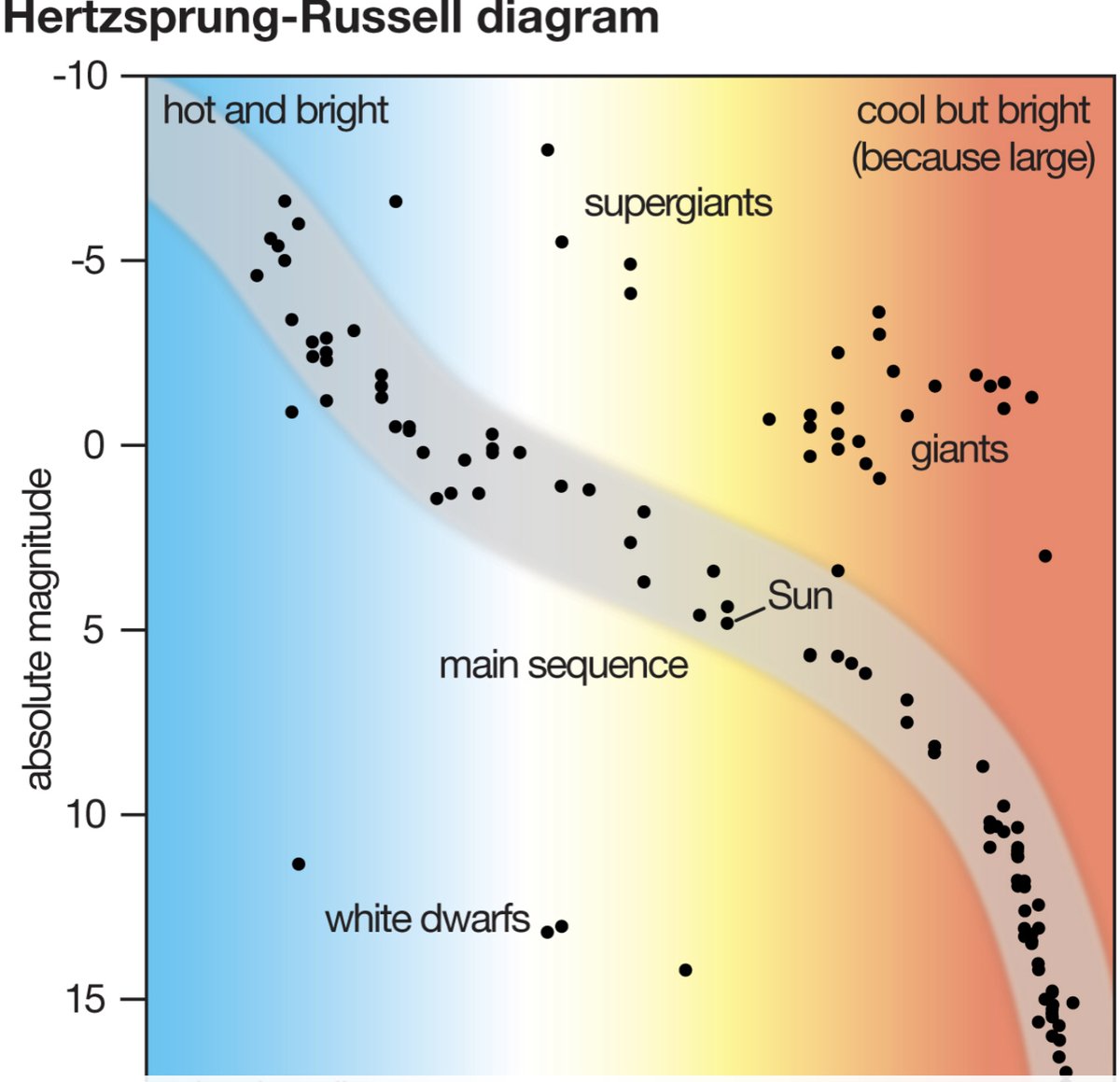
I also found that the magnitudes and the colors of the member stars formed a narrow sequence, a result later to be corroborated by modern photoelectric observations 🤶🏿
Before leaving Copenhagen, I photographed several clusters at the Urania Observatory, using coarse gratings in front of the objective of the telescope.🥴
I was elected to eleven academies and societies in both Europe and the United States, and received honorary doctorates from Utrecht (1923), Copenhagen (1946), and Paris (1947)🥳
My father, Severin Hertzsprung, had a graduate degree in astronomy from the University of Copenhagen but, for financial reasons, decided to accept a position in the Department of Finances of the Danish government and at a very early age became director of insurance🧐
In 1909 I noticed that two other stars, in widely separated regions of the sky, had motions directed toward the same convergent point of the sky as the five bright stars🔭
In my opinion the separation of the c- and ac-stars is the most important advancement in stellar classification since the trials by Vogel and Secchi ... To neglect the c-properties in classifying stellar spectra.
-Ejnar Hertzsprung🥶
In 1913 I determined the distances to several Cepheid variable stars by parallax, and was able to calibrate the relationship, discovered by Henrietta Leavitt, between Cepheid period and luminosity. 😏
Perhaps my greatest contribution to astronomy was the development of a classification system for stars to divide them by spectral type, stage in their development, and luminosity. 🤌🏼