Development update 🛠️
We just shipped GPU support on #LinqProtocol
↳ Select your Shard Type
↳ Configure GPU resources
↳ Deploy on-chain in seconds
Will be available on the dashboard in the next testing phase 👀
Custom Domain Integration: Complete ✅
We have finalized the integration for custom domains on #LinqProtocol. This update allows for a seamless connection between your domains and deployments.
The process is simplified into 3 steps:
1. Add your custom domain
2. Verify DNS settings to point to your deployment
3. Activate your domain
This update will be available on the LinqProtocol dashboard during the next phase of testing.👀
Introducing Lumo 🤖
Your project management AI co-pilot.
Plan, coordinate, and track your team across
@discord, @telegram, @SlackHQ, and the web app
without the usual overhead.
1/4 🧵
Introducing Lumo 🤖
Your project management AI co-pilot.
Plan, coordinate, and track your team across
@discord, @telegram, @SlackHQ, and the web app
without the usual overhead.
1/4 🧵
Kubernetes and Decentralized Compute – Part 4 ☸️
LinqProtocol combines global provider infrastructure with Kubernetes orchestration, enabling stable scheduling across distributed nodes.
Instead of relying on a single data centre, compute is sourced from a globally distributed network of providers, bringing resilience and scalability by design.
🟪 Deploy with familiar Kubernetes workflows
🟪 Scale seamlessly across CPU & GPU providers worldwide
🟪 Access globally distributed compute infrastructure
🟪 Settle trustlessly through smart contracts
#LinqProtocol
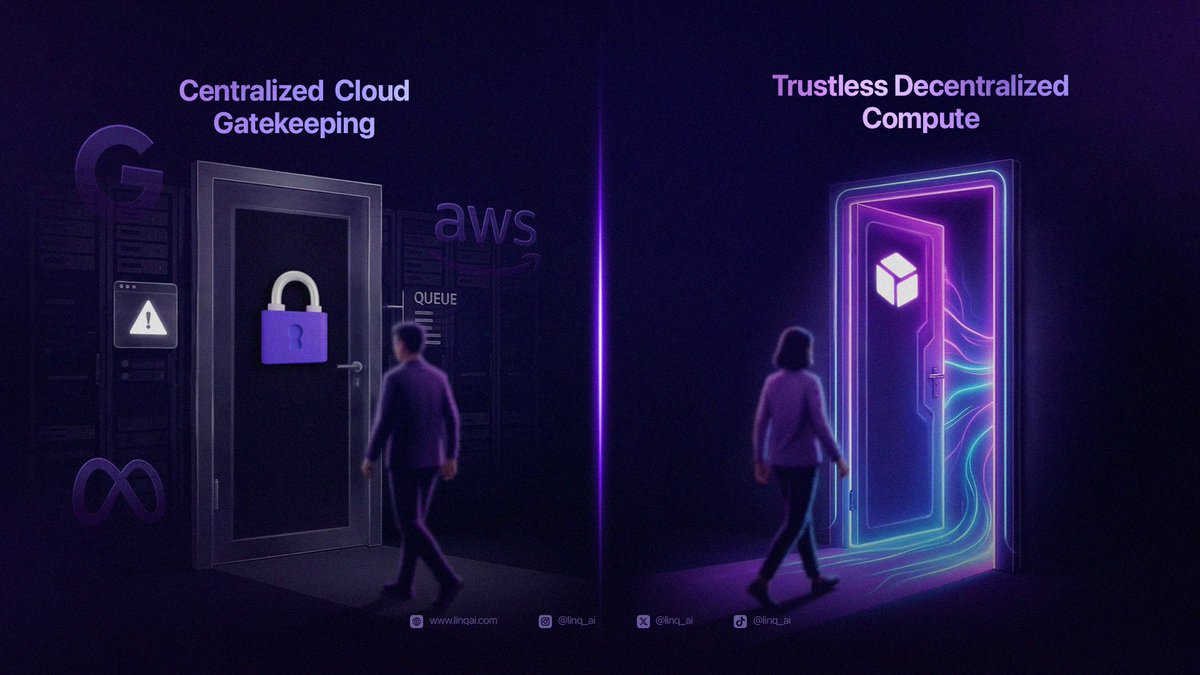
"Your request is in the queue." ✋
In the centralized world, you're a ticket number. In the decentralized world, you're a participant.
LinqProtocol replaces gatekeepers with smart contracts and transparent onchain settlement.
Compute becomes open infrastructure. 🚪
#LinqProtocol
Capabilities of Kubernetes – Part 3 ☸️
Kubernetes allows complex applications to run as distributed systems, coordinating multiple containers within a single environment.
By unifying web servers, databases, and APIs, Kubernetes creates a high-performance deployment ecosystem.
Deployment Specs:
• Scheduling → Maximises resource efficiency and stability.
• Persistence → Retains data across restarts and migrations.
• Auto-Scaling → Adjusts capacity based on real-time demand.
#LinqProtocol leverages these production-grade capabilities to ensure reliability across our decentralized compute marketplace.
Kubernetes in LinqProtocol – Part 2 ☸️
Kubernetes currently powers over 90% of global container orchestration, forming the backbone of many of the world’s most resilient systems.
The same technology used to scale infrastructure at @Google and @Airbnb now underpins our decentralized compute network.
LinqProtocol adopts this standard to bridge the gap between decentralization and enterprise-grade reliability. By running real Kubernetes clusters, we provide infrastructure capable of supporting large-scale AI workloads and high-throughput applications without compromising performance or security.
#LinqProtocol
Introduction to Kubernetes – Part 1 ☸️
Kubernetes is the industry standard for automating deployment, scaling, and management of containerized applications.
It abstracts compute into clusters and schedules workloads automatically across machines.
Key capabilities:
• Automated workload scheduling
• Self-healing infrastructure
• Scalable workload orchestration
LinqProtocol runs real Kubernetes clusters powering decentralized compute.
#LinqProtocol
User Metadata on LinqProtocol ⤵️
What is User Metadata?
It is protocol-level data about how jobs move through the network, not what is inside them.
✅ Job submissions and execution outcomes
✅ Network interaction stats
❌ Your private data
❌ Job contents or files
#LinqProtocol tracks job flow to keep the network efficient, reliable, and fair.
Your workloads remain private. Always.
Virtual Machines in LinqProtocol 🛡️
LinqProtocol runs full virtual machines using KubeVirt.
→ Run Ubuntu, Debian, CentOS, and similar operating systems
→ SSH access with your own private keys
→ Persistent storage and public networking when needed
→ Managed like a traditional VM
Used for 👇
• Legacy applications
• Development environments
• Databases
• Workloads where isolation matters
The secure execution foundation of #LinqProtocol.