PewDiePie just open-sourced his own ChatGPT alternative. 23k+ GitHub stars in 48 hours. 🚀
Why it matters: Building in public + personal brand = massive organic distribution.
1. Build speed: Use existing models. Ship fast.
2. AI workflow: Open-source forks cut costs and accelerate iteration.
3. Distribution: Attention compounds when you build publicly.
Operator judgment: Open-source a core component to drive adoption and community feedback.
Would you open-source your product for traction? 🔥
#OpenSource #AI
The Anthropic hackathon winner just open-sourced his entire AI coding stack for free. 🚀
This isn't another prompt collection. It's a complete engineering system.
1. 183 agent skills + 48 sub-agents — planning, coding, reviews, security, multi-agent orchestration
2. Works with Codex, Cursor, Gemini, Claude Code, and more
3. 79 ready-made commands, 10+ months refinement, MIT license — already 163K GitHub stars
Operator takeaway: Open source is moving faster than most realize. A finished, battle-tested stack you can deploy today.
Are you forking it or waiting for the next release? ⚡
Source: @DivyanshT91162
Microsoft just dropped 5 AI models in one shot. This is not a tech demo — it's a product strategy. 💥
Why it matters: the frontier model race is becoming a suite race. Pick the right capability for your bottleneck.
1. Build speed 🛠️
MAI Code 1 Flash handles complex coding end-to-end. Hook it into your dev pipeline.
2. AI workflow/automation 🧠
MAI Thinking 1 competes with Claude Opus 4.6 on SWE-Bench Pro. For tasks that need deep reasoning.
3. Distribution/attention 🎯
Image, voice, transcription in one release. Covers more user touchpoints out of the box.
Operator takeaway: the frontier is now a product suite. Most teams should optimize for one variable — speed, reasoning, or reach.
Which capability would unlock the most cost in your pipeline?
Claude Opus 4.8 just dropped. Every benchmark smashed 💥
If you're not upgrading today, you're falling behind.
Here's the exact playbook:
1. Switch all tasks from 4.7 to 4.8 — same price, way better
2. Turn on /fast mode — 2.5x speed at 1/3 the cost
3. Use Dynamic Workflow + Ultracode for complex projects — months of work in one session
When new tech launches, the winners adopt first. Waiting is the real risk.
Are you switching now or staying on old?
#Claude #AI
Everyone's been saying Claude agents feel slower. Now we have data. 📉
LiveBench just confirmed: Opus 4.8 ranks below GPT 5.4. Your hunch was right.
3 things to act on:
1. Build speed – GPT + Codex steamrolls for fast prototyping and iteration.
2. Workflow – Claude's regression means more token waste and reruns. Cost keeps adding up.
3. Distribution – If your agent stack relies on Claude, you're leaking money on inference.
Operator takeaway: Switch your agent backbone to GPT until Claude fixes inference quality. Don't wait for the next update. 🚀
Which model are you using for agents right now?
#AI #Claude
Claude Mythos pricing dropped:
Input: $25/M tokens
Output: $125/M tokens
And the upcoming Mythos-like model will likely be the same.
This isn't just a number. It's a decision filter for operators.
1️⃣ 5x output premium — heavy reasoning use cases (agents, analysis) burn fast
2️⃣ 2-4x more expensive than GPT-4o — but does the quality justify it?
3️⃣ Cost per useful output, not per token — measure value, not volume
Operator takeaway: at $125/M output tokens, every call must earn its keep. Don't use this for generic classification. 💰🔥
Which of your workflows would pass the ROI test?
Cursor isn't just a coding tool anymore—it's taking over cafes ☕
Cafe Cursor is popping up in 50+ cities this summer. Smart move.
1️⃣ Builds offline community → sticky developer relationships
2️⃣ Turns coffee shops into brand billboards (cheaper than ads)
3️⃣ Tests product vibe IRL—code with a latte = perfect positioning
Founders: don't ignore physical touchpoints. Distribution isn't just digital.
Is this the start of a developer ecosystem empire or just a trendy coffee chain? 🔥
#AI #Startup
5 Claude Code repos worth bookmarking 🔖
Most devs only use the built-in skills. Huge mistake.
1️⃣ OpenCode — open-source alternative to Claude Code. Run locally, multi-model, full customization. Perfect if you want control.
2️⃣ Claude Code Router — auto-route requests between Claude, GPT, Gemini, DeepSeek, local models. Cut costs without losing performance.
3️⃣ MCP Servers Collection — official repo to connect Claude to GitHub, databases, Slack, Google Drive, APIs. This is where Claude becomes a real assistant.
Bonus: Anthropic Skills — official skills from Anthropic. Many never look beyond the defaults. Don't be one of them.
Which repo has improved your workflow the most? 💭
#ClaudeCode
Anthropic hackathon winner just open-sourced his entire AI coding stack.
10 months of work, $15K in API credits prize — and he dropped it all under MIT license.
183 agent skills. 48 sub-agents. 79 ready-made commands.
Why this matters:
1. Build speed 🏗️ Plug in 183 pre-built agent skills instantly.
2. Workflow automation ⚙️ 79 commands form a complete dev pipeline.
3. Zero-cost entry 🆓 Full MIT license — no vendor lock-in.
Operator take:
This is a production-ready stack, not a demo. If you're building AI workflows, this saves months of trial and error.
Will you fork and modify, or run it as-is? 💥
Gemini just plugged Grok into its prediction market feed 🚀
This is not another AI dashboard. It's a workflow shift for operators.
1) Build speed: Command Center ingests live data + AI analysis — no more manual scraping
2) AI workflow: Grok integration means the feed is actionable, not just visual
3) Leverage: Prediction markets are all about edge. This shrinks the gap for everyone.
If you treat prediction markets as a business, this is infrastructure you can't ignore.
Are you building on prediction markets? Or just watching? ⚡🎯
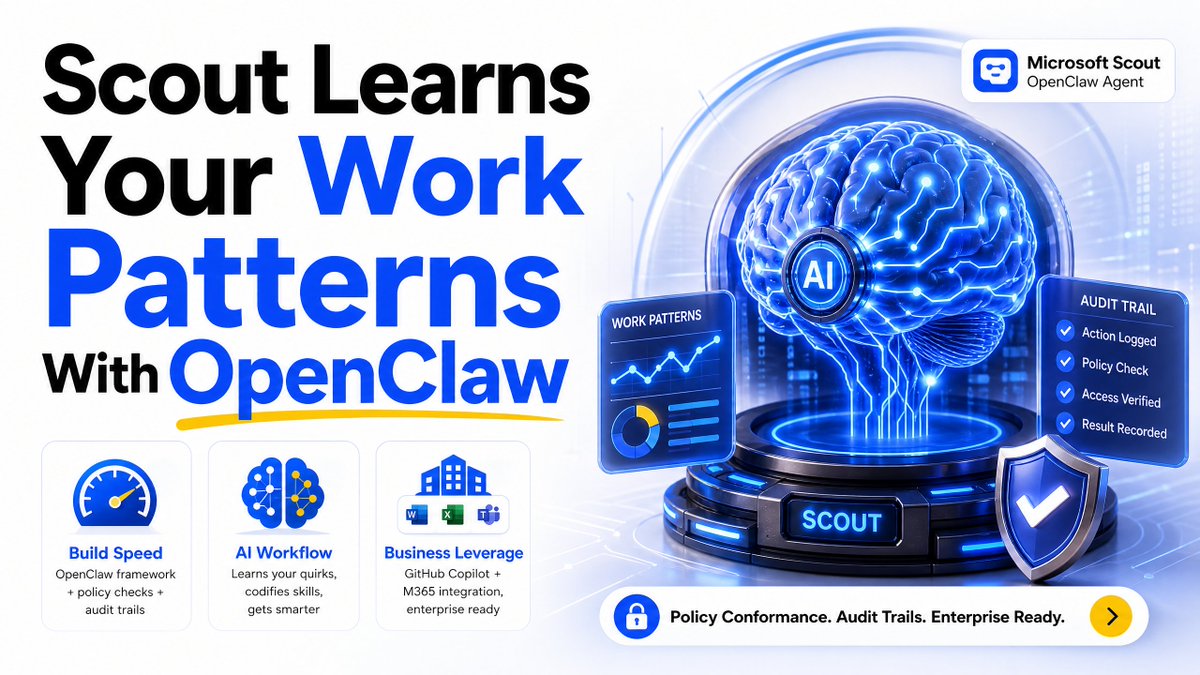
🚀 Microsoft just shipped Scout — OpenClaw's chaotic agent DNA, now inside Office 365.
This is the real enterprise agent play. Not a chatbot. A persistent, learning assistant that adapts to your quirks.
1️⃣ Name it, train it — it remembers your patterns and builds skills over time
2️⃣ Pre-built skills (calendar, agenda) + you can create your own
3️⃣ Policy conformance system with audit trails — no runaway agent nightmares
Operator takeaway: The deeper you train it, the stickier it gets. That’s the lock-in.
What’s the first task you’d hand over to your agent? ⚡
Codex just hit 5M weekly users — from 1M in Feb.
Devs aren't just testing. They're shipping fast automations, code gen, and even porting old games to Mac.
Only complaint: higher limits. 😅
3 things this tells me as an operator:
1. Speed: AI code gen is moving from toy to production tool. The 5x user growth in 3 months is a signal.
2. Workflow: Automations are the killer use case — not one-shot code, but repeatable pipelines.
3. Distribution: The barrier to building is dropping. If you're not experimenting with AI coding tools, you're leaving leverage on the table.
What's your go-to? Cursor, Codex, or Copilot?
Why Cursor wins: users want the best model per task, but hate switching between Claude Code and Codex.
1. No tool hopping 🚫
2. Best model for each job 🎯
3. Single workflow 🔗
Tool integration > model hype. Are you still switching?
#Cursor
seedance 2 is not a screen recording — it's live generation 🎬
1. Real-time output
2. No rendering wait
3. Clean enough for client demos
This changes the demo workflow. Are you already using it?
#seedance2
The real gap: senior devs use Sonnet, juniors complain Opus price or free Gemini 🎯
3 lessons:
1. Sonnet = speed & reliability
2. Cost != value; time is the real cost
3. Pick tools for ROI, not price
What's your primary model? 🚀
#AI#DevProductivity
Vibe coded an entire motion gallery with ONE prompt on Opus 4.8 🚀
This is build speed in 2025.
1. 1 prompt → full gallery
2. Vibe coding > traditional design
3. Creator leverage without code
If you can write a prompt, you can ship. Opus 4.8 is the edge.
ElevenLabs Dubbing V2 isn't just another TTS pipeline.
It models the original performance end-to-end:
1️⃣ Voice identity carries across 90+ languages
2️⃣ Emotion & delivery preserved
3️⃣ Sync-aware translation matches mouth movement
This changes localization for creators.
China just dropped new outbound investment rules after forcing Meta to unwind its Manus deal. 🚨
This matters because your next cross-border AI deal just got harder — and the old playbook is dead.
Here’s what changed:
1️⃣ Govt now requires authorization for exports of restricted Chinese tech, services, or data.
2️⃣ Indirect transfers via cross-border tech staff, guidance, or training are also blocked.
3️⃣ Effective July 1 — zero grace period.
Operator takeaway: If you’re sourcing AI talent or models from China, expect delays and more compliance hoops. The era of “just hire remotely” is over.
Are you restructuring your offshore AI workflow before July 1?
@Jmoon_174 That's the real failure mode most people miss. If the model misreads complexity, you get cascading errors instead of a graceful fallback. The fix isn't better detection — it's forcing a human checkpoint at each ambiguity boundary.
Claude Code's new dynamic workflow is the real deal. 🤖
Why it matters: It's not just a chain of prompts — it's an autonomous agent swarm.
1. Set model to Opus 4.8 + reasoning effort /ultracode
2. Claude detects complexity, writes orchestration script on the fly
3. Spawns a parallel fleet of coordinated subagents
Operator takeaway: This is the first time I've seen an agent actually decompose and delegate autonomously without a rigid framework.
Have you tried it yet? 🚀