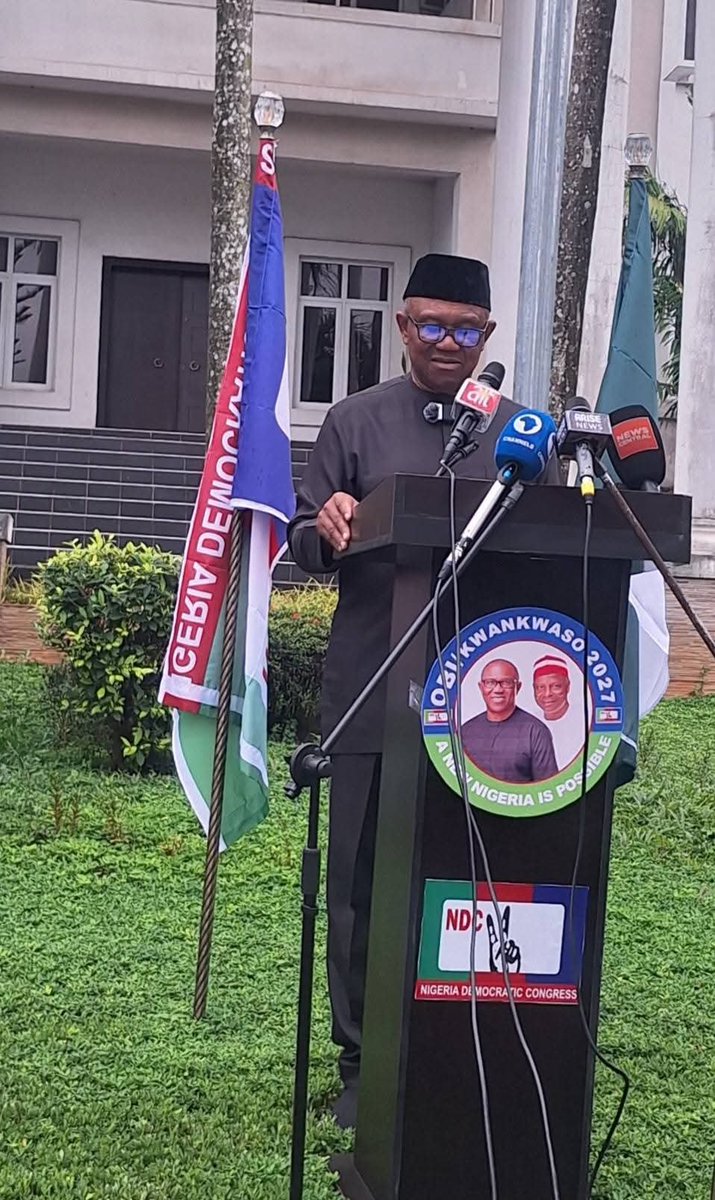
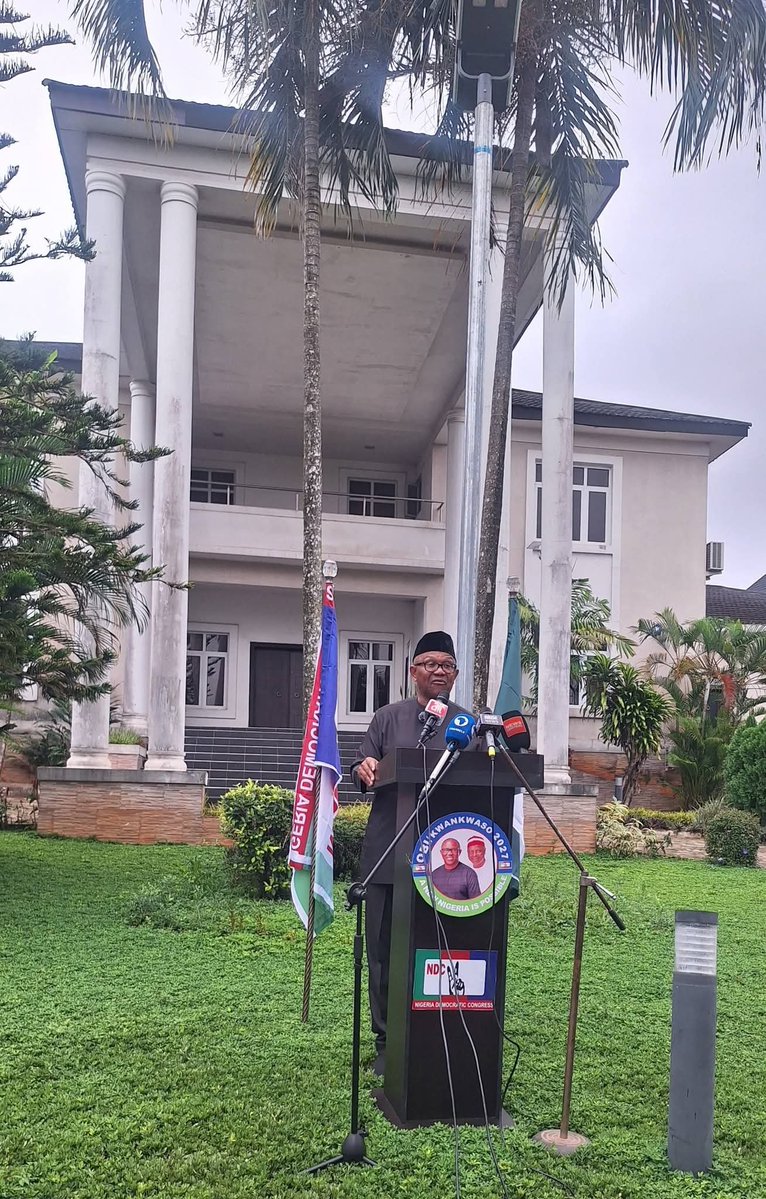
MY ADDRESS TO MARK THE COMMENCEMENT OF THE 2027 PRESIDENTIAL AND NATIONAL ASSEMBLY CAMPAIGNS
21 August 2026
Dear Compatriots,
Members of the Press,
Distinguished ladies and gentlemen,
Wednesday, 19 August 2026, marked the official start of the campaign period for the 2027 Presidential and National Assembly elections.
There is no doubt that this is a defining moment for our democracy. This moment gives Nigerians the opportunity to assess the records, ideas, and plans of those seeking their mandate to lead their country at a time of grave uncertainty in our rapidly changing world.
I consider myself quite privileged to be one of those seeking your mandate to deal with these challenges facing our country.
I enter this contest with one firm conviction: Nigeria can work, and Nigeria must work.
Nigeria faces several serious challenges. Some of them are indeed of existential proportions.
According to the IMF, 63%, or over 140 million Nigerians, live at or below the national poverty line, while humanitarian agencies estimate that 35 million people will need food assistance during the 2026 lean season. About 3.6 million Nigerians remain internally displaced, largely because of conflict and insecurity. Each year, millions of young people enter the labour market, yet too many struggle to find productive opportunities. Weak infrastructure, unreliable power, insecurity, and the excessive cost of doing business continue to burden households and constrain enterprise.
These are more than statistics. They reflect the daily realities of Nigerian families, farmers, workers, students, and businesses.
Yet I do not believe Nigeria lacks the ability to overcome these challenges. We have the people, resources, market, talent, and enterprise. What we must do now is turn these strengths into security, productivity, and shared prosperity.
LEADERSHIP MUST DELIVER RESULTS
My successful private-sector experience, studies in institutions of repute on policy and business matters, and my service as Governor of Anambra State have shaped my understanding of public leadership. Government must manage resources responsibly, set clear priorities, and measure the outcomes of its decisions. Public office is not a reward; it is a responsibility to the people.
In Anambra, I prioritised the foundations of long-term development: education, healthcare, infrastructure, fiscal discipline, and institutional capacity. I do not present that record as perfect, but as an experience from which Nigerians can draw their own conclusions.
Senator Rabiu Musa Kwankwaso brings a different but complementary governing experience.
As Governor of Kano State, he focused strongly on education, technical training, scholarships, infrastructure, and human-capital development. His administration’s investments in education and skills showed an understanding that the people are a state’s most important long-term resource.
Our experiences are different, but our conclusion is the same: Nigeria must invest in its people and manage public resources with discipline.
BUILDING AN ECONOMY THAT WORKS
Nigeria needs more than reactive reforms. We must focus on the questions that matter:
Are Nigerians better off than they were four years ago? Can they afford food, education, and healthcare? Can businesses produce, expand, and create jobs? Can young people find productive work? Can farmers work safely and get their produce to market?
Today marks the official nationwide kickoff of the presidential campaign for all political parties.
For Peter Obi, the ask is simple: give him four years, not eight. His ambition is not about clinging to power for eight years. It is about using four years to lay the foundation for a New Nigeria strong enough to outlive any one administration.
Four years of discipline, competence, accountability and purposeful leadership can change the direction of our country.
Today, the journey to laying the foundation for a New Nigeria begins.
#NigeriaWillBeOk
OSUN AND THE NEED TO SET NEW BOUNDARIES FOR POLITICAL CONDUCT IN OFF-CYCLE ELECTIONS
The outcome of the recent governorship election in Osun State demonstrates that, despite the challenges confronting our democracy, we possess the capacity to conduct elections in a manner that strengthens public confidence in our democratic institutions.
I therefore commend the Independent National Electoral Commission (INEC), the security agencies, political parties and, most importantly, the people of Osun State for the peaceful conduct of the recent governorship election.
While we commend the electoral process itself, there are developments surrounding the election and, more importantly, an emerging trend in political conduct during off-cycle elections that raises concerns.
The growing practice whereby serving governors, senior political office holders, party leaders and other influential government functionaries, accompanied by large numbers of aides and heavy security details from outside a state, converge on states where elections are being conducted raises an issue that demands national attention.
The conduct witnessed around the recent elections in Osun, Ekiti and Ondo States was, in my view, unusual. It is not a practice that should become normal in a democratic society.
I recall that, as President, similar situations arose during the 2013 Anambra and 2014 Ekiti governorship elections. On those occasions, senior political leaders mobilised and descended upon the states. Upon being briefed, I ordered party leaders and senior government officials to leave the states immediately.
This trend is unwholesome. If left unchecked, it could threaten our fragile democracy and have serious long-term implications for democratic stability.
Political parties are entitled to campaign, mobilise their supporters and deploy their legitimate party structures. That is an essential part of democracy. However, there is a point at which political mobilisation, particularly when it involves the overwhelming presence of serving governors, senior public officials and powerful political actors from across the country on election day, can create an atmosphere of apprehension, intimidation, bullying and undue pressure.
We must ask ourselves whether the increasing deployment of political power and large-scale mobilisation by senior office holders on election day in states holding elections is consistent with the spirit of free, fair and peaceful democratic competition.
This hardly happens in other democratic countries.
We must not allow political competition to become a contest in which victory is perceived as something that must be achieved at all costs.
There is also the question of precedent. If the current trend becomes established, what happens when governors from opposing political parties begin to descend on every state holding a competitive election? What happens when each party seeks to match political power with political power, governmental influence with governmental influence, and mobilisation with counter-mobilisation?
Such a development would not strengthen our democracy. It would deepen political tensions and could make elections increasingly resemble battles for political survival rather than peaceful contests for the mandate of the people.
I therefore believe that this matter should not be treated as a partisan dispute concerning the Osun election. It is a broader national issue concerning the future of our electoral democracy.
Those of us who have occupied public office must recognise that our conduct carries a greater responsibility. The power and influence attached to public office should be used to strengthen democratic institutions, not to create apprehension among political opponents or citizens.
WAEC is a very irresponsible organization. They have toyed with our children’s future for so long, with their age-long malpractices.
That needs to stop now. Our children’s future is all that matters.
I have now received further disturbing reports from multiple schools, teachers, parents and students about what happened during this 2026 WAEC examination.
In some examination centres, question papers were reportedly insufficient. I received reports of as many as FOUR students sharing ONE question paper.
Think about that.
Students prepared for years for an examination that could determine university admission, scholarships and, in many cases, the direction of their lives only to enter examination halls without enough question papers.
There are also serious reports concerning the security of examination materials, including allegations that some papers or answer materials circulated before the appropriate examination period. These allegations must be independently investigated, not internally explained away.
Even basic examination materials raise questions. Students have reported that calculators and other materials they expected WAEC to provide were unavailable in some centres.
We need an independent forensic investigation of the entire 2026 examination process from question-paper production and distribution to examination security, marking, CBE systems, grading, result processing and eventual release.
WAEC should preserve and make available for independent scrutiny the examination records and, subject to appropriate privacy safeguards, provide candidates access to their scripts including relevant paper-based scripts and CBE records.
If an independent investigation establishes that systemic failures were serious enough to compromise the integrity of the examination, then Nigeria must be prepared to consider every remedy necessary, including remarking, reprocessing results, rescheduling affected papers or, in the most extreme case, invalidating affected examinations.
No institution is bigger than the future of millions of Nigerian children.
Behind every WAEC result is a human being.
A child waiting for admission.
A scholarship that could disappear.
Parents who have sacrificed everything.
A family whose plans may depend on those grades.
This is why WAEC cannot be allowed to investigate WAEC and simply tell Nigerians that everything is fine.
The Federal Ministry of Education, National Assembly and other relevant authorities should urgently demand answers and establish an independent investigation into the conduct and processing of the 2026 WAEC examination.
If WAEC did everything correctly, an independent investigation will clear it.
But if something went terribly wrong, Nigerians deserve to know what happened, who was responsible, how many children were affected and how their futures will be restored.
This is no longer merely an examination issue. It is a question of institutional integrity, accountability and justice for Nigerian children.
We cannot gamble with the destinies of an entire generation.
What I am hearing about WAEC Nigeria is deeply troubling.
This year recorded the highest performance in the history of WAEC and they are not happy about it.
There is something many Nigerians do not understand about WAEC grading.
The score required for A1, B2, B3, C4 etc. may not simply be a permanently fixed number every year.
From the information available to me, WAEC applies statistical standardisation/normalisation based partly on the overall performance of candidates.
In simple English:
If a paper is unusually difficult and candidates generally perform poorly, the threshold required for a particular grade can effectively be lower.
If candidates perform extraordinarily well, the threshold can become much higher.
So hypothetically, what qualifies as an A in one examination could be around 60, while the statistical threshold in another circumstance could be 80, 90 or even higher.
Your final grade therefore may not tell the complete story of your raw score.
This year involved candidates sitting examinations under different modes, including computer-based/hybrid arrangements and the traditional paper-based system.
And there are serious allegations that questions circulated ahead of time in some paper-based centres.
If that happened on a significant scale, it could artificially inflate the overall performance of that population.
Then comes the critical question:
When WAEC carried out its standardisation, were candidates from fundamentally different examination conditions treated as one population?
Because if leaked questions artificially pushed one group’s scores upwards, and those abnormal scores subsequently influenced grade thresholds, an innocent student who genuinely scored very highly could suddenly appear statistically ordinary.
Imagine scoring what would ordinarily be excellent marks, only to receive a surprisingly poor grade because you were being compared against an abnormal national distribution.
That is the heart of what needs to be investigated.
And it wouldn’t affect only computer-based candidates.
Honest children who wrote paper-based examinations without cheating could also have been punished by the abnormal performance of people who had access to questions.
The innocent students potentially become the victims of the malpractice they never participated in.
This is why WAEC cannot simply tell Nigerians that these children failed.
Show us the data.
What were the raw scores?
What were the score distributions?
What thresholds produced A1, B2, B3, C4, C5 and C6 in each major subject?
Were those thresholds changed after marking?
Were computer-based and paper-based candidates standardised separately?
How were centres showing statistically abnormal performance treated?
And have results changed after candidates requested reviews?
Because I am also receiving disturbing reports that some people who aggressively challenged questionable results got their cases reconsidered, while millions of ordinary parents may not even know they can request a review.
If that is true, it is unacceptable.
A child whose parents have connections cannot have greater access to justice than a child sitting somewhere in a village.
And there is another dimension that must not be ignored: I am receiving serious allegations of internal management problems within WAEC Nigeria, including concerns about how staff who question certain decisions are treated.
Those allegations also deserve an independent investigation.
This is not an attack on WAEC.
It is a demand for accountability.
The Federal Ministry of Education and National Assembly should urgently invite the leadership of WAEC Nigeria.
Because behind every A1, C6 or F9 is not just a statistic.
There is a child. There is a family. There is a university admission. There is a scholarship. There is a future.
We cannot gamble with the destinies of an entire generation of Nigerian children.
Today, in our monthly journal club, a CPD program, a Medlab student sat us down for about half an hour and delivered a lecture on cryptococcosis using a case study from our hospital.
When I said " us", I meant our consultants, special regs, scientists, and technicians.