The gospel did not begin in Bethlehem, though it was revealed there with great clarity and power. The gospel entered history because it had already been established in the heart, wisdom, and purpose of God before the ages.
Scripture reveals a God who is never surprised, and never forced into emergency action. He is the sovereign Lord whose counsel stands forever.This is where true Christianity begins—not with man searching for God, but with God eternally determining His will in Christ.
At the heart of God’s dealings with His people is a consistent and gracious call: return.
This call is not directed to strangers, but to those who already belong to Him. It is a call to a people who may have drifted—not necessarily in outward rebellion, but in distance of heart.
Living as Sons in Light of His Appearing
Beloved, redemption does not begin in human seeking — it begins in the will of the Father. The story of salvation opens not with man reaching upward, but with God sending downward.
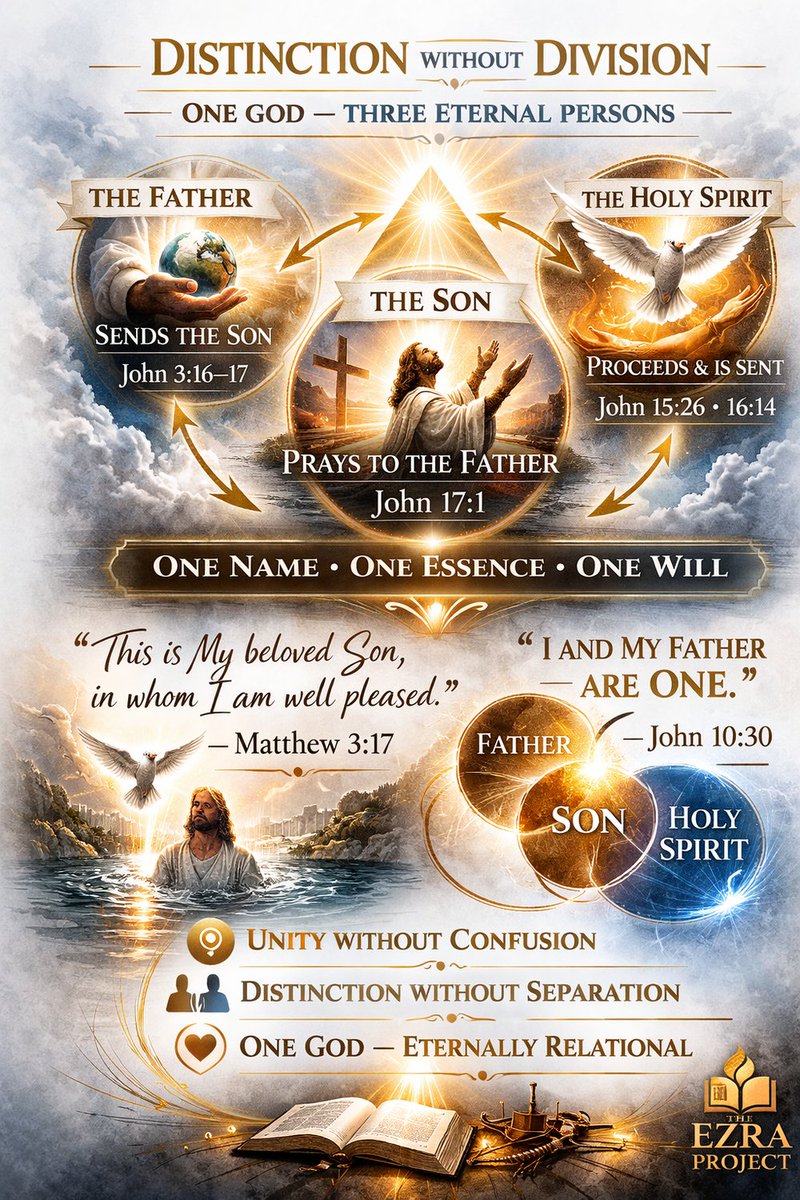
The testimony of Scripture presents a holy balance—clear personal distinction within the Godhead, yet unwavering divine unity. The Father is not the Son. The Son is not the Spirit. The Spirit is not the Father. And yet, none exists apart from the one indivisible divine essence.
When the risen Christ commissioned His disciples, He spoke with precise theological clarity:
“Go therefore and make disciples of all the nations, baptizing them in the name of the Father and of the Son and of the Holy Spirit.”
— Matthew 28:19
.
The Godhead is not three gods competing in unity.
Nor is it one God appearing in shifting roles.
Nor is it a hierarchy of greater and lesser beings.
It is the mystery of one indivisible divine essence—eternally and perfectly expressed in relational fullness.
Revelation gives us truth — but it does not reduce God to the boundaries of our understanding. What He reveals is sufficient, faithful, and life-giving, yet He is never confined to the limits of our language.
The declaration of Deuteronomy 6:4 — often called the Shema (from the Hebrew word “Hear”) — stands as the central confession of Israel’s faith and remains foundational for all biblical theology.
“Hear, O Israel: The LORD our God, the LORD is one.” (Deuteronomy 6:4)
Biblical monotheism calls humanity to clarity, loyalty, and surrender.
“Now this is eternal life: that they know you, the only true God, and Jesus Christ, whom you have sent.”
— John 17:3
There is one Creator.
One Lawgiver.
One Judge.
One Savior.
One God — forever.
Beloved, theology proper is not given to make us clevespeakers or skilled debaters. It is given to form faithful worshippers. The knowledge of God is not meant to terminate in the mind, but to take residence in the heart and shape the whole life..
Beloved, when God reveals Himself, He does so truthfully — but never exhaustively. What He shows us is real, reliable, and sufficient for life and godliness, yet it is never the full measure of who He is.
Beloved, words about God are never neutral. The moment His name is spoken, we are no longer in ordinary conversation. We are handling holy reality. Every statement we make about God either draws the heart nearer to truth or quietly reshapes God into human preference.
Babylon is not merely a city; it is a philosophy.
It is a system built on self-definition without submission.
“Come, let us build ourselves a city… and let us make a name for ourselves.”
— Genesis 11:4
Culture applauds the courage to “be yourself,” to “follow your heart,” and to “define your own reality.”
But Scripture exposes a sobering truth:
Self-definition is not liberation. It is the oldest deception humanity has ever believed.
“In the beginning God created the heavens and the earth.”
— Genesis 1:1 (NKJV)
Scripture establishes an unalterable distinction at the foundation of reality:
God is Creator.
Man is creature.
Purpose flows downward from the Creator, not upward from the creation.
From the opening pages of Scripture, identity is not portrayed as something to be discovered by introspection, constructed by culture, or asserted by will. It is bestowed by creation. Man is introduced into existence already defined made by God, for God, and under God’s authority
Theology is often treated as an intellectual discipline—reserved for classrooms, books, and scholars.
But in Scripture, theology is never presented as optional knowledge; it is survival truth.
Theology is knowing God well enough to stand when life collapses.
Why Every Human Life Matters to God
The doctrine of Imago Dei does not end with identity; it demands responsibility.
To be made in God’s image is not merely a theological statement—it is a moral claim upon how humanity must be treated.
Biblical strength is the product of revelation, not enthusiasm.
Scripture does not say, “They that feel bold shall be strong.”
It says,
“The people who know their God shall be strong, and carry out great exploits.”
— Daniel 11:32