A glimpse of a beautiful moment in their personal time — Guruji and Gurumataji enjoying a bike ride, surrounded by greenery, fresh air and the peaceful beauty of nature. 🌿🏍️❤️
साधना में आगे बढ़कर! जो महागुरुजी बता चुके हैं सभी को और अच्छे से मार्गदर्शन भी कर चुके हैं। उसी परम्परा में अपने आप को सम्मिलित करते हुए प्रत्यक्ष रूप से माँ की साधना में आगे बढ़ना है। यह अवसर केवल अभी प्���ाप्त हुआ है सभी को, इसे आप सभी को भुनाना चाहिए।
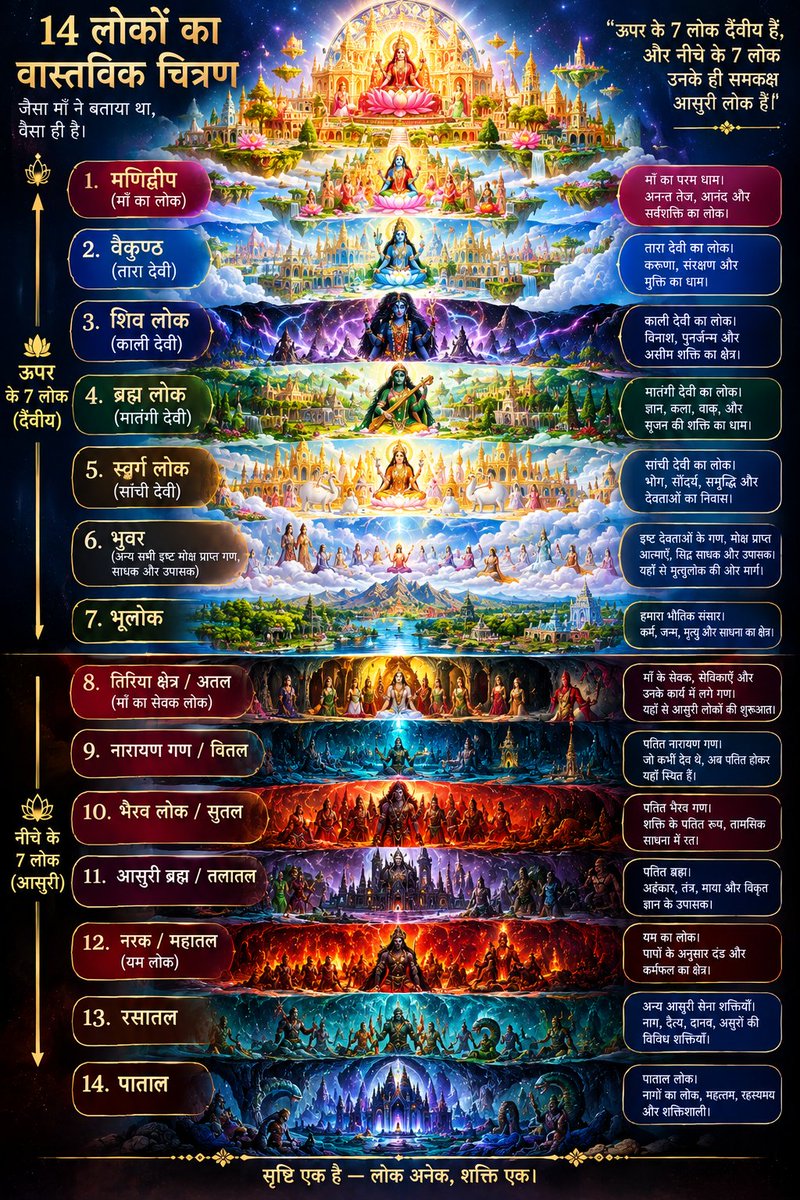
मृत्यु के समय जीव जिस पराशक्ति से ग्रसित होता है, उसी के अनुसार उसकी आगे की यात्रा निर्धारित होती है। परंतु माँ को छोड़कर, इस समय देवमंडल में कोई अन्य देवता उपस्थित नहीं है। इसलिए यदि हम किसी अन्य भगवान, वृक���ष, पशु अथवा पूर्वज की पूजा करते हैं, तो उस उपासना से संबंधित जीव पर शत-प्रतिशत किसी न किसी असुर का ही आधिपत्य होगा।
ऐसी स्थिति में, जब भी उस जीव की मृत्यु होगी, वह किसी न किसी नकारात्मक पराशक्ति से ग्रसित अवश्य होगा। परिणामस्वरूप, जिस नकारात्मक शक्ति के प्रभाव में वह जीव होगा, अंततः उसी के लोक को प्राप्त होगा।
अतः माँ के विधान को छोड़कर मनुष्य को किसी अन्य विधान का आश्रय नहीं लेना चाहिए।
तमस की परिभाषा इतनी सरल नहीं है। किसी परिस्थिति से उत्पन्न मानसिक क्लेश का कोई सार्वभौमिक मापदंड नहीं है; यह प्रत्येक जीव की परिस्थितियों, आवश्यकताओं और आसक्तियों के अनुसार भिन्न होता है।
एक सम्पन्न व्यक्ति के लिए ��ात में बिना एयर कंडीशनर के सोना उतना ही कष्टदायक हो सकता है, जितना किसी निर्धन व्यक्ति के लिए भूखे पेट सोना। निर्धन को बिजली न होने से उतना फर्क नहीं पड़ता, जितना भोजन न मिलने और अगले दिन की चिंता से। वहीं सम्पन्न व्यक्ति एक दिन डाइट के तौर पर उपवास कर सकता है, क्योंकि उसे अपने अगले भोजन की उपलब्धता का विश्वास है, लेकिन एयर कंडीशनर के बिना सोना उसके लिए कठिन हो जाता है। परिस्थितियाँ अलग हैं, ले��िन दोनों के लिए मानसिक क्लेश का कारण (तमस) उनकी अपनी आवश्यकताएँ और आसक्तियाँ हैं।
कर्मों को सात्त्विक, राजसिक और तामसिक श्रेणियों में बाँटकर समझना शास्त्रों की अपनी दृष्टि है, लेकिन व्यवहार में एक ही कर्म का प्रभाव प्रत्येक व्यक्ति पर समान नहीं होता। किसी का सत्त्व दूसरे के लिए तमस बन सकता है, तो किसी का रजस किसी अन्य के लिए साधना में बाधा।
उदाहरणार्थ, किसी विवाहित पुरुष का ब्रह्मचर्य उसकी पत्नी के लिए क्लेश का कारण (तमस) बन सकता है। राजसिक भोगों में लीन व्यक्ति को समय से पूर्व आध्यात्मिक अनुशा��न बेचैनी (तमस) दे सकता है, जबकि किसी संन्यासी के लिए वही भोग (रजस) उसकी साधना में बाधा बन सकते हैं। इसका अर्थ यह नहीं कि सत्त्व, रजस या कोई विशेष कर्म अपने आप में हर परिस्थिति में तमस है, बल्कि यह कि व्यक्ति की अवस्था, पात्रता और परिस्थितियाँ उसके अनुभव को प्रभावित करती हैं।
एक के लिए औषधि, दूसरे के लिए विष हो सकती है; एक का साधना-पथ दूसरे के लिए बंधन बन सकता है।
यदि हम जीवन में उत्पन्न होने वाले तमस का सामना करते हुए, रजस को बिना लिप्त हुए भोगकर सत्त्व की ओर अग्रसर हों, तो यही यात्रा मोक्षगामी हो सकती है। क्योंकि मुक्ति का अर्थ केवल एक गुण को दूसरे से बदलना नहीं, बल्कि अंततः तीनों गुणों के बंधन से परे जाना है।
अतः प्रश्न केवल सत्त्व, रजस और तमस के भेद का नहीं, बल्कि यह है कि हम उनसे प्रेरित होकर अपने जीवन को किस दिशा में ले जा रहे हैं—बंधन की ओर या मुक्ति की ओर।
-Maa Kamakhya and the Path to Moksha-
As mentioned before, the only Devta is Maa Kamakhya; the rest are Her sevaks, manifesting through the Panchatattva.
Modern science has, in one form or another, attempted to study the Panchatattva—Ether (Space), Air, Fire, Water, and Earth—because these can be experienced, measured, observed, or perceived through the human body and the instruments we have developed.
But Maa, as the very Soul, is beyond the reach of such instruments. She cannot be reduced to a measurement, confined to a formula, or captured within the limits of an apparatus. No instrument of modern science has been devised to trace Her existence. The only instrument capable of approaching Her is devotion itself—bhakti and Her kripa.
For those who seek to understand Her merely through external methods, Her existence remains an enduring mystery: something they may sense, intuit, and desperately attempt to grasp, yet never quite lay their hands upon. They are looking in the wrong direction for what lies beyond the reach of their method.
There is a fundamental limitation in trying to comprehend the transcendent through instruments designed only to measure the tangible. What lies beyond perception cannot necessarily be captured by the instruments of perception.
Countless studies and philosophical inquiries have attempted to understand the existence of the Soul, yet the mystery remains unresolved. Because, according to this path, without Her kripa, one cannot truly know Her—not even Her Name or Her existence, let alone enter Her Mandala.
The Soul, being a part of Maa, stands beyond even those Tattvas that we are capable of perceiving.
Now consider this: if Maa alone is the sovereign of the Soul, then who else can ultimately grant Moksha?
And yet, self-proclaimed Parambrahmas appear, asking devotees to chant their names and, in return, promising them Moksha.
But the question is simple:
One who has not dissolved his own identity—how can he promise to dissolve the identity of another?
Someone who still carries the entire burden of “I”—his identity, caste, lineage, birth, birthplace, birth date, personal history, reputation, charitra-character, and countless other labels—who remains entangled in the very identity from which liberation is supposed to free us...
How can such a person claim to offer Moksha to another?
The one who is still bound cannot claim to be the ferryman who carries others across the ocean of bondage.
That is precisely why, according to this understanding, Avatar worship is strictly prohibited by Maa.
Moksha is not the glorification of another personality. It is the dissolution of the very personality that insists upon being separate.
To attain Moksha, one must ultimately relinquish the ego of identity and dissolve oneself into Maa.
There is no shortcut around this. No borrowed identity. No personality cult. No mere repetition of another person's name can substitute for the dissolution of the “I”.
The drop does not become the ocean by worshipping the ocean; it becomes the ocean when its separateness disappears.
So let those who wish to keep roaring, proclaiming, and chanting their own man-made, self-declared Devtas continue to do so.
The path to Maa is not through another person's identity.
It is through the dissolution of one's own.
जय माँ कामाख्या। 🙏
How Does Devi Bless Her Devotees Who Are Suffering from Diseases? 🙏🏻
This profound knowledge was taught to us by Devi in a single day, in one continuous session. The entire principle, its underlying concepts, and the deeper understanding behind it were revealed to us by Her.
Though we are doctors trained in modern medical science, we understand that conventional medicine has its own scope and limitations, particularly when it comes to restoring certain bodily functions or regenerating tissues that have already been severely damaged. Devi took the roots of this knowledge from Ayurveda and began teaching us its fundamentals—the core principles and deeper insights that, in Her view, are often overlooked in the way Ayurveda is understood and practised today.
She explained the very composition of our body and its Prakriti through the principles of Vata, Pitta, and Kapha. Everything revolves around these fundamental principles, but Her explanation went far beyond the superficial understanding of them. She unfolded the subject in an entirely different depth, revealing connections that were difficult for us to comprehend all at once.
The sheer volume of knowledge was overwhelming. Imagine having an entire syllabus completed in a single day! Naturally, we had countless questions, doubts, and concepts that needed further clarification. But Devi patiently addressed every question, resolving our doubts with remarkable elegance and eloquence.
She instructed Mahaguru Ji to write down every single point. Whenever the knowledge becomes this precise and profound, She asks us to record it in our notes, point by point, ensuring that nothing is missed. She encourages us to ask questions and clear every doubt so that our understanding is complete and our concepts are firmly established.
Mahaguru Ji has always been an avid reader, deeply curious about the cosmos and the mysteries of cosmic knowledge. Yet, when Devi arrived, one of the very first things She did was begin resolving his longstanding doubts, imparting detailed knowledge of the cosmic world and its arrangements, right from the very beginning.
And today, through this profound understanding of the body and its underlying principles, Devi is guiding us in understanding the physical ailments of Her devotees. Through Her grace and guidance, we are witnessing devotees finding relief and improvement in their conditions.
For us, this is not merely about acquiring knowledge; it is about understanding the deeper principles of existence and learning how to apply that understanding in the service of those who come to Her seeking relief.
Maa's grace is truly beyond words. 🙏🏻
जय माँ कामाख्या! ❤️🙏🏻
🌿💦 When Gurumata Ji and Guruji step away from everything and simply enjoy the moment. ❤️
A serene pond, beautiful surroundings, a leisurely walk, and a few playful moments along the way. 😄✨
Because behind the Sadhana, responsibilities, and spiritual journey, there is always room for laughter, spontaneity, and enjoying life together. 🌸
Sometimes, the most beautiful moments are the ones that are completely unplanned. 🙏
जय माँ कामाख्या 🌺
🚗✨ When Gurumata Ji takes the wheel… the journey itself becomes an experience. 😎🔥
Cruising through breathtaking landscapes, enjoying the open road, the fresh air, and the beauty of nature — with pure confidence and effortless style. 🌿🏔️
Spirituality has many shades… and sometimes, it looks like Gurumata Ji enjoying a dashing drive through paradise. ❤️
Because the journey is just as beautiful as the destination. ✨
जय माँ कामाख्या 🌺
🌿✨ When the day slows down, even Gurudev and Gurumata enjoy the simple joys of nature. ❤️
A peaceful evening in the forest — away from the noise, surrounded by trees, fresh air, laughter, and each other’s company. 🌳🦋
Because spirituality is not only about Sadhana… sometimes, it is also about enjoying the beauty of the moment. 🙏❤️
जय माँ कामाख्या 🌺
Here comes that hour of the night when the world falls silent—and, for me, as a Sadhika of Maa, the darkness begins to speak.
We love the dark.
We embrace mysticism.
We walk the path of Tantra.
We cherish a dangerous kind of peace—the silence that unsettles the ordinary mind.
We are drawn to what the world calls forbidden, to solitude, to the unknown, to the eerie, and to the smoke of spirits that seems to rise from realms beyond the visible.
Perhaps it is because the unseen often feels more authentic than this mythical world we call “reality”—a world crowded with human constructs, fleeting attachments, manufactured identities, and illusions that will not accompany us beyond this life.
What is born must perish; what is created must dissolve.
And perhaps that is why the Paranormal feels so profoundly real.
The only reality is Paranormal.
The only normal is Paranormal.
There is a different kind of vibration in being with the Parashaktis—a presence that cannot always be explained, only experienced.
Some paths are not meant to be understood by the world; they are meant to be walked in solitude.
And as the saying goes, “The darkest night often reveals what daylight conceals.”
Every night, I choose the darkness—not because I fear the light, but because I have learned to see within the dark.
I have never been particularly drawn to fiction. Throughout my life, I have always looked for substance, insight, and something tangible beneath a story. Perhaps that is why novels have invariably found themselves at the very bottom of my reading list.
It is not that I dislike reading. Far from it. I simply have a very specific threshold for the kind of content I allow myself to consume. Rather than merely reading about experiences, I have always preferred living them, observing them, or learning something from them—experiencing the very things that fiction can only attempt to recreate.
Stories built around excessive drama, heightened emotions, and manufactured conflicts often feel mentally exhausting to me. I sometimes find myself wondering, “Is my academic syllabus not extensive enough that I should voluntarily add a few more books to it in the form of novels?”
Being pragmatic, for me, naturally comes with a certain resistance to becoming emotionally entangled in worlds that do not exist. Fiction asks the mind to suspend reality, invest emotionally in imaginary circumstances, and, at times, carry the emotional baggage of characters who are not even real. Why borrow trouble from a world that was never yours to begin with?
Perhaps that is also why I find art more appealing. Art leaves more room for interpretation; it does not necessarily demand emotional participation. One can appreciate it, contemplate it, and move on without carrying its emotional weight.
The same applies to dramatic and emotionally intense movies and web series. Watching them can leave me strangely exhausted—as though I have lived through someone else’s turmoil without having any stake in it. It is not your life, yet somehow you end up carrying its burden.
Life already comes with its own share of complexities, emotions, responsibilities, and unfinished stories. Why add unnecessary emotional luggage to the journey?
So, for me, avoiding such content is not an aversion to literature, cinema, or storytelling. It is simply a matter of selective consumption. I prefer content that expands my understanding rather than merely intensifies my emotions; that adds perspective rather than emotional baggage; that leaves the mind enriched rather than drained.
After all, life is too short to spend carrying burdens that were never ours in the first place.
-Guru, Grace and Discernment-
This cannot be called the presence of God.
If a disciple meets an accidental death while staying in an Ashram under the Chhatrachhaya—the protective shelter—of his Guru, one cannot simply dismiss the circumstances as fate and move on. At the very least, one must question what kind of protection, grace, and spiritual responsibility is actually being offered.
What is increasingly troubling is the tendency of some people to blindly sympathise with certain individuals and, on that very basis, accept them as their mentors or Gurus. Why? Because they see someone as a “Bechara”—someone unfortunate, afflicted by disease, born into poverty, orphaned, or burdened by difficult circumstances—and sympathy gradually takes the place of discernment.
It has almost become a trend: to be accepted as a Baba or Guru, one must first be portrayed as a victim of circumstances. The more deprived, diseased, helpless, or socially disadvantaged the person appears, the more readily people seem to surrender their judgment and follow them and their Sampradaya.
But spirituality was never meant to be a sanctuary for misplaced sympathy.
One must use Viveka—discernment—before surrendering one's faith.
A Guru is not one who is perpetually lacking. A Guru, in the traditional sense, is one who possesses Dhan, Vaibhava, Aishwarya, Vidya and, above all, the Siddhi born of the grace of the Daiviya Shakti. How can someone impart what he himself has never attained?
There is an old principle: no one can give what he does not possess.
If a person claims to have the Kripa of his Ishta, yet his own life reveals no evidence of that grace, then one must ask a simple question: how can he become the conduit through which others receive the very grace he claims to embody?
Either the Ishta is not what the person claims it to be, or the claimed connection with that Ishta does not exist. In either case, misleading people in the name of spirituality is profoundly wrong.
One must remember: Pravachans alone do not run the world.
The problems of the physical world cannot be solved merely by speaking about the spiritual world, just as spiritual evolution cannot be reduced to worldly comfort. A genuine spiritual journey must address both—Deha and Atma, the material and the spiritual, the visible and the invisible.
This means that spirituality should not be used as an excuse to ignore practical suffering, nor should material success and comfort be mistaken for spiritual progress. True guidance must help a person face worldly responsibilities while also cultivating inner growth, wisdom, discipline, and realization.
Faith without discernment becomes blind following.
Sympathy without wisdom becomes exploitation.
And spirituality without Siddhi becomes merely a performance.
Therefore, before accepting anyone as a Guru, one should not merely ask, “How much has this person suffered?”
One should ask:
“What has this person attained?
What can this person genuinely impart?
And does his life bear the evidence of the grace he claims to carry?”
Because in matters of Guru, Ishta and Sadhana, compassion has its place—but Viveka must never be sacrificed at its altar.